Bava Batra 101a: Talmud study for Daf Yomi
Study the Talmud for Daf Yomi with scanned pages, Hebrew text, English translations from Sefaria and AI-generated French translations.
Passage selection and English or AI-generated French translation are available where the scan has annotations. Daf Study is independent of Torah-Box and Sefaria.
Browse Bava Batra · בבא בתרא · All tractatesBava Batra 101a text and translations
This page of Bava Batra includes the Aramaic text, an English translation and an AI-generated French translation, alongside the scan above.
בבא בתרא ק״א א · Aramaic and Hebrew text
וְרׇחְבָּן שִׁשָּׁה.
רַבִּי שִׁמְעוֹן אוֹמֵר: עוֹשֶׂה תּוֹכָהּ שֶׁל מְעָרָה שֵׁשׁ אַמּוֹת עַל שְׁמוֹנֶה, וּפוֹתֵחַ לְתוֹכָהּ שְׁלֹשָׁה עָשָׂר כּוּךְ – אַרְבָּעָה מִכָּאן, וְאַרְבָּעָה מִכָּאן, וּשְׁלֹשָׁה מִכְּנֶגְדָּן, וְאֶחָד מִימִין הַפֶּתַח, וְאֶחָד מִן הַשְּׂמֹאל.
וְעוֹשֶׂה חָצֵר עַל פִּי הַמְּעָרָה שֵׁשׁ עַל שֵׁשׁ, כִּמְלֹא הַמִּטָּה וְקוֹבְרֶיהָ.
וּפוֹתֵחַ לְתוֹכָהּ שְׁתֵּי מְעָרוֹת – אַחַת מִכָּאן וְאַחַת מִכָּאן. רַבִּי שִׁמְעוֹן אוֹמֵר: אַרְבַּע לְאַרְבַּע רוּחוֹתֶיהָ.
רַבָּן שִׁמְעוֹן בֶּן גַּמְלִיאֵל אוֹמֵר: הַכֹּל לְפִי הַסֶּלַע.
גְּמָ׳ הָנֵי תְּרֵי לְהֵיכָא שָׁדֵי לְהוּ? אִי לְבָרַאי – הָא קָמִיתַּדְשִׁי לְהוּ! וְתוּ, הָא תְּנַן: חֲצַר הַקֶּבֶר, הָעוֹמֵד בְּתוֹכוֹ – טָהוֹר!
אָמַר רַבִּי יוֹסֵי בְּרַבִּי חֲנִינָא: דְּעָבֵיד לְהוּ כְּמִין נֶגֶר.
וְהָא אָמַר רַבִּי יוֹחָנָן:
Bava Batra 101a · English translation
and their width is six handbreadths.
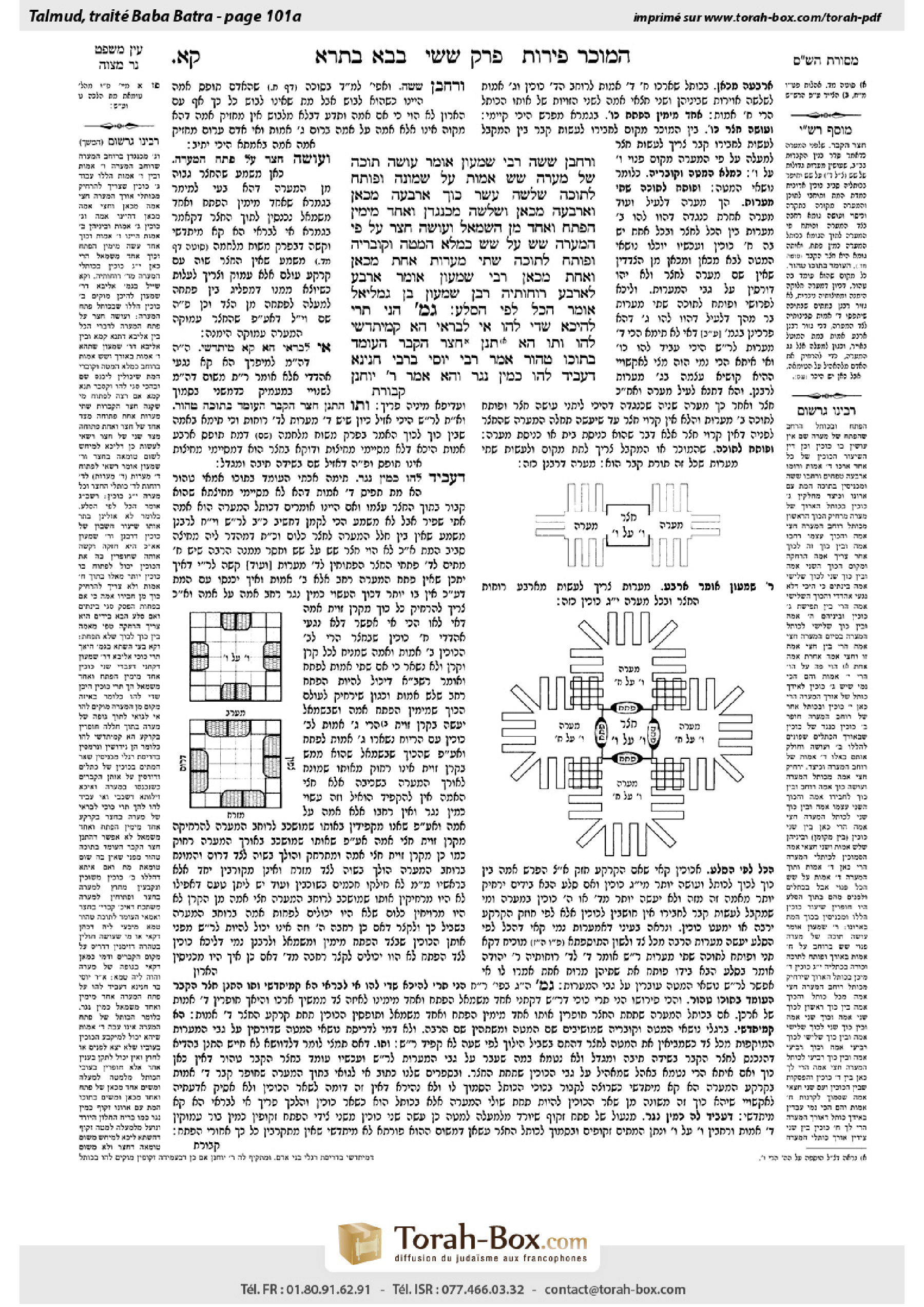
Rabbi Shimon says: He should construct the inside of each burial chamber six cubits wide by eight cubits long and open up into the chamber, by digging into its walls, thirteen burial niches. Four niches should be opened up from the wall here, along the length of the chamber, and four from there, along the other side, and three niches from the wall facing the entrance, and one from the right of the entrance and another one from the left.
The mishna describes the general structure of the catacomb: And he must fashion a courtyard at the entrance of the burial chamber that should be six cubits by six cubits, which is equal to the combined length of the bier of the deceased and those who bury him, to ensure adequate room for the burial to take place.
And he should open up two burial chambers into the courtyard, one from here and one from there, i.e., on opposite sides of the courtyard. Rabbi Shimon says: He should open up four burial chambers, one on each of the courtyard’s four sides.
Rabban Shimon ben Gamliel says: Everything is dependent on the nature of the bedrock. If the bedrock is hard and strong it will be able to accommodate more niches, which will be more closely packed together, with less bedrock between them. If the bedrock is softer, fewer and more sparsely spaced niches should be formed.
GEMARA: In Rabbi Shimon’s depiction of a burial chamber, he states that two niches should be opened up, one from the right of the entrance and one from the left. The Gemara asks: These two niches, in which direction does he set them? If they are directed toward the outside of the chamber, i.e., under the floor of the courtyard, won’t people trample over them when they enter the courtyard, which is improper? And furthermore, didn’t we learn in the mishna (Oholot 15:8): With regard to the courtyard of a catacomb, one who stands inside it is ritually pure because it can be presumed that he did not stand over a dead body? Clearly, these niches are not to be dug underneath the courtyard.
Rabbi Yosei, son of Rabbi Ḥanina, said: He makes these two niches at the side of the entrance, vertically, like a door bolt.
The Gemara challenges this explanation: But doesn’t Rabbi Yoḥanan say with regard to the burial of people in a vertical position:
Bava Batra 101a · Traduction française (IA)
et leur largeur est de six paumes.
Rabbi Šimon dit : Il doit construire l'intérieur de chaque chambre funéraire six coudées de largeur par huit coudées de longueur et ouvrir treize niches funéraires en creusant dans ses murs. Quatre niches doivent être ouvertes depuis le mur ici, le long de la longueur de la chambre, et quatre depuis là, le long de l'autre côté, et trois niches depuis le mur face à l'entrée, et une depuis la droite de l'entrée et une autre depuis la gauche.
La mitsva décrit la structure générale du cimetière souterrain : Il doit construire un cour de manière à l'entrée de la chambre funéraire qui doit être six coudées par six coudées, ce qui équivaut à la longueur du cercueil du défunt et de ceux qui le transportent, afin de garantir suffisamment de place pour la sépulture.
Et il doit ouvrir deux chambres funéraires dans le cour, une de ce côté et une de l'autre côté, c'est-à-dire sur les côtés opposés du cour. Rabbi Šimon dit : Il doit ouvrir quatre chambres funéraires, une sur chaque côté du cour.
Rabban Šimon ben Gamliel dit : Tout dépend de la nature du rocher. Si le rocher est dur et solide, il pourra accueillir plus de niches, qui seront plus serrées les unes contre les autres, avec moins de rocher entre elles. Si le rocher est plus mou, il faudra former moins de niches, plus espacées.
GUEMARA : Dans la description de Rabbi Šimon d'une chambre funéraire, il indique que deux niches doivent être ouvertes, une à droite de l'entrée et une à gauche. La Guemara pose la question : Ces deux niches, dans quelle direction les oriente-t-il ? Si elles sont orientées vers l'extérieur de la chambre, c'est-à-dire sous le plancher du cour, ne seront-elles pas foulées par les gens lorsqu'ils entrent dans le cour, ce qui est inapproprié ? Et de plus, n'avons-nous pas appris dans la mitsna (Oholot 15:8) : En ce qui concerne le cour d'un cimetière souterrain, celui qui se tient à l'intérieur est rituellement pur, car on peut supposer qu'il ne se tenait pas sur un corps mort ? Évidemment, ces niches ne doivent pas être creusées sous le cour.
Rabbi Yosei, fils de Rabbi Ḥanina, dit : Il doit faire ces deux niches aux côtés de l'entrée, verticalement, comme un verrou de porte.
La Guemara conteste cette explication : Mais n'a-t-il pas dit Rabbi Yoḥanan concernant la sépulture des personnes en position verticale :
Traduction française générée par IA à partir de l’édition anglaise de Sefaria. Vérifie toujours un passage avec le texte source.
Text from Sefaria: William Davidson Edition - Vocalized Aramaic (CC BY NC); William Davidson Edition - English (CC BY NC).