Bava Batra 101b: Talmud study for Daf Yomi
Study the Talmud for Daf Yomi with scanned pages, Hebrew text, English translations from Sefaria and AI-generated French translations.
Passage selection and English or AI-generated French translation are available where the scan has annotations. Daf Study is independent of Torah-Box and Sefaria.
Browse Bava Batra · בבא בתרא · All tractatesBava Batra 101b text and translations
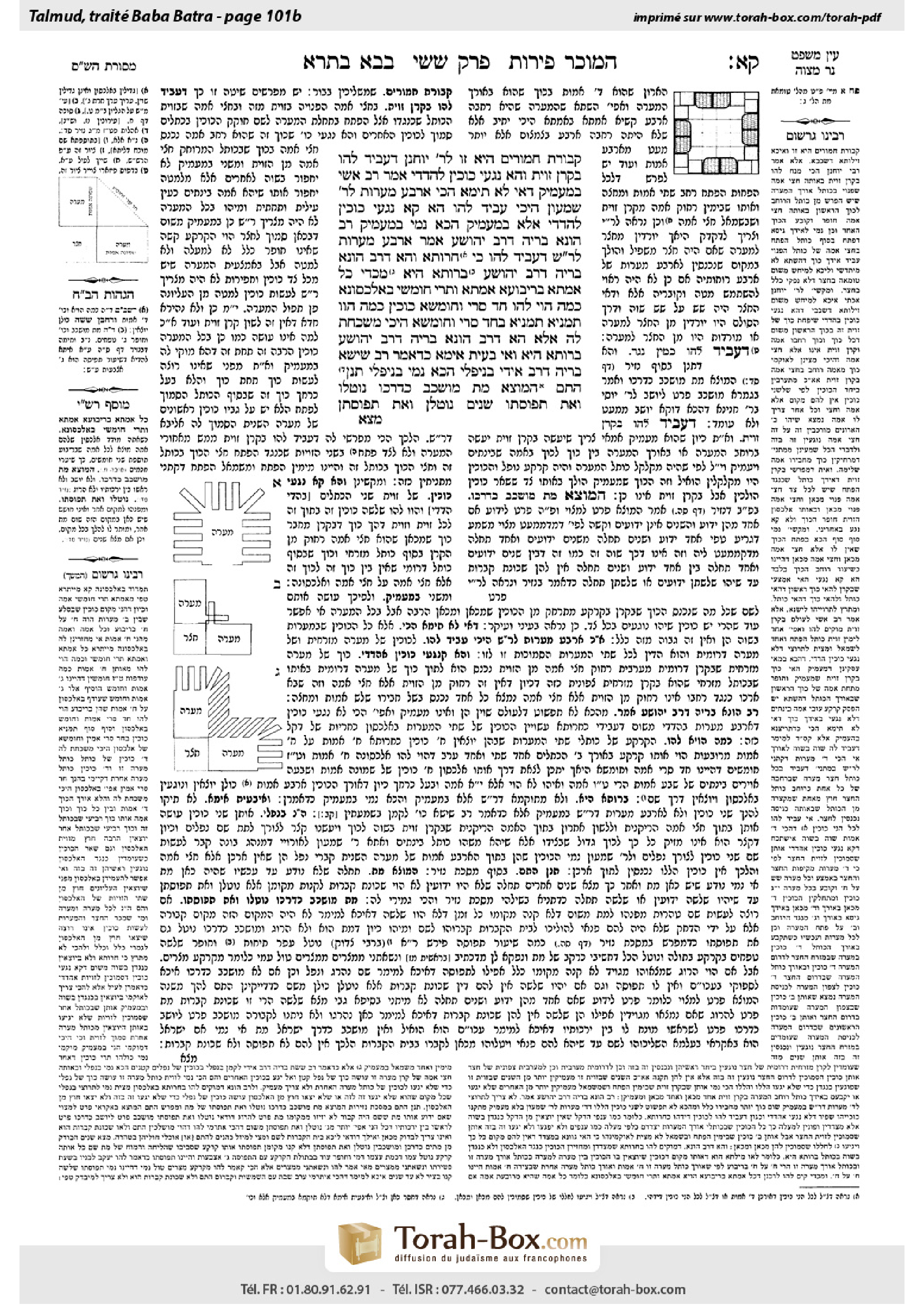
This page of Bava Batra includes the Aramaic text, an English translation and an AI-generated French translation, alongside the scan above.
בבא בתרא ק״א ב · Aramaic and Hebrew text
קְבוּרַת חֲמוֹרִים הִיא זוֹ!
לְרַבִּי יוֹחָנָן, דְּעָבֵיד לְהוּ בְּקֶרֶן זָוִית.
וְהָא נָגְעִי כּוּכִין לַהֲדָדֵי!
אָמַר רַב אָשֵׁי: בְּמַעֲמִיק. דְּאִי לָא תֵּימָא הָכִי, אַרְבַּע מְעָרוֹת לְרַבִּי שִׁמְעוֹן – הֵיכִי עָבֵיד לְהוּ? הָא קָא נָגְעִי כּוּכִין לַהֲדָדֵי! אֶלָּא בְּמַעֲמִיק; הָכָא נָמֵי בְּמַעֲמִיק.
רַב הוּנָא בְּרֵיהּ דְּרַב יְהוֹשֻׁעַ אָמַר: אַרְבַּע מְעָרוֹת לְרַבִּי שִׁמְעוֹן – דְּעָבֵיד לְהוּ כִּי חֲרוּתָא.
וְהָא דְּרַב הוּנָא בְּרֵיהּ דְּרַב יְהוֹשֻׁעַ – בְּרוּתָא הִיא. מִכְּדֵי כׇּל אַמְּתָא בְּרִיבּוּעָא אַמְּתָא וּתְרֵי חוּמְשֵׁי בַּאֲלַכְסוֹנָא; כַּמָּה הָוֵי לְהוּ? חַד סְרֵי וְחוּמְשָׁא; כּוּכִין כַּמָּה הָווּ? תְּמָנְיָא; תְּמָנְיָא בְּחַד סְרֵי וְחוּמְשָׁא הֵיכִי מַשְׁכַּחַתְּ לַהּ? אֶלָּא הָא דְּרַב הוּנָא בְּרֵיהּ דְּרַב יְהוֹשֻׁעַ – בְּרוּתָא הִיא.
וְאִי בָּעֵית אֵימָא, כִּדְאָמַר רַב שִׁישָׁא בְּרֵיהּ דְּרַב אִידִי: בְּנִיפְלֵי; הָכָא נָמֵי בְּנִיפְלֵי.
תְּנַן הָתָם: הַמּוֹצֵא מֵת מוּשְׁכָּב כְּדַרְכּוֹ, נוֹטְלוֹ וְאֶת תְּפוּסָתוֹ. שְׁנַיִם – נוֹטְלָן וְאֶת תְּפוּסָתָן.
Bava Batra 101b · English translation
This is like a burial of donkeys and is disrespectful.
The Gemara answers: According to the opinion of Rabbi Yoḥanan, each of these two niches is formed in a different corner of the chamber, aligned diagonally away from the chamber’s cavity.
The Gemara challenges: But if so, won’t the niches located around the corners touch one another? According to Rabbi Yoḥanan’s suggestion, there are, in fact, three niches located at each of the two back corners. One is recessed into the wall of the length of the chamber, at right angles to it, another is recessed into the back wall of the chamber, also at right angles to it, and a third that extends diagonally away from the chamber. The ends of these three niches will overlap, causing there to be too little space in them to fulfill the minimum required measurement.
Rav Ashi said: It is possible to do this where, when constructing the niches that extend diagonally away from the chamber, one deepens them, i.e., forms them lower down in the wall than the other niches adjacent to them. As, if you do not say that this is a solution, then how could the four chambers depicted by Rabbi Shimon be constructed? Won’t the niches touch one another? The niches of one chamber will overlap those of the chamber adjacent to it. Rather, it is possible to arrange the niches only where, when constructing the niches of two chambers at opposite ends of the courtyard, one deepens them, i.e., forms them lower down in the wall than the niches of the other two chambers that are adjacent to them. Here too, it is a case in which one deepens them.
Rav Huna, son of Rav Yehoshua, said that there is an alternative explanation: It is possible to fashion the four chambers depicted by Rabbi Shimon where one constructs them so that all the niches extend diagonally away from the cavity of the chamber like the leaves of a palm branch, which have spread out from its spine. If formed in this way, the niches of adjacent chambers will not overlap, even if they are at the same depth in the ground.
The Gemara notes: And this statement of Rav Huna, son of Rav Yehoshua, is an error, because it is not possible to form all the niches in this way, since the length of the diagonal of every square whose side is one cubit is one and two-fifths cubits. Each chamber is eight cubits long, which means that between two adjacent chambers, placed at right angles to each other, there is a square area of eight cubits by eight cubits into which the niches of those two chambers must be formed. How much is the diagonal of that area? Eleven and one-fifth cubits. How many niches have to fit in that space? Eight. How can you find that eight niches can possibly fit into eleven and one-fifth cubits? Each of the niches is a cubit wide, and there must be a cubit wall of bedrock between each niche. To accommodate this once would need an area of at least fifteen cubits. Rather, this statement of Rav Huna, son of Rav Yehoshua, is in error.
The Gemara provides an alternative solution to the problem of the niches at the corners overlapping. Or if you wish, say as Rav Sheisha, son of Rav Idi, said in answer to a similar question: It is referring to non-viable newborns, which require only very small burial niches. Similarly, here also, the niches at the corners of the chambers were used for non-viable newborns.
§ The Gemara considers another mishna that relates to the structure of a catacomb: We learned in a mishna there (Nazir 64b): With regard to one who finds a corpse while inspecting a place that was not previously established as a cemetery, to ensure that it is free of ritual impurity, and the corpse is lying in the usual manner of Jewish burial, he removes it from there and also removes its surrounding earth. And similarly, if he finds two corpses buried in the usual manner, he removes them and their surrounding earth. Since only one or two corpses were found, it may be assumed that the area is not a cemetery; therefore, the corpses may be removed.
Bava Batra 101b · Traduction française (IA)
C'est comme un enterrement de bêtes de somme et c'est impoli.
La Guemara répond : Selon l'opinion du Rabbi Yoḥanan, chaque une de ces deux niches est formée dans un coin différent de la pièce, alignée diagonalement en dehors de la cavité de la pièce.
La Guemara soulève un défi : Mais si c'est ainsi, les niches situées aux angles ne toucheraient-elles pas les unes les autres ? Selon la suggestion du Rabbi Yoḥanan, il y a effectivement trois niches situées à chaque coin arrière. Une est en retrait dans le mur de la longueur de la pièce, perpendiculairement à ce mur, une autre est en retrait dans le mur arrière de la pièce, également perpendiculairement à ce mur, et une troisième s'étend diagonalement en dehors de la pièce. Les extrémités de ces trois niches se chevaucheraient, ce qui entraînerait un espace insuffisant pour satisfaire la mesure minimale requise.
Rav Ashi a dit : Il est possible de le faire là où, lors de la construction des niches s'étendant diagonalement en dehors de la pièce, on les creuse davantage, c'est-à-dire qu'on les forme plus bas dans le mur que les autres niches adjacentes. En effet, si vous ne dites pas que c'est une solution, comment pourrait-on construire les quatre pièces décrites par Rabbi Shimon ? Ne toucheraient-elles pas les unes les autres ? Les niches d'une pièce chevaucheraient celles de la pièce adjacente. Plutôt, il est possible d'organiser les niches uniquement là où, lors de la construction des niches de deux pièces aux extrémités opposées du cour de la maison, on les creuse davantage, c'est-à-dire qu'on les forme plus bas dans le mur que les niches des deux autres pièces adjacentes. Ici aussi, c'est un cas où on les creuse davantage.
Rav Huna, fils de Rav Yehoshua, a dit qu'il existe une autre explication : Il est possible de construire les quatre pièces décrites par Rabbi Shimon en les faisant s'étendre diagonalement en dehors de la cavité de la pièce comme les feuilles d'un palmier, qui s'étendent depuis son tige. Si elles sont construites ainsi, les niches des pièces adjacentes ne se chevaucheront pas, même si elles sont à la même profondeur.
La Guemara note que cette déclaration de Rav Huna, fils de Rav Yehoshua, est une erreur, car il n'est pas possible de former toutes les niches ainsi, car la diagonale de chaque carré dont le côté est un cubit est un et deux-cinquièmes de cubit. Chaque pièce est de huit cubits de long, ce qui signifie que, entre deux pièces adjacentes, placées perpendiculairement l'une à l'autre, il y a une zone carrée de huit cubits par huit cubits dans laquelle les niches de ces deux pièces doivent être formées. Quelle est la diagonale de cette zone ? Onze et un-cinquième cubits. Combien de niches doivent s'y loger ? Huit. Comment peut-on trouver que huit niches peuvent s'insérer dans onze et un-cinquième cubits ? Chaque niche est d'un cubit de largeur, et il faut un cubit de mur de roche entre chaque niche. Pour accueillir cela une seule fois, on aurait besoin d'une surface d'au moins quinze cubits. Plutôt, cette déclaration de Rav Huna, fils de Rav Yehoshua, est une erreur.
La Guemara propose une autre solution au problème des niches aux angles qui se chevauchent. Ou, si vous préférez, dites comme Rav Sheisha, fils de Rav Idi, a répondu à une question similaire : Il s'agit de nouveaux-nés non viables, qui nécessitent seulement des niches de sépulture très petites. De même, ici aussi, les niches aux angles des pièces étaient utilisées pour des nouveaux-nés non viables.
§ La Guemara examine une autre mitsva concernant la structure d'un cimetière souterrain : Nous avons appris dans une mitsva là (Nazir 64b) : En ce qui concerne celui qui découvre un cadavre lors de l'inspection d'un lieu qui n'était pas auparavant désigné comme un cimetière, afin de s'assurer qu'il est libre de l'impureté rituelle, et le cadavre est allongé dans la manière habituelle d'enterrement juif, il le retire de là et il retire également la terre autour de lui. De même, si l'on découvre deux cadavres enterrés dans la manière habituelle, on les retire ainsi que la terre autour d'eux. Puisque seul un ou deux cadavres ont été trouvés, on peut supposer que la zone n'est pas un cimetière ; par conséquent, les cadavres peuvent être retirés.
Traduction française générée par IA à partir de l’édition anglaise de Sefaria. Vérifie toujours un passage avec le texte source.
Text from Sefaria: William Davidson Edition - Vocalized Aramaic (CC BY NC); William Davidson Edition - English (CC BY NC).