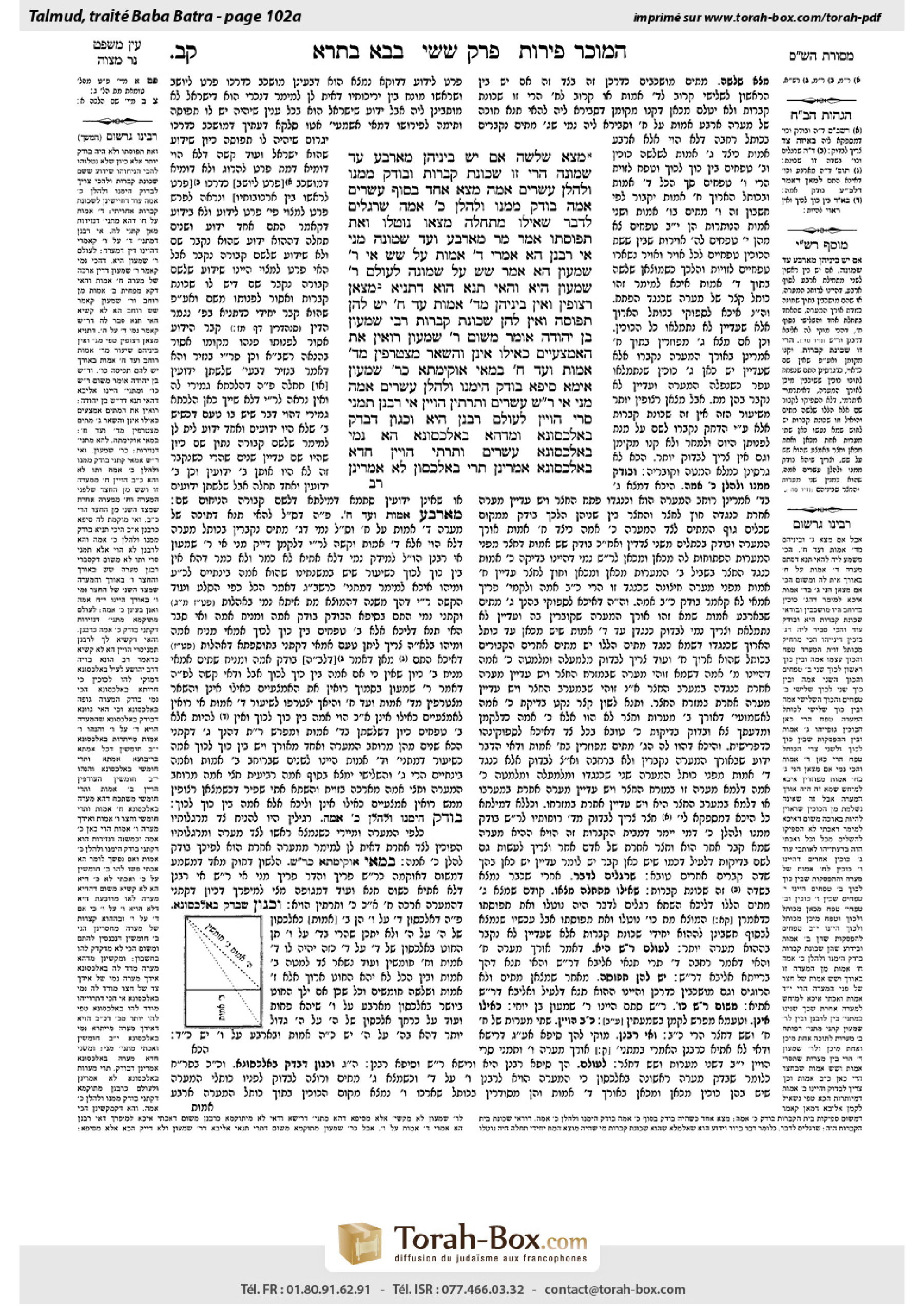
Bava Batra 102a: Talmud study for Daf Yomi
Study the Talmud for Daf Yomi with scanned pages, Hebrew text, English translations from Sefaria and AI-generated French translations.
Passage selection and English or AI-generated French translation are available where the scan has annotations. Daf Study is independent of Torah-Box and Sefaria.
Browse Bava Batra · בבא בתרא · All tractatesBava Batra 102a text and translations
This page of Bava Batra includes the Aramaic text, an English translation and an AI-generated French translation, alongside the scan above.
בבא בתרא ק״ב א · Aramaic and Hebrew text
מָצָא שְׁלֹשָׁה – אִם יֵשׁ בֵּינֵיהֶן מֵאַרְבַּע עַד שְׁמוֹנֶה, הֲרֵי זוֹ שְׁכוּנַת קְבָרוֹת, וּבוֹדֵק מִמֶּנּוּ וּלְהַלָּן עֶשְׂרִים אַמָּה. מָצָא אֶחָד בְּסוֹף עֶשְׂרִים אַמָּה – בּוֹדֵק מִמֶּנּוּ וּלְהַלָּן עֶשְׂרִים אַמָּה, שֶׁרַגְלַיִם לַדָּבָר. שֶׁאִילּוּ מִתְּחִלָּה מְצָאוֹ – נוֹטְלוֹ וְאֶת תְּפוּסָתוֹ.
אָמַר מָר: מֵאַרְבַּע וְעַד שְׁמוֹנֶה. מַנִּי? אִי רַבָּנַן – הָא אָמְרִי: אַרְבַּע אַמּוֹת עַל שֵׁשׁ! אִי רַבִּי שִׁמְעוֹן – הָא אָמַר: שֵׁשׁ עַל שְׁמוֹנֶה!
לְעוֹלָם רַבִּי שִׁמְעוֹן הִיא, וְהַאי תַּנָּא הוּא – דְּתַנְיָא: מְצָאָן רְצוּפִין, וְאֵין בֵּינֵיהֶן מֵאַרְבַּע אַמּוֹת עַד שְׁמוֹנֶה – יֵשׁ לָהֶן תְּפוּסָה, וְאֵין לָהֶן שְׁכוּנַת קְבָרוֹת. רַבִּי שִׁמְעוֹן בֶּן יְהוּדָה אוֹמֵר מִשּׁוּם רַבִּי שִׁמְעוֹן: רוֹאִין אֶת הָאֶמְצָעִיִּים כְּאִילּוּ אֵינָן, וְהַשְּׁאָר מִצְטָרְפִין מֵאַרְבַּע אַמּוֹת וְעַד שְׁמוֹנֶה.
בְּמַאי אוֹקֵימְתָּא – כְּרַבִּי שִׁמְעוֹן? אֵימָא סֵיפָא: בּוֹדֵק הֵימֶנּוּ וּלְהַלָּן עֶשְׂרִים אַמָּה. מַנִּי? אִי רַבִּי שִׁמְעוֹן, עֶשְׂרִים וְתַרְתֵּין הָוְיָין! אִי רַבָּנַן, תַּמְנֵי סְרֵי הָוְיָין!
לְעוֹלָם רַבָּנַן הִיא, וּכְגוֹן דִּבְדַק בַּאֲלַכְסוֹנָא.
וּמִדְּהָא בַּאֲלַכְסוֹנָא – הָא נָמֵי בַּאֲלַכְסוֹנָא; עֶשְׂרִים וְתַרְתֵּי הָוְיָין! חֲדָא בַּאֲלַכְסוֹנָא אָמְרִינַן, תְּרֵי בַּאֲלַכְסוֹן לָא אָמְרִינַן.
Bava Batra 102a · English translation
If he found three corpses lying parallel to each other, then if there is between them, i.e., the outer two corpses, a distance of four to eight cubits, then this is presumed to be a graveyard and the corpses may not be removed, and he must examine from that spot outward twenty cubits to discover whether there are other corpses buried there. If he finds even one corpse up to the distance of twenty cubits, he must continue to examine from the place he finds that corpse outward another twenty cubits. He continues to search for additional corpses, even if only one corpse was found within the twenty cubits, as there is a basis for anticipating the matter; it is probable that he has stumbled upon an ancient cemetery. He is not permitted to relocate the corpses, despite that fact that if he had found the single corpse by itself at first, without being aware of the gravesite, he would have been permitted to remove it and its surrounding earth.
The Gemara analyzes that mishna. The Master said: If there is between them a distance of four to eight cubits, then it is presumed to be a graveyard. The reason is that corpses buried in this manner are indicative of the standard layout of a burial chamber. The fact that this is said only when the distance between the corpses is between four and eight cubits assumes that the size of a burial chamber is four cubits by eight cubits. Based on this, the Gemara asks: Whose opinion is this? If it is the opinion of the Rabbis in the mishna above (100b), didn’t they say that the size of a burial chamber is four cubits by six cubits? If it is the opinion of Rabbi Shimon, didn’t he say that a burial cave is six cubits by eight cubits?
The Gemara answers: Actually this mishna is in accordance with the opinion of Rabbi Shimon, and it is in accordance with another version of Rabbi Shimon’s opinion, which is cited by this tanna, as it is taught in a baraita: If one found three corpses lying in close succession, and there is not a distance of four cubits to eight cubits between them, i.e., they are lying closer together, they have the halakha of the requirement to move their surrounding earth in which they are buried. But they are not considered to be part of a graveyard, since permanent graves are not placed so closely together. Perforce, their corpses were originally buried there on a temporary basis, but then they were never reinterred. Rabbi Shimon ben Yehuda says in the name of Rabbi Shimon: The corpses in the middle are viewed as if they are not there, i.e., as if they were buried there incidentally, and the other corpses thereby combine to form a graveyard in which corpses are found with a distance of four cubits to eight cubits between them.
The Gemara asks: In accordance with which opinion did you interpret the mishna? If it is in accordance with the opinion of Rabbi Shimon, then say the latter clause of that mishna: If he finds an area of graves, he must examine from there outward twenty cubits to discover whether there are other corpses buried there. Since the burial formation is indicative of burial within a burial chamber of a catacomb, he should continue to investigate the whole area that would be occupied by a catacomb. The Gemara asks: Whose opinion is this? If it is the opinion of Rabbi Shimon, the distance one should be required to examine would be twenty-two cubits, which is the total length of a catacomb, i.e., two chambers of eight cubits with a courtyard of six cubits between them. If it is the opinion of the Rabbis, the distance one should be required to examine would be eighteen cubits, as each catacomb consists of two chambers of six cubits long with a chamber of six cubits between them.
The Gemara answers: Actually, the mishna is in accordance with the opinion of the Rabbis, and it is necessary to examine twenty cubits in a case where he examined along the diagonal of the catacomb, which is longer than its length.
The Gemara asks: But since he examined this chamber along the diagonal, this second chamber on the other side of the courtyard should also be examined along the diagonal. If so, that would be twenty-two cubits. The Gemara answers: We say he should examine one chamber along the diagonal, but we do not say he should examine two chambers along the diagonal.
Bava Batra 102a · Traduction française (IA)
Si l'on découvre trois cadavres alignés les uns à côté des autres, alors si la distance entre eux, c'est-à-dire entre les deux cadavres externes, est de quatre à huit coudées, on considère cela comme un cimetière et les cadavres ne peuvent pas être retirés, et il doit examiner à partir de ce point vingt coudées pour découvrir s'il y a d'autres cadavres enterrés là. Si l'on découvre même un seul cadavre à une distance de vingt coudées, il doit continuer à examiner à partir du lieu où il a trouvé ce cadavre vingt coudées supplémentaires. Il continue à chercher d'autres cadavres, même s'il n'a trouvé qu'un seul cadavre dans les vingt coudées, car il y a une base pour anticiper la situation ; il est probable qu'il ait découvert un cimetière antique. Il n'est pas autorisé à déplacer les cadavres, malgré le fait que s'il avait découvert ce seul cadavre d'abord, sans savoir de quel cimetière il s'agissait, il aurait été autorisé à le retirer ainsi que le sol autour de lui.
La Guemara analyse cette Michna. Le Maître dit : Si la distance entre eux est de quatre à huit coudées, on considère cela comme un cimetière. La raison est que les cadavres enterrés ainsi sont caractéristiques de la disposition standard d'une chambre funéraire. Le fait que cela soit dit uniquement lorsque la distance entre les cadavres est entre quatre et huit coudées suppose que la taille d'une chambre funéraire est de quatre coudées par huit coudées. Sur cette base, la Guemara pose la question : De quel opinion s'agit-il ? Si c'est l'opinion des Rabbins mentionnés dans la Michna ci-dessus (100b), n'ont-ils pas dit que la taille d'une chambre funéraire est de quatre coudées par six coudées ? Si c'est l'opinion de Rabbi Shimon, n'a-t-il pas dit que la grotte funéraire est de six coudées par huit coudées ?
La Guemara répond : En réalité, cette Michna est conforme à l'opinion de Rabbi Shimon, et elle est conforme à une autre version de son opinion, qui est citée par ce tanna, comme il est enseigné dans une baraïta : Si l'on découvre trois cadavres allongés en succession rapprochée, et que la distance entre eux n'est pas de quatre coudées à huit coudées, c'est-à-dire qu'ils sont plus proches les uns des autres, ils sont soumis à la halakha de la nécessité de déplacer le sol dans lequel ils sont enterrés. Cependant, ils ne sont pas considérés comme faisant partie d'un cimetière, car les sépultures permanentes ne sont pas placées si rapprochées les unes des autres. Par conséquent, ces cadavres ont été initialement enterrés là de manière temporaire, mais ils n'ont jamais été réenterrés. Rabbi Shimon ben Yehuda cite en nom de Rabbi Shimon : Les cadavres du milieu sont vus comme s'ils n'étaient pas là, c'est-à-dire comme si ils avaient été enterrés là par hasard, et les autres cadavres forment ainsi un cimetière où les cadavres sont trouvés à une distance de quatre coudées à huit coudées entre eux.
La Guemara pose la question : Sur quelle opinion avez-vous interprété cette Michna ? Si c'est sur l'opinion de Rabbi Shimon, alors dites la dernière partie de cette Michna : Si l'on découvre une zone de sépultures, il doit examiner à partir de là vingt coudées pour découvrir s'il y a d'autres cadavres enterrés là. Puisque la disposition des sépultures indique une sépulture dans une chambre funéraire d'un catacombe, il devrait continuer à investiguer l'ensemble de la zone occupée par un catacombe. La Guemara pose la question : De quelle opinion s'agit-il ? Si c'est l'opinion de Rabbi Shimon, la distance à examiner serait de vingt-deux coudées, c'est-à-dire la longueur totale d'un catacombe, c'est-à-dire deux chambres de huit coudées avec un cour de six coudées entre elles. Si c'est l'opinion des Rabbins, la distance à examiner serait de dix-huit coudées, car chaque catacombe comprend deux chambres de six coudées de long avec une chambre de six coudées entre elles.
La Guemara répond : En réalité, cette Michna est en conformité avec l'opinion des Rabbins, et il est nécessaire d'examiner vingt coudées dans un cas où l'on examine le long de la diagonale du catacombe, qui est plus longue que sa longueur.
La Guemara pose la question : Mais puisque l'on examine cette chambre le long de la diagonale, cette deuxième chambre du côté de l'autre cour devrait aussi être examinée le long de la diagonale. Si c'est le cas, cela ferait vingt-deux coudées. La Guemara répond : Nous disons qu'il faut examiner une seule chambre le long de la diagonale, mais nous ne disons pas qu'il faut examiner deux chambres le long de la diagonale.
Traduction française générée par IA à partir de l’édition anglaise de Sefaria. Vérifie toujours un passage avec le texte source.
Text from Sefaria: William Davidson Edition - Vocalized Aramaic (CC BY NC); William Davidson Edition - English (CC BY NC).