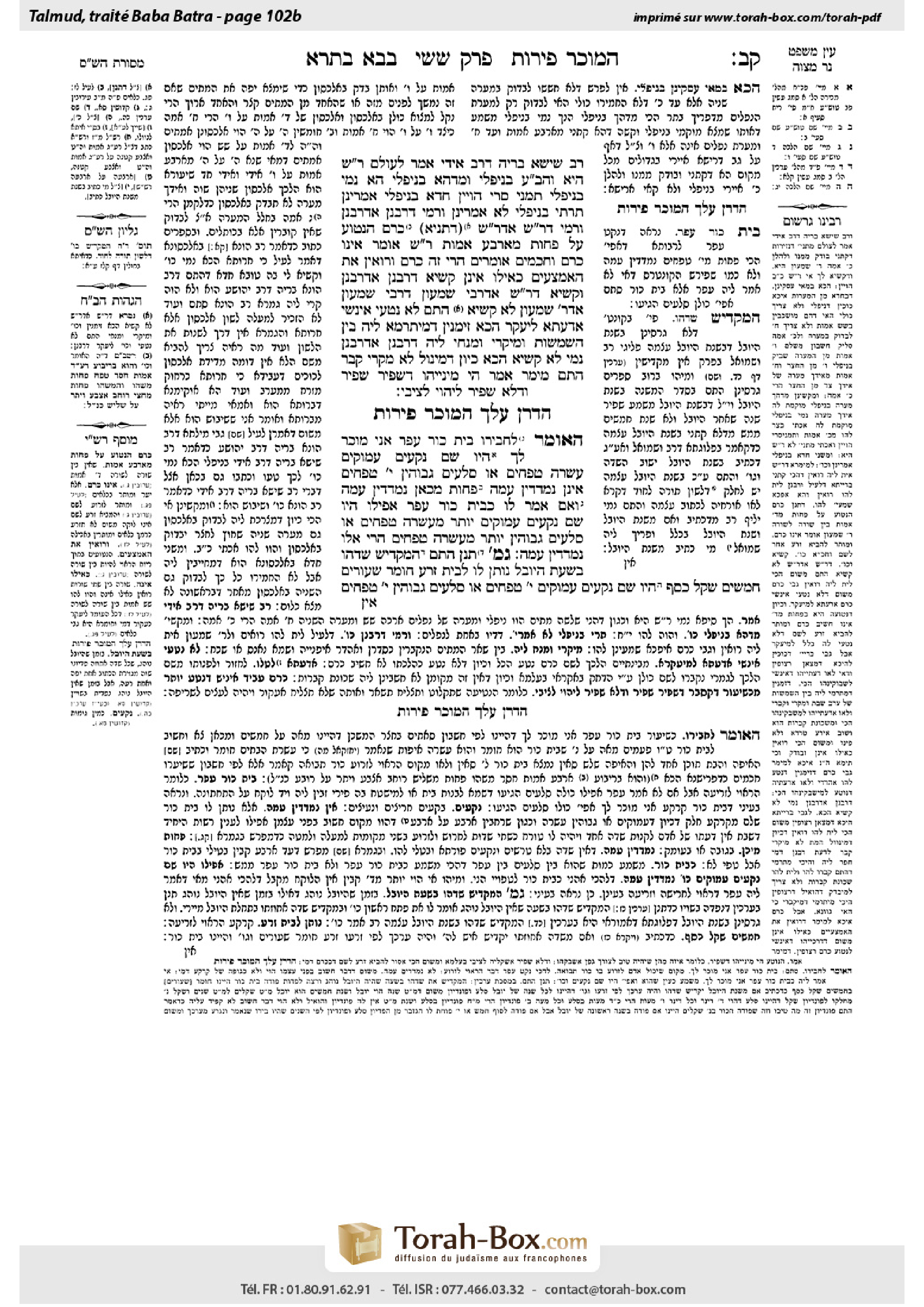
Bava Batra 102b: Talmud study for Daf Yomi
Study the Talmud for Daf Yomi with scanned pages, Hebrew text, English translations from Sefaria and AI-generated French translations.
Passage selection and English or AI-generated French translation are available where the scan has annotations. Daf Study is independent of Torah-Box and Sefaria.
Browse Bava Batra · בבא בתרא · All tractatesBava Batra 102b text and translations
This page of Bava Batra includes the Aramaic text, an English translation and an AI-generated French translation, alongside the scan above.
בבא בתרא ק״ב ב · Aramaic and Hebrew text
רַב שִׁישָׁא בְּרֵיהּ דְּרַב אִידִי אָמַר: לְעוֹלָם רַבִּי שִׁמְעוֹן הִיא, וְהָכָא בְּמַאי עָסְקִינַן – בְּנִיפְלֵי.
וּמִדְּהָא בְּנִיפְלֵי – הָא נָמֵי בְּנִיפְלֵי; תַּמְנֵי סְרֵי הָוְיָין! חֲדָא בְּנִיפְלֵי אָמְרִינַן, תַּרְתֵּי בְּנִיפְלֵי לָא אָמְרִינַן.
וְרָמֵי דְּרַבָּנַן אַדְּרַבָּנַן, וְרָמֵי דְּרַבִּי שִׁמְעוֹן אַדְּרַבִּי שִׁמְעוֹן –
דְּתַנְיָא: כֶּרֶם הַנָּטוּעַ עַל פָּחוֹת מֵאַרְבַּע אַמּוֹת – רַבִּי שִׁמְעוֹן אוֹמֵר: אֵינוֹ כֶּרֶם. וַחֲכָמִים אוֹמְרִים: הֲרֵי זֶה כֶּרֶם, וְרוֹאִין אֶת הָאֶמְצָעִיִּם כְּאִילּוּ אֵינָן.
קַשְׁיָא דְּרַבָּנַן אַדְּרַבָּנַן, וְקַשְׁיָא דְּרַבִּי שִׁמְעוֹן אַדְּרַבִּי שִׁמְעוֹן!
דְּרַבִּי שִׁמְעוֹן אַדְּרַבִּי שִׁמְעוֹן לָא קַשְׁיָא – הָתָם, לָא נָטְעִי אִינָשֵׁי אַדַּעְתָּא לְמִיעְקַר; הָכָא, זִימְנִין דְּמִיתְרְמֵא לֵיהּ בֵּין הַשְּׁמָשׁוֹת, וּמִיקְּרֵי וּמַנְּחִי לֵיהּ.
דְּרַבָּנַן אַדְּרַבָּנַן נָמֵי לָא קַשְׁיָא – הָכָא, כֵּיוָן דְּמִינַּוַּל – לָא מִקְּרֵי קֶבֶר; הָתָם, מֵימָר אָמַר: הֵי מִינַּיְיהוּ דְּשַׁפִּיר – שַׁפִּיר, וּדְלָא שַׁפִּיר – לֶיהֱוֵי לְצִיבֵי.
הֲדַרַן עֲלָךְ הַמּוֹכֵר פֵּירוֹת
הָאוֹמֵר לַחֲבֵירוֹ: ״בֵּית כּוֹר עָפָר אֲנִי מוֹכֵר לָךְ״ – הָיוּ שָׁם נְקָעִים עֲמוּקִּים עֲשָׂרָה טְפָחִים, אוֹ סְלָעִים גְּבוֹהִין עֲשָׂרָה טְפָחִים – אֵינָן נִמְדָּדִין עִמָּהּ. פָּחוֹת מִכָּאן – נִמְדָּדִין עִמָּהּ. וְאִם אָמַר לוֹ: ״כְּבֵית כּוֹר עָפָר״ – אֲפִילּוּ הָיוּ שָׁם נְקָעִים עֲמוּקִּים יוֹתֵר מֵעֲשָׂרָה טְפָחִים, אוֹ סְלָעִים גְּבוֹהִין יוֹתֵר מֵעֲשָׂרָה טְפָחִים, הֲרֵי אֵלּוּ נִמְדָּדִין עִמָּהּ.
גְּמָ׳ תְּנַן הָתָם: הַמַּקְדִּישׁ שָׂדֵהוּ בִּשְׁעַת הַיּוֹבֵל, נוֹתֵן לוֹ לְבֵית זֶרַע חוֹמֶר שְׂעוֹרִים – חֲמִשִּׁים שֶׁקֶל כָּסֶף. הָיוּ שָׁם נְקָעִים עֲמוּקִּים עֲשָׂרָה טְפָחִים, אוֹ סְלָעִים גְּבוֹהִין עֲשָׂרָה טְפָחִים –
Bava Batra 102b · English translation
Rav Sheisha, son of Rav Idi, said: Actually, the mishna is in accordance with the opinion of Rabbi Shimon, and here we are dealing with a case where the corpses found were of non-viable newborns buried in a smaller chamber only six cubits long. Adding a courtyard of six cubits and another regular-sized chamber of eight cubits yields a total length of the catacomb of twenty cubits.
The Gemara asks: But since this is dealing with a chamber that was created for burying non-viable newborns, there too, with regard to that chamber, on the other side of the courtyard, we are dealing with a chamber created for non-viable newborns as well. Therefore, the total length of the catacomb would be eighteen cubits. The Gemara answers: We say that perhaps one of the chambers is for non-viable newborns, but we do not say that two chambers might have been constructed for non-viable newborns.
§ Above, the Gemara cited a baraita that relates a dispute between Rabbi Shimon and the Rabbis with regard to three corpses buried close together. The Rabbis hold that this is not considered a graveyard, whereas Rabbi Shimon maintains that it can be. And the Gemara raises a contradiction from another ruling of the Rabbis against this ruling of the Rabbis, and it also raises a contradiction from another ruling of Rabbi Shimon against this ruling of Rabbi Shimon.
As it is taught in a mishna (Kilayim 5:2): With regard to a vineyard that is planted on an area where there is less than four cubits of open space between the vines, Rabbi Shimon says: It is not considered to be a vineyard with regard to the prohibition of diverse kinds and other halakhot, as it is overcrowded. And the Rabbis say: This is considered to be a vineyard, and the reason for this is that the middle vines are viewed as if they are not there, and the outer vines meet the requirements for a vineyard. Therefore, it is prohibited to plant other crops anywhere in that area.
The ruling of the Rabbis in this mishna is difficult, as it is contradicted by the ruling of the Rabbis in the baraita, as there the Rabbis did not say: The middle ones are viewed as if they are not there. And the ruling of Rabbi Shimon in this mishna is difficult, as it is contradicted by the ruling of Rabbi Shimon in the baraita, as there he did say: The corpses in the middle are viewed as if they are not there.
The Gemara answers: The fact that one ruling of Rabbi Shimon is contradicted by the other ruling of Rabbi Shimon is not difficult. There, with regard to vineyards, Rabbi Shimon holds that middle vines cannot be disregarded, as people do not plant vines with the intention of uprooting them. But here, with regard to burial, sometimes it happens that one has to bury a corpse at twilight just before the onset of Shabbat, and indiscriminately inters the body between other corpses with the intention of reburying it at a later date.
Similarly, the fact that one ruling of the Rabbis is contradicted by the other ruling of the Rabbis is not difficult. Here, with regard to burial, since it is a disgrace to bury bodies so close together, it is not called an area of graves. But there, with regard to vineyards, the owner of the vineyard says to himself: Whichever of the vines will flourish, will flourish and I will leave them, and whichever ones do not flourish, I will uproot them and they will be for firewood.
MISHNA: If one says to another: I am selling you a plot of earth of the size required for sowing one kor of seed [beit kor], and there on that plot there were crevices [neka’im] ten handbreadths deep or rocks ten handbreadths high, they are not measured together with the rest of the field. Rather, the buyer must be provided with land measuring a beit kor exclusive of those crevices or rocks. If the crevices or rocks measured less than ten handbreadths, they are measured together with the rest of the field. But if the seller said to the buyer: I am selling you a plot of earth that is about the size of a beit kor, then even if there on that plot there were crevices deeper than ten handbreadths or rocks higher than ten handbreadths, they are measured together with the rest of the field.
GEMARA: We learned in a mishna elsewhere (Arakhin 25a): With regard to one who consecrates his ancestral field during the time that the halakhot of the Jubilee Year are practiced, if he wishes to redeem the field he must give the Temple treasurer fifty silver shekels for every place that is fit for sowing a ḥomer of barley seed, which is the biblical equivalent of a kor, for all the years of the Jubilee cycle, as this is the sum fixed by the Torah for this purpose (see Leviticus 27:16). But if there were crevices ten handbreadths deep there, in the field, or rocks ten handbreadths high,
Bava Batra 102b · Traduction française (IA)
Rav Sheisha, fils de Rav Idi, a dit : En réalité, la Michna est conforme à l'opinion de Rabbi Shimon, et ici nous traitons d'un cas où les corps trouvés étaient des nouveau-nés non viables enterrés dans une petite pièce de six coudées de long. Ajouter une cour de six coudées et une autre pièce normale de huit coudées donne une longueur totale du catacombe de vingt coudées.
La Guemara pose la question : Mais puisque cela concerne une pièce construite pour enterrer des nouveau-nés non viables, il en est de même pour cette pièce, du côté de la cour, nous traitons d'une pièce construite pour des nouveau-nés non viables également. Par conséquent, la longueur totale du catacombe serait dix-huit coudées. La Guemara répond : Nous disons que peut-être une des pièces est destinée aux nouveau-nés non viables, mais nous ne disons pas que deux pièces auraient pu être construites pour des nouveau-nés non viables.
§ Plus haut, la Guemara a cité une baraïta qui rapporte un débat entre Rabbi Shimon et les Rabbins concernant trois corps enterrés ensemble. Les Rabbins pensent que cela ne constitue pas un cimetière, tandis que Rabbi Shimon affirme que cela peut l'être. Et la Guemara soulève une contradiction à partir d'un autre jugement des Rabbins contre ce jugement des Rabbins, et elle soulève également une contradiction à partir d'un autre jugement de Rabbi Shimon contre ce jugement de Rabbi Shimon.
Comme il est enseigné dans une Michna (Kilayim 5:2) : Concernant un domaine de vigne planté sur une surface où il y a moins de quatre coudées d'espace ouvert entre les vignes, Rabbi Shimon dit : Ce n'est pas considéré comme un domaine de vigne en ce qui concerne l'interdiction des espèces diverses et d'autres halakhot, car il est surpeuplé. Et les Rabbins disent : Cela constitue un domaine de vigne, et la raison en est que les vignes du milieu sont vues comme si elles n'étaient pas là, et les vignes externes remplissent les conditions d'un domaine de vigne. Par conséquent, il est interdit de planter d'autres cultures dans cette zone.
Le jugement des Rabbins dans cette Michna est difficile, car il est contredit par le jugement des Rabbins dans la baraïta, car là les Rabbins n'ont pas dit : Les vignes du milieu sont vues comme s'il n'y en avait pas. Et le jugement de Rabbi Shimon dans cette Michna est difficile, car il est contredit par le jugement de Rabbi Shimon dans la baraïta, car là il a dit : Les corps du milieu sont vus comme s'ils n'étaient pas là.
La Guemara répond : Le fait qu'un jugement de Rabbi Shimon soit contredit par un autre jugement de Rabbi Shimon n'est pas difficile. Là, concernant les domaines de vigne, Rabbi Shimon considère que les vignes du milieu ne peuvent pas être négligées, car les gens ne plantent pas de vignes avec l'intention de les arracher. Mais ici, concernant l'enterrement, il arrive parfois que l'on doive enterrer un corps à l'approche du Shabbat, et l'on enterrera indifféremment le corps entre d'autres corps avec l'intention de le reboucher ultérieurement.
De même, le fait qu'un jugement des Rabbins soit contredit par un autre jugement des Rabbins n'est pas difficile. Ici, concernant l'enterrement, puisque c'est honteux d'enterrer des corps si proches l'un de l'autre, cela n'est pas considéré comme une zone de cimetières. Mais là, concernant les vergers, le propriétaire du vergers se dit : Quelle que soit la vigne qui fleurira, elle fleurira et je la laisserai, et quelle que soit celle qui ne fleurira pas, je l'arracherai et elle sera utilisée comme bois de chauffage.
MICHNA : Si l'on dit à un autre : Je vends à toi un terrain de la taille nécessaire pour semer un kor de grain [beit kor], et sur ce terrain il y avait des fissures [neka’im] de dix paumes de profondeur ou des roches de dix paumes de hauteur, elles ne sont pas mesurées avec le reste du terrain. Plutôt, l'acheteur doit être fourni avec un terrain mesurant un beit kor exclusivement, sans ces fissures ou roches. Si les fissures ou roches mesuraient moins de dix paumes, elles sont mesurées avec le reste du terrain. Mais si le vendeur dit à l'acheteur : Je vends à toi un terrain de la taille d'un beit kor, alors même si sur ce terrain il y avait des fissures plus profondes que dix paumes ou des roches plus hautes que dix paumes, elles sont mesurées avec le reste du terrain.
GUEMARA : Nous avons appris dans une Michna ailleurs (Arakhin 25a) : Concernant celui qui consacre son terrain ancestral pendant la période où les halakhot de l'année du Jubilé sont en vigueur, s'il souhaite racheter son terrain, il doit donner au trésor du Temple cinquante sicloirs d'argent pour chaque lieu adapté à semer un ḥomer de grain de blé, qui est l'équivalent biblique d'un kor, pour toutes les années du cycle du Jubilé, car c'est la somme fixée par la Torah à cet effet (voir Lévitique 27:16). Mais si sur ce terrain il y avait des fissures de dix paumes de profondeur, ou des roches de dix paumes de hauteur,
Traduction française générée par IA à partir de l’édition anglaise de Sefaria. Vérifie toujours un passage avec le texte source.
Text from Sefaria: William Davidson Edition - Vocalized Aramaic (CC BY NC); William Davidson Edition - English (CC BY NC).