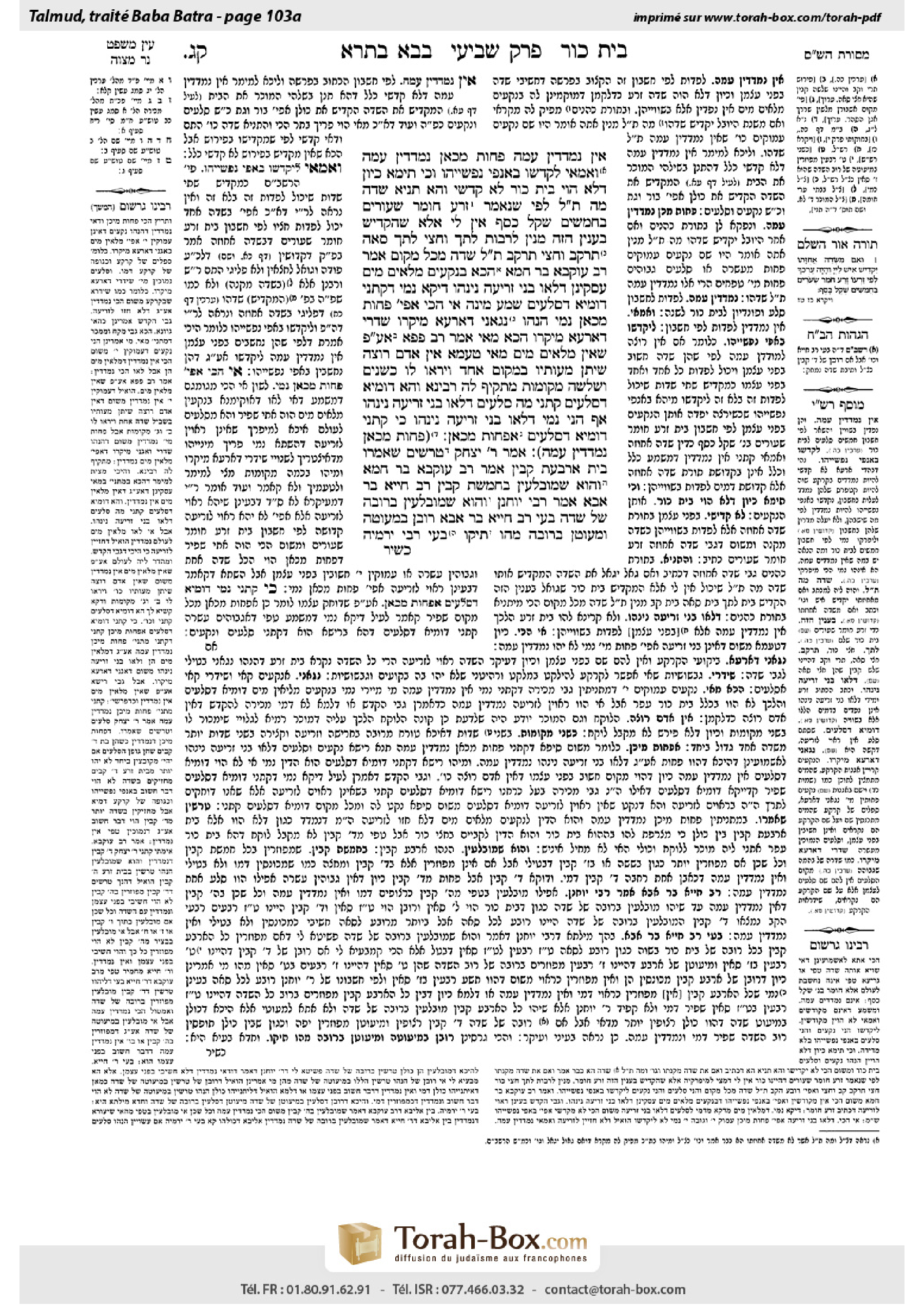
Bava Batra 103a: Talmud study for Daf Yomi
Study the Talmud for Daf Yomi with scanned pages, Hebrew text, English translations from Sefaria and AI-generated French translations.
Passage selection and English or AI-generated French translation are available where the scan has annotations. Daf Study is independent of Torah-Box and Sefaria.
Browse Bava Batra · בבא בתרא · All tractatesBava Batra 103a text and translations
This page of Bava Batra includes the Aramaic text, an English translation and an AI-generated French translation, alongside the scan above.
בבא בתרא ק״ג א · Aramaic and Hebrew text
אֵין נִמְדָּדִין עִמָּהּ. פָּחוֹת מִכָּאן – נִמְדָּדִין עִמָּהּ.
וְאַמַּאי? לִיקְדְּשׁוּ בְּאַנְפֵּי נַפְשַׁיְיהוּ! וְכִי תֵּימָא: כֵּיוָן דְּלָא הָוֵי בֵּית כּוֹר, לָא קָדְשִׁי;
וְהָא תַּנְיָא: ״שָׂדֶה״ – מָה תַּלְמוּד לוֹמַר? לְפִי שֶׁנֶּאֱמַר: ״זֶרַע חֹמֶר שְׂעֹרִים בַּחֲמִשִּׁים שֶׁקֶל כָּסֶף״; אֵין לִי אֶלָּא שֶׁהִקְדִּישׁ בָּעִנְיָן הַזֶּה,
מִנַּיִן לְרַבּוֹת לֶתֶךְ וַחֲצִי לֶתֶךְ, סְאָה, תַּרְקַב וַחֲצִי תַּרְקַב? תַּלְמוּד לוֹמַר: ״שָׂדֶה״, מִכׇּל מָקוֹם!
אָמַר רַב עוּקְבָא בַּר חָמָא: הָכָא בִּנְקָעִים מְלֵאִים מַיִם עָסְקִינַן, דְּלָאו בְּנֵי זְרִיעָה נִינְהוּ. דַּיְקָא נָמֵי, דְּקָתָנֵי דּוּמְיָא דִסְלָעִים; שְׁמַע מִינַּהּ.
אִי הָכִי, אֲפִילּוּ פָּחוֹת מִכָּאן נָמֵי! הָנְהוּ ״נְגָאנֵי דְאַרְעָא״ מִיקְּרוּ; ״שִׁדְרֵי דְאַרְעָא״ מִיקְּרוּ.
הָכָא מַאי? אֲמַר רַב פָּפָּא: אַף עַל פִּי שֶׁאֵין מְלֵאִים מַיִם. מַאי טַעְמָא? אֵין אָדָם רוֹצֶה שֶׁיִּתֵּן מְעוֹתָיו בִּמְקוֹם אֶחָד, וְיֵרָאוּ לוֹ כִּשְׁנַיִם וּשְׁלֹשָׁה מְקוֹמוֹת.
מַתְקֵיף לַהּ רָבִינָא: וְהָא דּוּמְיָא דִּסְלָעִים קָתָנֵי – מָה סְלָעִים דְּלָאו בְּנֵי זְרִיעָה נִינְהוּ, אַף הָנֵי נָמֵי דְּלָאו בְּנֵי זְרִיעָה נִינְהוּ! כִּי קָתָנֵי דּוּמְיָא דִּסְלָעִים – אַפָּחוֹת מִכָּאן.
פָּחוֹת מִכָּאן נִמְדָּדִין עִמָּהּ. אָמַר רַבִּי יִצְחָק: טְרָשִׁים שֶׁאָמְרוּ – בֵּית אַרְבַּעַת קַבִּין. אָמַר רַב עוּקְבָא בַּר חָמָא: וְהוּא שֶׁמּוּבְלָעִין בַּחֲמֵשֶׁת קַבִּין. רַב חִיָּיא בַּר אַבָּא אָמַר רַבִּי יוֹחָנָן: וְהוּא שֶׁמּוּבְלָעִין בְּרוּבָּהּ שֶׁל שָׂדֶה.
בָּעֵי רַב חִיָּיא בַּר אַבָּא: רוּבָּן בְּמִעוּטָהּ, וּמִעוּטָן בְּרוּבָּהּ, מַהוּ? תֵּיקוּ.
בָּעֵי רַבִּי יִרְמְיָה:
Bava Batra 103a · English translation
they are not measured together with the rest of the field. If the crevices or rocks were less than ten handbreadths, they are measured together with the rest of the field.
The Gemara asks: But why are the crevices that are deeper and the rocks that are higher than ten handbreadths not measured with the rest of the field? Let them at least be consecrated separately and require their own redemption. And if you would say that since they are not the size of a beit kor, they cannot be consecrated, there is a difficulty.
But isn’t it taught in a baraita concerning the verse: “And if he that sanctified the field will redeem it” (Leviticus 27:19): Why must the verse state the word “field”? Since the previous verses are all discussing a field, it would have sufficed for this verse to refer to the field with the pronoun: It. Rather, as it is stated in an earlier verse: “Then your valuation shall be according to the seed required for it; a ḥomer of barley seed shall be valued at fifty shekels of silver” (Leviticus 27:16), I have derived only the halakha in the case of one who consecrated in this manner, i.e., an area fit to sow a ḥomer of barley seed.
The baraita continues: From where do I learn that this halakha is also meant to include the case of one who consecrated a smaller area, e.g., an area fit to sow a letekh, i.e., a half-kor, a half-letekh, a se’a, a tarkav, and a half-tarkav? From where is it derived that these smaller plots of land can also be consecrated and redeemed in accordance with the fixed values stated in the Torah? The verse states: “A field,” teaching that this halakha applies in any case of a field, even to smaller plots.
Rav Ukva bar Ḥama said: Here, in the mishna in Arakhin, we are dealing with crevices filled with water. Being that they are not fit for sowing, they cannot be consecrated, as the verse states: “Then your valuation shall be according to the seed required for it” (Leviticus 27:16). The Gemara comments: The language of the mishna is also precise according to this interpretation, as it teaches the halakha about crevices that are similar to rocks, which are certainly not fit for sowing. The Gemara affirms: Learn from this that this explanation is correct.
The Gemara raises a difficulty: If this is so, that the crevices and rocks of the mishna are excluded from being consecrated because they are unfit for sowing, then even if they are less than ten handbreadths in depth or height, they also should not be consecrated. The Gemara answers: If the crevices or rocks are less than ten handbreadths deep or high, these crevices are called the cracks of the earth, and these rocks are called the spines [shidrei] of the earth. In other words, since they are considered standard features of the field and do not constitute separate areas, they are consecrated together with the rest of the field.
The Gemara asks: The halakha stated above was taught with regard to consecrated property. Here, in the case of a sale of land, with regard to which the mishna teaches that crevices ten handbreadths deep are not measured along with the land, what is the halakha? Does that halakha apply only when the crevices are filled with water? Rav Pappa said: Even if they are not filled with water they are not considered part of the field. What is the reason that in the case of a sale crevices are not considered part of the field even if they are not filled with water? Because a person buying a field does not want to give his money for the purchase of one plot when it appears to him like two or three different plots due to differences in the height of the terrain. Therefore, those crevices that are ten handbreadths deep are not measured along with the rest of the field, regardless of whether or not they are filled with water.
Ravina objects to this: But the mishna teaches the halakha about crevices in a manner indicating that they are similar to the rocks discussed in the mishna. Just as rocks are not fit for sowing, so too, these crevices are such that they are not fit for sowing. But if they are not filled with water, and are therefore fit for sowing, then even if they are lower than the rest of the field, they should be included in the sale. The Gemara replies: When the mishna teaches the halakha about crevices in a manner indicating that they are similar to the rocks discussed in the mishna, it teaches about crevices that are less than that, i.e., less than ten handbreadths deep. In such a case, even if they are not fit for sowing, they are measured along with the rest of the field.
§ The mishna teaches that if the crevices or rocks in the field measured less than ten handbreadths, they are measured together with the rest of the field. Rabbi Yitzḥak says: The rocks or crevices that measure less than ten handbreadths that the Sages said are measured together with the rest of the field must not measure more than an area required for sowing four kav of seed within an area required for sowing a kor. Rav Ukva bar Ḥama says: This applies specifically where the rocks are scattered throughout an area required for sowing five kav. Rav Ḥiyya bar Abba says that Rabbi Yoḥanan says: This applies specifically where the rocks are scattered throughout the greater part of the field.
Rabbi Ḥiyya bar Abba raises a dilemma with regard to the halakha taught in the name of Rabbi Yoḥanan: If the majority of the rocks are scattered throughout the smaller part of the field, and the minority of the rocks are scattered throughout the greater part of the field, what is the halakha? The Gemara answers: The dilemma shall stand unresolved, as no answer was found.
Rabbi Yirmeya raises another dilemma:
Bava Batra 103a · Traduction française (IA)
ils ne sont pas mesurés ensemble avec le reste du champ. Si les fissures ou les rochers étaient inférieurs à dix paumes, ils sont mesurés ensemble avec le reste du champ.
La Guemara pose la question : Mais pourquoi les fissures qui sont plus profondes et les rochers qui sont plus hauts que dix paumes ne sont-ils pas mesurés avec le reste du champ ? Laissons-les au moins être consacrés séparément et exiger leur propre rachat. Et si l'on dit que puisqu'ils ne sont pas de la taille d'un beit kor, ils ne peuvent pas être consacrés, il y a une difficulté.
Mais n'est-il pas enseigné dans une baraïta concernant la parole : « Et celui qui a consacré le champ le rachètera » (Lévitique 27:19) : Pourquoi la parole « champ » est-elle mentionnée ? Puisque les versets précédents parlent tous d'un champ, il aurait suffi que ce verset fasse référence au champ par la prononciation : Il. Mais, comme il est dit dans un verset précédent : « Et votre estimation sera selon la semence nécessaire pour cela ; un ḥomer de semence de blé sera estimé à cinquante sicles d'argent » (Lévitique 27:16), j'ai déduit seulement la halakha dans le cas d'une personne qui a consacré ainsi, c'est-à-dire une surface adaptée à semer un ḥomer de semence de blé.
La baraïta continue : D'où tire-t-on que cette halakha s'applique également au cas d'une personne qui a consacré une surface plus petite, par exemple une surface adaptée à semer un letekh, c'est-à-dire la moitié d'un kor, la moitié d'un letekh, un se'a, un tarkav et la moitié d'un tarkav ? D'où tire-t-on que ces petites parcelles de terre peuvent également être consacrées et rachetées conformément aux valeurs fixes établies dans la Torah ? Le verset dit : « Un champ », enseignant que cette halakha s'applique à tout cas de champ, même aux petites parcelles.
Rav Ukva bar Ḥama dit : Ici, dans la mitsva d'Arakhin, nous parlons de fissures remplies d'eau. Puisque ces fissures ne sont pas adaptées à la culture, elles ne peuvent pas être consacrées, comme le dit le verset : « Et votre estimation sera selon la semence nécessaire pour cela » (Lévitique 27:16). La Guemara commente : La formulation de la mitsva est aussi précise selon cette interprétation, car elle enseigne la halakha concernant les fissures semblables aux rochers, qui sont certainement non adaptées à la culture. La Guemara affirme : Apprenez-en que cette explication est correcte.
La Guemara soulève une difficulté : Si c'est ainsi, que les fissures et les rochers de la mitsva sont exclus de la consécration car ils ne sont pas adaptés à la culture, alors même s'ils sont inférieurs à dix paumes de profondeur ou de hauteur, ils ne devraient pas être consacrés. La Guemara répond : Si les fissures ou les rochers sont inférieurs à dix paumes de profondeur ou de hauteur, ces fissures sont appelées les fissures de la terre, et ces rochers sont appelés les épines [shidrei] de la terre. En d'autres termes, puisqu'ils sont considérés comme des caractéristiques standard du champ et ne constituent pas des zones distinctes, ils sont consacrés ensemble avec le reste du champ.
La Guemara pose la question : La halakha mentionnée ci-dessus a été enseignée concernant la propriété consacrée. Ici, dans le cas d'une vente de terre, concernant laquelle la mitsva enseigne que les fissures de dix paumes de profondeur ne sont pas mesurées avec la terre, quelle est la halakha ? Cette halakha s'applique-t-elle uniquement lorsque les fissures sont remplies d'eau ? Rav Pappa dit : Même s'ils ne sont pas remplis d'eau, ils ne sont pas considérés comme faisant partie du champ. Quelle est la raison pour laquelle, dans le cas d'une vente, les fissures ne sont pas considérées comme faisant partie du champ même s'ils ne sont pas remplis d'eau ? Parce qu'une personne achetant un champ ne veut pas donner son argent pour l'achat d'une parcelle lorsque cela lui semble comme deux ou trois parcelles différentes en raison des différences de hauteur du terrain. Par conséquent, ces fissures de dix paumes de profondeur ne sont pas mesurées avec le reste du champ, indépendamment du fait qu'elles soient ou non remplies d'eau.
Ravina s'oppose à cela : Mais la mitsva enseigne la halakha concernant les fissures d'une manière indiquant qu'elles sont semblables aux rochers discutés dans la mitsva. Tout comme les rochers ne sont pas adaptés à la culture, de même ces fissures sont telles qu'elles ne sont pas adaptées à la culture. Mais si elles ne sont pas remplies d'eau et sont donc adaptées à la culture, alors même si elles sont plus basses que le reste du champ, elles devraient être incluses dans la vente. La Guemara répond : Lorsque la mitsva enseigne la halakha concernant les fissures d'une manière indiquant qu'elles sont semblables aux rochers discutés dans la mitsva, elle enseigne concernant les fissures qui sont inférieures, c'est-à-dire inférieures à dix paumes de profondeur. Dans ce cas, même s'ils ne sont pas adaptés à la culture, ils sont mesurés avec le reste du champ.
§ La mitsva enseigne que si les fissures ou les rochers du champ mesurent moins de dix paumes, ils sont mesurés ensemble avec le reste du champ. Rabbi Yitzḥak dit : Les rochers ou les fissures qui mesurent moins de dix paumes, tels que les Sages l'ont dit, doivent être mesurés ensemble avec le reste du champ, mais ne doivent pas mesurer plus d'une surface adaptée à la culture de quatre kav de semence dans une surface adaptée à la culture d'un kor. Rav Ukva bar Ḥama dit : Cela s'applique spécifiquement là où les rochers sont dispersés dans une surface adaptée à la culture de cinq kav. Rav Ḥiyya bar Abba dit que Rabbi Yoḥanan dit : Cela s'applique spécifiquement là où les rochers sont dispersés dans la plus grande partie du champ.
Rabbi Ḥiyya bar Abba soulève un dilemme concernant la halakha enseignée au nom de Rabbi Yoḥanan : Si la majorité des rochers sont dispersés dans la petite partie du champ, et la minorité des rochers sont dispersés dans la grande partie du champ, quelle est la halakha ? La Guemara répond : Ce dilemme restera sans réponse, car aucune réponse n'a été trouvée.
Rabbi Yirmeya soulève un autre dilemme :
Traduction française générée par IA à partir de l’édition anglaise de Sefaria. Vérifie toujours un passage avec le texte source.
Text from Sefaria: William Davidson Edition - Vocalized Aramaic (CC BY NC); William Davidson Edition - English (CC BY NC).