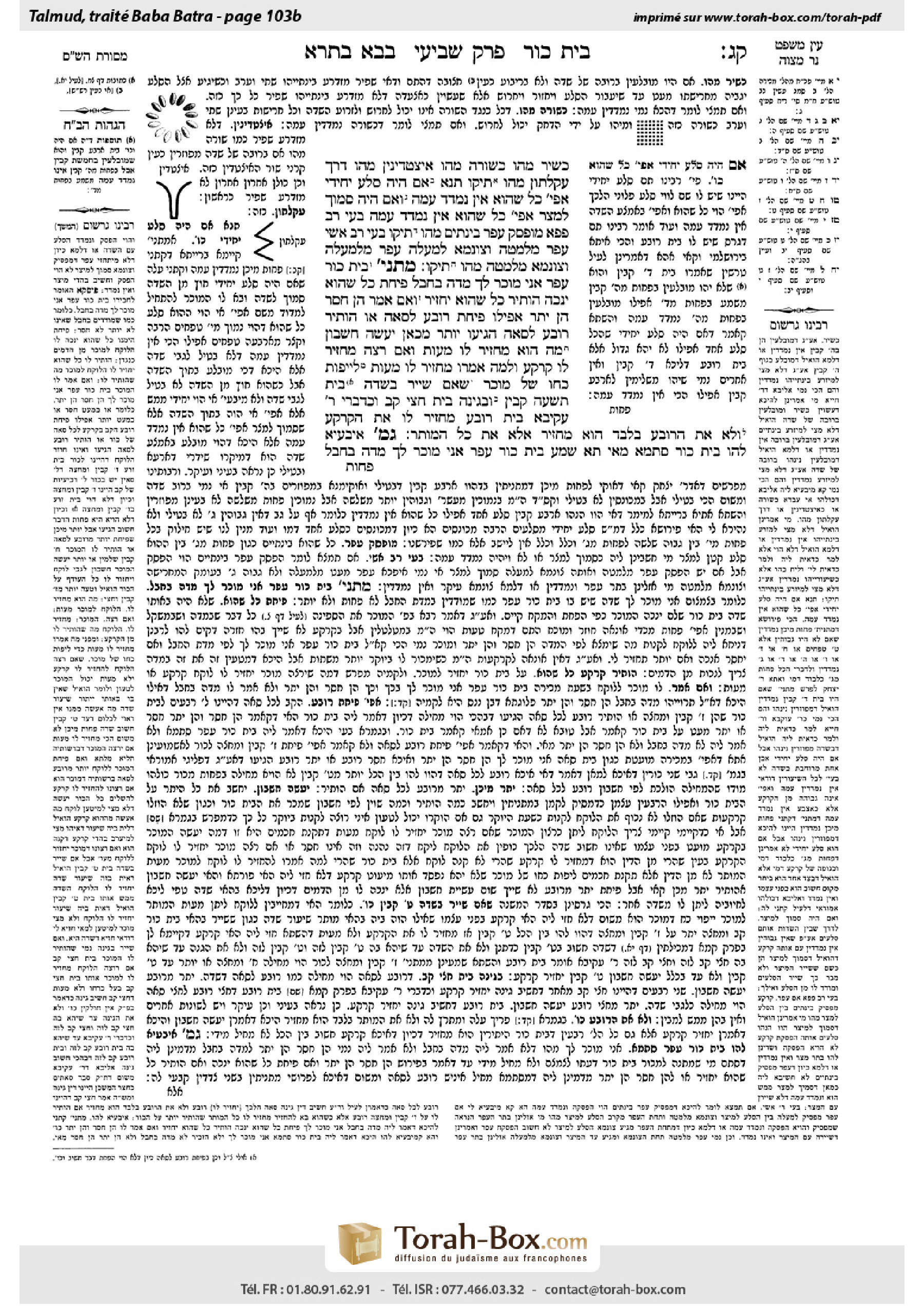
Bava Batra 103b: Talmud study for Daf Yomi
Study the Talmud for Daf Yomi with scanned pages, Hebrew text, English translations from Sefaria and AI-generated French translations.
Passage selection and English or AI-generated French translation are available where the scan has annotations. Daf Study is independent of Torah-Box and Sefaria.
Browse Bava Batra · בבא בתרא · All tractatesBava Batra 103b text and translations
This page of Bava Batra includes the Aramaic text, an English translation and an AI-generated French translation, alongside the scan above.
בבא בתרא ק״ג ב · Aramaic and Hebrew text
כְּשִׁיר מַהוּ? כְּשׁוּרָה מַהוּ? אִיצְטְדִינִין מַהוּ? דֶּרֶךְ עֲקַלָּתוֹן מַהוּ? תֵּיקוּ.
תָּנָא: אִם הָיָה סֶלַע יְחִידִי, אֲפִילּוּ כָּל שֶׁהוּא – אֵין נִמְדָּד עִמָּהּ. וְאִם הָיָה סָמוּךְ לַמֶּצֶר, אֲפִילּוּ כָּל שֶׁהוּא – אֵין נִמְדָּד עִמָּהּ.
בָּעֵי רַב פָּפָּא: מוּפְסָק עָפָר בֵּינְתַיִם, מַהוּ? תֵּיקוּ. בָּעֵי רַב אָשֵׁי: עָפָר מִלְּמַטָּה וְצוּנְמָא לְמַעְלָה; עָפָר מִלְּמַעְלָה וְצוּנְמָא מִלְּמַטָּה – מַהוּ? תֵּיקוּ.
מַתְנִי׳ ״בֵּית כּוֹר עָפָר אֲנִי מוֹכֵר לָךְ – מִדָּה בְּחֶבֶל״, פִּיחֵת כׇּל שֶׁהוּא – יְנַכֶּה, הוֹתִיר כׇּל שֶׁהוּא – יַחֲזִיר. וְאִם אָמַר: ״הֵן חָסֵר הֵן יָתֵר״, אֲפִילּוּ פִּיחֵת רוֹבַע לִסְאָה, אוֹ הוֹתִיר רוֹבַע לִסְאָה – הִגִּיעוֹ. יוֹתֵר מִכָּאן, יַעֲשֶׂה חֶשְׁבּוֹן.
מָה הוּא מַחֲזִיר לוֹ? מָעוֹת. וְאִם רָצָה, מַחֲזִיר לוֹ קַרְקַע. וְלָמָה אָמְרוּ מַחֲזִיר לוֹ מָעוֹת? לְיַיפּוֹת כֹּחוֹ שֶׁל מוֹכֵר – שֶׁאִם שִׁיֵּיר בַּשָּׂדֶה בֵּית תִּשְׁעָה קַבִּין, וּבַגִּינָּה בֵּית חֲצִי קַב; וּכְדִבְרֵי רַבִּי עֲקִיבָא – בֵּית רוֹבַע; מַחֲזִיר לוֹ אֶת הַקַּרְקַע. וְלֹא אֶת הָרוֹבַע בִּלְבַד הוּא מַחֲזִיר, אֶלָּא אֶת כָּל הַמּוֹתָר.
גְּמָ׳ אִיבַּעְיָא לְהוּ: ״בֵּית כּוֹר״ סְתָמָא, מַאי? תָּא שְׁמַע: ״בֵּית כּוֹר עָפָר אֲנִי מוֹכֵר לָךְ – מִדָּה בְּחֶבֶל״,
Bava Batra 103b · English translation
If the rocks are scattered throughout the greater part of the field but are arranged like a ring, what is the halakha? If the rocks stand in a row, what is the halakha? If the rocks form an angle, what is the halakha? If they are arranged in the shape of a crooked path, what is the halakha? The Gemara states: All these dilemmas shall stand unresolved.
A Sage taught in a baraita: If there is a solitary rock on the outskirts of the field, even if it is of a minimal size, it is not measured together with the rest of the field. And further, if that rock is adjacent to the field’s border, even if it is of a minimal size, it is not measured together with the rest of the field.
Rav Pappa raises a dilemma: If earth intervenes between the rock and the border of the field, so that the rock does not actually touch the border, what is the halakha? The Gemara states: This dilemma as well shall stand unresolved. Rav Ashi raises another dilemma: If there was a layer of earth below and rock above, or earth above and rock below, what is the halakha? The Gemara states: This dilemma as well shall stand unresolved.
MISHNA: If one says to another: I am selling you a plot of earth the size of a beit kor, measured precisely with a rope, and he gave him even the slightest amount less than what was stipulated, the seller must deduct the difference from the purchase price of the field and return money to the buyer. If he gave him even the slightest amount more than what was stipulated, the buyer must return the difference to the seller. And if the seller said to the buyer that he is selling him a beit kor of land more or less, then even if he gave him a quarter-kav per se’a less than what was stipulated, or he gave him a quarter-kav per se’a more that what was stipulated, i.e., he gave him one twenty-fourth more or less than what was required, it is his. The sale is valid, since the seller told the buyer in advance that he was not committing himself to precise measurements. If the difference is greater than that amount, he must make a calculation, and the party that suffered a loss must be compensated.
If the buyer received too much land, so that he must now compensate the seller, what does he return to him? He returns money, i.e., he pays the seller for the surplus land. And if the seller so wishes, the buyer returns the surplus land to him. Why then did the Sages say that he returns money to him? They said this in order to enhance the power of the seller, and enable him to demand payment for the surplus land, rather than accept its return. As, if the surplus in the field was an area required for sowing nine kav of seed, and in a garden an area required for sowing a half-kav of seed, or, according to the statement of Rabbi Akiva, an area required for sowing a quarter-kav of seed (see 11a), the buyer must return the land itself to the seller, and the seller cannot demand payment in money. And if the surplus is greater than a quarter-kav per se’a, it is not only the quarter-kav that he returns; rather, he returns all of the surplus. Since he is already required to make a refund, the refund must be made in the precise amount.
GEMARA: The mishna considers two cases of selling a beit kor of land: First, where the seller said that he is selling a beit kor measured precisely with a rope, in which case a refund must be made no matter how small the deviation; and second, where the seller said that he is selling a beit kor more or less, in which case the sale is valid as long as the deviation is no more than a quarter-kav per se’a. In connection with these cases, a dilemma was raised before the Sages: If one says he is selling a beit kor of land, and he said this without any further specification, what is the halakha? The Gemara suggests: Come and hear a solution from what was taught in the mishna: If one says to another: I am selling you a plot of earth the size of a beit kor, measured precisely with a rope,
Bava Batra 103b · Traduction française (IA)
Si les rochers sont dispersés dans une grande partie du champ mais sont disposés comme un anneau, quelle est la halakha ? Si les rochers sont alignés en ligne, quelle est la halakha ? Si les rochers forment un angle, quelle est la halakha ? Si ils sont disposés en forme de chemin tournant, quelle est la halakha ? La Guemara dit : Tous ces dilemmes restent sans solution.
Un tanna a enseigné dans une baraïta : Si un rocher seul est à la périphérie du champ, même s'il est de petite taille, il n'est pas mesuré avec le reste du champ. De plus, si ce rocher est adjacent à la frontière du champ, même s'il est de petite taille, il n'est pas mesuré avec le reste du champ.
Rav Pappa soulève un dilemme : Si de la terre intervient entre le rocher et la frontière du champ, de sorte que le rocher ne touche pas réellement la frontière, quelle est la halakha ? La Guemara dit : Ce dilemme également restera sans solution. Rav Ashi soulève un autre dilemme : Si il y avait une couche de terre en dessous et un rocher au-dessus, ou une couche de terre au-dessus et un rocher en dessous, quelle est la halakha ? La Guemara dit : Ce dilemme également restera sans solution.
MICHNA : Si l'un dit à l'autre : Je vends à toi un terrain de la taille d'un beit kor, mesuré précisément avec une corde, et qu'il lui donne même une quantité minimale inférieure à ce qui a été stipulé, le vendeur doit déduire la différence du prix d'achat du terrain et rembourser l'argent à l'acheteur. Si il lui donne même une quantité minimale supérieure à ce qui a été stipulé, l'acheteur doit rembourser la différence au vendeur. Et si le vendeur dit à l'acheteur qu'il lui vend un terrain de beit kor avec une marge, alors même s'il lui donne un quart de kav par se'a moins que ce qui a été stipulé, ou un quart de kav par se'a plus que ce qui a été stipulé, c'est-à-dire qu'il lui donne un vingtième plus ou moins que ce qui était requis, c'est à lui. La vente est valide, car le vendeur a informé l'acheteur à l'avance qu'il ne s'engageait pas à des mesures précises. Si la différence est supérieure à cette quantité, il doit faire un calcul, et la partie qui a subi une perte doit être indemnisée.
Si l'acheteur a reçu trop de terrain, de sorte qu'il doit maintenant indemniser le vendeur, qu'est-ce qu'il lui rend ? Il rend de l'argent, c'est-à-dire qu'il paie au vendeur pour le terrain en excès. Et si le vendeur le souhaite, l'acheteur rend le terrain en excès à lui. Pourquoi alors les Sages ont-ils dit qu'il lui rend de l'argent ? Ils l'ont dit afin d'augmenter le pouvoir du vendeur et de lui permettre de demander un paiement pour le terrain en excès, plutôt que d'accepter son retour. En effet, si le terrain en excès était une surface nécessaire pour semer neuf kav de grain, et dans un jardin une surface nécessaire pour semer demi-kav de grain, ou, selon la déclaration de Rabbi Akiva, une surface nécessaire pour semer un quart de kav de grain (voir 11a), l'acheteur doit rendre le terrain lui-même au vendeur, et le vendeur ne peut pas demander un paiement en argent. Et si l'excès est supérieur à un quart de kav par se'a, ce n'est pas seulement le quart de kav qu'il rend ; il rend tout l'excès. Puisque il est déjà requis de faire un remboursement, le remboursement doit être fait dans la quantité exacte.
GUEMARA : La Michna considère deux cas de vente d'un terrain de beit kor : le premier, où le vendeur a dit qu'il vend un terrain de beit kor mesuré précisément avec une corde, dans lequel cas un remboursement doit être fait indépendamment de la taille de la déviation ; et le second, où le vendeur a dit qu'il vend un terrain de beit kor avec une marge, dans lequel cas la vente est valide tant que la déviation ne dépasse pas un quart de kav par se'a. En lien avec ces cas, un dilemme a été soulevé devant les Sages : Si l'un dit qu'il vend un terrain de beit kor, et qu'il a dit cela sans précision supplémentaire, quelle est la halakha ? La Guemara suggère : Venez et entendez une solution de ce qui a été enseigné dans la Michna : Si l'un dit à l'autre : Je vends à toi un terrain de la taille d'un beit kor, mesuré précisément avec une corde,
Traduction française générée par IA à partir de l’édition anglaise de Sefaria. Vérifie toujours un passage avec le texte source.
Text from Sefaria: William Davidson Edition - Vocalized Aramaic (CC BY NC); William Davidson Edition - English (CC BY NC).