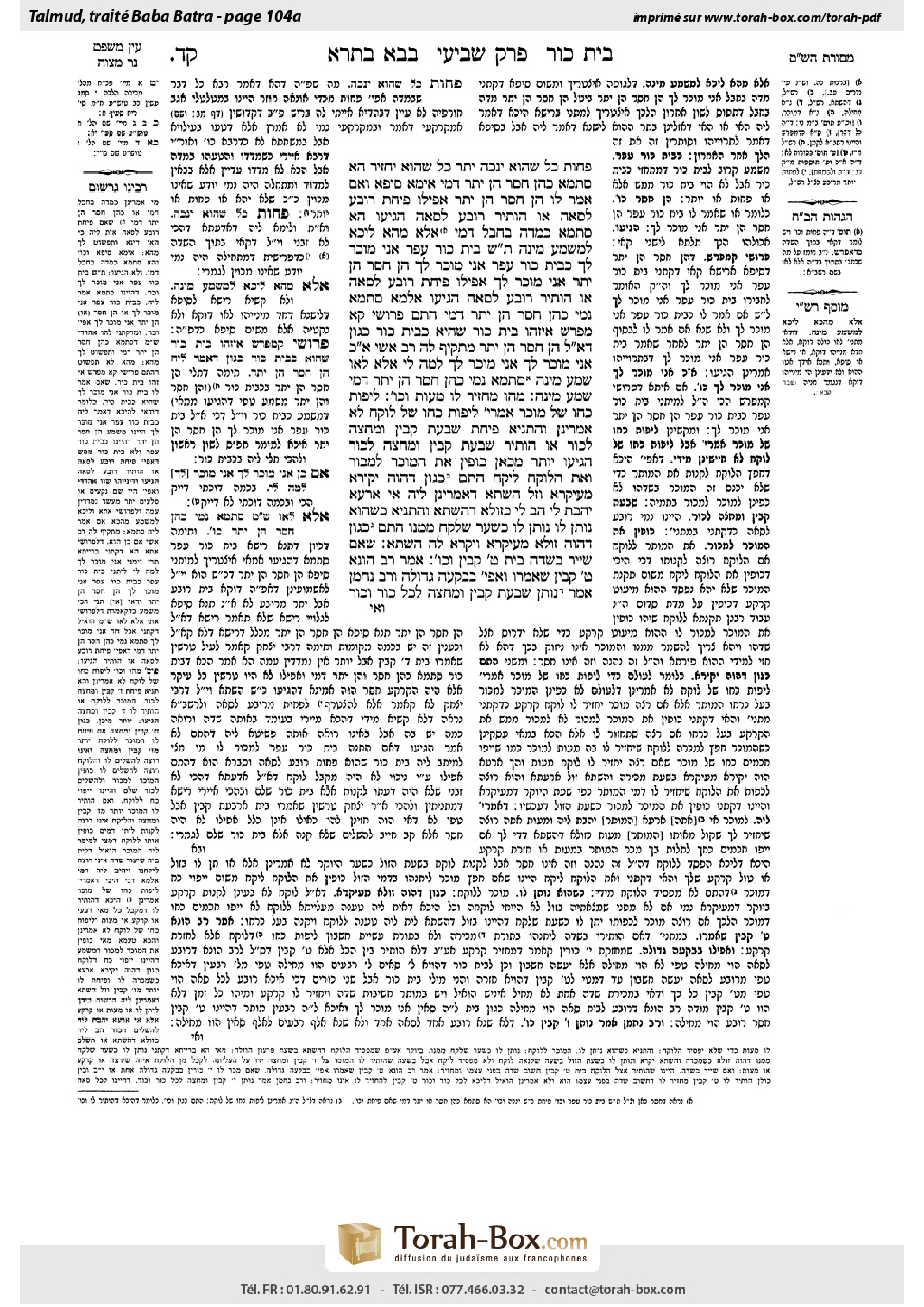
Bava Batra 104a: Talmud study for Daf Yomi
Study the Talmud for Daf Yomi with scanned pages, Hebrew text, English translations from Sefaria and AI-generated French translations.
Passage selection and English or AI-generated French translation are available where the scan has annotations. Daf Study is independent of Torah-Box and Sefaria.
Browse Bava Batra · בבא בתרא · All tractatesBava Batra 104a text and translations
This page of Bava Batra includes the Aramaic text, an English translation and an AI-generated French translation, alongside the scan above.
בבא בתרא ק״ד א · Aramaic and Hebrew text
פָּחוֹת כׇּל שֶׁהוּא – יְנַכֶּה, יָתֵר כׇּל שֶׁהוּא – יַחֲזִיר. הָא סְתָמָא – כְּ״הֵן חָסֵר הֵן יָתֵר״ דָּמֵי!
אֵימָא סֵיפָא – וְאִם אָמַר לוֹ: ״הֵן חָסֵר הֵן יָתֵר״; אֲפִילּוּ פִּיחֵת רוֹבַע לִסְאָה אוֹ הוֹתִיר רוֹבַע לִסְאָה – הִגִּיעוֹ. הָא סְתָמָא – כְּמִדָּה בְּחֶבֶל דָּמֵי! אֶלָּא מֵהָא לֵיכָּא לְמִשְׁמַע מִינַּהּ.
תָּא שְׁמַע: ״בֵּית כּוֹר עָפָר אֲנִי מוֹכֵר לָךְ״; ״כְּבֵית כּוֹר עָפָר אֲנִי מוֹכֵר לָךְ״; ״הֵן חָסֵר הֵן יָתֵר אֲנִי מוֹכֵר לָךְ״ – אֲפִילּוּ פִּיחֵת רוֹבַע לִסְאָה, אוֹ הוֹתִיר רוֹבַע לִסְאָה – הִגִּיעוֹ. אַלְמָא סְתָמָא נָמֵי, כְּ״הֵן חָסֵר הֵן יָתֵר״ דָּמֵי! הָתָם, פָּרוֹשֵׁי קָא מְפָרֵשׁ – אֵיזֶהוּ בֵּית כּוֹר שֶׁהִיא כְּבֵית כּוֹר? כְּגוֹן דַּאֲמַר לֵיהּ: ״הֵן חָסֵר הֵן יָתֵר״.
מַתְקֵיף לַהּ רַב אָשֵׁי: אִם כֵּן, ״אֲנִי מוֹכֵר לָךְ״ ״אֲנִי מוֹכֵר לָךְ״ לְמָה לִי? אֶלָּא לָאו שְׁמַע מִינַּהּ סְתָמָא נָמֵי כְּ״הֵן חָסֵר הֵן יָתֵר״ דָּמֵי? שְׁמַע מִינַּהּ.
מַהוּ מַחֲזִיר לוֹ? מָעוֹת וְכוּ׳. לְיַפּוֹת כֹּחוֹ שֶׁל מוֹכֵר אָמְרִינַן, לְיַפּוֹת כֹּחוֹ שֶׁל לוֹקֵחַ לָא אָמְרִינַן?!
וְהָתַנְיָא: פִּיחֵת שִׁבְעַת קַבִּין וּמֶחֱצָה לְכוֹר, אוֹ הוֹתִיר שִׁבְעַת קַבִּין וּמֶחֱצָה לְכוֹר – הִגִּיעוֹ. יוֹתֵר מִכָּאן – כּוֹפִין אֶת הַמּוֹכֵר לִמְכּוֹר וְאֶת הַלּוֹקֵחַ לִיקַּח.
הָתָם, כְּגוֹן דַּהֲוָה יַקִּירָא מֵעִיקָּרָא, וְזָל הַשְׁתָּא; דְּאָמְרִינַן לֵיהּ: אִי אַרְעָא יָהֲבַתְּ לִי – הַב לִי כְּזוּלָא דְּהַשְׁתָּא.
וְהָתַנְיָא: כְּשֶׁהוּא נוֹתֵן לוֹ – נוֹתֵן לוֹ כְּשַׁעַר שֶׁלָּקַח מִמֶּנּוּ! הָתָם, כְּגוֹן דַּהֲוָה זוּלָא מֵעִיקָּרָא, וְיָקְרָא לַהּ הַשְׁתָּא.
שֶׁאִם שִׁיֵּיר בַּשָּׂדֶה בֵּית תִּשְׁעָה קַבִּין וְכוּ׳. אָמַר רַב הוּנָא: תִּשְׁעָה קַבִּין שֶׁאָמְרוּ, וַאֲפִילּוּ בְּבִקְעָה גְּדוֹלָה.
וְרַב נַחְמָן אָמַר: נוֹתֵן שִׁבְעַת קַבִּין וּמֶחֱצָה לְכׇל כּוֹר וָכוֹר.
Bava Batra 104a · English translation
and he gave him even the slightest amount less that what was stipulated, the seller must deduct the difference from the purchase price of the field and return money to the buyer. If he gave him even the slightest amount more than what was stipulated, the buyer must return the difference to the seller. The reason that even the slightest difference in value must be returned is that the seller specified that he was selling land measured precisely with a rope. But had he sold the land without further specification, it would be like he sold it saying that it is a beit kor more or less.
The Gemara rejects this argument by proposing another, completely opposite proof: Say the latter clause of the mishna: And if the seller said to the buyer that he is selling him a beit kor of land more or less, then even if he gave him one-quarter of a kav per se’a less than what was stipulated, or he gave him one-quarter of a kav per se’a more than what was stipulated, it is his and the sale is valid. One can infer: The reason that the sale is valid is that he specified that he was selling a beit kor of land more or less. But had he sold the land without further specification, it would be like he sold it saying that he was selling the land measured precisely with a rope. Rather, since the mishna can be interpreted in two opposite ways, no inference is to be learned from the mishna.
The Gemara tries to present another proof: Come and hear a proof from a baraita: If the seller said to the buyer: I am selling you a plot of earth the size of a beit kor; or he said to him: I am selling you a plot of earth about the size of a beit kor; or he said to him: I am selling you a beit kor more or less; then even if he gave him one-quarter of a kav per se’a less than what was stipulated, or he gave him one-quarter of a kav per se’a more than what was stipulated, it is his and the sale is valid. One can infer: Apparently, selling a beit kor of land without further specification is also like selling it more or less. The Gemara rejects this proof: There, the tanna is explaining his statement, which should be understood as follows: When is the phrase a beit kor treated like the phrase about the size of a beit kor? In a case where the seller says to the buyer: I am selling you a beit kor more or less.
Rav Ashi objects to this: If that is so, then why do I need to repeat the words: I am selling you, three times? The fact that the baraita repeats these words in each clause indicates that it is discussing three separate sale transactions, and not that the three clauses are all referring to one case. Rather, isn’t it correct to conclude from the baraita that selling a beit kor of land without further specification is like selling it more or less? The Gemara affirms: Conclude from the baraita that this is so.
§ With regard to a buyer who received too much land and now must compensate the seller, the mishna teaches: What does he return to him? He pays him money, and if the seller so wishes, the buyer returns the surplus land to him, because the Sages said that the buyer pays money in order to enhance the power of the seller. In other words, the Sages allowed the seller to choose whether to take back the surplus land or to demand payment for it from the buyer, even though this effectively forces the buyer to purchase the surplus land from him. The Gemara asks: Is it correct that we say that the seller’s power should be enhanced, and that we do not say that the buyer’s power should be enhanced?
But isn’t it taught otherwise in a baraita: If the seller gave the buyer seven and a half kav per kor less than what was stipulated, which is the equivalent of a quarter-kav per se’a, as a kor is equal to thirty se’a, or he gave him seven and a half kav per kor more than what was stipulated, it is his and the sale is valid. If the difference is greater than that amount, the court compels the seller to sell and the buyer to buy the difference. This indicates that we also say that the buyer’s power should be enhanced, since if the buyer so wishes, the seller is compelled to sell him land and accept payment for it.
The Gemara replies: There, the baraita is not discussing a case where the buyer wishes to acquire the surplus land, but rather with a case where the land was initially, at the time of the sale, expensive, but now it is cheap, and the seller wants the buyer to pay him for the surplus land according to the initial higher rate. In this case, we say to the seller, in the name of the buyer: If you wish to give me land and receive money, give me the land according to the current, cheaper rate. This is what the baraita is referring to when it states that the seller is compelled to sell.
The Gemara raises a difficulty: But isn’t it taught in a baraita: When he gives him money in payment for the surplus land, he gives it to him according to the rate at which he had bought the rest of the land from him? The Gemara replies: There the baraita is referring to a case where the land was initially cheap but now it is expensive. If, in such a case, the seller wants the buyer to pay him for the surplus land, he is compelled to sell it to him according to the cheap rate from the time of the original sale.
§ The mishna teaches: As, if the surplus in the field was an area required for the sowing of nine kav of seed, and in a garden an area required for the sowing of a half-kav of seed, or, according to the Rabbi Akiva, an area required for the sowing of a quarter-kav of seed, the buyer can return the surplus land to the seller, and the seller cannot demand payment in money. Rav Huna says: The halakha that was stated in the mishna, that a surplus in the size of an area required for the sowing of nine kav of seed can be returned to the seller, applies even in a large valley which measures several kor. If the surplus is a significant plot of land equal in size to an area required for the sowing of nine kav of seed, the buyer can return it to the seller, even if it is less than one-quarter of a kav per se’a, i.e., less than one twenty-fourth the size of the field that was sold.
And Rav Naḥman says: He calculates seven and a half kav for each and every kor, which is equivalent to one-quarter of a kav per se’a. As long as the surplus does not exceed that ratio, he is not required to return it, even if the surplus is greater than the area required for the sowing of nine kav.
Bava Batra 104a · Traduction française (IA)
Et s'il lui a donné même une quantité minimale inférieure à ce qui était stipulé, le vendeur doit déduire la différence du prix d'achat du champ et rembourser l'argent à l'acheteur. Si s'il lui a donné même une quantité minimale supérieure à ce qui était stipulé, l'acheteur doit rembourser la différence au vendeur. La raison pour laquelle même une différence minimale de valeur doit être remise est que le vendeur a spécifié qu'il vendait un terrain mesuré précisément avec une corde. Mais s'il avait vendu le terrain sans précision supplémentaire, cela aurait été comme s'il avait dit qu'il vendait un terrain mesuré avec une corde.
La Guemara rejette cet argument en proposant un autre, tout aussi opposé : Disons la dernière clause de la Michna : Et si le vendeur a dit à l'acheteur qu'il lui vend un beit kor de terre plus ou moins, alors même s'il lui a donné un quart de kav par se'a moins que ce qui était stipulé, ou s'il lui a donné un quart de kav par se'a plus que ce qui était stipulé, c'est à lui et la vente est valide. On peut en déduire : La raison pour laquelle la vente est valide est qu'il a spécifié qu'il vendait un beit kor de terre plus ou moins. Mais s'il avait vendu le terrain sans précision supplémentaire, cela aurait été comme s'il avait dit qu'il vendait un terrain mesuré précisément avec une corde. En revanche, puisque la Michna peut être interprétée de deux manières opposées, aucune déduction ne peut être tirée de la Michna.
La Guemara tente de présenter une autre preuve : Viens écouter une preuve tirée d'une baraïta : Si le vendeur a dit à l'acheteur : Je te vends un terrain de la taille d'un beit kor ; ou s'il a dit : Je te vends un terrain d'environ la taille d'un beit kor ; ou s'il a dit : Je te vends un beit kor plus ou moins ; alors même s'il lui a donné un quart de kav par se'a moins que ce qui était stipulé, ou s'il lui a donné un quart de kav par se'a plus que ce qui était stipulé, c'est à lui et la vente est valide. On peut en déduire : Apparemment, vendre un beit kor de terre sans précision supplémentaire est aussi comme vendre plus ou moins. La Guemara rejette cette preuve : Là, le tanna explique sa déclaration, ce qui devrait être compris ainsi : Dans quel cas la phrase « un beit kor » est-elle traitée comme la phrase « environ la taille d'un beit kor » ? Dans un cas où le vendeur dit à l'acheteur : Je te vends un beit kor plus ou moins.
Rav Ashi s'oppose à cela : Si c'est ainsi, pourquoi ai-je besoin de répéter les mots « je te vends » trois fois ? Le fait que la baraïta répète ces mots dans chaque clause indique qu'il s'agit de trois transactions de vente différentes, et non pas que les trois clauses se réfèrent à un seul cas. En revanche, n'est-ce pas correct de conclure de la baraïta que vendre un beit kor de terre sans précision supplémentaire est comme vendre plus ou moins ? La Guemara confirme : Conclure de la baraïta que c'est ainsi.
§ En ce qui concerne un acheteur qui a reçu trop de terre et doit maintenant compenser le vendeur, la Michna enseigne : Qu'est-ce qu'il doit lui rendre ? Il paie de l'argent, et si le vendeur le souhaite, l'acheteur lui rend le surplus de terre, car les Sages ont dit que l'acheteur paie de l'argent afin d'augmenter le pouvoir du vendeur. En d'autres termes, les Sages ont permis au vendeur de choisir s'il veut récupérer le surplus de terre ou demander un paiement pour cela, même si cela force effectivement l'acheteur à acheter le surplus de terre. La Guemara pose une question : Est-ce correct que nous disions que le pouvoir du vendeur doit être renforcé, et que nous ne disions pas que le pouvoir de l'acheteur doit être renforcé ?
Mais n'est-ce pas enseigné autrement dans une baraïta : Si le vendeur a donné à l'acheteur sept et demi kav par kor moins que ce qui était stipulé, ce qui équivaut à un quart de kav par se'a, comme un kor est égal à trente se'a, ou s'il lui a donné sept et demi kav par kor plus que ce qui était stipulé, c'est à lui et la vente est valide. Si la différence est supérieure à cette quantité, la cour force le vendeur à vendre et l'acheteur à acheter la différence. Cela indique que nous disons aussi que le pouvoir de l'acheteur doit être renforcé, car si l'acheteur le souhaite, le vendeur est contraint de lui vendre la terre et d'accepter le paiement.
La Guemara répond : Là, la baraïta ne discute pas d'un cas où l'acheteur souhaite acquérir le surplus de terre, mais plutôt d'un cas où la terre était initialement chère, mais est maintenant peu chère, et le vendeur veut que l'acheteur paie pour le surplus de terre selon le taux initial plus élevé. Dans ce cas, nous disons au vendeur, au nom de l'acheteur : Si tu veux me donner la terre et recevoir de l'argent, donne-moi la terre selon le taux actuel, moins cher. C'est ce à quoi la baraïta fait référence lorsqu'elle dit que le vendeur est contraint à vendre.
La Guemara soulève une difficulté : Mais n'est-ce pas enseigné dans une baraïta : Lorsqu'il lui donne de l'argent en paiement pour le surplus de terre, il le donne selon le taux auquel il a acheté le reste de la terre ? La Guemara répond : Là, la baraïta fait référence à un cas où la terre était initialement peu chère mais est maintenant chère. Si, dans un tel cas, le vendeur veut que l'acheteur paie pour le surplus de terre, il est contraint à le vendre selon le taux bas de l'époque de la vente initiale.
§ La Michna enseigne : Par exemple, si le surplus du champ était une surface nécessaire pour semer neuf kav de grain, et dans un jardin une surface nécessaire pour semer demi-kav de grain, ou selon Rabbi Akiva, une surface nécessaire pour semer un quart de kav de grain, l'acheteur peut rendre le surplus de terre au vendeur, et le vendeur ne peut pas demander un paiement en argent. Rav Huna dit : La halakha énoncée dans la Michna, selon laquelle un surplus de taille équivalant à une surface nécessaire pour semer neuf kav de grain peut être rendu au vendeur, s'applique même dans une vallée grande mesurant plusieurs kor. Si le surplus est une parcelle importante de terre équivalant à une surface nécessaire pour semer neuf kav de grain, l'acheteur peut le rendre au vendeur, même s'il est inférieur à un quart de kav par se'a, c'est-à-dire inférieur à un vingt-quatrième de la taille du champ vendu.
Et Rav Naḥman dit : Il calcule sept et demi kav pour chaque kor, ce qui équivaut à un quart de kav par se’a. Aussi longtemps que le surplus ne dépasse pas ce rapport, il n'est pas tenu de le rendre, même si le surplus est supérieur à la quantité nécessaire pour semer neuf kav.
Traduction française générée par IA à partir de l’édition anglaise de Sefaria. Vérifie toujours un passage avec le texte source.
Text from Sefaria: William Davidson Edition - Vocalized Aramaic (CC BY NC); William Davidson Edition - English (CC BY NC).