Bava Batra 104b: Talmud study for Daf Yomi
Study the Talmud for Daf Yomi with scanned pages, Hebrew text, English translations from Sefaria and AI-generated French translations.
Passage selection and English or AI-generated French translation are available where the scan has annotations. Daf Study is independent of Torah-Box and Sefaria.
Browse Bava Batra · בבא בתרא · All tractatesBava Batra 104b text and translations
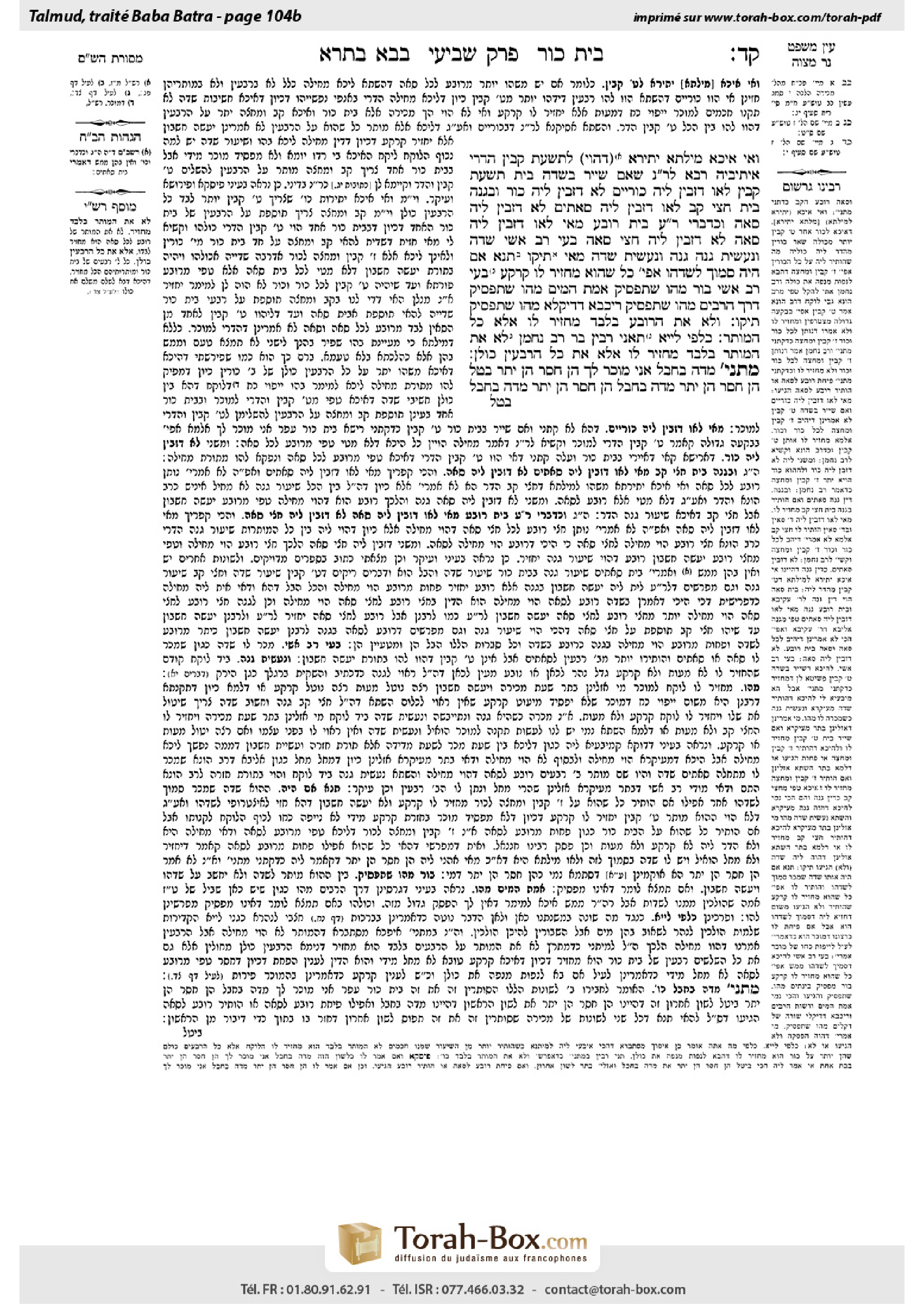
This page of Bava Batra includes the Aramaic text, an English translation and an AI-generated French translation, alongside the scan above.
בבא בתרא ק״ד ב · Aramaic and Hebrew text
וְאִי אִיכָּא מִילְּתָא יַתִּירָא, דְּהָוֵי לְתִשְׁעַת קַבִּין – הָדְרִי.
אֵיתִיבֵיהּ רָבָא לְרַב נַחְמָן: ״שֶׁאִם שִׁיֵּיר בַּשָּׂדֶה בֵּית תִּשְׁעַת קַבִּין״ – לָאו דְּזַבֵּין לֵיהּ כּוֹרַיִים? לָא, דְּזַבֵּין לֵיהּ כּוֹר.
״וּבַגִּנָּה בֵּית חֲצִי קַב״ – לָאו דְּזַבֵּין לֵיהּ סָאתַיִם? לָא, דְּזַבֵּין לֵיהּ סְאָה.
״וּכְדִבְרֵי רַבִּי עֲקִיבָא, בֵּית רוֹבַע״ – מַאי, לָאו דְּזַבֵּין לֵיהּ סְאָה? לָא, דְּזַבֵּין לֵיהּ חֲצִי סְאָה.
בָּעֵי רַב אָשֵׁי: שָׂדֶה – וְנַעֲשֵׂית גִּנָּה; גִּנָּה – וְנַעֲשֵׂיתָ שָׂדֶה, מַאי? תֵּיקוּ.
תָּנָא: אִם הָיָה סָמוּךְ לְשָׂדֵהוּ – אֲפִילּוּ כָּל שֶׁהוּא, מַחֲזִיר לוֹ קַרְקַע.
בָּעֵי רַב אָשֵׁי: בּוֹר, מַהוּ שֶׁתַּפְסִיק? אַמַּת הַמַּיִם, מַהוּ שֶׁתַּפְסִיק? דֶּרֶךְ הָרַבִּים, מַהוּ שֶׁתַּפְסִיק? רִיכְבָּא דְּדִיקְלָא, מַהוּ שֶׁתַּפְסִיק? תֵּיקוּ.
וְלֹא אֶת הָרוֹבַע בִּלְבַד מַחֲזִיר לוֹ, אֶלָּא כָּל הַמּוֹתָר. כְּלַפֵּי לְיָיא? תָּאנֵי רָבִין בַּר רַב נַחְמָן: לֹא אֶת הַמּוֹתָר בִּלְבַד מַחֲזִיר לוֹ, אֶלָּא אֶת כָּל הָרְבָעִין כּוּלָּן.
מַתְנִי׳ ״מִדָּה בְּחֶבֶל אֲנִי מוֹכֵר לָךְ, הֵן חָסֵר הֵן יָתֵר״ – בִּטֵּל ״הֵן חָסֵר הֵן יָתֵר״ ״מִדָּה בְּחֶבֶל״. ״הֵן חָסֵר הֵן יָתֵר, מִדָּה בְּחֶבֶל״ –
Bava Batra 104b · English translation
And if after this calculation there is still a surplus in excess of a quarter-kav per se’a, equal in size to an area required for the sowing of nine kav of seed, the entire surplus must be returned.
Rava raised an objection to Rav Naḥman: The mishna teaches that if the surplus in the field was an area required for the sowing of nine kav of seed, the buyer returns the land to the seller. Isn’t this the halakha even in a case where he sold him a field measuring two kor? This would seem to indicate that even if the surplus does not exceed a quarter-kav per se’a, as a quarter-kav per se’a in a field of two kor is fifteen kav, the sole determining factor is whether or not the surplus is equal in size to an area required for the sowing of nine kav. Rav Naḥman rejects this argument: No, the case in the mishna is specifically where he sold him a field measuring one kor.
Rava raised a further objection to Rav Naḥman: We learned in the continuation of the mishna that if the surplus in a garden was an area required for the sowing of a half-kav of seed, the buyer returns the land to the seller. Isn’t this the halakha even in a case where he sold him a garden measuring two se’a? Once again, this would seem to indicate that the surplus is returned to the seller, provided that it is equal in size to the minimum measure of a garden, even if the surplus does not exceed one-half of a kav per two se’a, which is equivalent to one-quarter of a kav per se’a. Rav Naḥman rejects this argument as well: No, the case in the mishna is where he sold him a garden measuring a se’a, so that the surplus is proportionately twice as large.
Rava raised yet another objection to Rav Naḥman from the next clause in the mishna, which states: Or, according to the statement of Rabbi Akiva, if the surplus in the garden was an area required for sowing a quarter-kav of seed, the buyer returns the land to the seller. What, isn’t this the halakha even in a case where he sold him a garden measuring a se’a? In that case, the surplus does not exceed one-quarter of a kav per se’a, and nevertheless the surplus is returned to the seller, provided that it is equal in size to the minimum measure of a garden. Rav Naḥman also rejects this argument: No, the case in the mishna is where he sold him a garden measuring a half-se’a, so that the surplus is proportionately twice as large.
The mishna teaches that in the case of a field, the buyer can return the land itself if the surplus was an area required for the sowing of nine kav of seed, and in the case of a garden, if the surplus was an area required for the sowing of a half-kav of seed. Rav Ashi raises a dilemma: If one sold a field and it turned out that the plot was larger than had been stipulated, but before the buyer returned the surplus, the plot was turned into a garden, or if it was initially a garden and it was turned into a field (see 11a), what is the halakha? Is the surplus governed by the halakhot applying to a field or by those applying to a garden? The Gemara answers: The dilemma shall stand unresolved, as no answer has been found.
A Sage taught in a baraita: If the field being sold was adjacent to another field belonging to the seller, then even if the surplus was of a minimal amount, the buyer can return the land itself to the seller, and the seller cannot demand payment in money. This is because the seller loses nothing when he receives a small tract of land, as he can cultivate it along with his adjoining field.
Rav Ashi raises a set of dilemmas: With regard to a pit between the surplus in the sold field and the adjoining field belonging to the seller, what is the halakha: Should the pit be considered an interposition between the two fields? With regard to a water channel between the two fields, what is the halakha: Should the water channel be considered an interposition? With regard to the public thoroughfare, what is the halakha: Should the public thoroughfare be considered an interposition? With regard to a row of palm trees, what is the halakha: Should a row of palm trees be considered an interposition? The Gemara states: All these dilemmas shall stand unresolved.
§ The mishna teaches that if the surplus is greater than a quarter-kav per se’a, it is not only the quarter-kav that the buyer returns; rather, he returns all of the surplus. Since he is already required to make a refund, the refund must be made in the precise amount. The Gemara raises a question: Isn’t it the opposite [kelappei layya]? The buyer is required to return the surplus even when the quarters of a kav remain in his possession. Ravin bar Rav Naḥman taught the mishna as follows: Not only must the buyer return the extra land that is beyond the limit of a quarter-kav area per beit se’a, but he must also return to him every one of the extra quarter-kav areas of land that he received beyond the stated area of a beit kor. When he is required to return the surplus, he returns not only the surplus, but also all the quarter-kav areas over and above what had originally been stipulated to be included in the sale.
MISHNA: If the seller says to the buyer: I am selling you a plot of land of a certain size measured precisely with a rope more or less, thereby attaching to the sale two contradictory stipulations; in this case, the words: More or less, nullify the words: Measured precisely with a rope. Accordingly, if the surplus did not exceed a quarter-kav per se’a, the sale is valid as is. Similarly, if the seller says to the buyer: I am selling you a plot of land of a certain size more or less measured precisely with a rope,
Bava Batra 104b · Traduction française (IA)
Et si, après ce calcul, il reste encore un surplus supérieur à un quart de kav par se’a, équivalent à une surface nécessaire pour semer neuf kav de grain, le surplus entier doit être rendu.
Rava a soulevé un objet contre Rav Naḥman : La mitsna enseigne que si le surplus dans le champ était une surface nécessaire pour semer neuf kav de grain, l'acheteur rend le terrain au vendeur. N'est-ce pas cette halakha même dans le cas où il lui a vendu un champ mesurant deux kor ? Cela semble indiquer que même si le surplus ne dépasse pas un quart de kav par se’a, comme un quart de kav par se’a dans un champ de deux kor est quinze kav, le seul facteur déterminant est si le surplus est équivalent à une surface nécessaire pour semer neuf kav. Rav Naḥman rejette cet argument : Non, le cas de la mitsna est spécifiquement celui où il lui a vendu un champ mesurant un kor.
Rava a soulevé une autre objection contre Rav Naḥman : Nous avons appris dans la continuation de la mitsna que si le surplus dans un jardin était une surface nécessaire pour semer demi-kav de grain, l'acheteur rend le terrain au vendeur. N'est-ce pas cette halakha même dans le cas où il lui a vendu un jardin mesurant deux se’a ? Une fois encore, cela semble indiquer que le surplus est rendu au vendeur, à condition qu'il soit équivalent à la mesure minimale d'un jardin, même si le surplus ne dépasse pas demi-kav par deux se’a, ce qui équivaut à un quart de kav par se’a. Rav Naḥman rejette cet argument également : Non, le cas de la mitsna est celui où il lui a vendu un jardin mesurant un se’a, de sorte que le surplus est proportionnellement deux fois plus grand.
Rava a soulevé une autre objection contre Rav Naḥman à partir de la clause suivante de la Michna, qui stipule : Ou, selon la déclaration de Rabbi Akiva, si le surplus dans le jardin était une surface nécessaire pour semer un quart de kav de grain, l'acheteur rend le terrain au vendeur. Qu'est-ce que cela ne serait pas cette halakha même dans le cas où il lui a vendu un jardin mesurant un se’a ? Dans ce cas, le surplus ne dépasse pas un quart de kav par se’a, et pourtant le surplus est rendu au vendeur, à condition qu'il soit équivalent à la mesure minimale d'un jardin. Rav Naḥman rejette également cet argument : Non, le cas de la Michna est celui où il lui a vendu un jardin mesurant un demi-se’a, de sorte que le surplus est proportionnellement deux fois plus grand.
La Michna enseigne que dans le cas d'un champ, l'acheteur peut rendre le terrain lui-même si le surplus était une surface nécessaire pour semer neuf kav de grain, et dans le cas d'un jardin, si le surplus était une surface nécessaire pour semer demi-kav de grain. Rav Ashi soulève un dilemme : Si l'on a vendu un champ et qu'il s'est avéré que la parcelle était plus grande que stipulé, mais avant que l'acheteur ne rendît le surplus, la parcelle est devenue un jardin, ou si elle était initialement un jardin et qu'elle est devenue un champ (voir 11a), quelle est la halakha ? Le surplus est-il régulé par les halakhot applicables à un champ ou par celles applicables à un jardin ? La Guemara répond : Ce dilemme restera sans réponse, car aucune réponse n'a été trouvée.
Un Sage a enseigné dans une baraïta : Si le champ vendu était adjacent à un autre champ appartenant au vendeur, alors même si le surplus était une quantité minimale, l'acheteur peut rendre le terrain lui-même au vendeur, et le vendeur ne peut pas exiger un paiement en argent. Cela est dû au fait que le vendeur ne perd rien en recevant une petite parcelle de terrain, car il peut l'exploiter avec son champ adjacent.
Rav Ashi soulève plusieurs dilemmes : Concernant un puits entre le surplus du champ vendu et le champ adjacent appartenant au vendeur, quelle est la halakha : Doit-on considérer le puits comme une interposition entre les deux champs ? Concernant un canal d'eau entre les deux champs, quelle est la halakha : Doit-on considérer le canal d'eau comme une interposition ? Concernant la voie publique, quelle est la halakha : Doit-on considérer la voie publique comme une interposition ? Concernant une rangée de palmiers, quelle est la halakha : Doit-on considérer une rangée de palmiers comme une interposition ? La Guemara indique : Tous ces dilemmes resteront sans réponse.
§ La mitsva enseigne que si le surplus est supérieur à un quart de kav par se’a, il n'est pas seulement le quart de kav que l'acheteur doit rendre ; il doit rendre tout le surplus. Puisque l'acheteur est déjà tenu de faire un remboursement, le remboursement doit être effectué dans la quantité exacte. La Guemara soulève une question : N'est-ce pas l'inverse [kelappei layya] ? L'acheteur est tenu de rendre le surplus même lorsque les quarts de kav restent en son possession. Ravin bar Rav Naḥman a enseigné la mitsva comme suit : Non seulement l'acheteur doit rendre la parcelle supplémentaire qui dépasse la limite d'un quart de kav par beit se’a, mais il doit aussi rendre à l'acheteur chaque quart de kav de terrain qu'il a reçu au-delà de la surface stipulée. Lorsqu'il est tenu de rendre le surplus, il rend non seulement le surplus, mais aussi toutes les surfaces de quart de kav au-delà de ce qui avait été initialement stipulé dans la vente.
MICHNA : Si le vendeur dit à l'acheteur : Je te vends un terrain d'une certaine taille mesuré précisément avec une corde, plus ou moins, en attachant ainsi à la vente deux stipulations contradictoires ; dans ce cas, les mots : Plus ou moins, annulent les mots : Mesuré précisément avec une corde. Ainsi, si le surplus n'a pas dépassé un quart de kav par se’a, la vente est valide telle quelle. De même, si le vendeur dit à l'acheteur : Je te vends un terrain d'une certaine taille plus ou moins mesuré précisément avec une corde,
Traduction française générée par IA à partir de l’édition anglaise de Sefaria. Vérifie toujours un passage avec le texte source.
Text from Sefaria: William Davidson Edition - Vocalized Aramaic (CC BY NC); William Davidson Edition - English (CC BY NC).