Bava Batra 105a: Talmud study for Daf Yomi
Study the Talmud for Daf Yomi with scanned pages, Hebrew text, English translations from Sefaria and AI-generated French translations.
Passage selection and English or AI-generated French translation are available where the scan has annotations. Daf Study is independent of Torah-Box and Sefaria.
Browse Bava Batra · בבא בתרא · All tractatesBava Batra 105a text and translations
This page of Bava Batra includes the Aramaic text, an English translation and an AI-generated French translation, alongside the scan above.
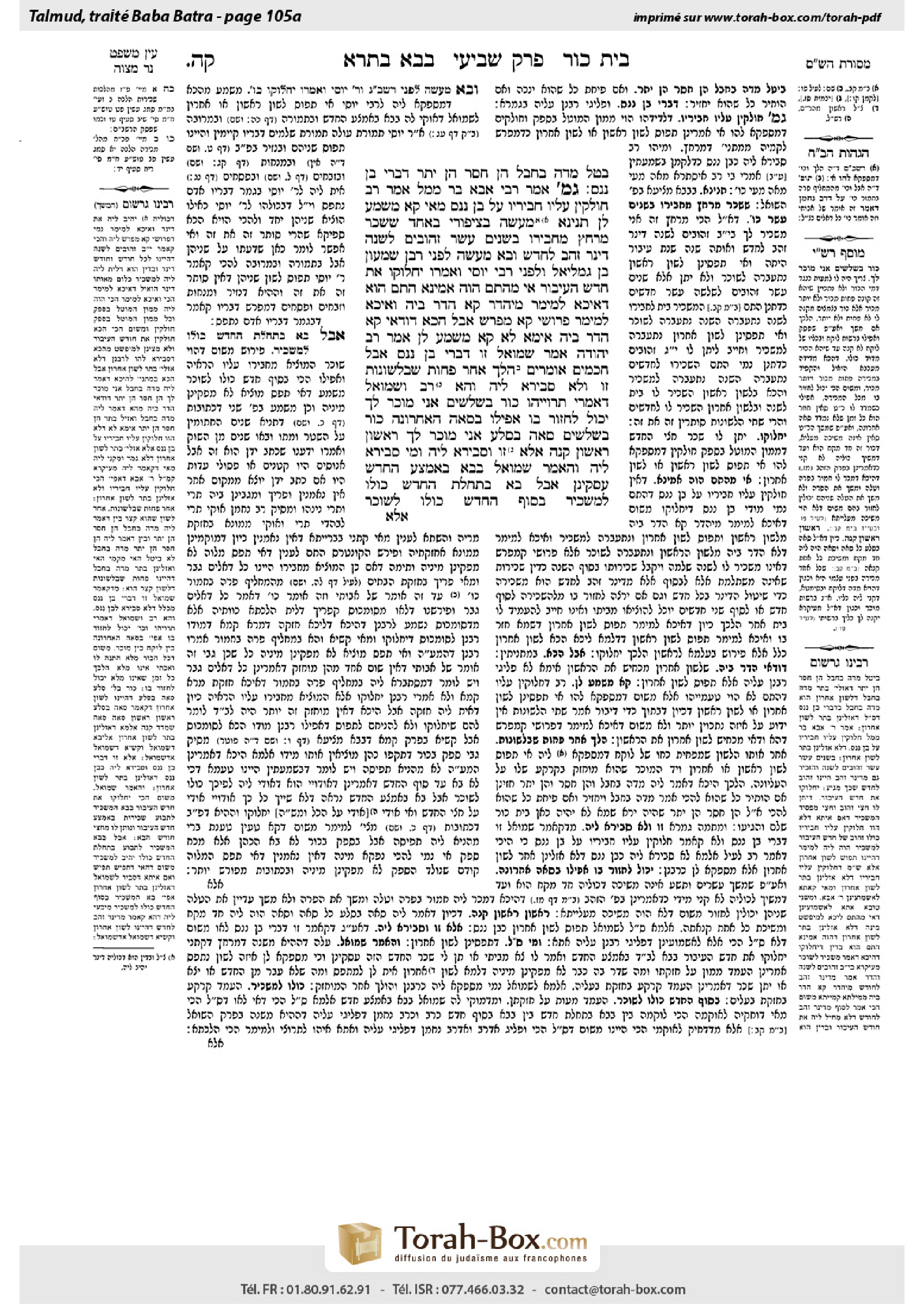
בבא בתרא ק״ה א · Aramaic and Hebrew text
בִּטֵּל ״מִדָּה בְּחֶבֶל״ ״הֵן חָסֵר הֵן יָתֵר״; דִּבְרֵי בֶּן נַנָּס.
גְּמָ׳ אָמַר רַבִּי אַבָּא בַּר מֶמֶל אָמַר רַב: חוֹלְקִין עָלָיו חֲבֵירָיו עַל בֶּן נַנָּס. מַאי קָא מַשְׁמַע לַן? תְּנֵינָא: מַעֲשֶׂה בְּצִיפּוֹרִי, בְּאֶחָד שֶׁשָּׂכַר מֶרְחָץ מֵחֲבֵירוֹ בִּשְׁנֵים עָשָׂר זְהוּבִים לְשָׁנָה – דִּינַר זָהָב לְחֹדֶשׁ;
וּבָא מַעֲשֶׂה לִפְנֵי רַבָּן שִׁמְעוֹן בֶּן גַּמְלִיאֵל וְלִפְנֵי רַבִּי יוֹסֵי, וְאָמְרוּ: יַחְלוֹקוּ אֶת חֹדֶשׁ הָעִיבּוּר!
אִי מֵהָתָם, הֲוָה אָמֵינָא: הָתָם הוּא דְּאִיכָּא לְמֵימַר מִיהְדָּר קָא הָדַר בֵּיהּ, וְאִיכָּא לְמֵימַר פָּרוֹשֵׁי קָא מְפָרֵשׁ. אֲבָל הָכָא, דְּוַדַּאי קָא הָדַר בֵּיהּ, אֵימָא לָא; קָא מַשְׁמַע לַן.
אָמַר רַב יְהוּדָה אָמַר שְׁמוּאֵל: זוֹ דִּבְרֵי בֶּן נַנָּס, אֲבָל חֲכָמִים אוֹמְרִים: הַלֵּךְ אַחַר פָּחוֹת שֶׁבַּלְּשׁוֹנוֹת.
״זוֹ״ – וְלָא סְבִירָא לֵיהּ?! וְהָא רַב וּשְׁמוּאֵל דְּאָמְרִי תַּרְוַיְיהוּ: ״כּוֹר בִּשְׁלֹשִׁים אֲנִי מוֹכֵר לָךְ״ – יָכוֹל לַחֲזוֹר בּוֹ אֲפִילּוּ בַּסְּאָה הָאַחֲרוֹנָה.
״כּוֹר בִּשְׁלֹשִׁים – סְאָה בְּסֶלַע אֲנִי מוֹכֵר לָךְ״ – רִאשׁוֹן רִאשׁוֹן קָנָה. אֶלָּא ״זוֹ״ – וּסְבִירָא לֵיהּ.
וּמִי סְבִירָא לֵיהּ?! וְהָאָמַר שְׁמוּאֵל: בְּבָא בָּאֶמְצַע הַחֹדֶשׁ עָסְקִינַן; אֲבָל בָּא בִּתְחִלַּת הַחֹדֶשׁ – כּוּלּוֹ לַמַּשְׂכִּיר. בְּסוֹף הַחֹדֶשׁ – כּוּלּוֹ לַשּׂוֹכֵר!
Bava Batra 105a · English translation
the words: Measured precisely with a rope, nullify the words: More or less, since the principle is that in all cases, one should attend to the final expression; this is the statement of ben Nanas.
GEMARA: Rabbi Abba bar Memel says that Rav says: Ben Nanas’s colleagues disagree with him with regard to his ruling that one should attend to the final expression. The Gemara asks: What new halakha is Rav teaching us? Don’t we already learn that they disagree from a mishna (Bava Metzia 102a): There was once an incident in Tzippori involving one who rented a bathhouse from another, and it was stated that the rental fee would be twelve gold dinars [zehuvim] a year, one gold dinar per month, and the year was later intercalated, an extra month being added.
The incident came before Rabban Shimon ben Gamliel and before Rabbi Yosei for a decision as to whether the intercalated month is included in the words: Twelve gold dinars a year, or whether an additional payment must be made for that month, as the agreement stipulated: One gold dinar per month. And they said: The landlord and the tenant should divide the intercalated month between them, and so the tenant should pay only half a gold dinar for it. This indicates that these Sages ruled that the meaning of an agreement containing two contradictory expressions is in doubt, and therefore the parties divide the disputed amount between them. From here it follows that they disagree with the opinion of ben Nanas, who says that in such a case one should attend to the final expression.
The Gemara replies: If the Sages’ opinion was derived only from there, I would not know that they disagree with the opinion of ben Nanas in all cases, as I would say that it is only there that the Sages say that the parties divide the disputed sum between them. As it is possible to say that the landlord retracted his first statement and set the rental fee at one gold dinar per month, but it is also possible to say that he is explaining his earlier statement. That is to say, he did not mean to relate to the intercalated month; rather, he was clarifying that payment was to be made not with a lump sum at the end of the year, but in monthly installments. Since there is uncertainty with regard to his intention, the parties divide the contested sum between them. But here in the mishna, where the seller certainly retracted his first statement, one might say that the Sages do not disagree with ben Nanas. Therefore, the mishna teaches us that in all cases the Sages disagree with ben Nanas.
Similar to what was cited above in the name of Rav, Rav Yehuda says that Shmuel says: This is the statement of ben Nanas, who says with regard to a case of contradictory expressions that one should attend to the final expression; but the Sages say: Follow the least inclusive expression, the one that is the least advantageous to the buyer, in keeping with the principle that in a case of uncertainty, the burden of proof rests upon the claimant.
The Gemara asks: Did Shmuel mean to say that this is the statement of ben Nanas, but he, Shmuel, does not agree with him? But don’t Rav and Shmuel both say: If the seller said to the buyer: I am selling you a kor of grain, an amount equivalent to thirty se’a, for the sum of thirty sela, he can renege on the entire sale even while measuring out the last se’a. Since the seller stipulated that he was selling a full kor of grain, as long as he has not yet measured out the full amount, he may still renege, as the sale is not yet complete.
But if the seller said to the buyer: I am selling you a kor of grain for thirty sela, each se’a for a sela, the buyer acquires each se’a one by one as it is being measured out to him. Since the seller specified the price per sela, he has indicated that he is ready to sell each sela on its own. This seems to indicate that Shmuel maintains that in a case of contradictory expressions, one should attend to the final expression. Rather, Shmuel’s formulation: This is the statement of ben Nanas, must be explained as follows: This is the statement of ben Nanas, and he, Shmuel, agrees with him that one should attend to the final expression.
The Gemara asks: And does Shmuel actually agree with him? But doesn’t Shmuel say: Concerning the ruling of the Sages that the landlord and the tenant should divide the intercalated month between them, we are dealing with a case where the landlord came to collect the rent in the middle of the month. Only in that case is the disputed rent divided between them. But in a case where he came to collect the rent at the beginning of the month, the entire sum goes to the landlord who is demanding payment, since he is in possession of the property. And if he came at the end of the month, the entire sum goes to the tenant who is refusing payment, since he is in possession of the money. This indicates that Shmuel maintains that in a case of contradictory expressions, one should not attend to the latter expression. Rather, the case is viewed as one of uncertainty, and the burden of proof rests upon the claimant.
Bava Batra 105a · Traduction française (IA)
les mots : Mesuré précisément avec une corde, annule les mots : Plus ou moins, car le principe est que dans tous les cas, on doit tenir compte de l'expression finale ; c'est la déclaration de Ben Nanas.
GUEMARA : Rabbi Abba bar Memel dit que Rav dit : Les collègues de Ben Nanas s'opposent à lui concernant sa décision selon laquelle on doit tenir compte de l'expression finale. La Guemara demande : Quelle nouvelle halakha Rav nous enseigne-t-il ? N'avons-nous pas déjà appris qu'ils s'opposent l'un à l'autre à partir d'une mitsva (Bava Metzia 102a) : Il y avait une fois un incident à Tzippori concernant un homme qui louait une salle de bain à un autre, et il était dit que le loyer serait de douze dinars d'or par an, un dina d'or par mois, et l'année fut ensuite intercalée, un mois supplémentaire étant ajouté.
L'incident fut porté devant Rabban Shimon ben Gamliel et devant Rabbi Yosei pour une décision sur le fait que le mois intercalé est inclus dans les mots : Douze dinars d'or par an, ou si un paiement supplémentaire doit être effectué pour ce mois, selon l'accord stipulé : Un dina d'or par mois. Et ils dirent : Le propriétaire et le locataire devraient partager le mois intercalé entre eux, de sorte que le locataire ne paierait qu'une moitié de dina d'or pour cela. Cela indique que ces Sages ont décidé que la signification d'un accord contenant deux expressions contradictoires est en doute, et par conséquent les parties partagent la somme contestée entre elles. De là, il suit que ces Sages s'opposent à l'opinion de Ben Nanas, qui dit que dans un tel cas, on doit tenir compte de l'expression finale.
La Guemara répond : Si l'opinion des Sages était dérivée uniquement d'ici, je ne saurais pas qu'ils s'opposent à l'opinion de Ben Nanas dans tous les cas, car je dirais que c'est seulement là qu'ils disent que les parties partagent la somme contestée entre elles. Il est possible de dire que le propriétaire a rétracté son premier énoncé et a fixé le loyer à un dina d'or par mois, mais il est aussi possible de dire qu'il explique son énoncé précédent. C'est-à-dire qu'il n'avait pas l'intention de concerner le mois intercalé ; plutôt, il clarifiait que le paiement devait être effectué non en une somme unique à la fin de l'année, mais en mensualités. Puisque l'intention est incertaine, les parties partagent la somme contestée entre elles. Mais ici, dans la Michna, où le vendeur a certainement rétracté son premier énoncé, on pourrait dire que les Sages ne s'opposent pas à l'opinion de Ben Nanas. Par conséquent, la Michna nous enseigne que dans tous les cas, les Sages s'opposent à l'opinion de Ben Nanas.
Similaire à ce qui a été cité ci-dessus au nom de Rav, Rav Yéhuda dit que Shmuel dit : C'est la déclaration de Ben Nanas, qui dit concernant un cas d'expressions contradictoires qu'on doit tenir compte de l'expression finale ; mais les Sages disent : Suivez l'expression la moins inclusive, celle qui est la moins avantageuse pour l'acheteur, conformément au principe que dans un cas d'incertitude, la charge de la preuve repose sur le plaignant.
La Guemara demande : Shmuel voulait-il dire que c'est la déclaration de Ben Nanas, mais lui, Shmuel, ne s'y conforme pas ? Mais n'ont pas Rav et Shmuel tous deux dit : Si le vendeur dit au acheteur : Je vends à toi un kor de blé, une quantité équivalente à trente se'a, pour la somme de trente sela, il peut révoquer la vente entière même pendant la mesure du dernier se'a. Puisque le vendeur a stipulé qu'il vendait un kor de blé complet, tant qu'il n'a pas encore mesuré la quantité totale, il peut encore révoquer la vente, car la vente n'est pas encore achevée.
Mais si le vendeur dit à l'acheteur : Je vends à toi un kor de blé pour trente sela, chaque se'a pour un sela, l'acheteur acquiert chaque se'a un par un pendant qu'il est mesuré à lui. Puisque le vendeur a spécifié le prix par sela, il a indiqué qu'il est prêt à vendre chaque sela individuellement. Cela semble indiquer que Shmuel maintient que dans un cas d'expressions contradictoires, on doit tenir compte de l'expression finale. Plutôt, la formulation de Shmuel : C'est la déclaration de Ben Nanas, doit être expliquée ainsi : C'est la déclaration de Ben Nanas, et lui, Shmuel, s'y conforme, qu'on doit tenir compte de l'expression finale.
La Guemara demande : Et Shmuel s'y conforme-t-il vraiment ? Mais n'a-t-il pas dit : Concernant la décision des Sages que le propriétaire et le locataire devraient partager le mois intercalé entre eux, nous sommes en présence d'un cas où le propriétaire est venu récupérer le loyer au milieu du mois. Seul dans ce cas la rente contestée est partagée entre eux. Mais dans un cas où il est venu récupérer le loyer au début du mois, toute la somme va au propriétaire qui exige le paiement, puisqu'il est en possession de la propriété. Et si il est venu à la fin du mois, toute la somme va au locataire qui refuse le paiement, puisqu'il est en possession de l'argent. Cela indique que Shmuel maintient que dans un cas d'expressions contradictoires, on ne doit pas tenir compte de l'expression ultérieure. Plutôt, le cas est vu comme un cas d'incertitude, et la charge de la preuve repose sur le plaignant.
Traduction française générée par IA à partir de l’édition anglaise de Sefaria. Vérifie toujours un passage avec le texte source.
Text from Sefaria: William Davidson Edition - Vocalized Aramaic (CC BY NC); William Davidson Edition - English (CC BY NC).