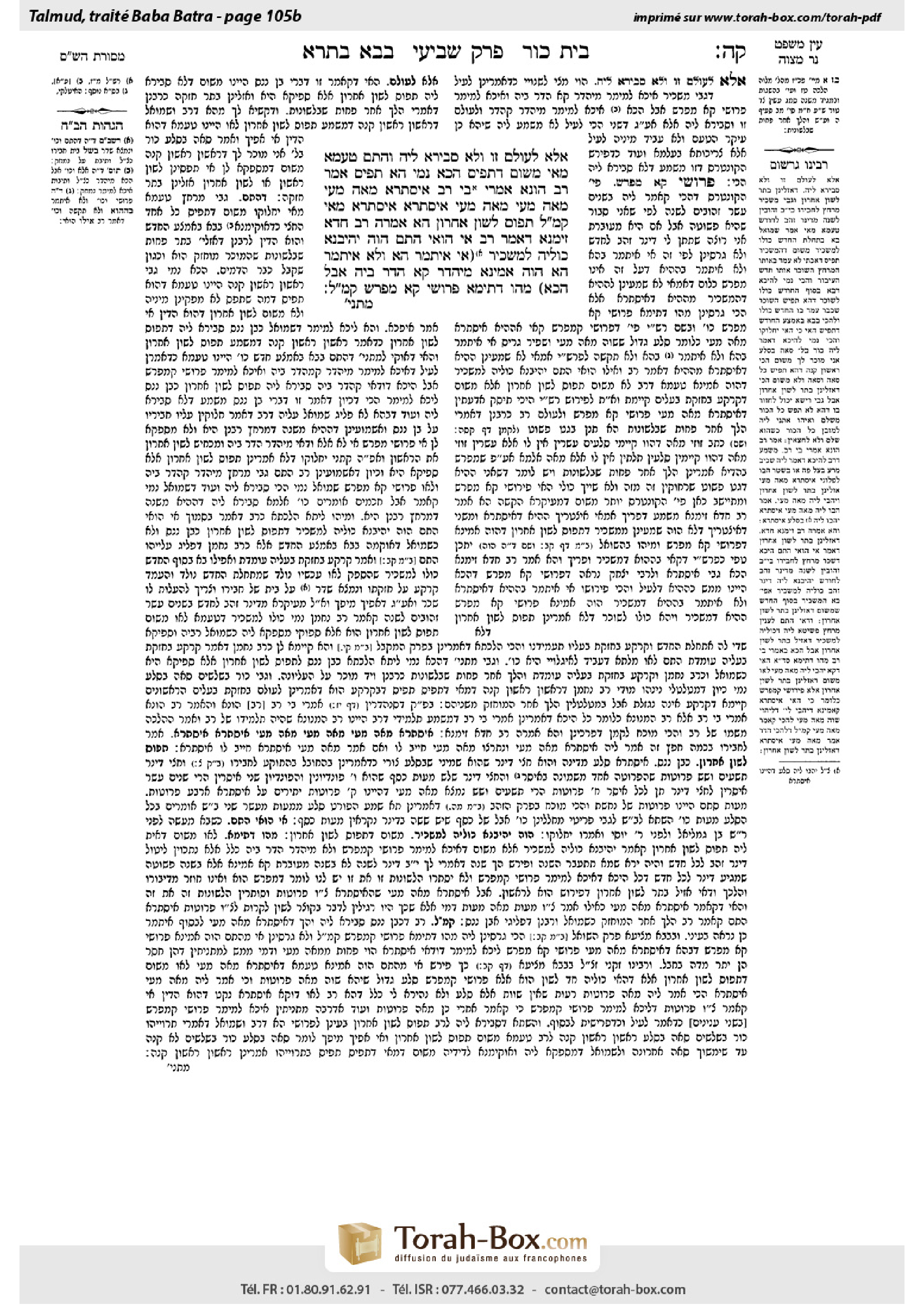
Bava Batra 105b: Talmud study for Daf Yomi
Study the Talmud for Daf Yomi with scanned pages, Hebrew text, English translations from Sefaria and AI-generated French translations.
Passage selection and English or AI-generated French translation are available where the scan has annotations. Daf Study is independent of Torah-Box and Sefaria.
Browse Bava Batra · בבא בתרא · All tractatesBava Batra 105b text and translations
This page of Bava Batra includes the Aramaic text, an English translation and an AI-generated French translation, alongside the scan above.
בבא בתרא ק״ה ב · Aramaic and Hebrew text
אֶלָּא לְעוֹלָם ״זוֹ״ – וְלָא סְבִירָא לֵיהּ. וְהָתָם טַעְמָא מַאי – מִשּׁוּם דְּתָפֵיס,
הָכָא נָמֵי – הָא תָּפֵיס.
אָמַר רַב הוּנָא, אָמְרִי בֵּי רַב: ״אִיסְתֵּרָא, מְאָה מָעֵי״ – מְאָה מָעֵי. ״מְאָה מָעֵי, אִיסְתֵּרָא״ – אִיסְתֵּרָא.
מַאי קָא מַשְׁמַע לַן – תְּפוֹס לָשׁוֹן אַחֲרוֹן? הָא אַמְרַהּ רַב חֲדָא זִימְנָא – דְּאָמַר רַב: אִי הֲוַאי הָתָם, הֲוָה יָהֵיבְנָא כּוּלֵּיהּ לְמַשְׂכִּיר!
אִי אִיתְּמַר הָא וְלָא אִיתְּמַר הָא, הֲוָה אָמֵינָא: מִיהְדָּר קָא הָדַר בֵּיהּ. אֲבָל הָכָא, מַהוּ דְּתֵימָא פָּרוֹשֵׁי קָא מְפָרֵשׁ; קָא מַשְׁמַע לַן.
Bava Batra 105b · English translation
Rather, it must be that Shmuel actually meant to say that this is the statement of ben Nanas, but he, Shmuel, does not agree with him that one should attend to the latter expression. In fact, he is in agreement with the Sages who maintain that two contradictory expressions create a case of uncertainty. And there, in the case of the rent for the intercalated month, what is the reason for his ruling that if the landlord came to collect the rent at the beginning of the month, the entire sum goes to the landlord, whereas if he came at the end of the month, the money goes to the tenant? Because the party who is awarded the money was seen as already being in possession of it, and in a case of uncertainty, money is left in the hands of the party enjoying possession.
Here too, in the case where the seller says that he is selling a kor of grain for thirty sela, each se’a for a sela, the buyer was seen as already being in possession of each se’a that was measured out to him, and therefore the seller cannot renege on the sale. It is for this reason that the buyer acquires the grain, and not because of the principle that in a case of contradictory expressions, one should attend to the latter expression.
On a similar topic, Rav Huna says that they say in the school of Rav: If the seller said to the buyer: I am selling you this item for an istera, one hundred ma’a, an istera being a silver coin equal to ninety-six copper ma’a, it is assumed he meant one hundred ma’a. And if the seller reversed the order and said that he was selling the item for one hundred ma’a, an istera, it is assumed he meant an istera.
The Gemara asks: What new halakha is Rav teaching us? Is it that with regard to a statement comprised of contradictory expressions one should attend only to the last statement? Didn’t Rav already say this on another occasion? As Rav says: Had I been there as a judge when the ruling was issued with regard to the rental fee for the intercalated month, I would have given the entire month’s rent to the landlord, based on the final expression in the rental agreement: One gold dinar per month.
The Gemara answers: Nevertheless, it was necessary to state both rulings, as the one cannot necessarily be inferred from the other. If this halakha with regard to the istera was stated and that halakha with regard to the intercalated month was not stated, I would say that when the seller uttered the second expression: One hundred ma’a, he retracted his first expression: An istera, as the two expressions contradict one another, and for that reason Rav said that one should attend to the final expression. But here, in the case of the intercalated month, perhaps you would say that when the landlord utters the second expression: One gold dinar per month, he is explaining the original intent of his first expression: Twelve gold dinars a year, and one should view it as a clarification. Therefore Rav comes and teaches us that in all cases one should attend to the final expression.
Bava Batra 105b · Traduction française (IA)
En réalité, il faut comprendre que Shmuel voulait dire que cette affirmation est celle de ben Nanas, mais lui, Shmuel, ne s'accorde pas avec lui sur le fait qu'on doive tenir compte de l'expression ultérieure. En fait, il s'accorde avec les Sages qui affirment que deux expressions contradictoires créent un cas d'incertitude. Et là, dans le cas de la location du mois intercalaire, quelle est la raison de son arrêt selon lequel si le propriétaire vient récupérer le loyer au début du mois, l'intégralité de la somme lui revient, tandis que si il vient à la fin du mois, l'argent revient au locataire ? Parce que la partie qui est reconnue comme possédant la somme a été vue comme déjà en possession, et dans un cas d'incertitude, l'argent reste entre les mains de la partie qui jouit de la possession.
Ici aussi, dans le cas où le vendeur dit qu'il vend un kor de blé pour trente sela, chaque se'a pour un sela, l'acheteur a été vu comme déjà en possession de chaque se'a qui lui avait été mesuré, et par conséquent le vendeur ne peut pas revenir sur la vente. C'est pour cette raison que l'acheteur acquiert le blé, et non pas en raison du principe selon lequel, dans un cas d'expressions contradictoires, on doit tenir compte de l'expression ultérieure.
Sur un sujet similaire, Rav Huna dit qu'ils disent dans l'école de Rav : Si le vendeur dit au acheteur : Je vends cet objet pour une istera, cent ma'a, une istera étant une pièce d'argent égale à quatre-vingt-seize ma'a en cuivre, on suppose qu'il voulait dire cent ma'a. Et si le vendeur inverse l'ordre et dit qu'il vend l'objet pour cent ma'a, une istera, on suppose qu'il voulait dire une istera.
La Guemara demande : Quelle nouvelle halakha Rav nous enseigne-t-il ? Est-ce que c'est que, concernant une déclaration comprenant des expressions contradictoires, on doit tenir compte uniquement de l'expression finale ? N'a-t-il pas déjà dit cela à une autre occasion ? Comme Rav dit : Si j'avais été présent comme juge lors de l'arrêt concernant le loyer du mois intercalaire, j'aurais donné l'intégralité du loyer mensuel au propriétaire, en se basant sur l'expression finale du contrat de location : un dinar d'or par mois.
La Guemara répond : Toutefois, il était nécessaire d'énoncer les deux arrêts, car l'un ne peut pas nécessairement être déduit de l'autre. Si cette halakha concernant la istera avait été énoncée et que celle concernant le mois intercalaire n'avait pas été énoncée, je dirais que lorsque le vendeur a prononcé l'expression finale : cent ma'a, il a rétracté son expression initiale : une istera, car les deux expressions sont contradictoires, et pour cette raison Rav a dit qu'on doit tenir compte de l'expression finale. Mais ici, dans le cas du mois intercalaire, peut-être tu dirais que lorsque le propriétaire a prononcé l'expression finale : un dinar d'or par mois, il explique l'intention originale de son expression initiale : douze dinars d'or par an, et on devrait le considérer comme une clarification. C'est pourquoi Rav vient et nous enseigne que dans tous les cas, on doit tenir compte de l'expression finale.
Traduction française générée par IA à partir de l’édition anglaise de Sefaria. Vérifie toujours un passage avec le texte source.
Text from Sefaria: William Davidson Edition - Vocalized Aramaic (CC BY NC); William Davidson Edition - English (CC BY NC).