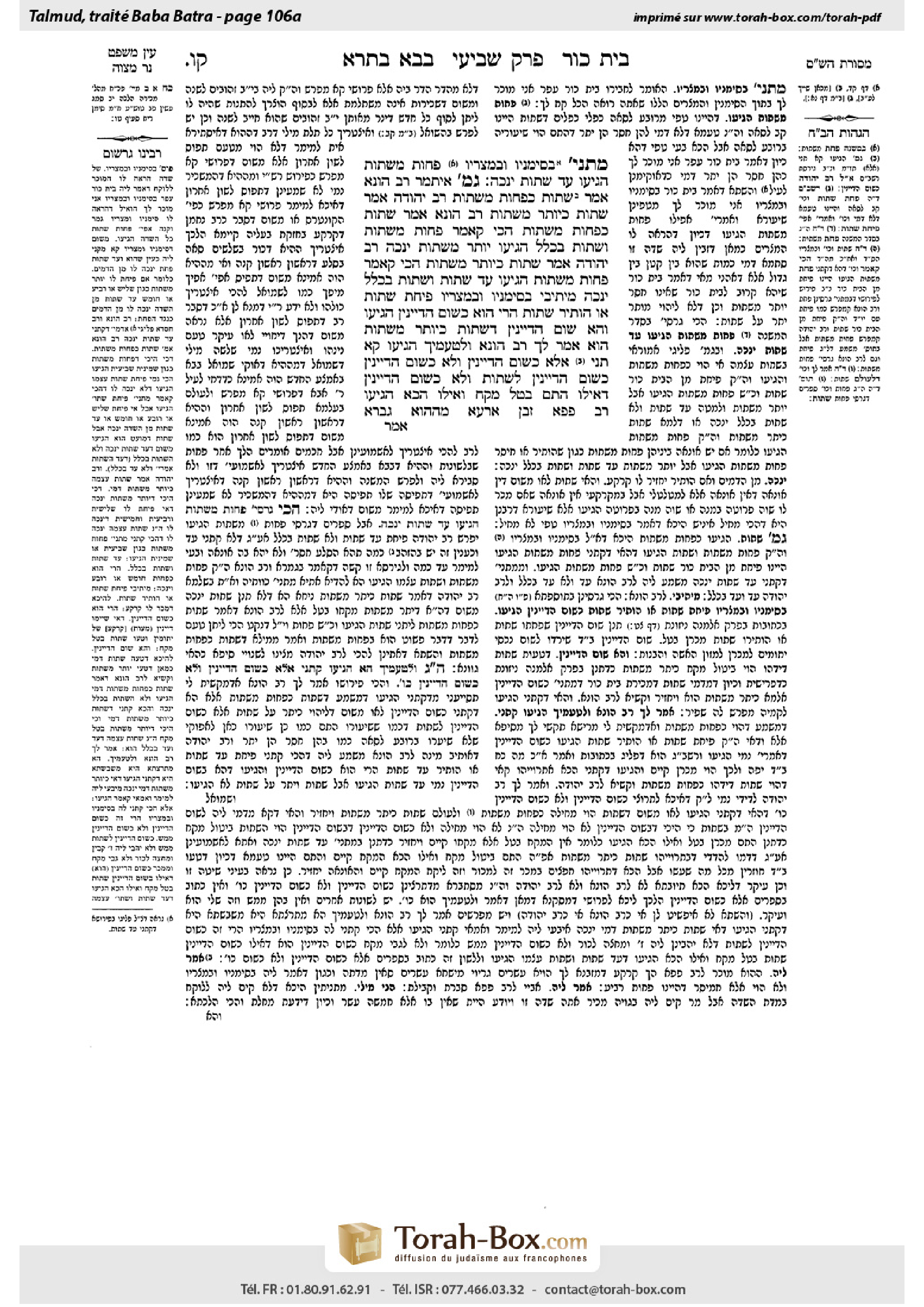
Bava Batra 106a: Talmud study for Daf Yomi
Study the Talmud for Daf Yomi with scanned pages, Hebrew text, English translations from Sefaria and AI-generated French translations.
Passage selection and English or AI-generated French translation are available where the scan has annotations. Daf Study is independent of Torah-Box and Sefaria.
Browse Bava Batra · בבא בתרא · All tractatesBava Batra 106a text and translations
This page of Bava Batra includes the Aramaic text, an English translation and an AI-generated French translation, alongside the scan above.
בבא בתרא ק״ו א · Aramaic and Hebrew text
מַתְנִי׳ ״בְּסִימָנָיו וּבִמְצָרָיו״; פָּחוֹת מִשְּׁתוּת – הִגִּיעוֹ, עַד שְׁתוּת – יְנַכֶּה.
גְּמָ׳ אִיתְּמַר, רַב הוּנָא אָמַר: שְׁתוּת – כְּפָחוֹת מִשְּׁתוּת. רַב יְהוּדָה אָמַר: שְׁתוּת – כְּיוֹתֵר מִשְּׁתוּת.
רַב הוּנָא אָמַר: שְׁתוּת כְּפָחוֹת מִשְּׁתוּת – הָכִי קָאָמַר: פָּחוֹת מִשְּׁתוּת, וּשְׁתוּת בַּכְּלָל – הִגִּיעוֹ. יוֹתֵר מִשְּׁתוּת – יְנַכֶּה. רַב יְהוּדָה אָמַר: שְׁתוּת כְּיוֹתֵר מִשְּׁתוּת – הָכִי קָאָמַר: פָּחוֹת מִשְּׁתוּת – הִגִּיעוֹ. עַד שְׁתוּת, וּשְׁתוּת בַּכְּלָל – יְנַכֶּה.
מֵיתִיבִי: ״בְּסִימָנָיו וּבִמְצָרָיו״, פִּיחֵת שְׁתוּת אוֹ הוֹתִיר שְׁתוּת – הֲרֵי הוּא כְּשׁוּם הַדַּיָּינִין, הִגִּיעוֹ. וְהָא שׁוּם הַדַּיָּינִין, דִּשְׁתוּת כְּיוֹתֵר מִשְּׁתוּת הוּא!
אָמַר לְךָ רַב הוּנָא: וּלְטַעְמָיךְ, ״הִגִּיעוֹ״ קָא תָּנֵי! אֶלָּא כְּשׁוּם הַדַּיָּינִין – וְלֹא כְּשׁוּם הַדַּיָּינִין; כְּשׁוּם הַדַּיָּינִין – לִשְׁתוּת, וְלֹא כְּשׁוּם הַדַּיָּינִין – דְּאִילּוּ הָתָם, בָּטֵל מִקָּח; וְאִילּוּ הָכָא, הִגִּיעוֹ.
רַב פָּפָּא זְבַן אַרְעָא מֵהַהוּא גַּבְרָא,
Bava Batra 106a · English translation
MISHNA: If one sells a field to another, telling him that he is selling him a field measuring a beit kor, with its particular demarcations and borders that the seller specifies for the buyer, the field’s measurement is not treated in as exacting a manner as in a standard sale. Therefore, if it later turns out that the field was not precisely a beit kor, but the difference is still less than one-sixth, the field is the buyer’s, and the sale is valid as is. But if the difference is greater, e.g., one-quarter or one-fifth, then, until it is calculated at one-sixth, the seller must deduct the difference from the purchase price and return money to the buyer.
GEMARA: It was stated that the amora’im disagreed about the following issue: Rav Huna says: A difference that is precisely one-sixth is like one that is less than one-sixth, and the sale is valid. Rav Yehuda says: A difference that is precisely one-sixth is like one that is more than one-sixth, and the difference must be deducted from the purchase price.
The Gemara explains the respective reasons of the two amora’im: Rav Huna says that a difference of one-sixth is like a difference of less than one-sixth, as this is what the mishna is saying: If the difference is less than one-sixth, and including a difference that is precisely one-sixth, it is the buyer’s, as the sale is valid, and if it is more than one-sixth, the seller must deduct the difference from the purchase price. Rav Yehuda says that a difference of one-sixth is like a difference of more than one-sixth, as this is what the mishna is saying: If the difference is less than one-sixth, it is the buyer’s, as the sale is valid, and if the difference is greater, until it is calculated at one-sixth, and including a difference that is precisely one-sixth, the seller must deduct the difference from the purchase price.
The Gemara raises an objection to Rav Huna’s statement from a baraita: If one sells a field to another, telling him that he is selling him a field measuring a beit kor within its particular demarcations and borders, and he gave him a field that is one-sixth less than the measure stipulated, or, alternatively, he gave him a field that is one-sixth more than the measure stipulated, it is like a sale of orphans’ property that is executed in accordance with the judges’ assessment of the value of that property, and therefore it is the buyer’s, as the sale is valid. The Gemara states the objection: But in the case of a sale executed in accordance with the judges’ assessment, an error of precisely one-sixth is like an error of more than one-sixth, and the sale is void. This contradicts Rav Huna’s opinion that an error of one-sixth is like an error of less than one-sixth.
The Gemara answers: Rav Huna could have said to you in reply: Even according to your reasoning, there is still a difficulty, since the baraita teaches that it is the buyer’s, i.e., the sale is final. Rather, the comparison drawn between this halakha and the judges’ assessment is not a general comparison. It is like the judges’ assessment, but it is not entirely like the judges’ assessment. It is like the judges’ assessment in that the limit is one-sixth, but it is not like the judges’ assessment, as there, in the case of the judges’ assessment, the sale is voided, while here, in the mishna, it is the buyer’s, and the sale is final.
It is related that Rav Pappa bought land from a certain man,
Bava Batra 106a · Traduction française (IA)
MICHNA : Si l'on vend un champ à un autre, en lui disant qu'on lui vend un champ mesurant un beit kor, avec ses limites spécifiques que le vendeur indique à l'acheteur, la mesure du champ n'est pas traitée avec autant de précision qu'en vente normale. Ainsi, si on découvre plus tard que le champ ne mesurait pas exactement un beit kor, mais que la différence est encore inférieure à un sixième, le champ appartient à l'acheteur et la vente est valide. Mais si la différence est supérieure, par exemple un quart ou un cinquième, alors, jusqu'à ce qu'elle soit calculée à un sixième, le vendeur doit déduire la différence du prix d'achat et rembourser l'acheteur.
GUEMARA : Il a été dit que les amoraïm étaient divisés sur le suivant : Rav Huna dit : Une différence exactement d'un sixième est comme une différence inférieure à un sixième, et la vente est valide. Rav Yehuda dit : Une différence exactement d'un sixième est comme une différence supérieure à un sixième, et la différence doit être déduite du prix d'achat.
La Guemara explique les raisons respectives des deux amoraïm : Rav Huna dit qu'une différence d'un sixième est comme une différence inférieure à un sixième, car c'est ce que dit la Michna : Si la différence est inférieure à un sixième, et y compris une différence exactement d'un sixième, c'est à l'acheteur qu'appartient le champ, car la vente est valide, et si la différence est supérieure, le vendeur doit déduire la différence du prix d'achat. Rav Yehuda dit qu'une différence d'un sixième est comme une différence supérieure à un sixième, car c'est ce que dit la Michna : Si la différence est inférieure à un sixième, c'est à l'acheteur qu'appartient le champ, car la vente est valide, et si la différence est supérieure, jusqu'à ce qu'elle soit calculée à un sixième, et y compris une différence exactement d'un sixième, le vendeur doit déduire la différence du prix d'achat.
La Guemara soulève une objection contre l'opinion de Rav Huna à partir d'une baraïta : Si l'on vend un champ à un autre, en lui disant qu'on lui vend un champ mesurant un beit kor avec ses limites spécifiques, et qu'on lui donne un champ qui est un sixième moins que la mesure stipulée, ou, alternativement, un champ qui est un sixième plus que la mesure stipulée, c'est comme une vente de propriété des orphelins exécutée selon l'évaluation des juges, et donc c'est à l'acheteur qu'appartient le champ, car la vente est valide. La Guemara formule l'objection : Mais dans le cas d'une vente exécutée selon l'évaluation des juges, une erreur exacte d'un sixième est comme une erreur supérieure à un sixième, et la vente est nulle. Cela contredit l'opinion de Rav Huna selon laquelle une erreur d'un sixième est comme une erreur inférieure à un sixième.
La Guemara répond : Rav Huna pourrait avoir dit à vous en réponse : Même selon votre raisonnement, il reste une difficulté, car la baraïta enseigne que c'est à l'acheteur qu'appartient le champ, c'est-à-dire que la vente est définitive. Plutôt, la comparaison faite entre cette halakha et l'évaluation des juges n'est pas une comparaison générale. C'est comme l'évaluation des juges, mais pas entièrement comme l'évaluation des juges. C'est comme l'évaluation des juges dans la mesure où la limite est un sixième, mais pas comme l'évaluation des juges, car là, dans le cas de l'évaluation des juges, la vente est annulée, tandis que ici, dans la Michna, c'est à l'acheteur qu'appartient le champ et la vente est définitive.
On raconte que Rav Pappa a acheté un terrain à un certain homme,
Traduction française générée par IA à partir de l’édition anglaise de Sefaria. Vérifie toujours un passage avec le texte source.
Text from Sefaria: William Davidson Edition - Vocalized Aramaic (CC BY NC); William Davidson Edition - English (CC BY NC).