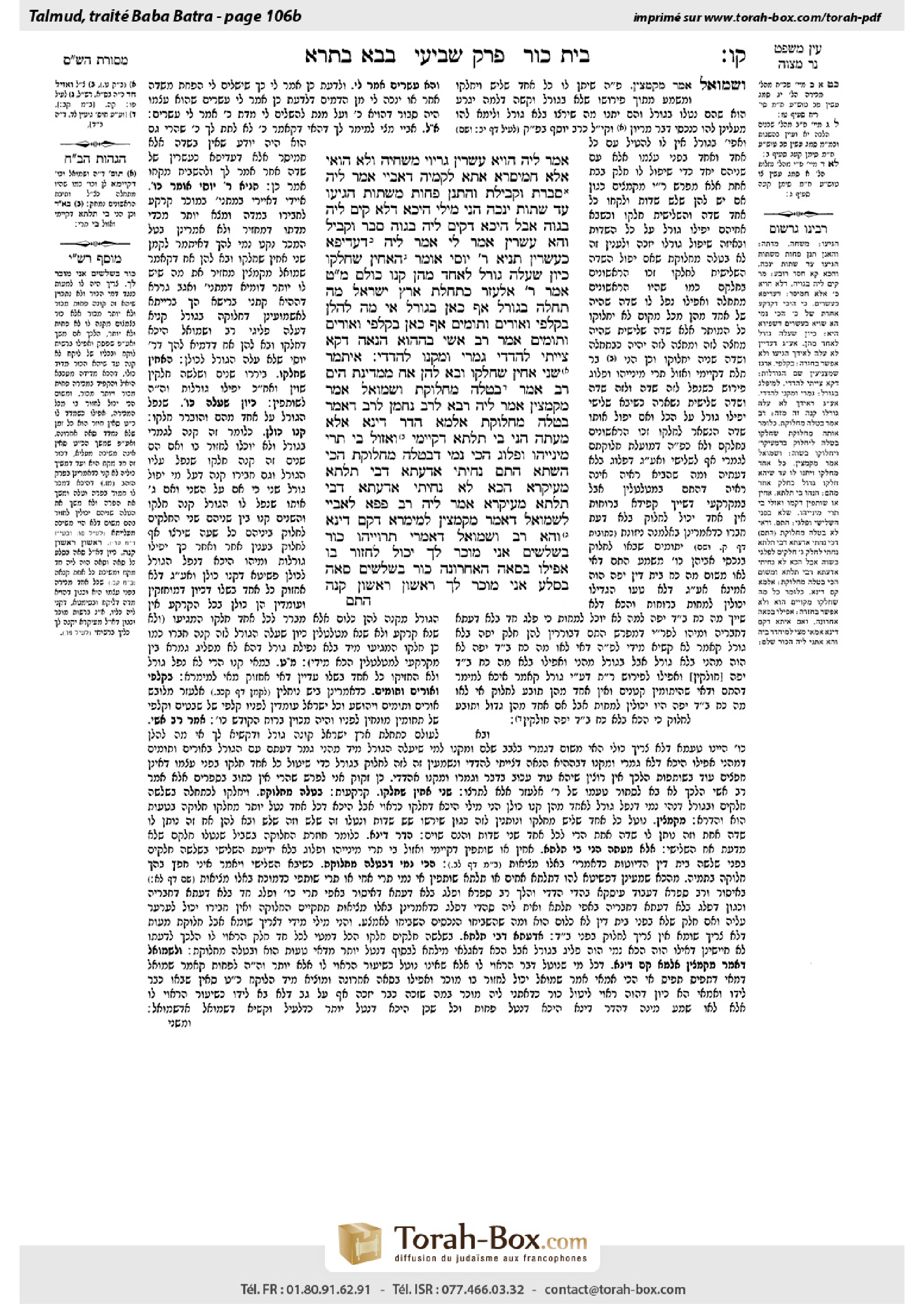
Bava Batra 106b: Talmud study for Daf Yomi
Study the Talmud for Daf Yomi with scanned pages, Hebrew text, English translations from Sefaria and AI-generated French translations.
Passage selection and English or AI-generated French translation are available where the scan has annotations. Daf Study is independent of Torah-Box and Sefaria.
Browse Bava Batra · בבא בתרא · All tractatesBava Batra 106b text and translations
This page of Bava Batra includes the Aramaic text, an English translation and an AI-generated French translation, alongside the scan above.
בבא בתרא ק״ו ב · Aramaic and Hebrew text
אֲמַר לֵיהּ: הָוְיָא עֶשְׂרִין גְּרִיוֵי. מְשַׁחֵיהּ, וְלָא הֲוַאי אֶלָּא חֲמֵיסְרָא. אֲתָא לְקַמֵּיהּ דְּאַבָּיֵי, אֲמַר לֵיהּ: סְבַרְתְּ וְקַבֵּילְתְּ.
וְהָתְנַן: פָּחוֹת מִשְּׁתוּת – הִגִּיעוֹ, עַד שְׁתוּת – יְנַכֶּה! הָנֵי מִילֵּי הֵיכָא דְּלָא קִים לֵיהּ בְּגַוַּהּ, אֲבָל הֵיכָא דְּקִים לֵיהּ בְּגַוַּהּ – סְבַר וְקַבֵּיל.
וְהָא עֶשְׂרִין אֲמַר לִי! אֲמַר לֵיהּ: דַּעֲדִיפָא כְּעֶשְׂרִין.
תַּנְיָא, רַבִּי יוֹסֵי אוֹמֵר: הָאַחִין שֶׁחָלְקוּ, כֵּיוָן שֶׁעָלָה גּוֹרָל לְאֶחָד מֵהֶן – קָנוּ כּוּלָּם. מַאי טַעְמָא? אָמַר רַבִּי אֶלְעָזָר: כִּתְחִלַּת אֶרֶץ יִשְׂרָאֵל – מָה תְּחִלָּה בְּגוֹרָל, אַף כָּאן בְּגוֹרָל.
אִי – מַה לְּהַלָּן בְּקַלְפִּי וְאוּרִים וְתוּמִּים, אַף כָּאן בְּקַלְפִּי וְאוּרִים וְתוּמִּים?! אָמַר רַב אָשֵׁי: בְּהָהוּא הֲנָאָה דְּקָא צָיְיתִי לַהֲדָדֵי, גָּמְרִי וּמַקְנוּ לַהֲדָדֵי.
אִיתְּמַר: שְׁנֵי אַחִין שֶׁחָלְקוּ, וּבָא לָהֶן אָח מִמְּדִינַת הַיָּם; רַב אָמַר: בָּטְלָה מַחְלוֹקֶת, וּשְׁמוּאֵל אָמַר: מְקַמְּצִין.
אֲמַר לֵיהּ רָבָא לְרַב נַחְמָן: לְרַב דְּאָמַר בָּטְלָה מַחְלוֹקֶת, אַלְמָא הָדַר דִּינָא; אֶלָּא מֵעַתָּה, הָנֵי בֵּי תְלָתָא דְּקָיְימִי, וַאֲזוּל בֵּי תְרֵי מִינַּיְיהוּ וּפְלוּג, הָכִי נָמֵי דְּבָטְלָה מַחְלוֹקֶת?
הָכִי הַשְׁתָּא?! הָתָם, נְחִיתוּ אַדַּעְתָּא דְּבֵי תְּלָתָא מֵעִיקָּרָא; הָכָא, לָא נְחִיתוּ אַדַּעְתָּא דְּבֵי תְלָתָא מֵעִיקָּרָא.
אֲמַר לֵיהּ רַב פָּפָּא לְאַבָּיֵי: לִשְׁמוּאֵל דְּאָמַר מְקַמְּצִין – לְמֵימְרָא דְּקָם דִּינָא?! וְהָא רַב וּשְׁמוּאֵל דְּאָמְרִי תַּרְוַיְיהוּ: ״כּוֹר בִּשְׁלֹשִׁים אֲנִי מוֹכֵר לָךְ״ – יָכוֹל לַחֲזוֹר בּוֹ אֲפִילּוּ בִּסְאָה הָאַחֲרוֹנָה. ״כּוֹר בִּשְׁלֹשִׁים – סְאָה בְּסֶלַע אֲנִי מוֹכֵר לָךְ״ – רִאשׁוֹן רִאשׁוֹן קָנָה!
Bava Batra 106b · English translation
who, after specifying its demarcations and boundaries, said to him: It is an area of twenty griv, meaning that it is fit for planting twenty se’a of grain. Rav Pappa later measured the field and found that it was fit for planting only fifteen se’a. Rav Pappa came before Abaye to sue the seller. Abaye said to him: You knew what you were buying and accepted the field as is.
Rav Pappa raised an objection to Abaye’s ruling from the mishna. But didn’t we learn in the mishna that when the seller specifies the field’s demarcations and borders, if the difference between the stated size of the field and its actual size is less than one-sixth, the field is the buyer’s, and the sale is valid as is, but if the difference is greater, until it is calculated at one-sixth, the seller must deduct the difference from the purchase price? And here, in this case, the difference between what the seller promised and the actual size of the field is greater than one-sixth. Abaye replied: That statement applies in a case where the buyer is unfamiliar with the plot being sold to him, but in a case where he is familiar with it, he knew what he was buying and accepted it as is.
Rav Pappa raised another objection to Abaye’s ruling: But the seller said to me that the field is fit for planting twenty se’a, and it is not. Abaye said to him: What he meant was that the field is as good and as fruitful as one that is fit for planting twenty se’a.
§ It is taught in a baraita that Rabbi Yosei says: When brothers divide their father’s estate between them by lottery, i.e., after dividing the property into equal shares they draw lots to determine which brother is to receive which portion, once the lot for one of them is drawn, they all acquire the remainder of the property, and they can no longer retract their decision to divide the estate in this manner. The Gemara asks: What is the reason for this? Drawing lots is not one of the recognized modes of acquisition. Rabbi Elazar said: The halakha that applies here is similar to the initial division of Eretz Yisrael among the tribes. Just as the initial division of Eretz Yisrael was carried out by drawing lots, so too here, the brothers can divide their father’s estate by drawing lots.
The Gemara challenges: If the brothers’ division of their father’s estate is comparable to the initial division of Eretz Yisrael, an additional comparison should apply: Just as there, the initial division of Eretz Israel was carried out through a receptacle [bekalpi] in which lots were placed and the Urim VeTummim, so too here, the division of the father’s estate should be executed only through a receptacle and the Urim VeTummim. Rav Ashi said: With the satisfaction that each of the brothers receives from the fact that they listen to each other and agree to accept the results of the lottery, they fully transfer ownership to each other. Therefore, the division becomes final as soon as the first lot is drawn.
§ It was stated that the amora’im disagreed about a related issue: If two brothers divided their father’s estate between them, and then later a third brother, of whose existence they had previously been unaware, arrived from a country overseas, Rav says: The original division of the property is void, and the brothers must now redivide the property among the three of them. And Shmuel says: The original division is still valid, but the two brothers must each take off a share from their portion and give it to the third brother.
The Gemara clarifies the opinions of Rav and Shmuel: Rava said to Rav Naḥman: According to Rav, who says that the division is void, apparently the halakha is that if a division of property was found to have been performed in error, the original verdict is reconsidered and the entire division is void. Accordingly, in the case of the brother who arrived from overseas, the original division of the father’s estate is void. But if that is so, then in the case of these three people who stand as partners, and two of them go and divide the property into three parts without consulting with the third partner, so too, the division should be void, and it should be necessary to divide the property a second time between the three partners. But elsewhere (Bava Metzia 31b), the Gemara indicates that in such a case, if the division of property took place in the presence of a court, it is valid.
Rav Naḥman rejects this comparison: How can these cases be compared? There is a clear difference between them: There, in the case of the three partners, they entered the process of dividing the property from the outset with the knowledge that they were three, and it was necessary only to clarify the portion to be received by each partner. Here, in the case of the brother who arrived from overseas, they did not enter the process of dividing the property from the outset with the knowledge that they were three, as at the time of the original division, they thought that there were only two brothers.
Rav Pappa said to Abaye: According to Shmuel, who says that the two brothers must each take off a share from their portion and give it to the third brother, is this to say that he is of the opinion that even if a division of property was found to have been made in error, the original verdict stands and the division is valid? But don’t Rav and Shmuel both say that if the seller said to the buyer: I am selling you one kor of grain, an amount equivalent to thirty se’a, for the sum of thirty sela, he can renege on the entire sale even while measuring out the last se’a; but if he said: I am selling you one kor of grain for thirty sela, each se’a for a sela, the buyer acquires each se’a one by one as it is being measured out to him? If the original verdict stands, why in the first case may the seller renege even on that portion of the sale that already reached the buyer?
Bava Batra 106b · Traduction française (IA)
qui, après avoir spécifié ses limites et ses bornes, dit à lui : C’est une parcelle de vingt griv, ce qui signifie qu’elle est adaptée à la culture de vingt se’a de céréales. Rav Pappa mesura plus tard le champ et découvrit qu’il était adapté à la culture de quinze se’a seulement. Rav Pappa alla devant Abaye pour engager une action en justice contre le vendeur. Abaye lui dit : Vous saviez ce que vous achetiez et avez accepté le champ tel qu’il était.
Rav Pappa souleva une objection contre la décision d’Abaye, en se basant sur la mitsna. Mais n’avons-nous pas appris dans la mitsna que lorsque le vendeur spécifie les limites et les bornes du champ, si la différence entre la taille indiquée du champ et sa taille réelle est inférieure à un sixième, le champ appartient à l’acheteur et la vente est valide, mais si la différence est supérieure, jusqu’à ce qu’elle soit calculée comme un sixième, le vendeur doit déduire la différence du prix d’achat ? Et ici, dans ce cas, la différence entre ce que le vendeur a promis et la taille réelle du champ est supérieure à un sixième. Abaye répondit : Cette déclaration s’applique dans un cas où l’acheteur n’est pas familier avec la parcelle qu’il achète, mais dans un cas où il est familier avec elle, il savait ce qu’il achetait et a accepté le champ tel qu’il était.
Rav Pappa souleva une autre objection contre la décision d’Abaye : Mais le vendeur m’a dit que le champ est adapté à la culture de vingt se’a, et ce n’est pas le cas. Abaye lui dit : Ce qu’il voulait dire, c’est que le champ est aussi bon et aussi fructueux qu’un champ adapté à la culture de vingt se’a.
§ Il est enseigné dans une baraïta que Rabbi Yosei dit : Lorsque des frères divisent la propriété de leur père entre eux par loterie, c’est-à-dire après avoir divisé la propriété en parts égales, ils tirent des lots pour déterminer à quel frère appartient quelle part, une fois que le lot d’un d’entre eux est tiré, tous acquièrent la reste de la propriété et ils ne peuvent plus revenir sur leur décision de diviser la propriété ainsi. La Guemara demande : Quelle est la raison de cela ? Tirer des lots n’est pas l’un des modes reconnus d’acquisition. Rabbi Elazar dit : La halakha qui s’applique ici est similaire à la division initiale de la Terre d’Israël entre les tribus. Comme la division initiale de la Terre d’Israël a été effectuée par tirage de lots, de même ici, les frères peuvent diviser la propriété de leur père par tirage de lots.
La Guemara conteste : Si la division des frères de leur père est comparable à la division initiale de la Terre d’Israël, une autre comparaison devrait s’appliquer : Comme là-bas, la division initiale de la Terre d’Israël a été effectuée par un récipient [bekalpi] dans lequel des lots ont été placés et les Urim VeTummim, de même ici, la division de la propriété de leur père devrait être exécutée uniquement par un récipient et les Urim VeTummim. Rav Ashi dit : Avec la satisfaction que chaque frère reçoit du fait qu’ils écoutent l’un l’autre et acceptent les résultats de la loterie, ils transfèrent pleinement la propriété l’un à l’autre. Par conséquent, la division devient définitive dès que le premier lot est tiré.
§ Il a été dit que les amora’im s’entendaient sur un sujet lié : Si deux frères divisent la propriété de leur père entre eux, et plus tard un troisième frère, dont ils n’étaient pas auparavant conscients, arrive d’un pays étranger, Rav dit : La division originale de la propriété est nulle, et les frères doivent maintenant redéfinir la propriété entre les trois d’entre eux. Et Shmuel dit : La division originale est toujours valide, mais les deux frères doivent chacun retirer une part de leur portion et la donner au troisième frère.
La Guemara clarifie les opinions de Rav et de Shmuel : Rava dit à Rav Naḥman : Selon Rav, qui dit que la division est nulle, il semble que la halakha soit que si une division de propriété a été trouvée avoir été effectuée en erreur, le verdict original est réexaminé et la division entière est nulle. Ainsi, dans le cas du frère qui est arrivé d’étranger, la division originale de la propriété de leur père est nulle. Mais si c’est ainsi, alors dans le cas de ces trois personnes qui sont des partenaires, et deux d’entre eux vont et divisent la propriété en trois parts sans consulter le troisième partenaire, la division devrait également être nulle, et il faudrait diviser la propriété une deuxième fois entre les trois partenaires. Mais ailleurs (Bava Metzia 31b), la Guemara indique que dans ce cas, si la division de la propriété s’est déroulée en présence d’un tribunal, elle est valide.
Rav Naḥman rejette cette comparaison : Comment peut-on comparer ces cas ? Il y a une différence claire entre eux : Là-bas, dans le cas des trois partenaires, ils ont commencé le processus de division de la propriété dès le début en sachant qu’ils étaient trois, et il suffisait de clarifier la part à recevoir par chaque partenaire. Ici, dans le cas du frère qui est arrivé d’étranger, ils n’ont pas commencé le processus de division de la propriété dès le début en sachant qu’ils étaient trois, car, à l’époque de la division originale, ils pensaient qu’il n’y avait qu’un seul frère.
Rav Pappa dit à Abaye : Selon Shmuel, qui dit que les deux frères doivent chacun retirer une part de leur portion et la donner au troisième frère, cela signifie-t-il qu’il est d’avis que même si une division de propriété a été trouvée avoir été effectuée en erreur, le verdict original reste valide et la division est valide ? Mais n’ont pas Rav et Shmuel tous deux dit que si le vendeur dit à l’acheteur : Je vends à vous un kor de céréales, une quantité équivalente à trente se’a, pour la somme de trente sela, il peut annuler la vente entière même pendant la mesure du dernier se’a ; mais si il dit : Je vends à vous un kor de céréales pour trente sela, un se’a pour un sela, l’acheteur acquiert chaque se’a un par un à mesure qu’il est mesuré à lui ? Si le verdict original reste valide, pourquoi dans le premier cas le vendeur peut-il annuler même la partie de la vente qui a déjà été reçue par l’acheteur ?
Traduction française générée par IA à partir de l’édition anglaise de Sefaria. Vérifie toujours un passage avec le texte source.
Text from Sefaria: William Davidson Edition - Vocalized Aramaic (CC BY NC); William Davidson Edition - English (CC BY NC).