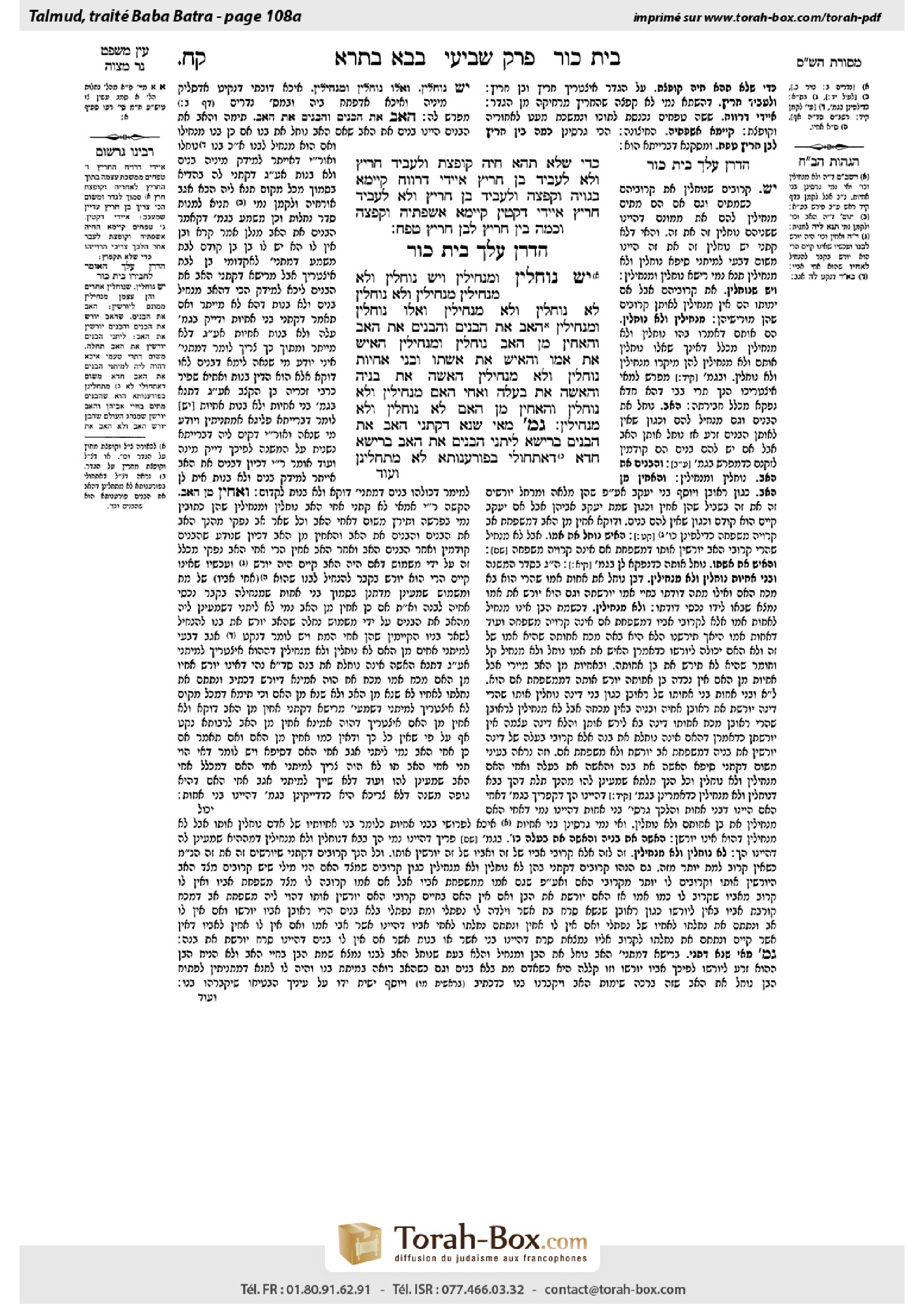
Bava Batra 108a: Talmud study for Daf Yomi
Study the Talmud for Daf Yomi with scanned pages, Hebrew text, English translations from Sefaria and AI-generated French translations.
Passage selection and English or AI-generated French translation are available where the scan has annotations. Daf Study is independent of Torah-Box and Sefaria.
Browse Bava Batra · בבא בתרא · All tractatesBava Batra 108a text and translations
This page of Bava Batra includes the Aramaic text, an English translation and an AI-generated French translation, alongside the scan above.
בבא בתרא ק״ח א · Aramaic and Hebrew text
כְּדֵי שֶׁלֹּא תְּהֵא חַיָּה קוֹפֶצֶת. וְלַעֲבֵיד חָרִיץ – וְלָא לַעֲבֵיד בֶּן חָרִיץ! אַיְּידֵי דְּרָוַוח, קָיְימָא בְּגַוֵּיהּ וְקָפְצָה. וְלַעֲבֵיד בֶּן חָרִיץ – וְלָא לַעֲבֵיד חָרִיץ! אַיְּידֵי דְּקַטִּין, קָיְימָא אַשִּׂפְתֵּיהּ וְקָפְצָה. וְכַמָּה בֵּין חָרִיץ לְבֶן חָרִיץ? טֶפַח.
הֲדַרַן עֲלָךְ בֵּית כּוֹר
יֵשׁ נוֹחֲלִין וּמַנְחִילִין, וְיֵשׁ נוֹחֲלִין וְלֹא מַנְחִילִין; מַנְחִילִין וְלֹא נוֹחֲלִין; לֹא נוֹחֲלִין וְלֹא מַנְחִילִין.
וְאֵלּוּ נוֹחֲלִין וּמַנְחִילִין: הָאָב אֶת הַבָּנִים, וְהַבָּנִים אֶת הָאָב, וְהָאַחִין מִן הָאָב – נוֹחֲלִין וּמַנְחִילִין. הָאִישׁ אֶת אִמּוֹ, וְהָאִישׁ אֶת אִשְׁתּוֹ, וּבְנֵי אֲחָיוֹת – נוֹחֲלִין וְלֹא מַנְחִילִין. הָאִשָּׁה אֶת בָּנֶיהָ, וְהָאִשָּׁה אֶת בַּעְלָהּ, וַאֲחֵי הָאֵם – מַנְחִילִין וְלֹא נוֹחֲלִין. וְהָאַחִין מִן הָאֵם – לֹא נוֹחֲלִין וְלֹא מַנְחִילִין.
גְּמָ׳ מַאי שְׁנָא דְּקָתָנֵי ״הָאָב אֶת הַבָּנִים״ בְּרֵישָׁא? לִיתְנֵי ״הַבָּנִים אֶת הָאָב״ בְּרֵישָׁא – חֲדָא, דְּאַתְחוֹלֵי בְּפוּרְעֲנוּתָא לָא מַתְחֲלִינַן;
Bava Batra 108a · English translation
so that an animal will not jump over the fence, enter the field, and cause damage. The Gemara asks: Let him make only a larger ditch and not make a smaller ditch. The Gemara replies: Since the ditch is wide, the animal can stand inside it and jump from there over the fence. The Gemara asks: If so, then let him make only a smaller ditch and not make a larger ditch? Since the ditch is small, the animal stands on its edge and jumps over the fence. The baraita explains the matter further: And how much space is there between the larger ditch and the smaller ditch? One handbreadth.
MISHNA: There are family members who both inherit from and bequeath to each other upon their respective deaths; and there are those who inherit from certain relatives but do not bequeath to them; and there are those who bequeath to certain relatives but do not inherit from them; and there are those who, despite being relatives, do not inherit from nor bequeath to one another.
The mishna lists those referred to above. And these both inherit and bequeath: A father with regard to his sons, and sons with regard to their father, and paternal brothers; all inherit from one another and bequeath to each other. A man with regard to his mother, and a man with regard to his wife, and sons of sisters, i.e., nephews born to the sisters of the deceased, all inherit from their respective relatives but do not bequeath to them. A woman with regard to her sons, and a woman with regard to her husband, and maternal uncles, all bequeath to their respective relatives but do not inherit from them. And maternal brothers, despite being blood relatives, do not inherit from each other nor do they bequeath to one another, as they are not considered relatives for the purpose of inheritance.
GEMARA: The Gemara begins by clarifying the order of the list in the mishna. What is different, i.e., what is the reason, that the mishna teaches: A father with regard to his sons, as the first example? Let it teach: Sons with regard to their father, as the first example. The Gemara explains why this would be preferable: One reason is that we do not want to begin with a calamity, as the death of a son during his father’s lifetime is a calamity; therefore, it would have been appropriate to begin with the example of sons inheriting from their father.
Bava Batra 108a · Traduction française (IA)
afin qu'un animal ne saute pas par-dessus le mur, entre dans le champ et cause des dommages. La Guemara pose la question : qu'il fasse seulement un fossé plus grand et non un fossé plus petit. La Guemara répond : puisque le fossé est large, l'animal peut se tenir à l'intérieur et sauter par-dessus le mur à partir de là. La Guemara pose alors la question : si c'est ainsi, qu'il fasse seulement un fossé plus petit et non un fossé plus grand ? Puisque le fossé est petit, l'animal se tient sur son bord et saute par-dessus le mur. La baraïta explique davantage la question : et quelle est la distance entre le grand fossé et le petit fossé ? Une paume.
MICHNA : Il y a des membres de la famille qui héritent l'un de l'autre et laissent des legs à l'autre à leur décès ; et il y a ceux qui héritent de certains parents mais ne laissent pas de legs à ceux-ci ; et il y a ceux qui laissent des legs à certains parents mais n'héritent pas de ceux-ci ; et il y a ceux qui, malgré leur parenté, n'héritent ni ne laissent de legs les uns aux autres.
La mishna liste ceux mentionnés ci-dessus. Et ceux qui héritent et laissent des legs : un père concernant ses fils, et les fils concernant leur père, et les frères paternels ; tous héritent les uns des autres et laissent des legs les uns aux autres. Un homme concernant sa mère, et un homme concernant son épouse, et les fils de sœurs, c'est-à-dire les neveux nés des sœurs du défunt, tous héritent de leurs parents respectifs mais ne laissent pas de legs à ceux-ci. Une femme concernant ses fils, et une femme concernant son mari, et les oncles maternels, tous laissent des legs à leurs parents respectifs mais n'héritent pas d'eux. Et les frères maternels, malgré leur parenté sanguine, n'héritent ni ne laissent de legs les uns aux autres, car ils ne sont pas considérés comme des parents pour l'héritage.
GUEMARA : La Guemara commence par clarifier l'ordre de la liste dans la Michna. Qu'est-ce qui est différent, c'est-à-dire quelle est la raison, que la Michna enseigne : un père concernant ses fils, comme premier exemple ? Qu'elle enseigne : les fils concernant leur père, comme premier exemple. La Guemara explique pourquoi cela serait préférable : une raison est que nous ne voulons pas commencer par une calamité, car la mort d'un fils pendant la vie de son père est une calamité ; donc, il aurait été approprié de commencer avec l'exemple des fils qui héritent de leur père.
Traduction française générée par IA à partir de l’édition anglaise de Sefaria. Vérifie toujours un passage avec le texte source.
Text from Sefaria: William Davidson Edition - Vocalized Aramaic (CC BY NC); William Davidson Edition - English (CC BY NC).