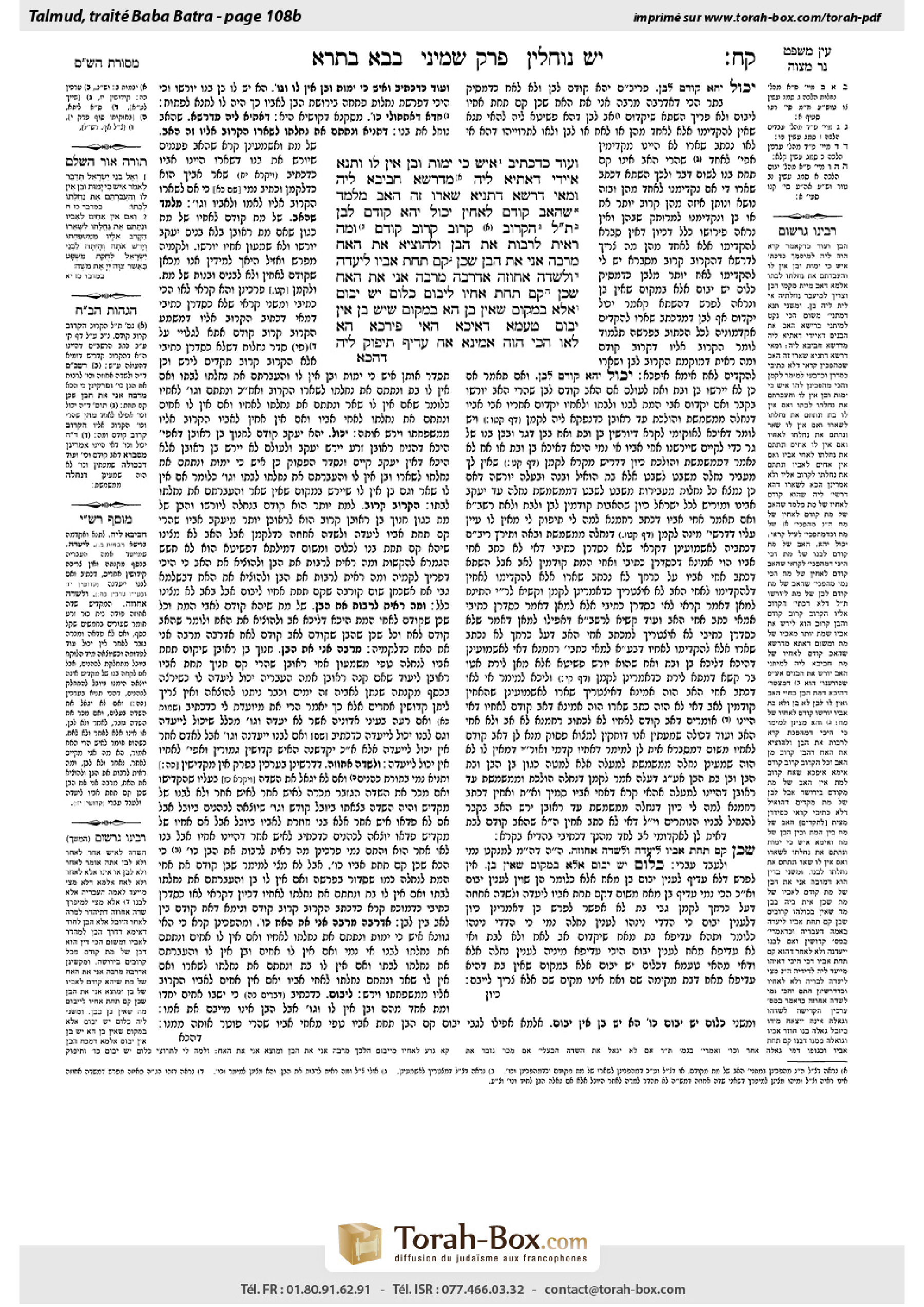
Bava Batra 108b: Talmud study for Daf Yomi
Study the Talmud for Daf Yomi with scanned pages, Hebrew text, English translations from Sefaria and AI-generated French translations.
Passage selection and English or AI-generated French translation are available where the scan has annotations. Daf Study is independent of Torah-Box and Sefaria.
Browse Bava Batra · בבא בתרא · All tractatesBava Batra 108b text and translations
This page of Bava Batra includes the Aramaic text, an English translation and an AI-generated French translation, alongside the scan above.
בבא בתרא ק״ח ב · Aramaic and Hebrew text
וְעוֹד, כְּדִכְתִיב: ״אִישׁ כִּי יָמוּת וּבֵן אֵין לוֹ״ –
וְתַנָּא, אַיְּידֵי דְּאָתְיָא לֵיהּ מִדְּרָשָׁא – חֲבִיבָא לֵיהּ!
וּמַאי דְּרָשָׁא? דְּתַנְיָא: ״שְׁאֵרוֹ״ – זֶה הָאָב; מְלַמֵּד שֶׁהָאָב קוֹדֶם לָאַחִין. יָכוֹל יְהֵא קוֹדֶם לַבֵּן? תַּלְמוּד לוֹמַר: ״הַקָּרוֹב״ – קָרוֹב קָרוֹב קוֹדֵם.
וּמָה רָאִיתָ לְרַבּוֹת אֶת הַבֵּן, וּלְהוֹצִיא אֶת הָאָח? מְרַבֶּה אֲנִי אֶת הַבֵּן – שֶׁכֵּן קָם תַּחַת אָבִיו לִיעִדָה וְלִשְׂדֵה אֲחוּזָּה.
אַדְּרַבָּה! מְרַבֶּה אֲנִי אֶת הָאָח, שֶׁכֵּן קָם תַּחַת אָחִיו לְיִבּוּם! כְּלוּם יֵשׁ יִבּוּם – אֶלָּא בְּמָקוֹם שֶׁאֵין בֵּן, הָא בְּמָקוֹם שֶׁיֵּשׁ בֵּן – אֵין יִבּוּם.
טַעְמָא דְּאִיכָּא הַאי פִּירְכָא, הָא לָאו הָכִי – הֲוָה אָמֵינָא אָח עֲדִיף? תִּיפּוֹק לֵיהּ
Bava Batra 108b · English translation
And furthermore, the verse first states that a son inherits from his father, as it is written in the portion concerning inheritance: “If a man dies, and has no son, then you shall pass his inheritance to his daughter” (Numbers 27:8).
The Gemara answers: And as for the tanna of the mishna who listed the father inheriting first, since the halakha that a father inherits from his son is learned through a derivation and is not explicitly mentioned in the verse, this halakha is dear to him; therefore, he listed it first.
And what is the derivation? As it is taught in a baraita concerning the verse: “And if his father has no brothers, then you shall give his inheritance to his kinsman who is next to him of his family, and he shall inherit it” (Numbers 27:11): “His kinsman”; this is referring to the father, and the Torah teaches that the father precedes the brothers of the deceased in inheriting from him. One might have thought that the father of the deceased should precede the son of the deceased in inheriting from him; the verse therefore states: “Next [hakkarov] to him,” teaching that the closer [karov] one is to the deceased, the earlier one is in the order of inheritance, and a son of the deceased is considered to be a closer relative to the deceased than the father of the deceased.
The Gemara asks: And what did you see to include the son as the closer relative than the father and to exclude the brother? The Gemara answers: I include the son, as he stands in place of his father to designate a Hebrew maidservant as a wife for himself, which a brother cannot do. And similarly, he stands in place of his father with regard to an ancestral field. If a son redeems a field consecrated by his father, it is considered as though the father himself redeemed it and the field returns to the family in the Jubilee Year. By contrast, if the brother of the one who consecrated it redeems the field, it does not return to the family (see Leviticus 27:16–21).
The Gemara asks: On the contrary, I should include the brother as the closer relative, as he stands in his brother’s place with regard to levirate marriage, and a son does not. The Gemara answers: This is not a valid claim, as is there levirate marriage except in a case where there is no son? In a case where there is a son, there is no levirate marriage. This indicates that a son stands in place of the deceased before a brother even with regard to levirate marriage.
The Gemara comments: The reason that a son is considered to be a closer relative than a brother is specifically due to this refutation, that where there is a son there is no levirate marriage. This indicates that without this refutation I would say that a brother is superior to a son in terms of how close a relative he is. The Gemara therefore asks: Why not derive that a son is closer to the deceased than a brother
Bava Batra 108b · Traduction française (IA)
Et de plus, la parabole commence par établir que le fils hérite de son père, comme il est écrit dans la portion concernant l'héritage : « Si un homme meurt et n'a pas de fils, vous donnerez alors son héritage à sa fille » (Nombres 27:8).
La Guemara répond : Et quant à la tanna de la michna qui a énuméré que le père hérite en premier, puisque la halakha selon laquelle le père hérite de son fils est tirée par déduction et n'est pas explicitement mentionnée dans la parabole, cette halakha lui est chère ; c'est pourquoi il l'a placée en premier.
Et quelle est cette déduction ? Comme il est enseigné dans une baraïta concernant la parabole : « Et si son père n'a pas de frères, vous donnerez alors son héritage à son parent proche qui est le plus proche de lui dans sa famille, et il héritera de lui » (Nombres 27:11) : « Son parent proche » ; cela fait référence au père, et la Torah enseigne que le père précède les frères du défunt dans l'héritage. On aurait pu penser que le père du défunt devrait précéder le fils du défunt dans l'héritage ; la parabole dit donc : « Le plus proche [hakkarov] de lui », enseignant que plus on est proche [karov] du défunt, plus on est tôt dans l'ordre d'héritage, et le fils du défunt est considéré comme un parent plus proche du défunt que le père du défunt.
La Guemara pose la question : Et pourquoi avez-vous inclus le fils comme le parent plus proche que le père et exclu le frère ? La Guemara répond : J'inclus le fils, car il remplace son père pour désigner une servante hébreuse comme épouse pour lui-même, ce que le frère ne peut pas faire. De même, il remplace son père concernant un champ ancestral. Si un fils rachète un champ consacré par son père, cela est considéré comme si le père lui-même l'avait racheté et que le champ retourne à la famille lors de l'année du Jubilé. À l'inverse, si le frère du propriétaire qui a consacré le champ rachète le champ, il ne retourne pas à la famille (voir Lévitique 27:16–21).
La Guemara pose la question : Au contraire, je devrais inclure le frère comme le parent plus proche, car il remplace son frère concernant le mariage levirat, et le fils ne le fait pas. La Guemara répond : Ce n'est pas une argumentation valable, car y a-t-il un mariage levirat sauf en cas où il n'y a pas de fils ? En cas où il y a un fils, il n'y a pas de mariage levirat. Cela indique que le fils remplace le défunt avant le frère même concernant le mariage levirat.
La Guemara commente : La raison pour laquelle le fils est considéré comme un parent plus proche que le frère est spécifiquement due à cette réfutation, que dans le cas où il y a un fils, il n'y a pas de mariage levirat. Cela indique que sans cette réfutation, je dirais que le frère est supérieur au fils en termes de proximité. La Guemara demande donc : Pourquoi ne pas déduire que le fils est plus proche du défunt que le frère ?
Traduction française générée par IA à partir de l’édition anglaise de Sefaria. Vérifie toujours un passage avec le texte source.
Text from Sefaria: William Davidson Edition - Vocalized Aramaic (CC BY NC); William Davidson Edition - English (CC BY NC).