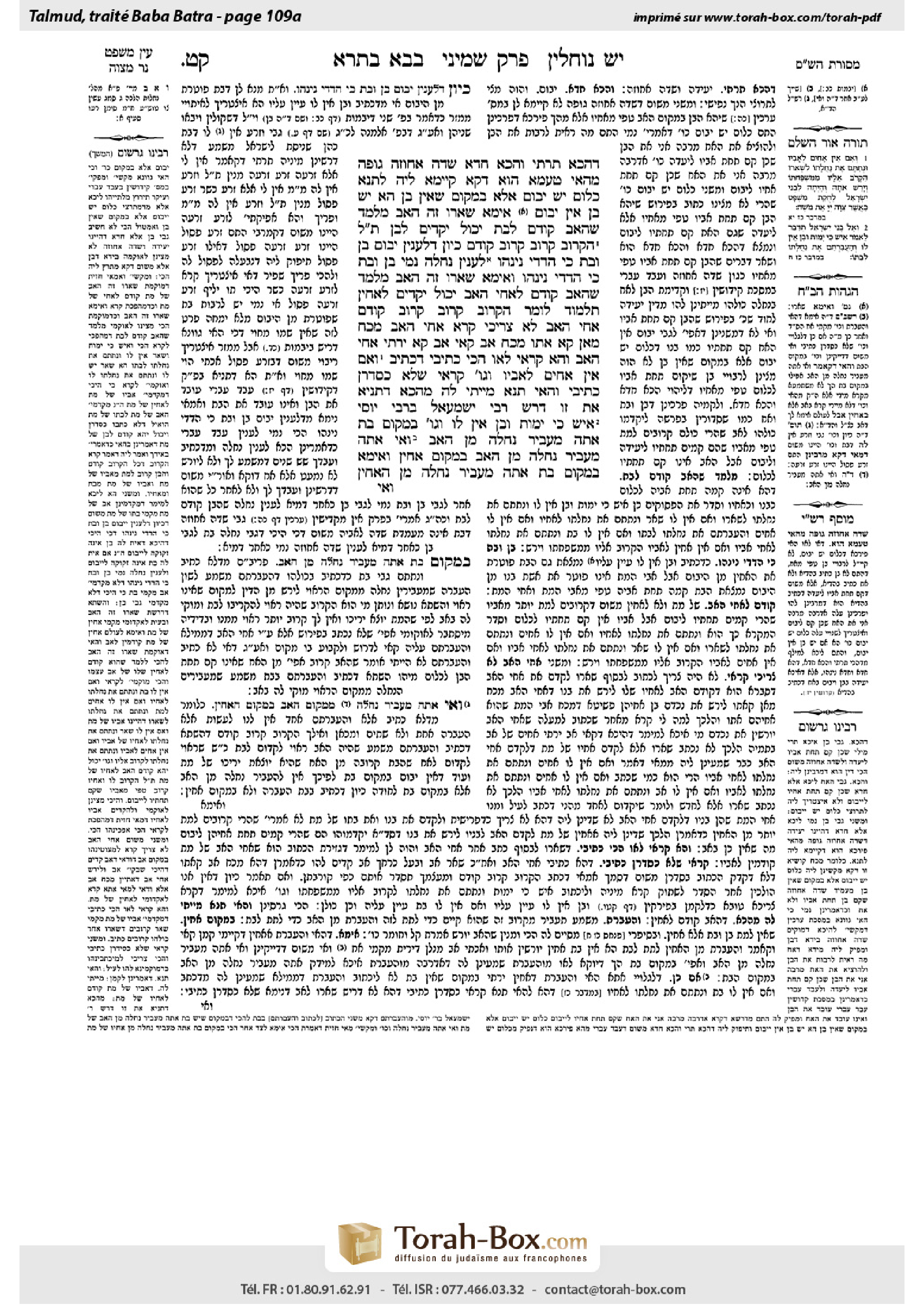
Bava Batra 109a: Talmud study for Daf Yomi
Study the Talmud for Daf Yomi with scanned pages, Hebrew text, English translations from Sefaria and AI-generated French translations.
Passage selection and English or AI-generated French translation are available where the scan has annotations. Daf Study is independent of Torah-Box and Sefaria.
Browse Bava Batra · בבא בתרא · All tractatesBava Batra 109a text and translations
This page of Bava Batra includes the Aramaic text, an English translation and an AI-generated French translation, alongside the scan above.
בבא בתרא ק״ט א · Aramaic and Hebrew text
דְּהָכָא תַּרְתֵּי, וְהָכָא חֲדָא!
שְׂדֵה אֲחוּזָּה גּוּפַהּ, מֵהַאי טַעְמָא הוּא; דְּקָא קַיְימָא לֵיהּ לְתַנָּא – כְּלוּם יֵשׁ יִבּוּם אֶלָּא בְּמָקוֹם שֶׁאֵין בֵּן, הָא יֵשׁ בֵּן אֵין יִבּוּם.
אֵימָא: ״שְׁאֵרוֹ״ – זֶה הָאָב, מְלַמֵּד שֶׁהָאָב קוֹדֵם לַבַּת. יָכוֹל יַקְדִּים לַבֵּן? תַּלְמוּד לוֹמַר: ״הַקָּרוֹב״ – קָרוֹב קָרוֹב קוֹדֵם!
כֵּיוָן דִּלְעִנְיַן יִבּוּם – בֵּן וּבַת כִּי הֲדָדֵי נִינְהוּ; לְעִנְיַן נַחֲלָה נָמֵי, בֵּן וּבַת כִּי הֲדָדֵי נִינְהוּ.
וְאֵימָא: ״שְׁאֵרוֹ״ – זֶה הָאָב, מְלַמֵּד שֶׁהָאָב קוֹדֵם לַאֲחֵי הָאָב. יָכוֹל יַקְדִּים לָאַחִין? תַּלְמוּד לוֹמַר: ״הַקָּרוֹב״ – קָרוֹב קָרוֹב קוֹדֵם!
אַחֵי הָאָב לָא צְרִיכִי קְרָא; אַחֵי הָאָב מִכֹּחַ מַאן קָא אָתוּ – מִכֹּחַ אָב; קָאֵי אָב, קָא יָרְתִי אַחֵי הָאָב?!
וְהָא קְרָאֵי לָאו הָכִי כְּתִיבִי – דִּכְתִיב: ״וְאִם אֵין אַחִים לְאָבִיו וְגוֹ׳״! קְרָאֵי שֶׁלֹּא כְּסִדְרָן כְּתִיבִי.
וְהַאי תַּנָּא מַיְיתֵי לַהּ מֵהָכָא – דְּתַנְיָא: אֶת זוֹ דָּרַשׁ רַבִּי יִשְׁמָעֵאל בְּרַבִּי יוֹסֵי: ״אִישׁ כִּי יָמוּת וּבֵן אֵין לוֹ וְגוֹ׳״ – בִּמְקוֹם בַּת אַתָּה מַעֲבִיר נַחֲלָה מִן הָאָב, וְאִי אַתָּה מַעֲבִיר נַחֲלָה מִן הָאָב בִּמְקוֹם אַחִין.
וְאֵימָא: בִּמְקוֹם בַּת אַתָּה מַעֲבִיר נַחֲלָה מִן הָאַחִין,
Bava Batra 109a · English translation
from the fact that here, there are two examples of the superiority of a son, designation and an ancestral field, and here, there is only one demonstration of the superiority of a brother, levirate marriage?
The Gemara answers: With regard to an ancestral field itself, the tanna establishes his ruling from this same reason: Is there levirate marriage except in a case where there is no son? In a case where there is a son, there is no levirate marriage. The determination that the redemption of the ancestral field by a son is in place of the redemption of the field by the father, whereas the redemption of the field by a brother is not, is based on the reasoning that the halakha of levirate marriage is not an indication that a brother is a closer relative than a son. Therefore, the halakha of an ancestral field cannot be regarded as a second example of the son’s superiority, as it stems from the first example, that of levirate marriage.
The Gemara suggests an alternative derivation: Why should the father of the deceased inherit before only the brothers? Say that he should inherit before the daughter of the deceased as well by interpreting the verse as follows: “His kinsman” (Numbers 27:11), this is referring to the father, and the Torah teaches that the father precedes the daughter of the deceased in inheriting from him. One might have thought that the father of the deceased should precede the son of the deceased in inheriting from him. The verse therefore states: “Next [hakkarov] to him,” teaching that the closer [karov] one is to the deceased, the earlier one is in the order of inheritance.
This suggestion is rejected: Since with regard to the matter of levirate marriage a son and a daughter are equivalent, as levirate marriage is not performed if the deceased had either a son or a daughter, it stands to reason that with regard to the matter of inheritance as well, a son and a daughter are equivalent in that the father does not precede the daughter.
The Gemara suggests an alternative derivation: Why should the father of the deceased inherit before the brothers of the deceased? Say that he should inherit only before his own brothers by interpreting the verse as follows: “His kinsman” ( Numbers 27:11), this is referring to the father, and the Torah teaches that the father precedes the father’s brothers in inheriting from the deceased. One might have thought that the father of the deceased should precede the brothers of the deceased in inheriting from him. The verse states: “Next [hakkarov] to him,” teaching that the closer [karov] one is to the deceased, the earlier one is in the order of inheritance.
The Gemara responds: A verse is not necessary to teach that the father of the deceased inherits before the father’s brothers, for the following reason: By whose virtue do the father’s brothers come to inherit from the deceased? By virtue of the father, as their right to inherit is a result of their being brothers of the father of the deceased. Could it be that while the father is still alive, his brothers should inherit? The Gemara therefore concludes that the father precedes the brothers of the deceased.
The Gemara challenges: But the verses are not written that way, as it is written: “And if he has no brothers, then you shall give his inheritance to his father’s brothers” (Numbers 27:10), and only later is it written: “And if his father has no brothers, then you shall give his inheritance to his kinsman who is next to him” (Numbers 27:11), indicating that the father, whose right to inherit is derived from the term “kinsman,” inherits only after the brothers of the deceased and his own brothers. The Gemara explains: The verses are not written in order, since as explained earlier, it is not reasonable that the father’s brothers inherit before the father. Therefore, it must be that the inheritance of the father is not written in its proper place, and he may inherit even before the brothers of the deceased.
§ The Gemara records an additional derivation for the halakha that the father precedes the brothers of the deceased. And this tanna cites it from here, as it is taught in a baraita: Rabbi Yishmael, son of Rabbi Yosei, taught this halakha: It is written: “If a man dies, and has no son, then you shall pass his inheritance to his daughter” (Numbers 27:8). In the rest of the passage the verse employs the phrase “and you shall give.” It is only in this verse that it employs the phrase “and you shall pass.” Based on this, Rabbi Yishmael teaches that in a case where there is a daughter, you pass an inheritance to her from one who appears to have precedence, namely, the father, and by inference, you do not pass the inheritance from the father in a case where there are brothers of the deceased.
The Gemara asks: But why not say that in a case where there is a daughter, you pass the inheritance to her from the brothers,
Bava Batra 109a · Traduction française (IA)
Pourquoi, ici, il y a deux exemples de la supériorité d'un fils, la désignation et le champ ancestral, et ici, il n'y a qu'un seul exemple de la supériorité d'un frère, le mariage levirique ?
La Guemara répond : En ce qui concerne le champ ancestral lui-même, le tanna établit sa décision à partir de la même raison : Y a-t-il un mariage levirique à moins qu'il n'y ait un fils ? Lorsqu'il y a un fils, il n'y a pas de mariage levirique. La détermination selon laquelle le rachat du champ ancestral par un fils remplace le rachat du champ par le père, alors que le rachat du champ par un frère n'est pas le cas, s'appuie sur la raison selon laquelle la halakha du mariage levirique ne montre pas que le frère est un parent plus proche que le fils. Par conséquent, la halakha du champ ancestral ne peut pas être considérée comme un deuxième exemple de la supériorité du fils, car elle découle du premier exemple, celui du mariage levirique.
La Guemara suggère une autre dérivation : Pourquoi le père du défunt hérite-t-il avant seulement ses frères ? Disons qu'il devrait hériter avant la fille du défunt également en interprétant la parole suivante ainsi : « Son parent proche » (Nombres 27:11), cela fait référence au père, et la Torah enseigne que le père précède la fille du défunt dans l'héritage. On aurait pu penser que le père du défunt devrait précéder le fils du défunt dans l'héritage. La parole donc dit : « Celui qui est proche de lui », enseignant que plus on est proche du défunt, plus on est tôt dans l'ordre d'héritage.
Cette suggestion est rejetée : Puisque, en ce qui concerne le mariage levirique, un fils et une fille sont équivalents, car le mariage levirique n'est pas effectué si le défunt a eu un fils ou une fille, il est logique que, en ce qui concerne l'héritage également, un fils et une fille soient équivalents, dans la mesure où le père ne précède pas la fille.
La Guemara suggère une autre dérivation : Pourquoi le père du défunt hérite-t-il avant les frères du défunt ? Disons qu'il devrait hériter seulement avant ses propres frères en interprétant la parole ainsi : « Son parent proche » (Nombres 27:11), cela fait référence au père, et la Torah enseigne que le père précède les frères du défunt dans l'héritage. On aurait pu penser que le père du défunt devrait précéder les frères du défunt dans l'héritage. La parole donc dit : « Celui qui est proche de lui », enseignant que plus on est proche du défunt, plus on est tôt dans l'ordre d'héritage.
La Guemara répond : Un verset n'est pas nécessaire pour enseigner que le père du défunt hérite avant les frères du défunt, pour la raison suivante : Sur quel droit les frères du défunt viennent-ils à hériter du défunt ? Sur le droit du père, car leur droit d'héritage découle de leur statut de frères du père du défunt. Pourrait-il être que, pendant que le père est encore vivant, ses frères devraient hériter ? La Guemara conclut donc que le père précède les frères du défunt.
La Guemara conteste : Mais les versets ne sont pas rédigés ainsi, car il est écrit : « Et s'il n'a pas de frères, alors vous donnerez son héritage à ses frères de père » (Nombres 27:10), et plus tard il est écrit : « Et s'il n'a pas de père, alors vous donnerez son héritage à son parent proche qui est proche de lui » (Nombres 27:11), indiquant que le père, dont le droit d'héritage découle du terme « parent proche », hérite seulement après les frères du défunt et ses propres frères. La Guemara explique : Les versets ne sont pas rédigés dans l'ordre, car, comme expliqué précédemment, il n'est pas raisonnable que les frères du père héritent avant le père. Par conséquent, il doit être que l'héritage du père n'est pas rédigé à sa place correcte, et il peut hériter même avant les frères du défunt.
§ La Guemara enregistre une autre dérivation pour la halakha selon laquelle le père précède les frères du défunt. Et ce tanna cite cela d'ici, car il est enseigné dans une baraïta : Rabbi Yishmael, fils de Rabbi Yosei, enseigne cette halakha : Il est écrit : « Si un homme meurt et n'a pas de fils, alors vous passerez son héritage à sa fille » (Nombres 27:8). Dans le reste du passage, le verset utilise la formule « et vous donnerez ». Il n'est que dans ce verset que la formule « et vous passerez » est utilisée. Sur cette base, Rabbi Yishmael enseigne que dans un cas où il y a une fille, on passe l'héritage à elle d'une personne qui semble avoir la priorité, à savoir le père, et par conséquent, on ne passe pas l'héritage du père dans un cas où il y a des frères du défunt.
La Guemara demande : Mais pourquoi ne pas dire que dans un cas où il y a une fille, on passe l'héritage à elle depuis les frères,
Traduction française générée par IA à partir de l’édition anglaise de Sefaria. Vérifie toujours un passage avec le texte source.
Text from Sefaria: William Davidson Edition - Vocalized Aramaic (CC BY NC); William Davidson Edition - English (CC BY NC).