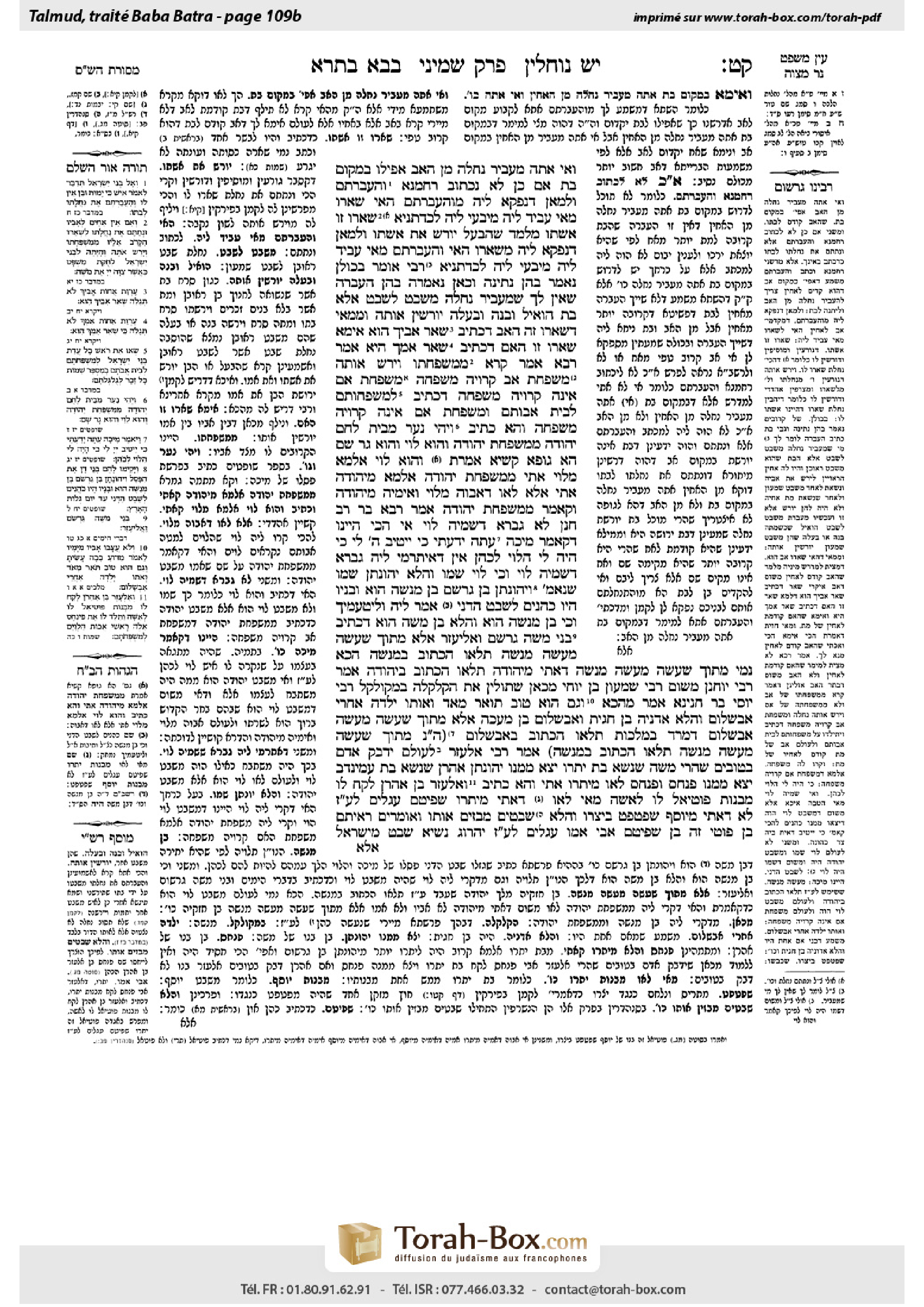
Bava Batra 109b: Talmud study for Daf Yomi
Study the Talmud for Daf Yomi with scanned pages, Hebrew text, English translations from Sefaria and AI-generated French translations.
Passage selection and English or AI-generated French translation are available where the scan has annotations. Daf Study is independent of Torah-Box and Sefaria.
Browse Bava Batra · בבא בתרא · All tractatesBava Batra 109b text and translations
This page of Bava Batra includes the Aramaic text, an English translation and an AI-generated French translation, alongside the scan above.
בבא בתרא ק״ט ב · Aramaic and Hebrew text
וְאִי אַתָּה מַעֲבִיר נַחֲלָה מִן הָאָב אֲפִילּוּ בִּמְקוֹם בַּת! אִם כֵּן, לָא נִכְתּוֹב רַחֲמָנָא ״וְהַעֲבַרְתֶּם״!
וּלְמַאן דְּנָפְקָא לֵיהּ מִ״וְהַעֲבַרְתֶּם״, הַאי ״שְׁאֵרוֹ״ מַאי עָבֵיד לֵיהּ? מִיבְּעֵי לֵיהּ לְכִדְתַנְיָא: ״שְׁאֵרוֹ״ – זוֹ אִשְׁתּוֹ, מְלַמֵּד שֶׁהַבַּעַל יוֹרֵשׁ אֶת אִשְׁתּוֹ.
וּלְמַאן דְּנָפְקָא לֵיהּ מִ״שְּׁאֵרוֹ״, הַאי ״וְהַעֲבַרְתֶּם״ מַאי עָבֵיד לֵיהּ? מִיבְּעֵי לֵיהּ לְכִדְתַנְיָא – רַבִּי אוֹמֵר: בְּכוּלָּן נֶאֱמַר בָּהֶן ״נְתִינָה״, וְכָאן נֶאֶמְרָה בָּהֶן ״הַעֲבָרָה״; שֶׁאֵין לְךָ שֶׁמַּעֲבִיר נַחֲלָה מִשֵּׁבֶט לְשֵׁבֶט אֶלָּא בַּת, הוֹאִיל וּבְנָהּ וּבַעְלָהּ יוֹרְשִׁין אוֹתָהּ.
וּמִמַּאי דִּ״שְׁאֵרוֹ״ זֶה הָאָב? דִּכְתִיב: ״שְׁאֵר אָבִיךָ הִיא״. אֵימָא: ״שְׁאֵרוֹ״ – זוֹ הָאֵם, דִּכְתִיב: ״שְׁאֵר אִמְּךָ הִיא״!
אָמַר רָבָא, אָמַר קְרָא: ״מִמִּשְׁפַּחְתּוֹ וְיָרַשׁ אֹתָהּ״; מִשְׁפַּחַת אָב קְרוּיָה ״מִשְׁפָּחָה״, מִשְׁפַּחַת אֵם אֵינָהּ קְרוּיָה ״מִשְׁפָּחָה״ – דִּכְתִיב: ״לְמִשְׁפְּחֹתָם לְבֵית אֲבֹתָם״.
וּמִשְׁפַּחַת אֵם אֵינָהּ קְרוּיָה ״מִשְׁפָּחָה״?! וְהָא כְּתִיב: ״וַיְהִי נַעַר מִבֵּית לֶחֶם יְהוּדָה מִמִּשְׁפַּחַת יְהוּדָה, וְהוּא לֵוִי, וְהוּא גָר שָׁם״ – הָא גוּפָא קַשְׁיָא; אָמְרַתְּ ״וְהוּא לֵוִי״ – אַלְמָא מִלֵּוִי אָתֵי, ״מִמִּשְׁפַּחַת יְהוּדָה״ – אַלְמָא מִיהוּדָה אָתֵי! אֶלָּא לָאו דַּאֲבוּהּ מִלֵּוִי, וְאִימֵּיהּ מִיהוּדָה? וְקָאָמַר ״מִמִּשְׁפַּחַת יְהוּדָה״!
אָמַר רָבָא בַּר רַב חָנָן: לָא; גַּבְרָא דִּשְׁמֵיהּ לֵוִי. אִי הָכִי, הַיְינוּ דְּקָאָמַר מִיכָה: ״עַתָּה יָדַעְתִּי כִּי יֵיטִיב ה׳ לִי, כִּי הָיָה לִי הַלֵּוִי לְכֹהֵן״? אִין, דְּאִיתְרְמִי לֵיהּ גַּבְרָא דִּשְׁמֵיהּ לֵוִי.
וְכִי לֵוִי שְׁמוֹ?! וַהֲלֹא יְהוֹנָתָן שְׁמוֹ, שֶׁנֶּאֱמַר: ״וִיהוֹנָתָן בֶּן גֵּרְשֹׁם בֶּן מְנַשֶּׁה, הוּא וּבָנָיו הָיוּ כֹהֲנִים לְשֵׁבֶט הַדָּנִי״! (אֲמַר לֵיהּ: וְלִיטַעְמָיךְ) וְכִי בֶּן מְנַשֶּׁה הוּא?! וַהֲלֹא בֶּן מֹשֶׁה הוּא, דִּכְתִיב: ״בְּנֵי מֹשֶׁה גֵּרְשׁוֹם וֶאֱלִיעֶזֶר״!
אֶלָּא מִתּוֹךְ שֶׁעָשָׂה מַעֲשֵׂה מְנַשֶּׁה, תְּלָאוֹ הַכָּתוּב בִּמְנַשֶּׁה; הָכָא נָמֵי, מִתּוֹךְ שֶׁעָשָׂה מַעֲשֵׂה מְנַשֶּׁה – דְּאָתֵי מִיהוּדָה, תְּלָאוֹ הַכָּתוּב בִּיהוּדָה.
אָמַר רַבִּי יוֹחָנָן מִשּׁוּם רַבִּי שִׁמְעוֹן בֶּן יוֹחַי: מִכָּאן שֶׁתּוֹלִין אֶת הַקַּלְקָלָה בַּמְקוּלְקָל. רַבִּי יוֹסֵי בַּר חֲנִינָא אָמַר, מֵהָכָא: ״וְגַם הוּא טוֹב תֹּאַר מְאֹד, וְאֹתוֹ יָלְדָה אַחֲרֵי אַבְשָׁלוֹם״ – וַהֲלֹא אֲדֹנִיָּה בֶּן חַגִּית וְאַבְשָׁלוֹם בֶּן מַעֲכָה! אֶלָּא, מִתּוֹךְ שֶׁעָשָׂה מַעֲשֵׂה אַבְשָׁלוֹם – דְּמָרַד בַּמַּלְכוּת, תְּלָאוֹ הַכָּתוּב בְּאַבְשָׁלוֹם. הָכָא נָמֵי, מִתּוֹךְ שֶׁעָשָׂה מַעֲשֵׂה מְנַשֶּׁה – תְּלָאוֹ הַכָּתוּב בִּמְנַשֶּׁה.
אָמַר רַבִּי אֶלְעָזָר: לְעוֹלָם יִדְבַּק אָדָם בַּטּוֹבִים, שֶׁהֲרֵי מֹשֶׁה שֶׁנָּשָׂא בַּת יִתְרוֹ – יָצָא מִמֶּנּוּ יְהוֹנָתָן; אַהֲרֹן שֶׁנָּשָׂא בַּת עַמִּינָדָב – יָצָא מִמֶּנּוּ פִּנְחָס.
וּפִנְחָס לָאו מִיִּתְרוֹ אָתֵי? וְהָא כְּתִיב: ״וְאֶלְעָזָר בֶּן אַהֲרֹן לָקַח לוֹ מִבְּנוֹת פּוּטִיאֵל לוֹ לְאִשָּׁה״; מַאי, לָאו דְּאָתֵי מִיִּתְרוֹ – שֶׁפִּיטֵּם עֲגָלִים לַעֲבוֹדָה זָרָה? לָא, דְּאָתֵי מִיּוֹסֵף – שֶׁפִּטְפֵּט בְּיִצְרוֹ.
וַהֲלֹא שְׁבָטִים מְבַזִּים אוֹתוֹ, וְאוֹמְרִים: רְאִיתֶם ״בֶּן פּוּטִי״ זֶה – בֵּן שֶׁפִּיטֵּם אֲבִי אִמּוֹ עֲגָלִים לַעֲבוֹדָה זָרָה, יַהֲרוֹג נְשִׂיא שֵׁבֶט מִיִּשְׂרָאֵל?!
Bava Batra 109b · English translation
but you do not pass an inheritance from the father even in a case where there is a daughter, so that the father precedes the daughter in the order of inheritance? The Gemara answers: If so, the Merciful One would not write: “Then you shall pass the inheritance to his daughter” (Numbers 27:8). This indicates that the logical order of inheritance is being overridden, as the fact that the daughter precedes the brothers of the deceased is due to her being a closer relative of his. It is obvious that the Torah intends that she precede even the father.
Having quoted two derivations for the halakha that the father precedes the brothers, the Gemara proceeds to discuss them and asks: And according to the one who derives it from the term: “And you shall pass,” what does he do with this term: “His kinsman,” which was said to refer to the father? The Gemara answers: He requires it for that which is taught in a baraita: “His kinsman.” This is referring to his wife, and the Torah teaches that a husband inherits from his wife.
The Gemara asks: And according to the one who derives it from the term: “His kinsman,” what does he do with this term: “And you shall pass”? He requires it for that which is taught in a baraita, that Rabbi Yehuda HaNasi says: In the context of all of the relatives listed in the passage detailing the laws of inheritance, it is stated concerning them with the terminology of giving, and only here, in the context of daughters, it is stated concerning them with the terminology of passing. This teaches us that you have no one who passes an inheritance of land in Eretz Yisrael from one tribe to another except for a daughter, since her son and husband inherit from her.
§ The Gemara returns to discuss the interpretation of the term: “His kinsman” (Numbers 27:11). And from where does one know to derive that with regard to the term: “His kinsman [she’ero],” this is referring to the father, as it is written in the context of forbidden sexual relations: “She is your father’s kinswoman [she’er]” (Leviticus 18:12)? Perhaps one should say instead: “His kinswoman,” this is referring to the mother, as it is also written: “For she is your mother’s kinswoman [she’er]” (Leviticus 18:13).
Rava said in response that the verse states: “Then you shall give his inheritance to his kinsman who is next to him of his family, and he shall inherit it” (Numbers 27:11), emphasizing that “kinsman” is referring specifically to someone who is of his family, and it is the father’s family that is called one’s family, while one’s mother’s family is not called one’s family. Proof for this is found in another verse, as it is written: “By their families, by their fathers’ houses” (Numbers 1:2).
The Gemara raises a difficulty: And is one’s mother’s family indeed not called one’s family? But it is written in the episode of Micah forming an idol to be worshipped: “And there was a young man of Bethlehem in Judah of the family of Judah who was a Levite, and he sojourned there” (Judges 17:7). The Gemara explains the difficulty: This matter itself is difficult. You said: “Who was a Levite,” as apparently he came from the tribe of Levi, but the verse says: “Of the family of Judah,” so apparently he came from the tribe of Judah. Rather, is it not that his father was from the tribe of Levi and his mother was from the tribe of Judah, and yet the verse says that he was: “Of the family of Judah”? This appears to prove that one’s mother’s family is also called his family.
Rava bar Rav Ḥanan said in response: No, the verse speaks of a man whose name was Levi, but his father was of the tribe of Judah. The Gemara asks: If that is so, how is that which Micah said when that man agreed to serve as his priest: “Now I know that the Lord will do me good, seeing that I have a Levite as my priest” (Judges 17:13), understood? It is understood only if he was an actual Levite, not if he was from the tribe of Judah and named Levi. Rava bar Rav Ḥanan responded: Yes, it is understood. Micah understood the fact that a man whose name is Levi happened upon him as an auspicious sign.
The Gemara asks further: But is it so that his name was indeed Levi; but wasn’t Jonathan his name, as it is stated: “And Jonathan, the son of Gershom, the son of Manasseh, he and his sons were priests to the tribe of the Danites” (Judges 18:30)? Rava bar Rav Ḥanan said to him: And according to your reasoning, that his name was not Levi but he was from the tribe of Levi, there is also a difficulty from that same verse: But is it so that he was the son of Manasseh; but wasn’t he the son of Moses, as it is written: “The sons of Moses: Gershom and Eliezer” (I Chronicles 23:15)?
Rava bar Rav Ḥanan explains the verse: Rather, although he was the son of Moses, because he acted as Manasseh the king of Judah, who was notorious for idol worship, acted, the verse linked him to Manasseh by calling him “the son of Manasseh.” Here too, in the verse from which you seek to prove that one’s mother’s family is called one’s family, since he acted as Manasseh, who came from the tribe of Judah, acted, the verse linked him to Judah by stating that he was “of the family of Judah,” but he was, in fact, a Levite.
In connection with this, Rabbi Yoḥanan says in the name of Rabbi Shimon ben Yoḥai: From here it is learned that corruption is linked to one who is corrupt, as this man was linked to Manasseh and Judah despite having no familial connection to them. Rabbi Yosei bar Ḥanina says: That concept can be seen from here, in the matter of Adonijah, the son of David: “And he was also a very handsome man; and she gave birth to him after Absalom,” (I Kings 1:6) but Adonijah wasn’t the son of Haggith and Absalom was the son of Maachah, so why does the verse state: “And she gave birth to him after Absalom,” as if they were sons of the same mother? Rather, since Adonijah acted in a manner fit for Absalom, who also rebelled against the monarchy, the verse linked him to Absalom, referring to him as his full brother. Here too, with regard to Jonathan, since he acted as Manasseh acted, the verse linked him to Manasseh.
§ In connection with the story of Jonathan, son of Manasseh, the Gemara cites a related statement. Rabbi Elazar says: A person should always cleave to good people, meaning one should marry a woman from a good family, as this is beneficial for the offspring of that marriage. As in the case of Moses, who married a daughter of Yitro, who was a priest of idolatry, Jonathan, who was also a priest of idolatry, descended from him, while in the case of Aaron, who married the daughter of Amminadab, who was of distinguished lineage in the tribe of Judah, Pinehas descended from him.
The Gemara asks: And did Pinehas not also come from Yitro? But it is written: “And Elazar, Aaron’s son, took one of the daughters of Putiel as a wife; and she bore him Pinehas” (Exodus 6:25). What, is it not stating that Pinehas came from the family of Yitro, who was also called Putiel because he fattened [pittem] calves for idol worship? The Gemara answers: No, it is stating that he came from Joseph, who battled [shepitpet] with his desire by resisting the advances of Potiphar’s wife.
The Gemara asks: But didn’t the tribes denigrate him after he killed Zimri (see Numbers, chapter 25), and say of him: Have you seen this son of Puti, the son of he whose mother’s father fattened calves for idol worship? Should such a man kill a prince of a tribe of Israel?
Bava Batra 109b · Traduction française (IA)
mais vous ne transmettez pas une succession du père même dans le cas où il y a une fille, de sorte que le père précède la fille dans l'ordre de succession ? La Guemara répond : Si c'était ainsi, le Miséricordieux n'aurait pas écrit : « Puis tu transmettras la succession à sa fille » (Nombres 27:8). Cela indique que l'ordre logique de succession est contourné, car le fait que la fille précède les frères du défunt est dû à ce qu'elle est un parent plus proche. Il est évident que la Torah veut que la fille précède même le père.
Ayant cité deux dérivation pour la halakha que le père précède les frères, la Guemara passe à en discuter et pose la question : Et selon celui qui dérive cela du terme : « Et tu transmettras », que fait-il avec le terme : « Son parent », qui était dit pour désigner le père ? La Guemara répond : Il l'exige pour ce qui est enseigné dans une baraïta : « Son parent ». Cela désigne sa femme, et la Torah enseigne que le mari hérite de sa femme.
La Guemara pose la question : Et selon celui qui dérive cela du terme : « Son parent », que fait-il avec le terme : « Et tu transmettras » ? Il l'exige pour ce qui est enseigné dans une baraïta, que Rabbi Yéhuda HaNasi dit : Dans le contexte de tous les parents mentionnés dans le passage détaillant les lois de succession, il est dit concernant eux avec le vocabulaire de donner, et seulement ici, dans le contexte des filles, il est dit concernant elles avec le vocabulaire de transmettre. Cela nous apprend que personne ne transmet une succession de terre en Israël d'une tribu à une autre sauf la fille, car son fils et son mari héritent d'elle.
§ La Guemara reprend la discussion sur l'interprétation du terme : « Son parent » (Nombres 27:11). Et d'où sait-on que, concernant le terme : « Son parent [she'ero] », cela désigne le père, comme il est écrit dans le contexte des relations sexuelles interdites : « Elle est la parente de ton père [she'er] » (Lévitique 18:12) ? Peut-être devrait-on plutôt dire : « Son parente [she'era] », cela désigne la mère, comme il est aussi écrit : « Car elle est la parente de ta mère [she'era] » (Lévitique 18:13).
Rava répondit en ce sens que le verset dit : « Puis tu donneras la succession de son parent qui est proche de lui dans sa famille, et il héritera d'elle » (Nombres 27:11), soulignant que « parent » désigne spécifiquement quelqu'un qui est de sa famille, et c'est la famille du père qui est appelée la famille d'une personne, tandis que la famille de la mère n'est pas appelée la famille d'une personne. La preuve de cela se trouve dans un autre verset, comme il est écrit : « Par leurs familles, par leurs maisons paternelles » (Nombres 1:2).
La Guemara soulève une difficulté : Et est-ce que la famille de la mère n'est pas effectivement appelée la famille d'une personne ? Mais il est écrit dans l'histoire de Michah qui forma un idole à adorer : « Et il y avait un jeune homme de Béth-Séar de la tribu de Juda qui était un Lévite, et il demeurait là » (Juges 17:7). La Guemara explique la difficulté : Cette affaire elle-même est difficile. Vous dites : « Qui était un Lévite », comme si apparemment il venait de la tribu de Lévi, mais le verset dit : « De la famille de Juda », donc apparemment il venait de la tribu de Juda. Plutôt, n'est-ce pas que son père était de la tribu de Lévi et sa mère de la tribu de Juda, et pourtant le verset dit qu'il était : « De la famille de Juda » ? Cela semble prouver que la famille de la mère est aussi appelée la famille d'une personne.
Rava bar Rav Ḥanan répondit en ce sens : Non, le verset parle d'un homme dont le nom était Lévi, mais dont le père était de la tribu de Juda. La Guemara pose la question : Si c'est ainsi, comment comprend-on ce que Michah dit lorsqu'il accepta de servir en tant que prêtre : « Maintenant je sais que l'Éternel fera du bien à moi, vu que j'ai un Lévite comme prêtre » (Juges 17:13) ? Cela est compris uniquement s'il était un Lévite réel, pas s'il était de la tribu de Juda et nommé Lévi. Rava bar Rav Ḥanan répondit : Oui, cela est compris. Michah comprit que le fait qu'un homme dont le nom est Lévi se présentât à lui était un signe favorable.
La Guemara pose une question supplémentaire : Mais est-ce que son nom était effectivement Lévi ; mais n'était-ce pas Jonathan, comme il est dit : « Et Jonathan, le fils de Gershom, le fils de Manassé, lui et ses fils étaient des prêtres pour la tribu des Danites » (Juges 18:30) ? Rava bar Rav Ḥanan dit à lui : Et selon votre raisonnement, que son nom n'était pas Lévi mais qu'il était de la tribu de Lévi, il y a aussi une difficulté à partir de ce même verset : Mais est-ce que c'était le fils de Manassé ; mais n'était-ce pas le fils de Moïse, comme il est écrit : « Les fils de Moïse : Gershom et Eliezer » (Chroniques I 23:15) ?
Rava bar Rav Ḥanan explique le verset : Plutôt, bien qu'il fût le fils de Moïse, car il agissait comme Manassé, roi de Juda, connu pour son idolâtrie, agissait, le verset l'a lié à Manassé en le désignant comme « le fils de Manassé ». Ici aussi, dans le verset d'où vous tentez de prouver que la famille de la mère est appelée la famille d'une personne, puisqu'il agissait comme Manassé, qui venait de la tribu de Juda, agissait, le verset l'a lié à Juda en disant qu'il était « de la famille de Juda », mais en réalité, il était un Lévite.
En lien avec cela, Rabbi Yoḥanan dit au nom de Rabbi Shimon ben Yoḥai : On apprend d'ici que la corruption est liée à celui qui est corrompu, comme ce homme a été lié à Manassé et à Juda malgré n'avoir aucun lien familial avec eux. Rabbi Yosei bar Ḥanina dit : Ce concept peut être vu d'ici, dans l'affaire d'Adonijah, le fils de David : « Et il était aussi un homme très beau ; et elle lui donna naissance après Absalom », (I Rois 1:6) mais Adonijah n'était pas le fils de Haggith et Absalom était le fils de Maachah, donc pourquoi le verset dit : « Et elle lui donna naissance après Absalom », comme si ils étaient les fils de la même mère ? Plutôt, puisque Adonijah agissait de manière convenable pour Absalom, qui avait également rebelle contre la monarchie, le verset l'a lié à Absalom, le désignant comme son frère aîné. Ici aussi, concernant Jonathan, puisqu'il agissait comme Manassé agissait, le verset l'a lié à Manassé.
§ En lien avec l'histoire de Jonathan, fils de Manassé, la Guemara cite une déclaration connexe. Rabbi Eléazar dit : Une personne devrait toujours s'attacher aux gens de bien, c'est-à-dire qu'on devrait épouser une femme d'une bonne famille, car cela est bénéfique pour les enfants de ce mariage. Comme dans le cas de Moïse, qui épousa une fille de Yitro, qui était un prêtre d'idolâtrie, Jonathan, qui était également un prêtre d'idolâtrie, descendait de lui, tandis que dans le cas d'Aaron, qui épousa la fille d'Amminadab, qui était d'une lignée distinguée dans la tribu de Juda, Pinhas descendait de lui.
La Guemara demande : Et Pinhas n'est-il pas venu aussi de Yitro ? Mais il est écrit : « Et Eléazar, fils d'Aaron, prit une des filles de Putiel pour épouse ; et elle lui donna Pinhas » (Exode 6 : 25). Qu'est-ce que cela ne signifie pas que Pinhas descendait de la famille de Yitro, qui était aussi appelé Putiel parce qu'il élevait des veaux pour l'idolâtrie ? La Guemara répond : Non, cela signifie qu'il descendait de Joseph, qui lutta contre son désir en résistant aux avances de la femme de Potiphar.
La Guemara demande : Mais n'ont-ils pas dénigré Pinhas après qu'il eut tué Zimri (voir Nombres, chapitre 25), et dit-on de lui : Avez-vous vu ce fils de Puti, le fils de celui dont la mère avait pour père des veaux élevés pour l'idolâtrie ? Devrait-on laisser un tel homme tuer un prince d'une tribu d'Israël ?
Traduction française générée par IA à partir de l’édition anglaise de Sefaria. Vérifie toujours un passage avec le texte source.
Text from Sefaria: William Davidson Edition - Vocalized Aramaic (CC BY NC); William Davidson Edition - English (CC BY NC).