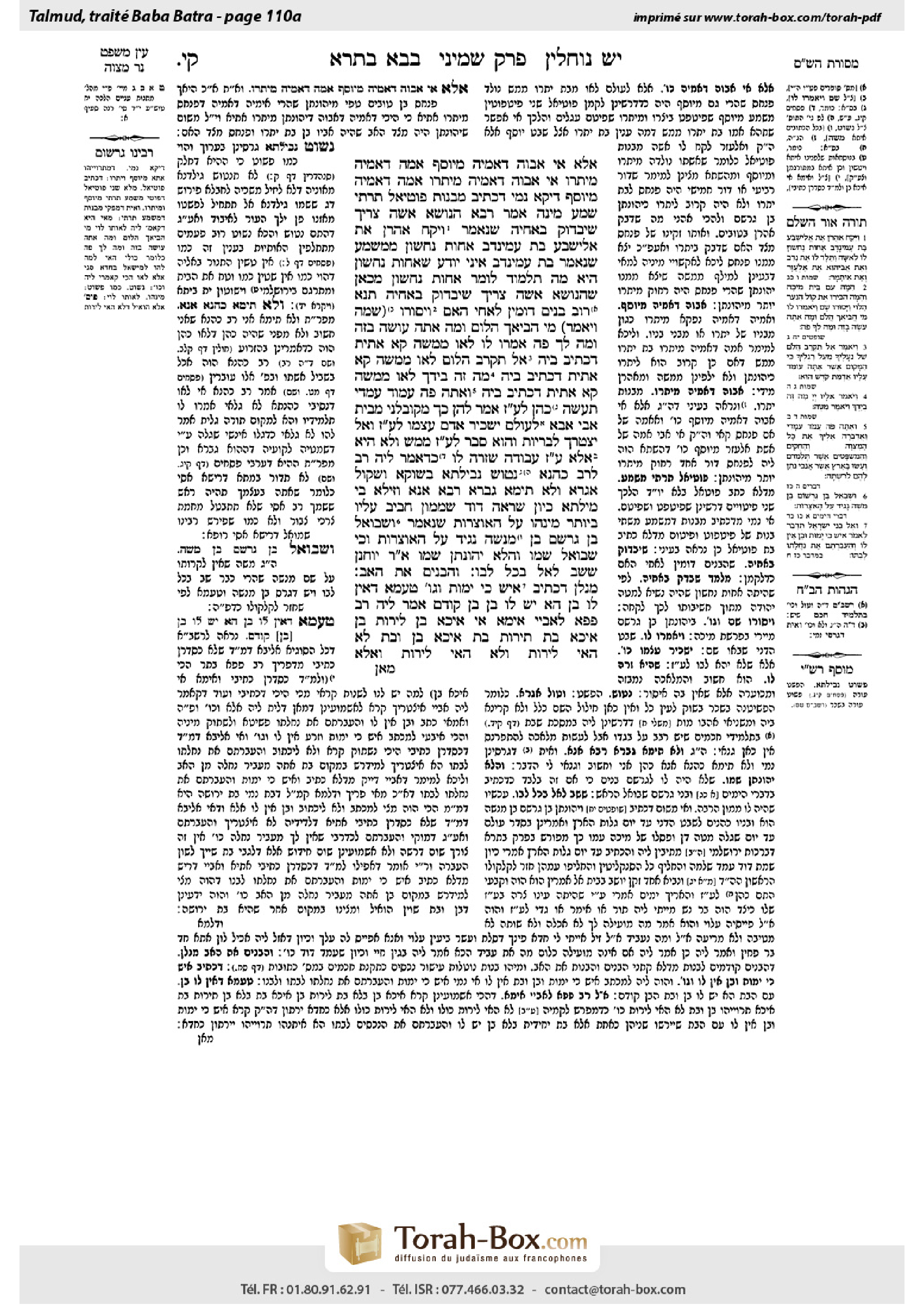
Bava Batra 110a: Talmud study for Daf Yomi
Study the Talmud for Daf Yomi with scanned pages, Hebrew text, English translations from Sefaria and AI-generated French translations.
Passage selection and English or AI-generated French translation are available where the scan has annotations. Daf Study is independent of Torah-Box and Sefaria.
Browse Bava Batra · בבא בתרא · All tractatesBava Batra 110a text and translations
This page of Bava Batra includes the Aramaic text, an English translation and an AI-generated French translation, alongside the scan above.
בבא בתרא ק״י א · Aramaic and Hebrew text
אֶלָּא אִי אֲבוּהּ דְּאִמֵּיהּ מִיּוֹסֵף – אִמַּהּ דְּאִמֵּיהּ מִיִּתְרוֹ; אִי אֲבוּהּ דְּאִמֵּיהּ מִיִּתְרוֹ – אִמַּהּ דְּאִמֵּיהּ מִיּוֹסֵף. דַּיְקָא נָמֵי, דִּכְתִיב: ״מִבְּנוֹת פּוּטִיאֵל״ – תַּרְתֵּי שְׁמַע מִינַּהּ.
אָמַר רָבָא: הַנּוֹשֵׂא אִשָּׁה, צָרִיךְ שֶׁיִּבְדּוֹק בְּאַחֶיהָ, שֶׁנֶּאֱמַר: ״וַיִּקַּח אַהֲרֹן אֶת אֱלִישֶׁבַע בַּת עַמִּינָדָב אֲחוֹת נַחְשׁוֹן״ – מִמַּשְׁמַע שֶׁנֶּאֱמַר ״בַּת עַמִּינָדָב״, אֵינִי יוֹדֵעַ שֶׁאֲחוֹת נַחְשׁוֹן הִיא? מָה תַּלְמוּד לוֹמַר: ״אֲחוֹת נַחְשׁוֹן״? מִכָּאן שֶׁהַנּוֹשֵׂא אִשָּׁה צָרִיךְ שֶׁיִּבְדּוֹק בְּאַחֶיהָ. תָּנָא: רוֹב בָּנִים דּוֹמִין לַאֲחֵי הָאֵם.
״וַיָּסוּרוּ שָׁמָּה, וַיֹּאמֶר: מִי הֱבִיאֲךָ הֲלֹם, וּמָה אַתָּה עוֹשֶׂה בָּזֶה, וּמַה לְּךָ פֹה?״. אָמְרוּ לוֹ: לָאו מִמֹּשֶׁה קָא אָתֵית, דִּכְתִיב בֵּיהּ: ״אַל תִּקְרַב הֲלֹם״? לָאו מִמֹּשֶׁה קָא אָתֵית, דִּכְתִיב בֵּיהּ: ״מַה זֶּה בְּיָדְךָ״? לָאו מִמֹּשֶׁה קָא אָתֵית, דִּכְתִיב בֵּיהּ: ״וְאַתָּה פֹּה עֲמֹד עִמָּדִי״? תֵּעָשֶׂה כּוֹמֶר לַעֲבוֹדָה זָרָה?!
אָמַר לָהֶן, כָּךְ מְקוּבְּלַנִי מִבֵּית אֲבִי אַבָּא: לְעוֹלָם יַשְׂכִּיר אָדָם עַצְמוֹ לַעֲבוֹדָה זָרָה, וְאַל יִצְטָרֵךְ לַבְּרִיּוֹת.
וְהוּא סָבַר – לַעֲבוֹדָה זָרָה מַמָּשׁ; וְלָא הִיא, אֶלָּא ״עֲבוֹדָה זָרָה״ – עֲבוֹדָה שֶׁזָּרָה לוֹ, כְּדַאֲמַר לֵיהּ רַב לְרַב כָּהֲנָא: נְטוֹשׁ נְבֵילְתָּא בְּשׁוּקָא וּשְׁקוֹל אַגְרָא, וְלָא תֵּימָא: גַּבְרָא רַבָּא אֲנָא וְזִילָא בִּי מִילְּתָא.
כֵּיוָן שֶׁרָאָה דָּוִד שֶׁמָּמוֹן חָבִיב עָלָיו בְּיוֹתֵר, מִינָּהוּ עַל הָאוֹצָרוֹת, שֶׁנֶּאֱמַר: ״וּשְׁבֻאֵל בֶּן גֵּרְשׁוֹם בֶּן מְנַשֶּׁה נָגִיד עַל הָאֹצָרוֹת״. וְכִי שְׁבוּאֵל שְׁמוֹ? וַהֲלֹא יְהוֹנָתָן שְׁמוֹ! אָמַר רַבִּי יוֹחָנָן: שֶׁשָּׁב לָאֵל בְּכׇל לִבּוֹ.
וְהַבָּנִים אֶת הָאָב. מְנָלַן? דִּכְתִיב: ״אִישׁ כִּי יָמוּת וְגוֹ׳״. טַעְמָא דְּאֵין לוֹ בֵּן, הָא יֵשׁ לוֹ בֵּן – בֵּן קוֹדֵם. אֲמַר לֵיהּ רַב פָּפָּא לְאַבָּיֵי, אֵימָא: אִי אִיכָּא בֵּן – לֵירוֹת בֵּן, אִיכָּא בַּת – תֵּירוֹת בַּת, אִיכָּא בֵּן וּבַת – לָא הַאי לֵירוֹת וְלָא הַאי לֵירוֹת!
וְאֶלָּא
Bava Batra 110a · English translation
Rather, this is how the matter should be resolved: If his mother’s father came from the family of Joseph, his mother’s mother came from the family of Yitro, and if his mother’s father came from the family of Yitro, his mother’s mother came from the family of Joseph, so while his mother was descended from Joseph on one side and from Yitro on the other, Pinehas was a more distant relative to Yitro than Jonathan was. Based on this conclusion, the language of the verse is also precise, as it is written: “And Elazar, Aaron’s son, took one of the daughters of Putiel” (Exodus 6:25). Conclude from the wording of the verse that Pinehas was descended from two men who were referred to as Puti: Yitro and Joseph.
Rava says: One who marries a woman needs to first examine her brothers so that he will know in advance what character his children will have, as it is stated: “And Aaron took Elisheva, the daughter of Amminadav, the sister of Nahshon” (Exodus 6:23). By inference from that which is stated: “The daughter of Amminadav,” do I not know that she is the sister of Nahshon, as Nahshon was the son of Amminadav? What is the meaning when the verse states: “The sister of Nahshon”? From here one learns that one who marries a woman needs to examine her brothers. The reason is as the Sages taught: Most sons resemble the mother’s brothers.
In connection with the Gemara’s mention of Jonathan, who served as a priest for Micah, the Gemara quotes additional statements of the Sages concerning that episode. Describing when the men from the tribe of Dan passed through Micah’s house, the verse states: “And they turned aside there and said to him: Who brought you here [halom], and what [ma] are you doing in this place, and what do you have here [po]?” (Judges 18:3). The Sages interpret their multiple questions. They said to him: Do you not come from Moses, about whom it is written: “Do not draw close to here [halom]” (Exodus 3:5)? Do you not come from Moses, about whom it is written: “What [ma] is that in your hand” (Exodus 4:2)? Do you not come from Moses, about whom it is written: “But as for you, stand here [po] with me” (Deuteronomy 5:27)? Shall you, a descendant of our teacher Moses, become a priest for idol worship?
Jonathan said to them: This is the tradition that I received from the house of my father’s father: A person should always hire himself out to idol worship and not require the help of people by receiving charity, and I took this position in order to avoid having to take charity.
The Gemara comments: And he, Jonathan, thought that this referred to actual idol worship, but that is not so, that was not the intent of the tradition. Rather, here the term idol worship, literally: Strange service, is referring to service, i.e., labor, that is strange, i.e., unsuitable, for him. In other words, one should be willing to perform labor that is difficult and humiliating in his eyes rather than become a recipient of charity. As Rav said to Rav Kahana, his student: Skin a carcass in the market and take payment, but do not say: I am a great man and this matter is beneath me.
The Gemara continues its discussion of that episode. Later, when King David saw that money was excessively precious to Jonathan, he appointed him as director of the treasuries of the Temple, as it is stated: “And Shebuel, the son of Gershom, the son of Moses, was ruler over the treasuries” (I Chronicles 26:24). The Gemara asks: And was his name really Shebuel; but wasn’t his name Jonathan? Rabbi Yoḥanan says: He is called Shebuel in order to allude to the fact that he repented and returned to God [shav la’el ] with all his heart.
§ The mishna teaches in the list of those who inherit from and bequeath to each other: Sons with regard to their father. The Gemara asks: From where do we derive this halakha that sons inherit the entire estate and daughters do not receive a share along with them? As it is written: “If a man dies, and has no son, then you shall pass his inheritance to his daughter” (Numbers 27:8). The reason the inheritance would be passed to a daughter is that he has no son, but if he has a son, the son takes precedence. Rav Pappa said to Abaye: Why not say the following: If there is only a son, let the son inherit the father’s estate; if there is only a daughter, let the daughter inherit the father’s estate; and if there is both a son and a daughter, neither this one should inherit nor that one should inherit.
Abaye asked Rav Pappa: And rather,
Bava Batra 110a · Traduction française (IA)
En réalité, la question doit être résolue ainsi : Si le père de sa mère descendait de la famille de Joseph, la mère de sa mère descendait de la famille de Yitro, et si le père de sa mère descendait de la famille de Yitro, la mère de sa mère descendait de la famille de Joseph, alors bien que sa mère descendît de Joseph d’un côté et de Yitro de l’autre, Pinḥas était un parent plus éloigné de Yitro que Jonathan. Selon cette conclusion, la formulation du verset est aussi précise, car il est écrit : « Et Eléazar, fils d’Aaron, prit l’une des filles de Putiel » (Exode 6:25). Concluez de la formulation du verset que Pinḥas descendait de deux hommes désignés comme Puti : Yitro et Joseph.
Rava dit : Celui qui épouse une femme doit d’abord examiner ses frères afin de savoir à l’avance quel caractère auront ses enfants, car il est dit : « Et Aaron prit Elisheva, la fille d’Amminadav, la sœur de Nahshon » (Exode 6:23). Par l’interprétation de ce qui est dit : « la fille d’Amminadav », ne sais-je pas qu’elle est la sœur de Nahshon, puisque Nahshon était le fils d’Amminadav ? Quel est le sens lorsque le verset dit : « la sœur de Nahshon » ? D’où l’on apprend que celui qui épouse une femme doit examiner ses frères. La raison est comme l’ont enseigné les Sages : la plupart des fils ressemblent aux oncles de leur mère.
En lien avec la mention de Jonathan dans la Guemara, qui a été prêtre pour Micah, la Guemara cite également d’autres propos des Sages concernant cet épisode. Décrivant le moment où les hommes du tribu de Dan passèrent par la maison de Micah, le verset dit : « Et ils s’arrêtèrent là et dirent à lui : Qui t’a amené ici [halom], et que [ma] fais-tu ici, et que [po] as-tu ici ? » (Juges 18:3). Les Sages interprètent leurs multiples questions. Ils dirent à lui : N’es-tu pas issu de Moïse, dont il est écrit : « Ne t’approche pas ici [halom] » (Exode 3:5) ? N’es-tu pas issu de Moïse, dont il est écrit : « Que [ma] as-tu en ta main » (Exode 4:2) ? N’es-tu pas issu de Moïse, dont il est écrit : « Mais toi, reste ici [po] avec moi » (Deutéronome 5:27) ? Et toi, descendant de notre maître Moïse, deviens-tu prêtre pour l’idolâtrie ?
Jonathan dit à eux : C’est la tradition que j’ai reçue de la maison de mon grand-père : une personne doit toujours se prostituer à l’idolâtrie et ne pas exiger l’aide des gens en recevant des charités, et j’ai adopté cette position afin d’éviter de devoir recevoir des charités.
La Guemara commente : Et lui, Jonathan, pensait que cela faisait référence à l’idolâtrie réelle, mais ce n’est pas ainsi, ce n’était pas l’intention de la tradition. En réalité, ici le terme « idolâtrie », littéralement : « service étranger », fait référence au service, c’est-à-dire au travail, qui est étranger, c’est-à-dire inadapté, pour lui. En d’autres termes, on doit être prêt à effectuer un travail difficile et humiliant à ses yeux plutôt que de devenir receveur de charité. Comme Rav a dit à Rav Kahana, son élève : Dépèce un cadavre au marché et prends un paiement, mais ne dis pas : Je suis un grand homme et cette affaire est en dessous de moi.
La Guemara poursuit sa discussion de cet épisode. Plus tard, lorsque le roi David vit que l’argent était trop précieux pour Jonathan, il le nomma directeur des trésoreries du Temple, car il est dit : « Et Shebuel, fils de Gershom, fils de Moïse, était chef des trésoreries » (I Rois 26:24). La Guemara demande : Et son nom n’était-il pas vraiment Jonathan ? Et ne s’appelait-il pas Jonathan ? Rabbi Yoḥanan dit : Il est appelé Shebuel afin d’indiquer qu’il s’est repent et est revenu à Dieu [shav la’el] avec tout son cœur.
§ La Michna enseigne dans la liste de ceux qui héritent de et transmettent à chacun : les fils concernant leur père. La Guemara demande : D’où dérivons-nous cette halakha que les fils héritent de l’ensemble du patrimoine et que les filles ne reçoivent pas une part en même temps qu’eux ? Car il est écrit : « Si un homme meurt et n’a pas de fils, alors vous passerez son héritage à sa fille » (Nombres 27:8). La raison pour laquelle l’héritage est transmis à une fille est que l’homme n’a pas de fils, mais s’il a un fils, ce fils a la priorité. Rav Pappa dit à Abaye : Pourquoi ne pas dire ceci : Si il y a seulement un fils, que le fils hérite du patrimoine du père ; si il y a seulement une fille, que la fille hérite du patrimoine du père ; et si il y a à la fois un fils et une fille, ni celui-ci ne doit hériter ni celui-là ne doit hériter.
Abaye demanda à Rav Pappa : Et plutôt,
Traduction française générée par IA à partir de l’édition anglaise de Sefaria. Vérifie toujours un passage avec le texte source.
Text from Sefaria: William Davidson Edition - Vocalized Aramaic (CC BY NC); William Davidson Edition - English (CC BY NC).