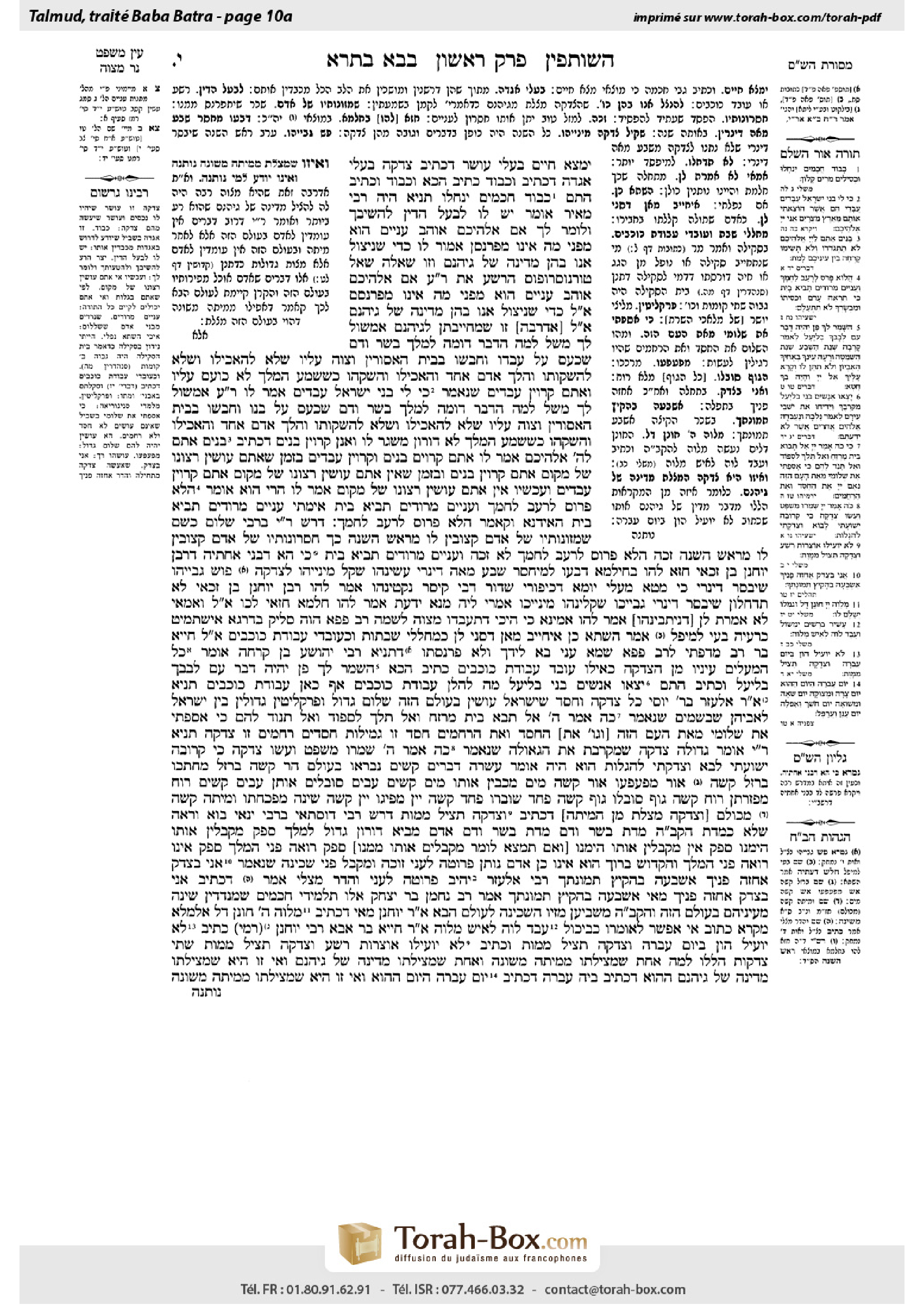
Bava Batra 10a: Talmud study for Daf Yomi
Study the Talmud for Daf Yomi with scanned pages, Hebrew text, English translations from Sefaria and AI-generated French translations.
Passage selection and English or AI-generated French translation are available where the scan has annotations. Daf Study is independent of Torah-Box and Sefaria.
Browse Bava Batra · בבא בתרא · All tractatesBava Batra 10a text and translations
This page of Bava Batra includes the Aramaic text, an English translation and an AI-generated French translation, alongside the scan above.
בבא בתרא י׳ א · Aramaic and Hebrew text
״יִמְצָא חַיִּים״. בַּעֲלֵי עוֹשֶׁר – דִּכְתִיב: ״צְדָקָה״. בַּעֲלֵי אַגָּדָה – דִּכְתִיב: ״וְכָבוֹד״ – כְּתִיב הָכָא: ״וְכָבוֹד״, וּכְתִיב הָתָם: ״כָּבוֹד חֲכָמִים יִנְחָלוּ״.
תַּנְיָא: הָיָה רַבִּי מֵאִיר אוֹמֵר, יֵשׁ לוֹ לְבַעַל הַדִּין לַהֲשִׁיבְךָ וְלוֹמַר לְךָ: אִם אֱלֹהֵיכֶם אוֹהֵב עֲנִיִּים הוּא, מִפְּנֵי מָה אֵינוֹ מְפַרְנְסָן? אֱמוֹר לוֹ: כְּדֵי שֶׁנִּיצּוֹל אָנוּ בָּהֶן מִדִּינָהּ שֶׁל גֵּיהִנָּם. וְזוֹ שְׁאֵלָה שָׁאַל טוֹרָנוּסְרוּפוּס הָרָשָׁע אֶת רַבִּי עֲקִיבָא: אִם אֱלֹהֵיכֶם אוֹהֵב עֲנִיִּים הוּא, מִפְּנֵי מָה אֵינוֹ מְפַרְנְסָם? אָמַר לוֹ: כְּדֵי שֶׁנִּיצּוֹל אָנוּ בָּהֶן מִדִּינָהּ שֶׁל גֵּיהִנָּם.
אָמַר לוֹ: [אַדְּרַבָּה], זוֹ שֶׁמְּחַיַּיבְתָּן לְגֵיהִנָּם! אֶמְשׁוֹל לְךָ מָשָׁל, לְמָה הַדָּבָר דּוֹמֶה? לְמֶלֶךְ בָּשָׂר וָדָם שֶׁכָּעַס עַל עַבְדּוֹ, וַחֲבָשׁוֹ בְּבֵית הָאֲסוּרִין, וְצִוָּה עָלָיו שֶׁלֹּא לְהַאֲכִילוֹ וְשֶׁלֹּא לְהַשְׁקוֹתוֹ. וְהָלַךְ אָדָם אֶחָד וְהֶאֱכִילוֹ וְהִשְׁקָהוּ. כְּשֶׁשָּׁמַע הַמֶּלֶךְ, לֹא כּוֹעֵס עָלָיו? וְאַתֶּם קְרוּיִן עֲבָדִים, שֶׁנֶּאֱמַר: ״כִּי לִי בְנֵי יִשְׂרָאֵל עֲבָדִים״!
אָמַר לוֹ רַבִּי עֲקִיבָא, אֶמְשׁוֹל לְךָ מָשָׁל: לְמָה הַדָּבָר דּוֹמֶה? לְמֶלֶךְ בָּשָׂר וָדָם שֶׁכָּעַס עַל בְּנוֹ וַחֲבָשׁוֹ בְּבֵית הָאֲסוּרִין, וְצִוָּה עָלָיו שֶׁלֹּא לְהַאֲכִילוֹ וְשֶׁלֹּא לְהַשְׁקוֹתוֹ. וְהָלַךְ אָדָם אֶחָד וְהֶאֱכִילוֹ וְהִשְׁקָהוּ. כְּשֶׁשָּׁמַע הַמֶּלֶךְ, לֹא דּוֹרוֹן מְשַׁגֵּר לוֹ?! וַאֲנַן קְרוּיִן בָּנִים, דִּכְתִיב: ״בָּנִים אַתֶּם לַה׳ אֱלֹהֵיכֶם״!
אָמַר לוֹ: אַתֶּם קְרוּיִם בָּנִים וּקְרוּיִן עֲבָדִים, בִּזְמַן שֶׁאַתֶּם עוֹשִׂין רְצוֹנוֹ שֶׁל מָקוֹם אַתֶּם קְרוּיִן בָּנִים, וּבִזְמַן שֶׁאֵין אַתֶּם עוֹשִׂין רְצוֹנוֹ שֶׁל מָקוֹם אַתֶּם קְרוּיִן עֲבָדִים; וְעַכְשָׁיו אֵין אַתֶּם עוֹשִׂים רְצוֹנוֹ שֶׁל מָקוֹם! אָמַר לוֹ, הֲרֵי הוּא אוֹמֵר: ״הֲלֹא פָרֹס לָרָעֵב לַחְמֶךָ וַעֲנִיִּים מְרוּדִים תָּבִיא בָיִת״; אֵימָתַי ״עֲנִיִּים מְרוּדִים תָּבִיא בָיִת״ – הָאִידָּנָא, וְקָאָמַר: ״הֲלֹא פָרֹס לָרָעֵב לַחְמֶךָ״.
דָּרֵשׁ רַבִּי יְהוּדָה בְּרַבִּי שָׁלוֹם: כְּשֵׁם שֶׁמְּזוֹנוֹתָיו שֶׁל אָדָם קְצוּבִין לוֹ מֵרֹאשׁ הַשָּׁנָה, כָּךְ חֶסְרוֹנוֹתָיו שֶׁל אָדָם קְצוּבִין לוֹ מֵרֹאשׁ הַשָּׁנָה. זָכָה – ״הֲלֹא פָרֹס לָרָעֵב לַחְמֶךָ״. לֹא זָכָה – ״וַעֲנִיִּים מְרוּדִים תָּבִיא בָיִת״.
כִּי הָא דִּבְנֵי אֲחָתֵיהּ דְּרַבָּן יוֹחָנָן בֶּן זַכַּאי, חֲזָא לְהוּ בְּחֶילְמָא דְּבָעוּ לְמִיחְסַר שְׁבַע מְאָה דִּינָרֵי. עַשִּׂינְהוּ שְׁקַל מִינַּיְיהוּ לִצְדָקָה, פּוּשׁ גַּבַּיְיהוּ שִׁיבְסַר דִּינָרֵי. כִּי מְטָא מַעֲלֵי יוֹמָא דְכִיפּוּרֵי, שַׁדּוּר דְּבֵי קֵיסָר נַקְטִינְהוּ.
אֲמַר לְהוּ רַבָּן יוֹחָנָן בֶּן זַכַּאי: לָא תִּדְחֲלוּן, שִׁיבְסַר דִּינָרֵי גַּבַּיְיכוּ שַׁקְלִינְהוּ מִינַּיְיכוּ. אָמְרִי לֵיהּ: מְנָא יָדְעַתְּ? אֲמַר לְהוּ: חֶלְמָא חֲזַאי לְכוּ. אֲמַרוּ לֵיהּ: וְאַמַּאי לָא אֲמַרְתְּ לַן [דְּנִיתְּבִינְהוּ]? אֲמַר לְהוּ: אָמֵינָא, כִּי הֵיכִי דְּתַעְבְּדוּ מִצְוָה לִשְׁמָהּ.
רַב פָּפָּא הֲוָה סָלֵיק בְּדַרְגָּא, אִישְׁתְּמִיט כַּרְעֵיהּ בָּעֵי לְמִיפַּל. אֲמַר: הַשְׁתָּא (כֵּן) [כּוּ], אִיחַיַּיב מַאן דְּסָנֵי לַן כִּמְחַלְּלֵי שַׁבָּתוֹת וּכְעוֹבְדֵי עֲבוֹדָה זָרָה. אֲמַר לֵיהּ חִיָּיא בַּר רַב מִדִּפְתִּי לְרַב פָּפָּא: שֶׁמָּא עָנִי בָּא לְיָדְךָ וְלֹא פִּרְנַסְתּוֹ.
דְּתַנְיָא, רַבִּי יְהוֹשֻׁעַ בֶּן קׇרְחָה אוֹמֵר: כׇּל הַמַּעֲלִים עֵינָיו מִן הַצְּדָקָה, כְּאִילּוּ עוֹבֵד עֲבוֹדָה זָרָה – כְּתִיב הָכָא: ״הִשָּׁמֶר לְךָ פֶּן יִהְיֶה דָבָר עִם לְבָבְךָ בְּלִיַּעַל״, וּכְתִיב הָתָם: ״יָצְאוּ אֲנָשִׁים בְּנֵי בְלִיַּעַל״; מַה לְהַלָּן עֲבוֹדָה זָרָה, אַף כָּאן עֲבוֹדָה זָרָה.
תַּנְיָא, אָמַר רַבִּי אֶלְעָזָר בְּרַבִּי יוֹסֵי: כֹּל צְדָקָה וָחָסֶד שֶׁיִּשְׂרָאֵל עוֹשִׂין בָּעוֹלָם הַזֶּה, שָׁלוֹם גָּדוֹל וּפְרַקְלִיטִין גְּדוֹלִין בֵּין יִשְׂרָאֵל לַאֲבִיהֶן שֶׁבַּשָּׁמַיִם – שֶׁנֶּאֱמַר: ״כֹּה אָמַר ה׳, אַל תָּבֹא בֵּית מַרְזֵחַ וְאַל תֵּלֵךְ לִסְפּוֹד וְאַל תָּנֹד לָהֶם, כִּי אָסַפְתִּי אֶת שְׁלוֹמִי מֵאֵת הָעָם הַזֶּה וְגוֹ׳ [אֶת] הַחֶסֶד וְאֶת הָרַחֲמִים״; ״חֶסֶד״ – זוֹ גְּמִילוּת חֲסָדִים, ״רַחֲמִים״ – זוֹ צְדָקָה.
תַּנְיָא, רַבִּי יְהוּדָה אוֹמֵר: גְּדוֹלָה צְדָקָה שֶׁמְּקָרֶבֶת אֶת הַגְּאוּלָּה, שֶׁנֶּאֱמַר: ״כֹּה אָמַר ה׳, שִׁמְרוּ מִשְׁפָּט וַעֲשׂוּ צְדָקָה, כִּי קְרוֹבָה יְשׁוּעָתִי לָבֹא וְצִדְקָתִי לְהִגָּלוֹת״. הוּא הָיָה אוֹמֵר, עֲשָׂרָה דְּבָרִים קָשִׁים נִבְרְאוּ בָּעוֹלָם: הַר קָשֶׁה – בַּרְזֶל מְחַתְּכוֹ, בַּרְזֶל קָשֶׁה – אוּר מְפַעְפְּעוֹ, אוּר קָשֶׁה – מַיִם מְכַבִּין אוֹתוֹ, מַיִם קָשִׁים – עָבִים סוֹבְלִים אוֹתָן, עָבִים קָשִׁים – רוּחַ מְפַזַּרְתָּן, רוּחַ קָשֶׁה – גּוּף סוֹבְלוֹ, גּוּף קָשֶׁה – פַּחַד שׁוֹבְרוֹ, פַּחַד קָשֶׁה – יַיִן מְפִיגוֹ, יַיִן קָשֶׁה – שֵׁינָה מְפַכַּחְתּוֹ; וּמִיתָה – קָשָׁה מִכּוּלָּם [וּצְדָקָה מַצֶּלֶת מִן הַמִּיתָה] – דִּכְתִיב: ״וּצְדָקָה תַּצִּיל מִמָּוֶת״.
דָּרֵשׁ רַבִּי דּוֹסְתַּאי בְּרַבִּי יַנַּאי: בּוֹא וּרְאֵה, שֶׁלֹּא כְּמִדַּת הַקָּדוֹשׁ בָּרוּךְ הוּא – מִדַּת בָּשָׂר וָדָם; מִדַּת בָּשָׂר וָדָם, אָדָם מֵבִיא דּוֹרוֹן גָּדוֹל לַמֶּלֶךְ – סָפֵק מְקַבְּלִין אוֹתוֹ הֵימֶנּוּ, סָפֵק אֵין מְקַבְּלִין אוֹתוֹ הֵימֶנּוּ; [וְאִם תִּמְצָא לוֹמַר מְקַבְּלִים אוֹתוֹ מִמֶּנּוּ –] סָפֵק רוֹאֶה פְּנֵי הַמֶּלֶךְ, סָפֵק אֵינוֹ רוֹאֶה פְּנֵי הַמֶּלֶךְ. וְהַקָּדוֹשׁ בָּרוּךְ הוּא אֵינוֹ כֵּן, אָדָם נוֹתֵן פְּרוּטָה לֶעָנִי – זוֹכֶה וּמְקַבֵּל פְּנֵי שְׁכִינָה, שֶׁנֶּאֱמַר: ״אֲנִי בְּצֶדֶק אֶחֱזֶה פָנֶיךָ, אֶשְׂבְּעָה בְהָקִיץ תְּמוּנָתֶךָ״.
רַבִּי אֶלְעָזָר יָהֵיב פְּרוּטָה לְעָנִי, וַהֲדַר מְצַלֵּי – אָמַר, דִּכְתִיב: ״אֲנִי בְּצֶדֶק אֶחֱזֶה פָנֶיךָ״. מַאי ״אֶשְׂבְּעָה בְהָקִיץ תְּמוּנָתֶךָ״? אָמַר רַב נַחְמָן בַּר יִצְחָק: אֵלּוּ תַּלְמִידֵי חֲכָמִים שֶׁמְּנַדְּדִין שֵׁינָה מֵעֵינֵיהֶם בָּעוֹלָם הַזֶּה, וְהַקָּדוֹשׁ בָּרוּךְ הוּא מַשְׂבִּיעָן מִזִּיו הַשְּׁכִינָה לָעוֹלָם הַבָּא.
אָמַר רַבִּי יוֹחָנָן, מַאי דִּכְתִיב: ״מַלְוֵה ה׳ חוֹנֵן דַּל״? אִלְמָלֵא מִקְרָא כָּתוּב אִי אֶפְשָׁר לְאוֹמְרוֹ – כִּבְיָכוֹל ״עֶבֶד לֹוֶה לְאִישׁ מַלְוֶה״.
אָמַר רַבִּי חִיָּיא בַּר אַבָּא: רַבִּי יוֹחָנָן רָמֵי, כְּתִיב: ״לֹא יוֹעִיל הוֹן בְּיוֹם עֶבְרָה, וּצְדָקָה תַּצִּיל מִמָּוֶת״, וּכְתִיב: ״לֹא יוֹעִילוּ אוֹצְרוֹת רֶשַׁע, וּצְדָקָה תַּצִּיל מִמָּוֶת״ – שְׁתֵּי צְדָקוֹת הַלָּלוּ לָמָּה? אַחַת שֶׁמַּצִּילָתוֹ מִמִּיתָה מְשׁוּנָּה, וְאַחַת שֶׁמַּצִּילָתוֹ מִדִּינָהּ שֶׁל גֵּיהִנָּם. וְאֵי זוֹ הִיא שֶׁמַּצִּילָתוֹ מִדִּינָהּ שֶׁל גֵּיהִנָּם? הַהוּא דִּכְתִיב בֵּיהּ ״עֶבְרָה״ – דִּכְתִיב: ״יוֹם עֶבְרָה הַיּוֹם הַהוּא״. וְאֵי זוֹ הִיא שֶׁמַּצִּילָתוֹ מִמִּיתָה מְשׁוּנָּה?
Bava Batra 10a · English translation
“He who pursues charity and mercy, finds life” (Proverbs 21:21), and with regard to wisdom it is written: “He who finds Me, finds life” (Proverbs 8:35). Masters of wealth, as it is written: “He who pursues charity and mercy finds charity,” meaning he will be able to give charity. Masters of aggada, as it is written: “He who pursues charity and mercy, finds honor.” And how do we know that this refers to masters of aggada? It is written here “honor,” and it is written there: “The wise shall inherit honor” (Proverbs 3:35).
§ It is taught in a baraita: Rabbi Meir would say: An opponent may bring an argument against you and say to you: If your God loves the poor, for what reason does He not support them Himself? In such a case, say to him: He commands us to act as His agents in sustaining the poor, so that through them we will be credited with the performance of mitzvot and therefore be saved from the judgment of Gehenna. And this is the question that Turnus Rufus the wicked asked Rabbi Akiva: If your God loves the poor, for what reason does He not support them Himself? Rabbi Akiva said to him: He commands us to sustain the poor, so that through them and the charity we give them we will be saved from the judgment of Gehenna.
Turnus Rufus said to Rabbi Akiva: On the contrary, it is this charity which condemns you, the Jewish people, to Gehenna because you give it. I will illustrate this to you with a parable. To what is this matter comparable? It is comparable to a king of flesh and blood who was angry with his slave and put him in prison and ordered that he should not be fed or given to drink. And one person went ahead and fed him and gave him to drink. If the king heard about this, would he not be angry with that person? And you, after all, are called slaves, as it is stated: “For the children of Israel are slaves to Me” (Leviticus 25:55). If God decreed that a certain person should be impoverished, one who gives him charity defies the will of God.
Rabbi Akiva said to Turnus Rufus: I will illustrate the opposite to you with a different parable. To what is this matter comparable? It is comparable to a king of flesh and blood who was angry with his son and put him in prison and ordered that he should not be fed or given to drink. And one person went ahead and fed him and gave him to drink. If the king heard about this once his anger abated, would he not react by sending that person a gift? And we are called sons, as it is written: “You are sons of the Lord your God” (Deuteronomy 14:1).
Turnus Rufus said to him: You are called sons and you are called slaves. When you fulfill the will of the Omnipresent, you are called sons; when you do not fulfill the will of the Omnipresent, you are called slaves. And since now you do not fulfill the will of the Omnipresent, the parable that I offered is more apt. Rabbi Akiva said to him: The verse states: “Is it not to share your bread with the hungry, and that you shall bring the poor that are cast out to your house?” (Isaiah 58:7). When do we bring the poor that are cast out into our houses? Now, when we have to billet the Roman soldiers in our homes; and about that very time, the verse states: “Is it not to share your bread with the hungry?”
Rabbi Yehuda, son of Rabbi Shalom taught: Just as a person’s entire livelihood is allocated to him from Rosh HaShana, when God issues His judgments for the entire year, so too are a person’s monetary losses allocated to him from Rosh HaShana. If one merits, the following verse is applied to him: “You shall share your bread with the hungry,” i.e., he will spend the sum allocated to him on gifts of charity; and if he does not merit, the following verse is applied to him: “You shall bring the poor that are cast out to your house, i.e., he will be compelled by the government to billet soldiers in his house and feed them against his will.
It is like this incident involving the nephews of Rabban Yoḥanan ben Zakkai, who once saw in a dream that his nephews were destined to lose seven hundred dinars over the course of the year. He encouraged them and took money from them for charity, and they were left with seventeen dinars out of the seven hundred. When Yom Kippur eve arrived, the government sent messengers who came and took the remaining seventeen dinars.
Rabban Yoḥanan ben Zakkai said to them: Do not fear that they will take even more from you; they took from you the seventeen dinars that were still with you. The nephews said to him: How did you know? Rabban Yoḥanan ben Zakkai said to them: I saw a dream about you, and he related his dream to them. They said to him: And why did you not tell us about the dream? Rabban Yoḥanan ben Zakkai said to them: I said, It is better that they perform a mitzva for its own sake. Had you known from the start that you were fated to lose that amount of money, the mitzva would not have been performed purely for its own sake.
The Gemara relates: Rav Pappa was once climbing up a ladder when his foot slipped and he almost fell. He said: Now, is the one who hates us, a euphemism for himself, liable like Shabbat desecrators and idol worshippers, who are subject to death by stoning, which is similar to death by falling, the punishment that Rav Pappa narrowly escaped? Ḥiyya bar Rav of Difti said to Rav Pappa: Perhaps a poor person once approached you and you did not sustain him, and therefore you were given a glimpse of the punishment that you actually deserve.
As it is taught in a baraita: Rabbi Yehoshua ben Korḥa says: Anyone who turns his eyes away from one seeking charity is considered as if he worships idols. From where is this derived? It is written here: “Beware that there be not a base thought in your heart…and your eye be evil against your poor brother, and you give him nothing” (Deuteronomy 15:9). And it is written there: “Certain base men have gone out…and have drawn away the inhabitants of their city, saying, Let us go and serve other gods” (Deuteronomy 13:14). Just as there, the base men sin with idolatry, so too here, the base thought is treated like idolatry.
It is taught in a baraita that Rabbi Elazar, son of Rabbi Yosei, said: All acts of charity and kindness that Jews perform in this world make great peace and are great intercessors between the Jewish people and their Father in Heaven, as it is stated: “So said the Lord, enter not into a house of mourning, neither go to lament nor bemoan them, for I have taken away My peace from this people, says the Lord, both kindness and mercy” (Jeremiah 16:5). “Kindness”; this is referring to acts of kindness. “Mercy”; this is referring to acts of charity. This indicates that when there is kindness and mercy, God is at peace with His people.
It is taught in a baraita that Rabbi Yehuda says: Great is charity in that it advances the redemption, as it is stated: “So said the Lord, uphold justice and do charity, for My salvation is near to come, and My righteousness to be revealed” (Isaiah 56:1). He would say: Ten strong entities were created in the world, one stronger than the other. A mountain is strong, but iron, which is stronger, cleaves it. Iron is strong, but fire melts it. Fire is strong, but water extinguishes it. Water is strong, but clouds bear it. Clouds are strong, but wind disperses them. Wind is strong, but the human body withstands it. The human body is strong, but fear breaks it. Fear is strong, but wine dispels it. Wine is strong, but sleep drives it off. And death is stronger than them all, but charity saves a person from death, as it is written: “And charity delivers from death” (Proverbs 10:2, 11:4).
Rabbi Dostai, son of Rabbi Yannai, taught: Come and see that the attribute of the Holy One, Blessed be He, is not like the attribute of flesh and blood. An illustration of the attribute of flesh and blood is that when a person brings a great gift to the king, it is uncertain whether the king will accept it from him or will not accept it from him. And if you say that the king will accept it from him, it is uncertain whether the person who brought the gift will eventually see the face of the king, or will not see the face of the king. But the Holy One, Blessed be He, does not act in this way. Even when a person gives a mere peruta to a poor person, he merits to receive the Divine Presence, as it is stated: “As for me, I will behold Your face through charity; I will be satisfied, when I awake, with Your likeness” (Psalms 17:15).
It is related that Rabbi Elazar would first give a peruta to a poor person and only then would he pray. He said: As it is written in the same verse: “I will behold Your face through charity.” The Gemara asks: What is the meaning of that which is written: “I will be satisfied, when I awake, with your likeness”? Rav Naḥman bar Yitzḥak says: These are Torah scholars, who in pursuit of their studies banish sleep from their eyes in this world, and the Holy One, Blessed be He, satiates them with the radiance of the Divine Presence in the World-to-Come.
Rabbi Yoḥanan says: What is the meaning of that which is written: “He that graciously gives to the poor makes a loan to the Lord, and that which he has given, He will pay him back” (Proverbs 19:17)? How can it be that one is considered to have granted a loan to God? Were it not explicitly written in the verse, it would be impossible to say this, that somebody who is gracious to a poor person is seen as lending to God. It would be impertinent, since “the borrower is servant to the lender” (Proverbs 22:7), as it were.
Rabbi Ḥiyya bar Abba says: Rabbi Yoḥanan raises a contradiction between two texts. In one place it is written: “Riches profit not on the day of wrath, but charity delivers from death” (Proverbs 11:4), and elsewhere it is written: “Treasures of wickedness profit nothing, but charity delivers from death” (Proverbs 10:2). Why is it necessary to have these two verses about charity, that it delivers from death? Rabbi Ḥiyya bar Abba continues: One verse serves to teach that charity delivers from an unnatural death in this world, and one verse serves to teach that charity delivers from the judgment of Gehenna in the World-to-Come. And in which of the verses is that charity which delivers from the judgment of Gehenna mentioned? It is in that verse in which “wrath” is written, as with regard to the day of judgment it is written: “That day is a day of wrath” (Zephaniah 1:15). And which type of charity is that which delivers from an unnatural death?
Bava Batra 10a · Traduction française (IA)
« Celui qui poursuit la charité et la miséricorde trouve la vie » (Proverbes 21:21), et concernant la sagesse, il est écrit : « Celui qui me trouve trouve la vie » (Proverbes 8:35). Les maîtres de richesse, comme il est écrit : « Celui qui poursuit la charité et la miséricorde trouve la charité », c'est-à-dire qu'il sera en mesure de donner de la charité. Les maîtres d'aggada, comme il est écrit : « Celui qui poursuit la charité et la miséricorde trouve l'honneur ». Et comment savons-nous que cela se réfère aux maîtres d'aggada ? Il est écrit ici « l'honneur », et il est écrit là : « Le sage héritera de l'honneur » (Proverbes 3:35).
§ Il est enseigné dans une baraïta : Rabbi Meïr disait : Un adversaire peut présenter un argument contre vous et vous dire : Si votre Dieu aime les pauvres, pourquoi ne les soutient-il pas lui-même ? Dans ce cas, dites-lui : Il nous commande d'agir en tant que ses agents pour sustenter les pauvres, de sorte que par cela nous serons crédités avec la performance de mitsvot et donc sauvés de la condamnation de l'Enfer. Et c'est cette question que Turnus Rufus le méchant a posée à Rabbi Akiva : Si votre Dieu aime les pauvres, pourquoi ne les soutient-il pas lui-même ? Rabbi Akiva lui a répondu : Il nous commande de sustenter les pauvres, de sorte que par cela et la charité que nous leur donnons nous serons sauvés de la condamnation de l'Enfer.
Turnus Rufus a dit à Rabbi Akiva : Au contraire, c'est cette charité qui vous condamne, peuple juif, à l'Enfer, car vous la donnez. Je vais vous illustrer cela avec une comparaison. À quoi est-ce comparable ? C'est comparable à un roi de chair et de sang qui était en colère contre son serviteur et l'avait mis en prison, et avait ordonné qu'on ne lui donne ni à manger ni à boire. Et une personne est allée devant et a nourri et donné à boire. Si le roi avait appris cela, ne serait-il pas en colère contre cette personne ? Et vous, après tout, êtes appelés des serviteurs, comme il est dit : « Les enfants d'Israël sont mes serviteurs » (Lévitique 25:55). Si Dieu a décidé qu'une certaine personne devienne pauvre, celui qui lui donne de la charité défie la volonté de Dieu.
Rabbi Akiva a dit à Turnus Rufus : Je vais vous illustrer l'opposé avec une autre comparaison. À quoi est-ce comparable ? C'est comparable à un roi de chair et de sang qui était en colère contre son fils et l'avait mis en prison, et avait ordonné qu'on ne lui donne ni à manger ni à boire. Et une personne est allée devant et a nourri et donné à boire. Si le roi avait appris cela une fois que sa colère s'était apaisée, ne serait-il pas réagi en envoyant à cette personne un cadeau ? Et nous sommes appelés des fils, comme il est écrit : « Vous êtes les fils du Seigneur votre Dieu » (Deutéronome 14:1).
Turnus Rufus dit à lui : Vous êtes appelés des fils et vous êtes appelés des serviteurs. Lorsque vous accomplissez la volonté de l'Éternel, vous êtes appelés des fils ; lorsque vous ne l'accomplissez pas, vous êtes appelés des serviteurs. Et puisque maintenant vous ne l'accomplissez pas, la comparaison que j'ai offerte est plus appropriée. Rabbi Akiva dit à lui : La Parole dit : « N'est-ce pas partager votre pain avec le faible, et ramener chez vous celui qui est expulsé ? » (Isaïe 58:7). Lorsque nous ramenons chez nous celui qui est expulsé, à quel moment ? Maintenant, lorsque nous devons loger les soldats romains chez nous ; et à ce moment précis, la Parole dit : « N'est-ce pas partager votre pain avec le faible ? »
Rabbi Yéhouda, fils de Rabbi Shalom enseignait : Comme la totalité des revenus d'une personne est allouée à lui à Rosh HaShana, lorsque Dieu prononce ses jugements pour l'année entière, de même sont les pertes monétaires d'une personne allouées à elle à Rosh HaShana. Si l'un mérite, la Parole suivante s'applique à lui : « Vous partagez votre pain avec le faible », c'est-à-dire qu'il dépensera la somme allouée à lui sur des dons de charité ; et si il ne mérite pas, la Parole suivante s'applique à lui : « Vous ramenez chez vous celui qui est expulsé », c'est-à-dire qu'il sera contraint par l'État de loger des soldats chez lui et de les nourrir contre sa volonté.
C'est comme l'incident concernant les neveux de Rabban Yoḥanan ben Zakkai, qui une fois ont vu dans un rêve que leurs neveux étaient destinés à perdre sept cents dinars au cours de l'année. Il les encouragea et prit de l'argent de leurs mains pour la charité, et ils restèrent avec dix-sept dinars parmi les sept cents. Lorsque la veille de Yom Kippour arriva, l'administration envoya des messagers qui vinrent et emportèrent les dix-sept dinars restants.
Rabban Yoḥanan ben Zakkai dit à eux : Ne craignez pas qu'ils ne vous prennent encore davantage ; ils ont pris de vous les dix-sept dinars qui étaient encore avec vous. Les neveux dirent à lui : Comment avez-vous su ? Rabban Yoḥanan ben Zakkai dit à eux : J'ai vu un rêve à votre sujet, et je leur ai relaté mon rêve. Ils dirent à lui : Et pourquoi ne nous avez-vous pas dit ce rêve ? Rabban Yoḥanan ben Zakkai dit à eux : J'ai dit, Il est préférable qu'ils accomplissent une mitsva pour sa propre raison. Si vous aviez su dès le début que vous étiez destinés à perdre cette somme, la mitsva n'aurait pas été accomplie pour sa propre raison.
La Guemara rapporte : Rav Pappa était une fois en train de monter une échelle quand son pied glissait et qu'il risquait de tomber. Il dit : Maintenant, est-ce que celui qui nous hait, un euphémisme pour lui-même, est responsable comme les transgresseurs de sabbat et les adorateurs d'idoles, qui sont soumis à la mort par lapidation, qui est semblable à la punition que Rav Pappa a échappé ? Ḥiyya bar Rav de Difti dit à Rav Pappa : Peut-être un pauvre est venu vers vous et vous n'avez pas sustenté, et donc vous avez eu un aperçu de la punition que vous méritez réellement.
Comme il est enseigné dans une baraïta : Rabbi Yéhoshua ben Korḥa dit : Quiconque tourne les yeux d'un mendiant est considéré comme s'il adorait des idoles. D'où cela est tiré ? Il est écrit ici : « Soyez vigilants afin qu'il n'y ait pas un mauvais pensée dans votre cœur… et votre œil soit mauvais contre votre frère pauvre, et vous lui donniez rien » (Deutéronome 15:9). Et il est écrit là : « Certains mauvais hommes sont sortis… et ont attiré les habitants de leur ville, disant : Allons et servons d'autres dieux » (Deutéronome 13:14). Comme là, les mauvais hommes péchent par l'idolâtrie, de même ici, la mauvaise pensée est traitée comme l'idolâtrie.
Il est enseigné dans une baraïta que Rabbi Eléazar, fils de Rabbi Yosei, a dit : Tous les actes de charité et de bonté que les Juifs accomplissent dans ce monde procurent une grande paix et sont de grands intercesseurs entre le peuple juif et son Père céleste, comme il est dit : « Ainsi parle l'Éternel, n'entrez pas dans une maison de deuil, ni allez-vous pleurer ni vous lamenter, car j'ai ôté ma paix de ce peuple, dit l'Éternel, tant la bonté que la miséricorde » (Jérémie 16:5). « La bonté » : cela fait référence aux actes de bonté. « La miséricorde » : cela fait référence aux actes de charité. Cela montre que lorsque la bonté et la miséricorde existent, Dieu est en paix avec son peuple.
Il est enseigné dans une baraïta que Rabbi Yéhouda dit : La charité est grande car elle accélère la rédemption, comme il est dit : « Ainsi parle l'Éternel, observe la justice et fais la charité, car ma salut est proche de venir, et ma justice sera révélée » (Yachout 56:1). Il disait : Dix choses puissantes ont été créées dans le monde, l'une plus puissante que l'autre. Une montagne est puissante, mais l'acier, plus puissant, la brise. L'acier est puissant, mais le feu le fond. Le feu est puissant, mais l'eau l'éteint. L'eau est puissante, mais les nuages la portent. Les nuages sont puissants, mais le vent les disperse. Le vent est puissant, mais le corps humain résiste. Le corps humain est puissant, mais la peur le brise. La peur est puissante, mais le vin l'éloigne. Le vin est puissant, mais le sommeil l'éloigne. Et la mort est plus puissante que toutes ces choses, mais la charité sauve une personne de la mort, comme il est écrit : « Et la charité sauve de la mort » (Proverbes 10:2, 11:4).
Rabbi Dostai, fils de Rabbi Yannai, enseignait : Approchez-vous et voyez que l'attribut du Saint des Saints, béni soit-Il, n'est pas comme l'attribut de la chair et du sang. Une illustration de l'attribut de la chair et du sang est que lorsque une personne apporte un grand cadeau au roi, on ne sait pas si le roi l'acceptera ou non. Et si l'on dit que le roi l'acceptera, on ne sait pas si la personne qui a apporté le cadeau verra un jour le visage du roi ou non. Mais le Saint des Saints, béni soit-Il, ne fait pas ainsi. Même lorsqu'une personne donne un peruta à un pauvre, il mérite de recevoir la présence divine, comme il est dit : « Pour moi, je regarderai ton visage par la charité ; je serai rassasié, quand je me réveillerai, de ta ressemblance » (Psaumes 17:15).
Il est rapporté que Rabbi Eléazar donnait d'abord un peruta à un pauvre et ne priait qu'ensuite. Il disait : Comme il est écrit dans le même verset : « Je regarderai ton visage par la charité. » La Guemara demande : Quelle est la signification de ce qui est écrit : « Je serai rassasié, quand je me réveillerai, de ta ressemblance » ? Rav Naḥman bar Yitzḥak dit : Ce sont des savants de la Torah, qui, en poursuivant leurs études, expulsent le sommeil de leurs yeux dans ce monde, et l'Éternel, béni soit-Il, les rassasie avec la lumière de Sa présence dans le Monde à Venir.
Rabbi Yoḥanan dit : Quelle est la signification de ce qui est écrit : « Celui qui donne gracieusement aux pauvres prête à l'Éternel, et ce qu'il a donné, Il le lui rendra » (Proverbes 19:17) ? Comment peut-on dire qu'on prête à Dieu ? S'il n'avait pas été explicitement écrit dans le verset, on ne pourrait pas dire cela, que celui qui est gracieux envers un pauvre est vu comme ayant prêté à Dieu. Cela serait impertinent, car « le prêteur est le serviteur du prêteur » (Proverbes 22:7), comme si cela était.
Rabbi Ḥiyya bar Abba dit : Rabbi Yoḥanan soulève une contradiction entre deux textes. Dans un endroit il est écrit : « Les richesses ne profitent pas le jour de la colère, mais la charité sauve de la mort » (Proverbes 11:4), et ailleurs il est écrit : « Les trésors de la malice ne profitent rien, mais la charité sauve de la mort » (Proverbes 10:2). Pourquoi a-t-on besoin de ces deux versets sur la charité qui sauve de la mort ? Rabbi Ḥiyya bar Abba continue : Un verset sert à enseigner que la charité sauve d'une mort inattendue dans ce monde, et un autre verset sert à enseigner que la charité sauve de la condamnation de Géhenna dans le Monde à Venir. Et dans quel verset est mentionné la charité qui sauve de la condamnation de Géhenna ? C'est dans celui où « la colère » est écrit, car concernant le jour du jugement, il est écrit : « Ce jour est un jour de colère » (Zacharie 1:15). Et quel type de charité est celle qui sauve d'une mort inattendue ?
Traduction française générée par IA à partir de l’édition anglaise de Sefaria. Vérifie toujours un passage avec le texte source.
Text from Sefaria: William Davidson Edition - Vocalized Aramaic (CC BY NC); William Davidson Edition - English (CC BY NC).