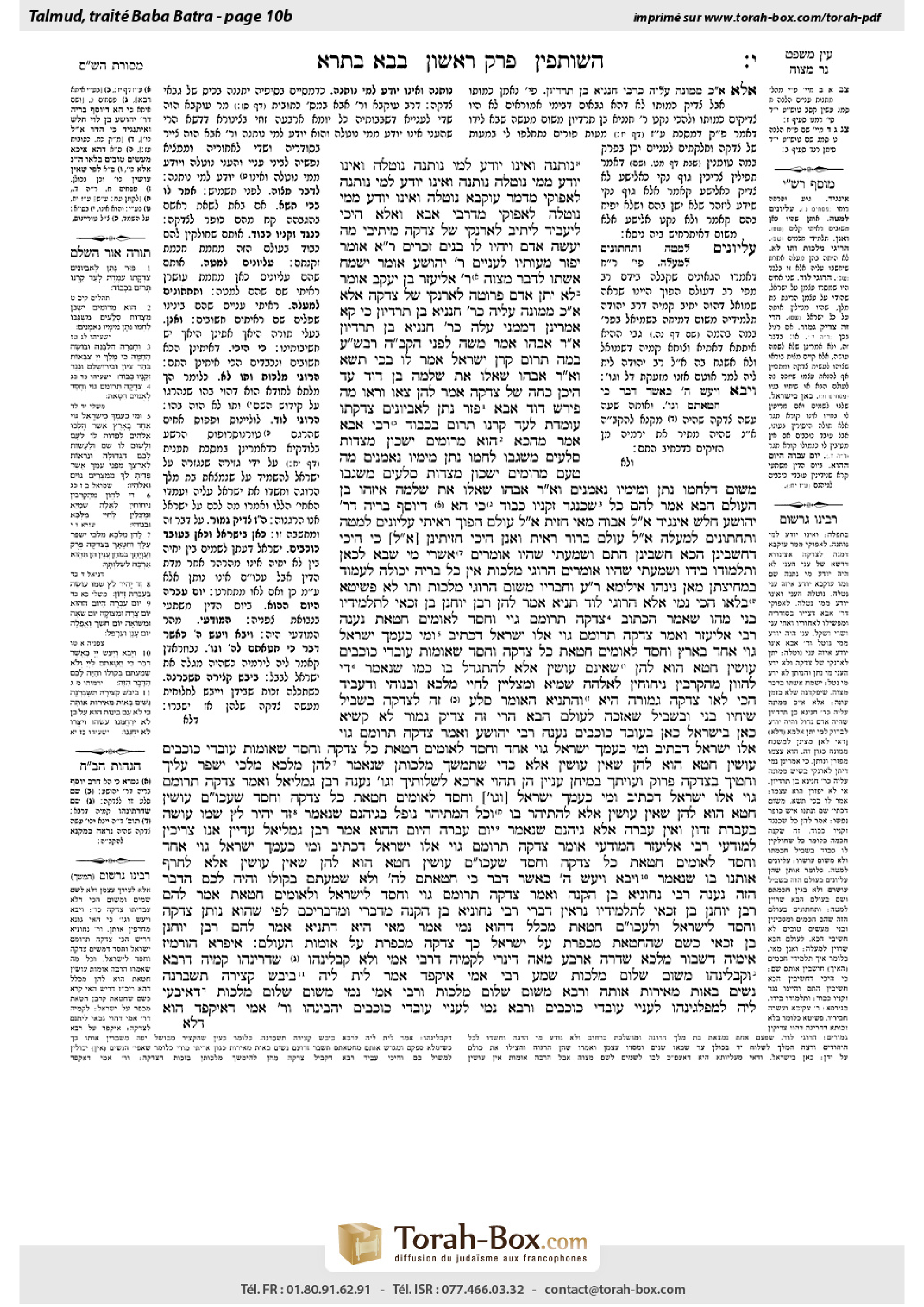
Bava Batra 10b: Talmud study for Daf Yomi
Study the Talmud for Daf Yomi with scanned pages, Hebrew text, English translations from Sefaria and AI-generated French translations.
Passage selection and English or AI-generated French translation are available where the scan has annotations. Daf Study is independent of Torah-Box and Sefaria.
Browse Bava Batra · בבא בתרא · All tractatesBava Batra 10b text and translations
This page of Bava Batra includes the Aramaic text, an English translation and an AI-generated French translation, alongside the scan above.
בבא בתרא י׳ ב · Aramaic and Hebrew text
נוֹתְנָהּ – וְאֵינוֹ יוֹדֵעַ לְמִי נוֹתְנָהּ, נוֹטְלָהּ – וְאֵינוֹ יוֹדֵעַ מִמִּי נוֹטְלָהּ. נוֹתְנָהּ וְאֵינוֹ יוֹדֵעַ לְמִי נוֹתְנָהּ – לְאַפּוֹקֵי מִדְּמַר עוּקְבָא; נוֹטְלָהּ וְאֵינוֹ יוֹדֵעַ מִמִּי נוֹטְלָהּ – לְאַפּוֹקֵי מִדְּרַבִּי אַבָּא. וְאֶלָּא הֵיכִי לֶיעְבֵּיד? לִיתֵּיב לְאַרְנָקִי שֶׁל צְדָקָה.
מֵיתִיבִי: מָה יַעֲשֶׂה אָדָם וְיִהְיוּ לוֹ בָּנִים זְכָרִים? רַבִּי אֱלִיעֶזֶר אוֹמֵר: יְפַזֵּר מְעוֹתָיו לַעֲנִיִּים. רַבִּי יְהוֹשֻׁעַ אוֹמֵר: יְשַׂמַּח אִשְׁתּוֹ לִדְבַר מִצְוָה. רַבִּי אֱלִיעֶזֶר בֶּן יַעֲקֹב אוֹמֵר: לֹא יִתֵּן אָדָם פְּרוּטָה לְאַרְנָקִי שֶׁל צְדָקָה, אֶלָּא אִם כֵּן מְמוּנֶּה עָלֶיהָ כְּרַבִּי חֲנַנְיָא בֶּן תְּרַדְיוֹן! כִּי קָא אָמְרִינַן – דִּמְמַנֵּי עֲלַהּ כְּרַבִּי חֲנַנְיָא בֶּן תְּרַדְיוֹן.
אָמַר רַבִּי אֲבָהוּ, אָמַר מֹשֶׁה לִפְנֵי הַקָּדוֹשׁ בָּרוּךְ הוּא: רִבּוֹנוֹ שֶׁל עוֹלָם, בַּמֶּה תָּרוּם קֶרֶן יִשְׂרָאֵל? אָמַר לוֹ: בְּ״כִי תִשָּׂא״.
וְאָמַר רַבִּי אֲבָהוּ, שָׁאֲלוּ אֶת שְׁלֹמֹה בֶּן דָּוִד: עַד הֵיכָן כֹּחָהּ שֶׁל צְדָקָה? אָמַר לָהֶן, צְאוּ וּרְאוּ מָה פֵּירֵשׁ דָּוִד אַבָּא: ״פִּזַּר נָתַן לָאֶבְיוֹנִים – צִדְקָתוֹ עוֹמֶדֶת לָעַד, קַרְנוֹ תָּרוּם בְּכָבוֹד״. רַבִּי אַבָּא אָמַר מֵהָכָא: ״הוּא מְרוֹמִים יִשְׁכֹּן, מְצָדוֹת סְלָעִים מִשְׂגַּבּוֹ, לַחְמוֹ נִתָּן, מֵימָיו נֶאֱמָנִים״; מָה טַעַם ״מְרוֹמִים יִשְׁכֹּן, מְצָדוֹת סְלָעִים מִשְׂגַּבּוֹ״ – מִשּׁוּם דְּ״לַחְמוֹ נִתָּן״ וּ״מֵימָיו נֶאֱמָנִים״.
וְאָמַר רַבִּי אֲבָהוּ, שָׁאֲלוּ אֶת שְׁלֹמֹה: אֵיזֶהוּ בֶּן הָעוֹלָם הַבָּא? אָמַר לָהֶם: כֹּל שֶׁכְּנֶגֶד זְקֵנָיו כָּבוֹד. כִּי הָא דְּיוֹסֵף בְּרֵיהּ דְּרַבִּי יְהוֹשֻׁעַ חֲלַשׁ, אִינְּגִיד. אֲמַר לֵיהּ אֲבוּהּ: מַאי חָזֵית? אֲמַר לֵיהּ: עוֹלָם הָפוּךְ רָאִיתִי – עֶלְיוֹנִים לְמַטָּה, וְתַחְתּוֹנִים לְמַעְלָה. אֲמַר לֵיהּ: עוֹלָם בָּרוּר רָאִיתָ. וַאֲנַן, הֵיכִי חֲזֵיתִינַּן? [אֲמַר לֵיהּ:] כִּי הֵיכִי דַּחֲשִׁבִינַן הָכָא, חֲשִׁבִינַן הָתָם.
וְשָׁמַעְתִּי שֶׁהָיוּ אוֹמְרִים: אַשְׁרֵי מִי שֶׁבָּא לְכָאן – וְתַלְמוּדוֹ בְּיָדוֹ. וְשָׁמַעְתִּי שֶׁהָיוּ אוֹמְרִים: הֲרוּגֵי מַלְכוּת – אֵין כׇּל בְּרִיָּה יְכוֹלָה לַעֲמוֹד בִּמְחִיצָתָן. מַאן נִינְהוּ? אִילֵימָא רַבִּי עֲקִיבָא וַחֲבֵרָיו, מִשּׁוּם הֲרוּגֵי מַלְכוּת – וְתוּ לָא?! פְּשִׁיטָא, בְּלָאו הָכִי נָמֵי! אֶלָּא הֲרוּגֵי לוֹד.
תַּנְיָא, אָמַר לָהֶן רַבָּן יוֹחָנָן בֶּן זַכַּאי לְתַלְמִידָיו: בָּנַי, מַהוּ שֶׁאָמַר הַכָּתוּב: ״צְדָקָה תְרוֹמֵם גּוֹי, וְחֶסֶד לְאֻמִּים חַטָּאת״? נַעֲנָה רַבִּי אֱלִיעֶזֶר וְאָמַר: ״צְדָקָה תְּרוֹמֵם גּוֹי״ – אֵלּוּ יִשְׂרָאֵל, דִּכְתִיב: ״וּמִי כְּעַמְּךָ יִשְׂרָאֵל גּוֹי אֶחָד בָּאָרֶץ״; ״וָחָסֶד לְאֻמִּים חַטָּאת״ – כׇּל צְדָקָה וָחֶסֶד שֶׁאוּמּוֹת הָעוֹלָם עוֹשִׂין, חֵטְא הוּא לָהֶן; שֶׁאֵינָם עוֹשִׂין אֶלָּא לְהִתְגַּדֵּל בּוֹ, כְּמוֹ שֶׁנֶּאֱמַר: ״דִּי לֶהֱוֹן מְהַקְרְבִין נִיחוֹחִין לֶאֱלָהּ שְׁמַיָּא, וּמְצַלַּיִן לְחַיֵּי מַלְכָּא וּבְנוֹהִי״.
וּדְעָבֵיד הָכִי, לָאו צְדָקָה גְּמוּרָה הִיא?! וְהָתַנְיָא, הָאוֹמֵר: ״סֶלַע זֶה לִצְדָקָה, בִּשְׁבִיל שֶׁיִּחְיוּ בָּנַי״, וּ״בִשְׁבִיל שֶׁאֶזְכֶּה לָעוֹלָם הַבָּא״ – הֲרֵי זֶה צַדִּיק גָּמוּר! לָא קַשְׁיָא; כָּאן בְּיִשְׂרָאֵל, כָּאן בְּגוֹי.
נַעֲנָה רַבִּי יְהוֹשֻׁעַ וְאָמַר: ״צְדָקָה תְּרוֹמֵם גּוֹי״ – אֵלּוּ יִשְׂרָאֵל, דִּכְתִיב: ״וּמִי כְּעַמְּךָ יִשְׂרָאֵל גּוֹי אֶחָד״; ״וָחָסֶד לְאֻמִּים חַטָּאת״ – כׇּל צְדָקָה וָחֶסֶד שֶׁאוּמּוֹת הָעוֹלָם עוֹשִׂין, חֵטְא הוּא לָהֶן; שֶׁאֵין עוֹשִׂין אֶלָּא כְּדֵי שֶׁתִּמָּשֵׁךְ מַלְכוּתָן, שֶׁנֶּאֱמַר: ״לָהֵן מַלְכָּא, מִלְכִּי יִשְׁפַּר עֲלָךְ, וַחֲטָיָךָ בְּצִדְקָה פְרֻק, וַעֲוָיָתָךְ בְּמִחַן עֲנָיִן, הֵן תֶּהֱוֵי אַרְכָא לִשְׁלֵוְתָךְ וְגוֹ׳״.
נַעֲנָה רַבָּן גַּמְלִיאֵל וְאָמַר: ״צְדָקָה תְּרוֹמֵם גּוֹי״ – אֵלּוּ יִשְׂרָאֵל, ״דִּכְתִיב: וּמִי כְּעַמְּךָ יִשְׂרָאֵל [וְגוֹ׳]״; ״וְחֶסֶד לְאֻמִּים חַטָּאת״ – כׇּל צְדָקָה וָחֶסֶד שֶׁגּוֹיִים עוֹשִׂין, חֵטְא הוּא לָהֶן; שֶׁאֵין עוֹשִׂין אֶלָּא לְהִתְיַהֵר בּוֹ, וְכׇל הַמִּתְיַהֵר נוֹפֵל בְּגֵיהִנָּם – שֶׁנֶּאֱמַר: ״זֵד יָהִיר לֵץ שְׁמוֹ, עוֹשֶׂה בְּעֶבְרַת זָדוֹן״ – וְאֵין ״עֶבְרָה״ אֶלָּא גֵּיהִנָּם, שֶׁנֶּאֱמַר: ״יוֹם עֶבְרָה הַיּוֹם הַהוּא״.
אָמַר רַבָּן גַּמְלִיאֵל: עֲדַיִין אָנוּ צְרִיכִין לַמּוֹדָעִי – רַבִּי אֱלִיעֶזֶר הַמּוֹדָעִי אוֹמֵר: ״צְדָקָה תְּרוֹמֵם גּוֹי״ – אֵלּוּ יִשְׂרָאֵל, דִּכְתִיב: ״וּמִי כְּעַמְּךָ יִשְׂרָאֵל גּוֹי אֶחָד״; ״וָחֶסֶד לְאֻמִּים חַטָּאת״ – כׇּל צְדָקָה וָחֶסֶד שֶׁאוּמּוֹת הָעוֹלָם עוֹשִׂין, חֵטְא הוּא לָהֶן; שֶׁאֵין עוֹשִׂין אֶלָּא לְחָרֵף אוֹתָנוּ בּוֹ, שֶׁנֶּאֱמַר: ״וַיָּבֹא וַיַּעַשׂ ה׳ כַּאֲשֶׁר דִּבֵּר, כִּי חֲטָאתֶם לַה׳ וְלֹא שְׁמַעְתֶּם בְּקוֹלוֹ, וְהָיָה לָכֶם הַדָּבָר הַזֶּה״.
נַעֲנָה רַבִּי נְחוּנְיָא בֶּן הַקָּנָה וְאָמַר: ״צְדָקָה תְרוֹמֵם גּוֹי וָחֶסֶד״ – לְיִשְׂרָאֵל; וּ״לְאֻמִּים – חַטָּאת״. אָמַר לָהֶם רַבָּן יוֹחָנָן בֶּן זַכַּאי לְתַלְמִידָיו: נִרְאִין דִּבְרֵי רַבִּי נְחוּנְיָא בֶּן הַקָּנָה מִדְּבָרַי וּמִדִּבְרֵיכֶם, לְפִי שֶׁהוּא נוֹתֵן צְדָקָה וָחֶסֶד לְיִשְׂרָאֵל, וְלָאוּמּוֹת חַטָּאת. מִכְּלָל דְּהוּא נָמֵי אָמַר; מַאי הִיא? דְּתַנְיָא, אָמַר לָהֶם רַבָּן יוֹחָנָן בֶּן זַכַּאי: כְּשֵׁם שֶׁהַחַטָּאת מְכַפֶּרֶת עַל יִשְׂרָאֵל – כָּךְ צְדָקָה מְכַפֶּרֶת עַל אוּמּוֹת הָעוֹלָם.
אִיפְרָא הוֹרְמִיז אִימֵּיהּ דְּשַׁבּוּר מַלְכָּא, שַׁדַּרָה אַרְבַּע מְאָה דִּינָרֵי לְקַמֵּיהּ דְּרַבִּי אַמֵּי, וְלָא קַבְּלִינְהוּ. שַׁדַּרְ[תִּ]ינְהוּ קַמֵּיהּ דְּרָבָא, וְקַבְּלִינְהוּ מִשּׁוּם שְׁלוֹם מַלְכוּת. שְׁמַע רַבִּי אַמֵּי, אִיקְּפַד, אֲמַר: לֵית לֵיהּ: ״בִּיבֹשׁ קְצִירָהּ תִּשָּׁבַרְנָה, נָשִׁים בָּאוֹת מְאִירוֹת אוֹתָהּ״?! וְרָבָא – מִשּׁוּם שְׁלוֹם מַלְכוּת.
וְרַבִּי אַמֵּי נָמֵי, מִשּׁוּם שְׁלוֹם מַלְכוּת! דְּאִיבְּעִי לֵיהּ לְמִפְלְגִינְהוּ לַעֲנִיֵּי גוֹיִים. וְרָבָא נָמֵי – לַעֲנִיֵּי גוֹיִים יַהֲבִינְהוּ; וְרַבִּי אַמֵּי דְּאִיקְּפַד, הוּא
Bava Batra 10b · English translation
It is the type in which one gives the charity without knowing to whom he gave it, and the other one takes it without knowing from whom he took it. The Gemara explains: One gives it without knowing to whom he gave it, this serves to exclude the practice of Mar Ukva, who would personally give charity to poor people without their knowing he was the donor. The other one takes it without knowing from whom he took it; this serves to exclude the practice of Rabbi Abba, who would render his money ownerless, so that poor people would come and take it without his knowing whom he helped, although they would know from whom the money came. The Gemara asks: Rather, how then should one act to conceal his own identity and also remain ignorant of the identities of the recipients? The Gemara answers: The best method is to put the money into the charity purse.
The Gemara raises an objection from what is taught in a baraita: What should a person do to have male offspring? Rabbi Eliezer says: He should distribute his money liberally among the poor. Rabbi Yehoshua says: He should gladden his wife before engaging in the mitzva of conjugal relations. Rabbi Eliezer ben Ya’akov says: A person should not donate a peruta to the charity purse unless a great and trusted individual like Rabbi Ḥananya ben Teradyon is appointed as supervisor over it. This seems to indicate that putting money into the charity box is not always preferred. The Gemara answers: When we say that putting money into the charity box is the preferred way to give charity, this is referring to when a man like Rabbi Ḥananya ben Teradyon is appointed as supervisor over it.
The Gemara discusses other matters concerning charity. Rabbi Abbahu says: Moses said before the Holy One, Blessed be He: Master of the Universe, with what shall the horn of Israel be exalted? God said to him: With the passage of “When you raise,” i.e., Israel will be exalted by way of the donations and charity that they will give, as it is stated: “When you raise the heads of the children of Israel…then shall they give” (Exodus 30:12).
And Rabbi Abbahu says: They asked King Solomon, son of David: How far does the power of charity extend? King Solomon said to them: Go out and see what my father David explained: “He has distributed freely, he has given to the poor, his righteousness endures forever, his horn shall be exalted with honor” (Psalms 112:9). Rabbi Abba said: It is derived from here how far the power of charity extends: “He shall dwell on high, his place of defense shall be the fortress of rocks; his bread shall be given, his water shall be sure” (Isaiah 33:16). What is the reason that “He shall dwell on high, his place of defense shall be the fortress of rocks”? Because “his bread shall be given” to the poor, and “his water shall be sure,” i.e., it shall be given faithfully and he can be trusted in the matter.
And Rabbi Abbahu says: They asked King Solomon: Who is one who is destined for the World-to-Come? King Solomon said to them: All those about whom it is stated: “And before His Elders will be His glory” (Isaiah 24:23), referring to those who are honored in this world due to their wisdom. This is like the incident involving Yosef, son of Rabbi Yehoshua, who became ill and fainted. When he returned to good health, his father said to him: What did you see when you were not conscious? Yosef said to him: I saw an inverted world. Those above, i.e., those who are considered important in this world, were below, insignificant, while those below, i.e., those who are insignificant in this world, were above. Rabbi Yehoshua said to him: You have seen a clear world. The world you have seen is the true world, one in which one’s spiritual and moral standing determines his true importance. Rabbi Yehoshua further asked him: And how did you see us, the Torah scholars, there? Yosef said to him: Just as we are important here, we are important there.
Yosef added: And I heard that they were saying in that world: Happy is the one who arrives with his studies in hand. And I also heard that they were saying: Those executed by the government enjoy such exalted status that no one can stand in their section. The Gemara asks: Who are these martyrs to whom Yosef was referring? If we say that he was referring to Rabbi Akiva and his colleagues, who were killed by the Romans, this cannot be: Is their elevated status due only to the fact that they were martyred by the Roman government and nothing more? These men were exceptional in their piety and sanctity during their lives as well. Therefore it is obvious that even without their martyrdom they would be greater than other people. Rather, it is referring to those like the martyrs of Lod, who died for the sanctification of God’s name but were not Torah scholars.
It is taught in a baraita: Rabban Yoḥanan ben Zakkai said to his students: My sons, what is the meaning of that which the verse states: “Righteousness exalts a nation, but the kindness of the peoples is sin” (Proverbs 14:34)? Rabbi Eliezer answered and said: “Righteousness exalts a nation”; these are the people of Israel, as it is written: “And who is like your people Israel, one nation on the earth?” (I Chronicles 17:21). “But the kindness of the peoples is sin,” meaning that all the acts of charity and kindness that the nations of the world perform are counted as a sin for them, since they perform them only to elevate themselves in prestige, as it is stated: “That they may sacrifice offerings of pleasing aroma to the God of heaven, and pray for the life of the king and of his sons” (Ezra 6:10). Even though they donated offerings, they did so only for their own benefit.
The Gemara asks: And if one acts this way, is it not full-fledged charity? But isn’t it taught in a baraita that one who says: I am contributing this sela to charity so that my sons will live, or if he says: I am performing the mitzva so that I will merit a share in the World-to-Come, this person is a full-fledged righteous person, as far as that mitzva is concerned, even though he has his own welfare in mind? The Gemara answers: This is not difficult. Here, the statement that he is considered absolutely righteous is with regard to a Jew; while there, the statement that such benefaction is not credited as charity is with regard to a gentile.
Rabbi Yehoshua answered Rabban Yoḥanan ben Zakkai’s challenge to interpret the verse and said: “Righteousness exalts a nation”; these are the people of Israel, as it is written: “And who is like your people Israel, one nation on the earth.” “But the kindness of the peoples is sin” means that all the acts of charity and kindness that the nations of the world perform is counted as a sin for them, since they perform them only to perpetuate their dominion, as it is stated by Daniel to Nebuchadnezzar: “Therefore, O king, let my counsel be acceptable to you, and break off your sins by charity, and your iniquities by showing mercy to the poor; that there may be an extension of your serenity” (Daniel 4:24). Since this is the argument that persuaded Nebuchadnezzar, it would appear that his actual motive was his own benefit.
Rabban Gamliel answered and said: “Righteousness exalts a nation”; these are the people of Israel, as it is written: “And who is like your people Israel, one nation on the earth.” “But the kindness of the peoples is sin” means that all the acts of charity and kindness that the nations of the world perform is counted as a sin for them, since they perform them only in order to act haughtily through them, and whoever acts haughtily falls into Gehenna, as it is stated: “The proud and haughty one, scorner is his name, acts in arrogant wrath” (Proverbs 21:24). And wrath means nothing other than Gehenna, as it is stated: “That day is a day of wrath” (Zephaniah 1:15).
Rabban Gamliel said: We still need to hear what the Moda’i has to say, as Rabbi Eliezer HaModa’i says: “Righteousness exalts a nation”; these are the people of Israel, as it is written: “And who is like your people Israel, one nation on the earth.” “But the kindness of the peoples is sin” means that all the acts of charity and kindness that the nations of the world perform is counted as a sin for them, since they perform them only to taunt us with them, as it is stated that the Babylonian officer Nebuzaradan said: “The Lord has brought it, and done according as He has said; because you have sinned against the Lord and have not obeyed His voice, therefore this matter is come upon you” (Jeremiah 40:3).
Rabbi Neḥunya ben HaKana answered and said: “Righteousness exalts a nation and kindness” is referring to Israel; and in addition, “of the peoples is sin.” Rabban Yoḥanan ben Zakkai said to his students: The statement of Rabbi Neḥunya ben HaKana appears to be more precise than both my statement and your statements, because he assigns both righteousness and kindness to Israel, and sin to the peoples of the world. The Gemara asks: By inference, it appears that he, Rabban Yoḥanan ben Zakkai, also offered an interpretation of this verse. What is it? As it is taught in a baraita: Rabban Yoḥanan ben Zakkai said to them that the verse should be understood as follows: Just as a sin-offering atones for Israel, so charity atones for the nations of the world.
It is related that Ifera Hurmiz, the mother of King Shapur, king of Persia, sent four hundred dinars to Rabbi Ami, but he did not accept them. She then sent them to Rava, and he accepted them for the sake of peace with the kingdom. Rabbi Ami heard what Rava had done and was angry. He said: Does Rava not accept the lesson of the verse: “When the boughs are withered, they shall be broken off; the women shall come and set them on fire” (Isaiah 27:11), meaning that when righteousness has ceased from a particular nation, it is time for its citizens to be punished, and therefore we should not help them perform any meritorious deeds, which would delay their punishment? The Gemara asks: And why did Rava accept the money? The Gemara answers: He did so for the sake of peace with the kingdom.
The Gemara asks: But did Rabbi Ami not also see the importance of accepting the money for the sake of peace with the kingdom? The Gemara answers: Rabbi Ami maintains that Rava should have distributed the money to the gentile poor rather than to the Jewish poor, as it is a disgrace to the Jews to require the kindness of the nations of the world in order to support their poor. The Gemara comments: In fact, Rava also gave the money to the gentile poor and not to the Jewish poor. And Rabbi Ami got angry because
Bava Batra 10b · Traduction française (IA)
C'est le cas où l'on donne la charité sans savoir à qui on a donné, et l'autre prend sans savoir d'où il a pris. La Guemara explique : Donner sans savoir à qui on a donné, cela sert à exclure la pratique de Mar Ukva, qui donnait personnellement de la charité aux pauvres sans qu'ils sachent qu'il était le donateur. L'autre prend sans savoir d'où il a pris ; cela sert à exclure la pratique de Rabbi Abba, qui rendait son argent sans propriétaire, afin que les pauvres viennent le prendre sans qu'il ne sache à qui il avait aidé, bien qu'ils sachent d'où venait l'argent. La Guemara demande : Et alors, comment devrait-on agir pour cacher son identité et rester ignorant de l'identité des bénéficiaires ? La Guemara répond : La meilleure méthode est de mettre l'argent dans la boîte de charité.
La Guemara soulève une objection à partir de ce qui est enseigné dans une baraïta : Quel est le moyen qu'une personne doit employer pour avoir des enfants mâles ? Rabbi Eliezer dit : Il doit distribuer généreusement son argent aux pauvres. Rabbi Yéhoshua dit : Il doit réjouir sa femme avant d'entreprendre la mitsva des relations conjugales. Rabbi Eliezer ben Ya'akov dit : Une personne ne doit pas donner un peruta à la boîte de charité, sauf si un grand et fiable individu comme Rabbi Ḥananya ben Teradyon est désigné comme surveillant. Cela semble indiquer que mettre de l'argent dans la boîte de charité n'est pas toujours préférable. La Guemara répond : Lorsque nous disons que mettre de l'argent dans la boîte de charité est la méthode préférée pour donner de la charité, cela se réfère à quand un homme comme Rabbi Ḥananya ben Teradyon est désigné comme surveillant.
La Guemara discute d'autres questions concernant la charité. Rabbi Abbahu dit : Moïse a dit devant le Saint, le Très Haut : Seigneur de l'Univers, avec quoi le corne d'Israël sera-t-il exalté ? Il a dit à lui : Avec la phrase « Quand tu lèveras », c'est-à-dire Israël sera exalté par les dons et la charité qu'ils donneront, comme il est dit : « Quand tu lèveras les têtes des enfants d'Israël… alors ils donneront » (Exode 30:12).
Et Rabbi Abbahu dit : Ils ont interrogé le roi Salomon, fils de David : Jusqu'où s'étend la puissance de la charité ? Le roi Salomon a dit à eux : Sortez et voyez ce que mon père David a expliqué : « Il a distribué librement, il a donné aux pauvres, sa droiture endure éternellement, son corne sera exalté avec honneur » (Psaumes 112:9). Rabbi Abba a dit : C'est à partir de là que l'on comprend jusqu'où s'étend la puissance de la charité : « Il habitera haut, son lieu de défense sera le rocher, son pain sera donné, son eau sera assurée » (Isaïe 33:16). Pourquoi « Il habitera haut, son lieu de défense sera le rocher » ? Parce que « son pain sera donné » aux pauvres, et « son eau sera assurée », c'est-à-dire il sera donné fidèlement et il peut être confiant dans cette affaire.
Et Rabbi Abbahu dit : Ils ont interrogé le roi Salomon : Qui est celui qui est destiné au Monde à Venir ? Le roi Salomon a dit à eux : Tous ceux dont il est dit : « Et devant Ses Anciens sera Sa gloire » (Isaïe 24:23), c'est-à-dire ceux qui sont honorés dans ce monde en raison de leur sagesse. C'est comme l'incident concernant Yosef, fils de Rabbi Yéhoshua, qui est tombé malade et s'est évanoui. Lorsqu'il est revenu à la santé, son père lui a demandé : Qu'as-tu vu quand tu étais inconscient ? Yosef a répondu à lui : J'ai vu un monde renversé. Ceux qui sont considérés importants dans ce monde étaient en bas, insignifiants, tandis que ceux qui sont insignifiants dans ce monde étaient en haut. Rabbi Yéhoshua a dit à lui : Tu as vu un monde clair. Le monde que tu as vu est le vrai monde, celui où la valeur spirituelle et morale d'une personne détermine son importance réelle. Rabbi Yéhoshua a encore demandé à lui : Et comment as-tu vu nous, les savants de la Torah, là-bas ? Yosef a répondu à lui : Comme nous sommes importants ici, nous sommes importants là-bas.
Yosef a ajouté : Et j'ai entendu dire qu'ils disaient dans ce monde : Heureux celui qui arrive avec ses études. Et j'ai aussi entendu dire qu'ils disaient : Ceux exécutés par l'État jouissent d'une telle position élevée que personne ne peut se tenir dans leur section. La Guemara demande : De qui sont ces martyrs auxquels Yosef faisait référence ? Si nous disons qu'il faisait référence à Rabbi Akiva et ses collègues, tués par les Romains, cela ne peut pas être : Leur statut élevé est-il dû uniquement au fait qu'ils ont été exécutés par le gouvernement romain et rien de plus ? Ces hommes étaient exceptionnels en piété et sainteté pendant leur vie. Par conséquent, il est évident qu'ils seraient plus grands que les autres même sans leur martyre. Plutôt, il s'agit de ceux comme les martyrs de Lod, qui sont morts pour la sanctification du nom de Dieu mais n'étaient pas des savants de la Torah.
Il est enseigné dans une baraïta : Rabban Yoḥanan ben Zakkai a dit à ses élèves : Mes fils, quelle est la signification de ce que la Parashah dit : « La justice exalte un peuple, mais la bonté des peuples est un péché » (Proverbes 14:34) ? Rabbi Eliezer a répondu et a dit : « La justice exalte un peuple » ; ce sont les Israélites, comme il est écrit : « Et qui est semblable à votre peuple Israël, une nation sur la terre ? » (I Chroniques 17:21). « Mais la bonté des peuples est un péché », c'est-à-dire que toutes les actions de charité et de bonté que les nations du monde accomplissent sont comptées comme un péché pour eux, car ils les accomplissent uniquement pour s'élever en prestige, comme il est dit : « Qu'ils offrent des offrandes agréables à Dieu du ciel, et prient pour la vie du roi et de ses fils » (Esdras 6:10). Même s'ils ont offert des offrandes, ils le faisaient uniquement pour leur propre bénéfice.
La Guemara demande : Et si l'on agit ainsi, n'est-ce pas une charité complète ? Mais n'est-il pas enseigné dans une baraïta que celui qui dit : Je contribue ce sela à la charité afin que mes fils vivent, ou s'il dit : Je pratique la mitsva afin de mériter une part dans le Monde à Venir, cette personne est une personne justement accomplie, concernant cette mitsva, même s'il a en tête son propre bien-être ? La Guemara répond : Ce n'est pas difficile. Ici, l'affirmation qu'il est considéré comme un justement accompli est concernant un Juif ; là-bas, l'affirmation que cette bienfaisance n'est pas comptée comme une charité est concernant un non-Juif.
Rabbi Yéhoshua a répondu au défi de Rabban Yochanan ben Zakki d'interpréter la verset et a dit : « La justice exalte un peuple » ; ces sont les peuples d'Israël, comme il est écrit : « Et qui est semblable à votre peuple Israël, un seul peuple sur la terre. » « Mais la bonté des peuples est un péché » signifie que toutes les œuvres de charité et de bienfaits que les nations du monde accomplissent sont comptées comme un péché pour elles, car elles les accomplissent uniquement pour prolonger leur domination, comme il est dit par Daniel à Nebuchadnetsar : « Par conséquent, ô roi, que mon conseil soit agréable à tes yeux, et coupe tes péchés par la charité, et tes iniquités par la bienveillance envers les pauvres ; afin que l'extension de ta tranquillité » (Daniel 4:24). Puisque c'est l'argument qui a convaincu Nebuchadnetsar, il semble que son véritable motif fût son propre intérêt.
Rabban Gamliel a répondu et a dit : « La justice exalte un peuple » ; ces sont les peuples d'Israël, comme il est écrit : « Et qui est semblable à votre peuple Israël, un seul peuple sur la terre. » « Mais la bonté des peuples est un péché » signifie que toutes les œuvres de charité et de bienfaits que les nations du monde accomplissent sont comptées comme un péché pour elles, car elles les accomplissent uniquement pour agir avec hauteur à travers elles, et celui qui agit avec hauteur tombe en Géhenna, comme il est dit : « Le fier et l'arrogant, le méprisant est son nom, agit en colère arrogante » (Proverbes 21:24). Et la colère signifie rien d'autre que Géhenna, comme il est dit : « Ce jour est un jour de colère » (Zacharie 1:15).
Rabban Gamliel a dit : Nous devons encore entendre ce que le Moda'i a à dire, car Rabbi Eliezer HaModa'i dit : « La justice exalte un peuple » ; ces sont les peuples d'Israël, comme il est écrit : « Et qui est semblable à votre peuple Israël, un seul peuple sur la terre. » « Mais la bonté des peuples est un péché » signifie que toutes les œuvres de charité et de bienfaits que les nations du monde accomplissent sont comptées comme un péché pour elles, car elles les accomplissent uniquement pour nous taquiner avec elles, comme il est dit que l'officier babylonien Nebuzaradan a dit : « L'Éternel a fait cela, et il l'a fait selon ce qu'Il a dit ; car vous avez péché contre l'Éternel et n'avez pas obéi à Sa voix, donc c'est cela qui est arrivé à vous » (Jérémie 40:3).
Rabbi Néhunya ben HaKana a répondu et a dit : « La justice exalte un peuple et la bonté » se réfère à Israël ; et en outre, « de la part des peuples est un péché. » Rabban Yochanan ben Zakki a dit à ses élèves : La déclaration de Rabbi Néhunya ben HaKana semble être plus précise que mes déclarations et vos déclarations, car il attribue à la fois la justice et la bonté à Israël, et le péché aux peuples du monde. La Guemara demande : Par déduction, il semble que lui, Rabban Yochanan ben Zakki, ait également offert une interprétation de ce verset. Quelle est-elle ? Comme il est enseigné dans une baraïta : Rabban Yochanan ben Zakki a dit à eux que le verset doit être compris ainsi : Tout comme l'offrande expiatoire atone pour Israël, ainsi la charité atone pour les nations du monde.
Il est rapporté que Ifera Hurmiz, la mère du roi Shapur, roi de Perse, a envoyé quatre cents dinars à Rabbi Ami, mais il ne les a pas acceptés. Elle les a ensuite envoyés à Rava, et il les a acceptés pour la paix avec le royaume. Rabbi Ami a entendu ce que Rava avait fait et s'est fâché. Il a dit : Rava ne comprend pas la leçon du verset : « Quand les branches sont fanées, elles seront brisées ; les femmes viendront et les mettront à feu » (Isaïe 27:11), signifiant que quand la justice a cessé d'un peuple particulier, c'est le moment pour ses citoyens d'être punis, et donc nous ne devrions pas aider à accomplir des mérites, ce qui retarderait leur punition ? La Guemara demande : Et pourquoi Rava a-t-il accepté l'argent ? La Guemara répond : Il l'a fait pour la paix avec le royaume.
La Guemara demande : Mais Rabbi Ami n'a-t-il pas aussi vu l'importance d'accepter l'argent pour la paix avec le royaume ? La Guemara répond : Rabbi Ami maintient que Rava aurait dû distribuer l'argent aux pauvres païens plutôt qu'aux pauvres juifs, car il est honteux pour les Juifs de demander la bonté des nations du monde pour soutenir leurs pauvres. La Guemara commente : En fait, Rava a aussi donné l'argent aux pauvres païens et non aux pauvres juifs. Et Rabbi Ami s'est fâché parce que
Traduction française générée par IA à partir de l’édition anglaise de Sefaria. Vérifie toujours un passage avec le texte source.
Text from Sefaria: William Davidson Edition - Vocalized Aramaic (CC BY NC); William Davidson Edition - English (CC BY NC).