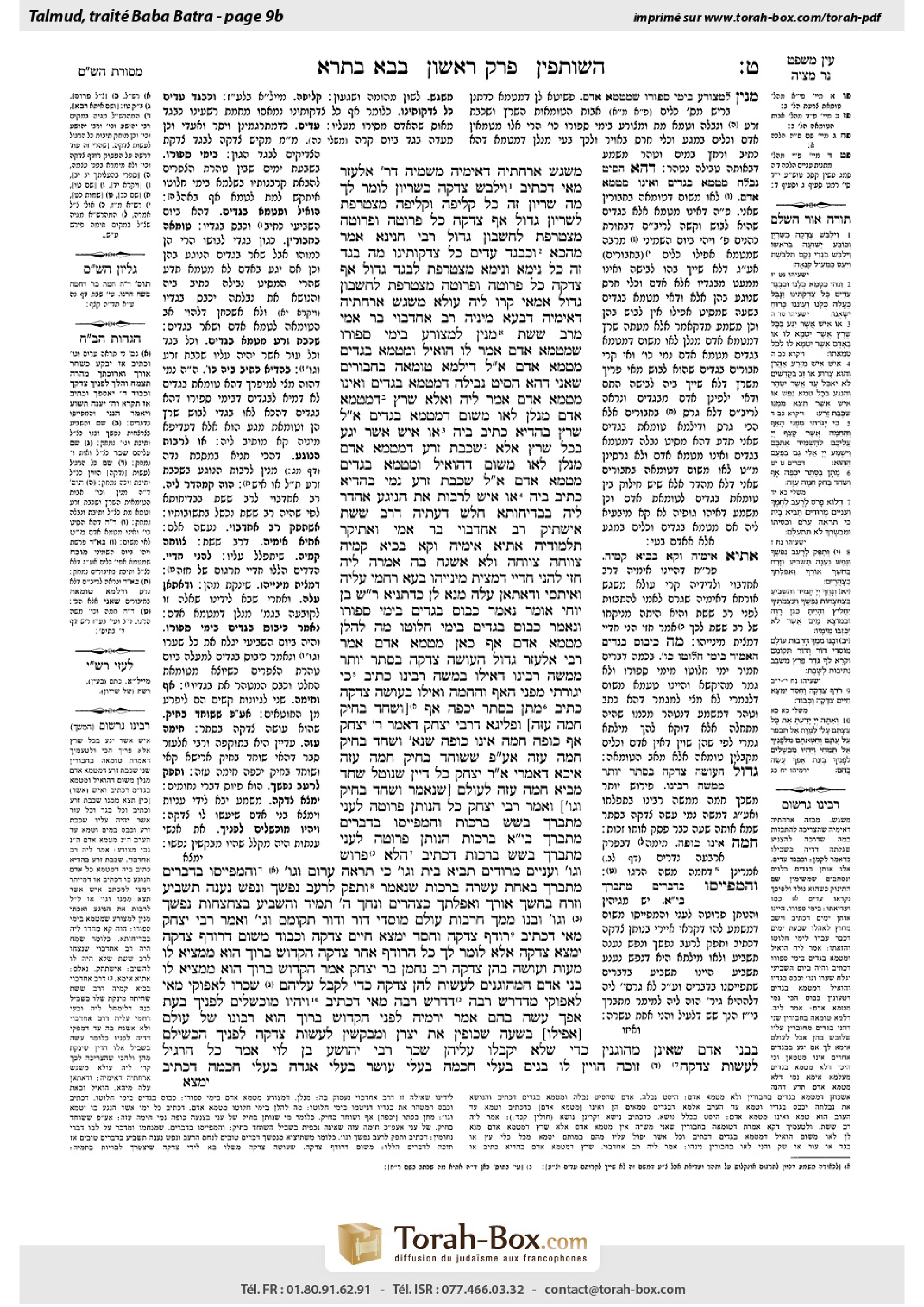
Bava Batra 9b: Talmud study for Daf Yomi
Study the Talmud for Daf Yomi with scanned pages, Hebrew text, English translations from Sefaria and AI-generated French translations.
Passage selection and English or AI-generated French translation are available where the scan has annotations. Daf Study is independent of Torah-Box and Sefaria.
Browse Bava Batra · בבא בתרא · All tractatesBava Batra 9b text and translations
This page of Bava Batra includes the Aramaic text, an English translation and an AI-generated French translation, alongside the scan above.
בבא בתרא ט׳ ב · Aramaic and Hebrew text
״מְשַׁגֵּשׁ אֹרְחָתַיהּ דְּאִימֵּיהּ״, מִשְּׁמֵיהּ דְּרַבִּי אֶלְעָזָר – מַאי דִּכְתִיב: ״וַיִּלְבַּשׁ צְדָקָה כַּשִּׁרְיֹן״? לוֹמַר לָךְ: מָה שִׁרְיוֹן זֶה – כׇּל קְלִיפָּה וּקְלִיפָּה מִצְטָרֶפֶת לְשִׁרְיוֹן גָּדוֹל, אַף צְדָקָה – כׇּל פְּרוּטָה וּפְרוּטָה מִצְטָרֶפֶת לְחֶשְׁבּוֹן גָּדוֹל. רַבִּי חֲנִינָא אָמַר מֵהָכָא: ״וּכְבֶגֶד עִדִּים כׇּל צִדְקֹתֵינוּ״; מָה בֶּגֶד זֶה – כׇּל נִימָא וְנִימָא מִצְטָרֶפֶת לְבֶגֶד גָּדוֹל, אַף צְדָקָה – כׇּל פְּרוּטָה וּפְרוּטָה מִצְטָרֶפֶת לְחֶשְׁבּוֹן גָּדוֹל.
אַמַּאי קָרוּ לֵיהּ ״עוּלָּא מְשַׁגֵּשׁ אֹרְחָתַיהּ דְּאִימֵּיהּ״? דִּבְעָא מִינֵּיהּ רַב אַחָדְבוּי בַּר אַמֵּי מֵרַב שֵׁשֶׁת: מִנַּיִן לִמְצוֹרָע בִּימֵי סְפוֹרוֹ, שֶׁמְטַמֵּא אָדָם? אָמַר לוֹ: הוֹאִיל וּמְטַמֵּא בְּגָדִים, מְטַמֵּא אָדָם.
אֲמַר לֵיהּ: דִּילְמָא טוּמְאָה בְּחִבּוּרִים שָׁאנֵי, דְּהָא הֵסִיט נְבֵילָה – דִּמְטַמֵּא בְּגָדִים, וְאֵינוֹ מְטַמֵּא אָדָם!
אֲמַר לֵיהּ: וְאֶלָּא שֶׁרֶץ דִּמְטַמֵּא אָדָם – מְנָלַן? לָאו מִשּׁוּם דִּמְטַמֵּא בְּגָדִים?! אֲמַר לֵיהּ: שֶׁרֶץ בְּהֶדְיָא כְּתִיב בֵּיהּ: ״אוֹ אִישׁ אֲשֶׁר יִגַּע בְּכׇל שֶׁרֶץ״. אֶלָּא שִׁכְבַת זֶרַע דִּמְטַמֵּא אָדָם – מְנָלַן? לָאו מִשּׁוּם דְּהוֹאִיל וּמְטַמֵּא בְּגָדִים, מְטַמֵּא אָדָם? אֲמַר לֵיהּ: שִׁכְבַת זֶרַע נָמֵי בְּהֶדְיָא כְּתִיב בֵּיהּ: ״אוֹ אִישׁ״ – לְרַבּוֹת אֶת הַנּוֹגֵעַ.
אַהְדַּר לֵיהּ בִּבְדִיחוּתָא. חֲלַשׁ דַּעְתֵּיהּ דְּרַב שֵׁשֶׁת, אִישְׁתִּיק רַב אַחָדְבוּי בַּר אַמֵּי וְאִתְיַקַּר תַּלְמוּדֵיהּ. אָתְיָא אִימֵּיהּ וְקָא בָּכְיָא קַמֵּיהּ, צָוְוחָה צָוְוחָה וְלָא אַשְׁגַּח בָּהּ. אֲמַרָה לֵיהּ: חֲזִי לְהָנֵי חַדְיֵי דִּמְצֵית מִינַּיְיהוּ. בְּעָא רַחֲמֵי עֲלֵיהּ, וְאִיתַּסִּי.
וְדַאֲתָאן עֲלַהּ; מְנָא לַן? כִּדְתַנְיָא, רַבִּי שִׁמְעוֹן בֶּן יוֹחַי אוֹמֵר: נֶאֱמַר כִּבּוּס בְּגָדִים בִּימֵי סְפוֹרוֹ, וְנֶאֱמַר כִּבּוּס בְּגָדִים בִּימֵי חִלּוּטוֹ, מָה לְהַלָּן מְטַמֵּא אָדָם – אַף כָּאן מְטַמֵּא אָדָם.
אָמַר רַבִּי אֶלְעָזָר: גָּדוֹל הָעוֹשֶׂה צְדָקָה בַּסֵּתֶר, יוֹתֵר מִמֹּשֶׁה רַבֵּינוּ – דְּאִילּוּ בְּמֹשֶׁה רַבֵּינוּ כְּתִיב: ״כִּי יָגֹרְתִּי מִפְּנֵי הָאַף וְהַחֵמָה״, וְאִילּוּ בְּעוֹשֶׂה צְדָקָה כְּתִיב: ״מַתָּן בַּסֵּתֶר יִכְפֶּה אָף, [וְשֹׁחַד בַּחֵק חֵמָה עַזָּה]״. וּפְלִיגָא דְּרַבִּי יִצְחָק, דְּאָמַר רַבִּי יִצְחָק: אַף כּוֹפֶה, חֵמָה אֵינוֹ כּוֹפֶה; שֶׁנֶּאֱמַר: ״וְשֹׁחַד בַּחֵק חֵמָה עַזָּה״ – אַף עַל פִּי שֶׁשּׁוֹחַד בַּחֵיק – חֵמָה עַזָּה. אִיכָּא דְּאָמְרִי, אָמַר רַבִּי יִצְחָק: כׇּל דַּיָּין שֶׁנּוֹטֵל שֹׁחַד – מֵבִיא חֵמָה עַזָּה לָעוֹלָם [שֶׁנֶּאֱמַר: וְשֹׁחַד בַּחֵק וְגוֹ׳].
וְאָמַר רַבִּי יִצְחָק: כׇּל הַנּוֹתֵן פְּרוּטָה לְעָנִי – מִתְבָּרֵךְ בְּשֵׁשׁ בְּרָכוֹת, וְהַמְפַיְּיסוֹ בִּדְבָרִים – מִתְבָּרֵךְ בְּאַחַת עֶשְׂרֵה בְּרָכוֹת. הַנּוֹתֵן פְּרוּטָה לְעָנִי מִתְבָּרֵךְ בְּשֵׁשׁ בְּרָכוֹת – דִּכְתִיב: ״הֲלֹא פָרֹשׂ וְגוֹ׳, וַעֲנִיִּים מְרוּדִים תָּבִיא בָיִת (וְגוֹ׳) כִּי תִרְאֶה עָרֹם וְגוֹ׳״.
וְהַמְפַיְּיסוֹ בִּדְבָרִים מִתְבָּרֵךְ בְּאַחַת עֶשְׂרֵה בְּרָכוֹת – שֶׁנֶּאֱמַר: ״וְתָפֵק לָרָעֵב נַפְשֶׁךָ וְנֶפֶשׁ נַעֲנָה תַּשְׂבִּיעַ, וְזָרַח בַּחֹשֶׁךְ אוֹרֶךָ וַאֲפֵלָתְךָ כַּצׇּהֳרָיִם. וְנָחֲךָ ה׳ תָּמִיד, וְהִשְׂבִּיעַ בְּצַחְצָחוֹת נַפְשֶׁךָ וְגוֹ׳, וּבָנוּ מִמְּךָ חׇרְבוֹת עוֹלָם, מוֹסְדֵי דוֹר וָדוֹר תְּקוֹמֵם וְגוֹ׳״.
וְאָמַר רַבִּי יִצְחָק, מַאי דִּכְתִיב: ״רוֹדֵף צְדָקָה וָחָסֶד יִמְצָא חַיִּים צְדָקָה וְכָבוֹד״? מִשּׁוּם דְּרוֹדֵף צְדָקָה – יִמְצָא צְדָקָה?! אֶלָּא לוֹמַר לָךְ: כׇּל הָרוֹדֵף אַחַר צְדָקָה – הַקָּדוֹשׁ בָּרוּךְ הוּא מַמְצִיא לוֹ מָעוֹת וְעוֹשֶׂה בָּהֶן צְדָקָה.
רַב נַחְמָן בַּר יִצְחָק אָמַר: הַקָּדוֹשׁ בָּרוּךְ הוּא מַמְצִיא לוֹ בְּנֵי אָדָם הַמְהוּגָּנִים לַעֲשׂוֹת לָהֶן צְדָקָה, כְּדֵי לְקַבֵּל עֲלֵיהֶם שְׂכָרוֹ. לְאַפּוֹקֵי מַאי? לְאַפּוֹקֵי מִדְּדָרֵשׁ רַבָּה – דְּדָרֵשׁ רַבָּה, מַאי דִּכְתִיב: ״וְיִהְיוּ מֻכְשָׁלִים לְפָנֶיךָ, בְּעֵת אַפְּךָ עֲשֵׂה בָּהֶם״? אָמַר יִרְמְיָה לִפְנֵי הַקָּדוֹשׁ בָּרוּךְ הוּא: רִבּוֹנוֹ שֶׁל עוֹלָם, [אֲפִילּוּ] בְּשָׁעָה שֶׁכּוֹפִין אֶת יִצְרָן וּמְבַקְּשִׁין לַעֲשׂוֹת צְדָקָה לְפָנֶיךָ, הַכְשִׁילֵם בִּבְנֵי אָדָם שֶׁאֵינָן מְהוּגָּנִין, כְּדֵי שֶׁלֹּא יְקַבְּלוּ עֲלֵיהֶן שָׂכָר.
רַבִּי יְהוֹשֻׁעַ בֶּן לֵוִי אָמַר: כׇּל הָרָגִיל לַעֲשׂוֹת צְדָקָה – זוֹכֶה, הָוְיִין לוֹ בָּנִים בַּעֲלֵי חׇכְמָה, בַּעֲלֵי עוֹשֶׁר, בַּעֲלֵי אַגָּדָה. בַּעֲלֵי חׇכְמָה – דִּכְתִיב:
Bava Batra 9b · English translation
who perverted the ways of his mother. He said in the name of Rabbi Elazar: What is the meaning of that which is written: “And He donned charity like a coat of mail” (Isaiah 59:17)? This verse serves to tell you that just as with regard to this coat of mail, each and every scale of which it is fashioned combines to form one large coat of mail, so too with regard to charity, each and every peruta that one gives combines to form a great sum. Rabbi Ḥanina says: The same idea is derived from here, as it is stated: “And all our charity is as a polluted garment” (Isaiah 64:5). Just as with regard to this garment, each and every thread in it combines to form one large garment, so too with regard to charity, each and every peruta combines to form a great sum.
The Gemara comments: Why was this Sage called the infant who perverted the ways of his mother? It was because of the following incident: Rav Aḥadvoi bar Ami asked Rav Sheshet: From where is it derived that a leper renders a person impure through contact during his days of counting, i.e., during the seven days that the leper must count from the start of his purification process, when he brings his birds, until he completes that process with the bringing of his sacrifices? Rav Sheshet said to him: Since he renders his garments impure, as it states that on the seventh day of his purification he must wash his clothes (see Leviticus 14:9), he also renders people impure.
Rav Aḥadvoi said to him: Perhaps connected impurity is different, meaning perhaps he renders his garments impure because they are connected to the source of the impurity, but this does not mean that he renders impure a person whom he touches. A proof for this distinction may be brought from the fact that if one moves an animal carcass, an action that renders him impure even if there was no actual contact with the carcass, he renders the garments that he is wearing impure but does not render another person impure.
Rav Sheshet said to him: But from where do we derive that the carcass of a creeping animal renders a person impure? Is it not because we know that it renders his garments impure? Rav Aḥadvoi said to him: It is written explicitly with regard to the carcass of a creeping animal: “Or a man who touches any creeping animal, whereby he may be made unclean” (Leviticus 22:5). Rav Sheshet said to him: But from where do we derive that semen renders a person impure? Is it not because we say that since it renders his garments impure (see Leviticus 15:17) it also renders a person impure? Rav Aḥadvoi said to him: It is also written explicitly with regard to semen: “Or a man from whom semen is expelled” (Leviticus 22:4), and the Sages expound the superfluous word “or” as serving to include as impure one who touches semen.
The Gemara relates that with each of his answers Rav Aḥadvoi responded to Rav Sheshet in a mocking tone, intimating that he doubted Rav Sheshet’s grasp of Torah verses. Rav Sheshet was deeply offended, and as punishment, Rav Aḥadvoi bar Ami became mute and forgot his learning. Rav Aḥadvoi’s mother came and wept before Rav Sheshet. She cried and cried but he ignored her. As she had once been Rav Sheshet’s nursemaid, she said to him: Look at these breasts of mine from which you suckled. Upon hearing that, Rav Sheshet prayed for mercy for Rav Aḥadvoi, and he was healed. And since it was Rav Aḥadvoi whose behavior led to his mother’s acting in this manner, he was referred to as the infant who perverted his mother’s ways.
The Gemara comments: With regard to that which we arrived at, i.e., this particular subject, let us clarify the matter: From where do we derive that a leper renders impure a person with whom he comes into contact during his days of counting? As it is taught in a baraita: Rabbi Shimon bar Yoḥai says: Washing garments is stated with respect to his days of counting, and washing garments is stated with respect to his days of confirmed leprosy, after he has been declared conclusively impure by a priest. Just as there, when he is a confirmed leper he renders a person impure, as is explicitly stated in the Torah, so too here, during his days of counting he renders a person impure.
§ The Gemara resumes its discussion of the virtues of giving charity. Rabbi Elazar said: One who performs acts of charity in secret is greater than Moses, our teacher. Whereas with regard to Moses, our teacher, it is written: “For I was afraid of the anger and the wrath” (Deuteronomy 9:19), with regard to one who performs acts of charity it is written: “A gift in secret pacifies anger, and a present in the bosom fierce wrath” (Proverbs 21:14). The Gemara comments: And this statement disagrees with a statement of Rabbi Yitzḥak, as Rabbi Yitzḥak says: A secret gift pacifies anger, but it does not pacify wrath, as it is stated: “And a present in the bosom fierce wrath,” meaning that although a present is in the bosom, i.e., even if one gives charity in secret, nevertheless fierce wrath can still harm him. There are those who say that Rabbi Yitzḥak says as follows: Any judge who accepts a bribe brings fierce wrath upon the world, as it is stated: “And a present in the bosom fierce wrath.”
And Rabbi Yitzḥak says: Anyone who gives a peruta to a poor person receives six blessings, and whoever consoles him with words of comfort and encouragement receives eleven blessings. The Gemara explains: One who gives a peruta to a poor person receives six blessings, as it is written: “Is it not to share your bread with the hungry, and that you shall bring the poor that are cast out to your house? When you see the naked, that you cover him” (Isaiah 58:7). And the next verses list six blessings: “Then shall your light break forth like the dawn, and your health shall spring forth speedily, and your righteousness shall go before you, the glory of the Lord shall be your rearguard. Then, shall you call, and the Lord shall answer; you shall cry, and He shall say: Here I am” (Isaiah 58:8–9).
And whoever consoles a poor person with words of comfort and encouragement receives eleven blessings, as it is stated: “And if you draw out your soul to the hungry and satisfy the afflicted soul, then shall your light shine in darkness, and your gloom shall be as the noonday. And the Lord shall guide you continually, and satisfy your thirst in drought… And they that shall be of you shall build the old waste places, you shall raise up the foundations of many generations” (Isaiah 58:10–12).
And Rabbi Yitzḥak says: What is the meaning of that which is written: “He who pursues charity and mercy finds life, charity, and honor” (Proverbs 21:21)? Is this to say that because one has pursued charity, he himself shall find charity? That is, shall the reward of one who has always given charity be that he will eventually become poor and other people will act charitably toward him? Rather, the verse serves to tell you that with regard to anyone who pursues charity, giving to the poor and leading others to do so, the Holy One, Blessed be He, furnishes him with money with which to perform his acts of charity.
Rav Naḥman bar Yitzḥak says: The Holy One, Blessed be He, sends him people who are deserving of charity, so that he will reap his just reward for helping them. The Gemara comments: What does this statement serve to exclude? It serves to exclude Rabba’s homiletical interpretation of a different verse, as Rabba taught: What is the meaning of that which is written: “Let them be made to stumble before You; deal thus with them in the time of Your anger” (Jeremiah 18:23)? The prophet Jeremiah said before the Holy One, Blessed be He: Master of the Universe, even when those wicked men who pursued me subdue their inclinations and seek to perform acts of charity before You, cause them to stumble upon dishonest people who are not deserving of charity, so that they will not receive reward for coming to their assistance.
Rabbi Yehoshua ben Levi says: Anyone who is accustomed to performing acts of charity merits blessing; he will have sons who are masters of wisdom, masters of wealth, and masters of aggada. The Gemara explains: Masters of wisdom, as it is written:
Bava Batra 9b · Traduction française (IA)
qui a corrompu les voies de sa mère. Il cite le nom de Rabbi Eléazar : Quelle est la signification de ce qui est écrit : « Et il vêtit la charité comme une armure » (Yachout 59:17) ? Cette versette sert à vous dire que tout comme cette armure, chaque éclat qui la compose se combine pour former une grande armure, de même la charité, chaque petite somme que l'on donne se combine pour former une grande somme. Rabbi Hanaïna dit : L'idée est tirée de là aussi, car il est dit : « Et toute notre charité est comme une robe souillée » (Yachout 64:5). Tout comme cette robe, chaque fil qui la compose se combine pour former une grande robe, de même la charité, chaque petite somme que l'on donne se combine pour former une grande somme.
Le Guemara commente : Pourquoi ce Sage était-il appelé l'enfant qui a corrompu les voies de sa mère ? C'était à cause de l'incident suivant : Rav Achaï bar Ami demanda à Rav Sheshét : D'où vient-on que le lépreux rend impur une personne par contact pendant ses jours de comptage, c'est-à-dire pendant les sept jours qu'il doit compter à partir du début de son processus de purification, lorsqu'il apporte ses oiseaux, jusqu'à ce qu'il accomplisse ce processus avec l'apport de ses sacrifices ? Rav Sheshét répondit à lui : Puisque cela rend ses vêtements impurs, comme il est dit que le septième jour de sa purification il doit laver ses vêtements (voir Lévitique 14:9), il rend aussi les personnes impures.
Rav Achaï dit à lui : Peut-être que l'impureté connectée est différente, c'est-à-dire peut-être qu'il rend ses vêtements impurs parce qu'ils sont connectés à la source de l'impureté, mais cela ne signifie pas qu'il rend impur une personne qu'il touche. Une preuve de cette distinction pourrait être tirée du fait que si l'on déplace un cadavre d'animaux, une action qui rend impur même sans contact réel avec le cadavre, il rend impur les vêtements qu'on porte mais ne rend pas une autre personne impure.
Rav Sheshét dit à lui : Mais d'où vient-on que le cadavre d'un animal rampant rend une personne impure ? N'est-ce pas parce qu'on sait qu'il rend ses vêtements impurs ? Rav Achaï dit à lui : Il est écrit explicitement concernant le cadavre d'un animal rampant : « Ou un homme qui touche tout animal rampant, par lequel il peut être rendu impur » (Lévitique 22:5). Rav Sheshét dit à lui : Mais d'où vient-on que le sperme rend une personne impure ? N'est-ce pas parce qu'on dit que puisque cela rend ses vêtements impurs (voir Lévitique 15:17), il rend aussi une personne impure ? Rav Achaï dit à lui : Il est aussi écrit explicitement concernant le sperme : « Ou un homme dont le sperme est expulsé » (Lévitique 22:4), et les Sages expliquent le mot superflu « ou » comme servant à inclure celui qui touche le sperme.
Le Guemara rapporte que pour chaque réponse qu'il donnait, Rav Achaï répondait à Rav Sheshét avec un ton moqueur, intimant qu'il douterait de la compréhension de Rav Sheshét des versets de la Torah. Rav Sheshét fut profondément offensé, et en punition, Rav Achaï bar Ami devint muet et oublia ses études. La mère de Rav Achaï vint pleurer devant Rav Sheshét. Elle pleura et pleura mais il l'ignora. Comme elle avait été autrefois la nourrice de Rav Sheshét, elle lui dit : Regarde ces seins dont tu as suivi le lait. En entendant cela, Rav Sheshét pria pour la miséricorde de Rav Achaï, et il fut guéri. Et puisque c'était Rav Achaï dont le comportement avait conduit sa mère à agir ainsi, il fut appelé l'enfant qui avait corrompu les voies de sa mère.
Le Guemara commente : Concernant ce que nous avons établi, c'est-à-dire cette matière particulière, clarifions-la : D'où vient-on que le lépreux rend impur une personne avec laquelle il entre en contact pendant ses jours de comptage ? Comme il est enseigné dans une baraïta : Rabbi Simon bar Yochai dit : Le lavage des vêtements est mentionné concernant ses jours de comptage, et le lavage des vêtements est mentionné concernant ses jours de lépreuse confirmée, après qu'il ait été déclaré impur de manière définitive par un prêtre. Tout comme là, lorsqu'il est une lépreuse confirmée, il rend une personne impure, comme il est explicitement dit dans la Torah, de même ici, pendant ses jours de comptage, il rend une personne impure.
§ Le Guemara reprend la discussion sur les vertus de la charité. Rabbi Eléazar dit : Celui qui fait des actes de charité en secret est supérieur à Moïse, notre maître. Concernant Moïse, notre maître, il est écrit : « Car j'avais peur de la colère et de la fureur » (Deutéronome 9:19), concernant celui qui fait des actes de charité, il est écrit : « Un don secret apaise la colère, et un présent dans le sein la fureur impitoyable » (Proverbes 21:14). Le Guemara commente : Et cette déclaration contredit une déclaration de Rabbi Yitzhak, car Rabbi Yitzhak dit : Un don secret apaise la colère, mais il ne apaise pas la fureur, comme il est dit : « Et un présent dans le sein la fureur impitoyable », c'est-à-dire que même si un présent est dans le sein, c'est-à-dire même si l'on donne de la charité en secret, la fureur impitoyable peut encore nuire. Certains disent que Rabbi Yitzhak dit ainsi : Tout juge qui accepte une rançon apporte la fureur impitoyable au monde, comme il est dit : « Et un présent dans le sein la fureur impitoyable ».
Et Rabbi Yitzhak dit : Quiconque donne un peruta à un pauvre reçoit six bénédictions, et celui qui console avec des paroles de réconfort et d'encouragement reçoit onze bénédictions. Le Guemara explique : Celui qui donne un peruta à un pauvre reçoit six bénédictions, comme il est écrit : « N'est-ce pas partager ton pain avec le faim, et que tu apportes le pauvre qui est expulsé à ta maison ? Quand tu vois le nu, que tu le couvres » (Isaïe 58:7). Et les versets suivants listent six bénédictions : « Alors ton éclat brillera comme l'aube, et ta santé sortira rapidement, et ta justice marchera devant toi, la gloire du Seigneur sera ton escorte. Alors, tu appelleras, et le Seigneur répondra ; tu crieras, et Il dira : Ici je suis » (Isaïe 58:8–9).
Et celui qui console un pauvre avec des paroles de réconfort et d'encouragement reçoit onze bénédictions, comme il est dit : « Et si tu étends ton âme vers le faim, et que tu satisfasses l'âme opprimée, alors ta lumière brillera dans l'obscurité, et ton ombre sera comme le midi. Et l'Éternel te guidera continuellement, et il satisfera ta soif en temps de sécheresse… Et ceux qui seront à toi reconstruiront les lieux abandonnés, tu érigeras les fondations de plusieurs générations » (Isaïe 58:10–12).
Et Rabbi Yitzḥak dit : Quelle est la signification de ce qui est écrit : « Celui qui poursuit la charité et la miséricorde trouvera la vie, la charité et l'honneur » (Proverbes 21:21) ? Est-ce pour dire que parce qu'on a poursuivi la charité, on trouvera lui-même la charité ? C'est-à-dire, la récompense de celui qui a toujours donné la charité sera qu'il deviendra un jour pauvre et que d'autres personnes agiront charitablement à son égard ? Plutôt, la parole sert à te dire que concernant celui qui poursuit la charité, donner à l'indigent et conduire les autres à le faire, l'Éternel, béni soit Son Nom, lui fournit de l'argent avec lequel il accomplira ses actes de charité.
Rav Naḥman bar Yitzḥak dit : L'Éternel, béni soit Son Nom, envoie à lui des personnes dignes de charité, afin qu'il récolte sa juste récompense pour avoir aidé celles-ci. La Guemara commente : Quel est le but de cette déclaration ? Elle sert à exclure l'interprétation homiletique de Rabba d'une autre versette, comme Rabba enseignait : Quelle est la signification de ce qui est écrit : « Faites-leur tomber devant toi ; traitez-les ainsi en temps de votre colère » (Jérémie 18:23) ? Le prophète Jérémie a dit devant l'Éternel, béni soit Son Nom : Seigneur de l'Univers, même quand ces hommes mauvais qui m'ont persécuté ont dompté leurs inclinations et cherchent à accomplir des actes de charité devant toi, fais-leur tomber sur des personnes malhonnêtes qui ne sont pas dignes de charité, afin qu'ils ne reçoivent pas de récompense pour avoir voulu les aider.
Rabbi Yehoshua ben Levi dit : Celui qui est habitué à accomplir des actes de charité mérite la béatitude ; il aura des fils qui sont maîtres de la sagesse, maîtres de la richesse et maîtres d'aggada. La Guemara explique : Maîtres de la sagesse, comme il est écrit :
Traduction française générée par IA à partir de l’édition anglaise de Sefaria. Vérifie toujours un passage avec le texte source.
Text from Sefaria: William Davidson Edition - Vocalized Aramaic (CC BY NC); William Davidson Edition - English (CC BY NC).