Bava Batra 11a: Talmud study for Daf Yomi
Study the Talmud for Daf Yomi with scanned pages, Hebrew text, English translations from Sefaria and AI-generated French translations.
Passage selection and English or AI-generated French translation are available where the scan has annotations. Daf Study is independent of Torah-Box and Sefaria.
Browse Bava Batra · בבא בתרא · All tractatesBava Batra 11a text and translations
This page of Bava Batra includes the Aramaic text, an English translation and an AI-generated French translation, alongside the scan above.
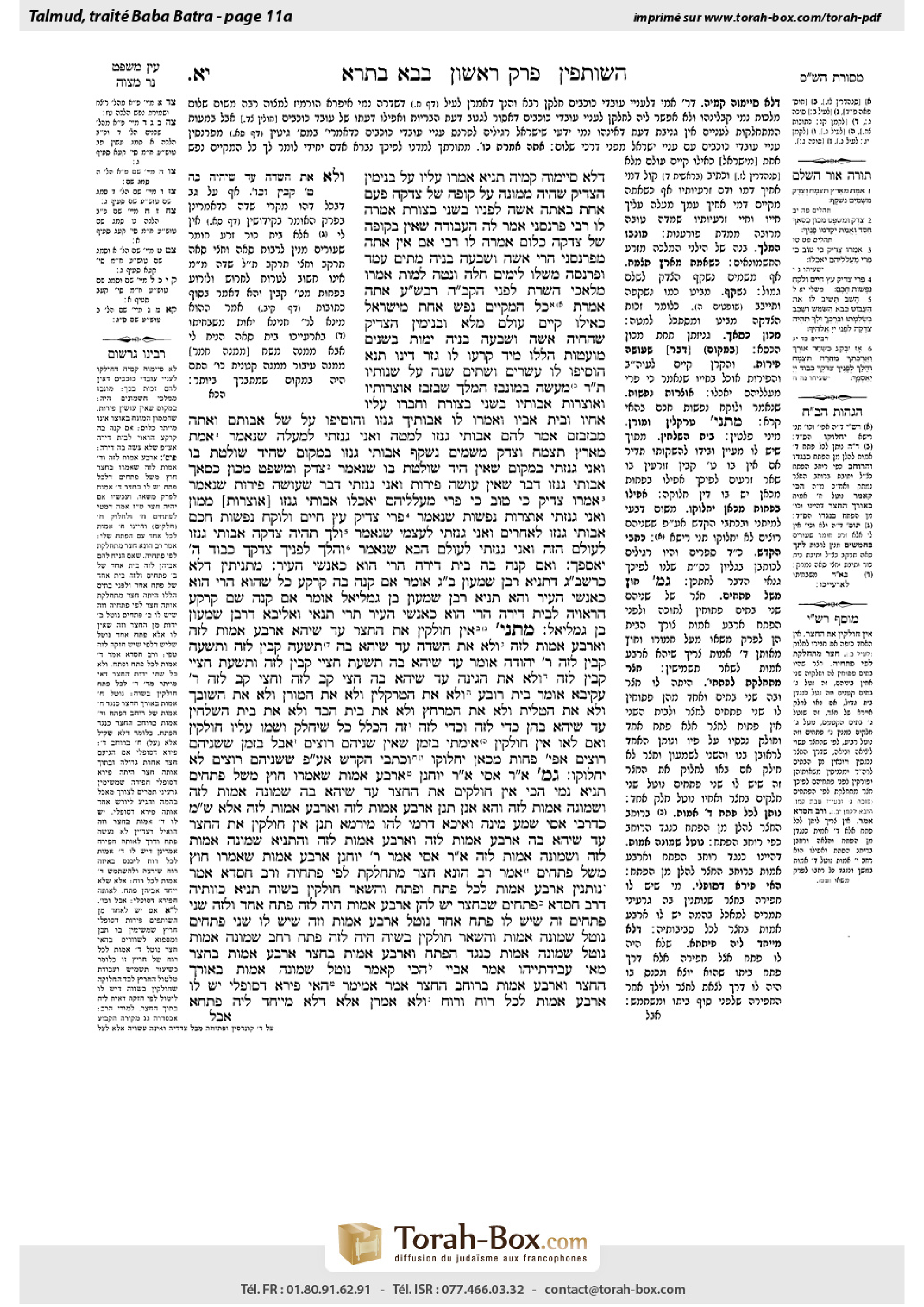
בבא בתרא י״א א · Aramaic and Hebrew text
דְּלָא סַיְּימוּהָ קַמֵּיהּ.
תַּנְיָא: אָמְרוּ עָלָיו עַל בִּנְיָמִין הַצַּדִּיק, שֶׁהָיָה מְמוּנֶּה עַל קוּפָּה שֶׁל צְדָקָה; פַּעַם אַחַת בָּאתָה אִשָּׁה לְפָנָיו בִּשְׁנֵי בַצּוֹרֶת, אָמְרָה לוֹ: רַבִּי, פַּרְנְסֵנִי! אָמַר לָהּ: הָעֲבוֹדָה, שֶׁאֵין בְּקוּפָּה שֶׁל צְדָקָה כְּלוּם! אָמְרָה לוֹ: רַבִּי, אִם אֵין אַתָּה מְפַרְנְסֵנִי, הֲרֵי אִשָּׁה וְשִׁבְעָה בָּנֶיהָ מֵתִים! עָמַד וּפִרְנְסָהּ מִשֶּׁלּוֹ. לְיָמִים חָלָה וְנָטָה לָמוּת, אָמְרוּ מַלְאֲכֵי הַשָּׁרֵת לִפְנֵי הַקָּדוֹשׁ בָּרוּךְ הוּא: רִבּוֹנוֹ שֶׁל עוֹלָם, אַתָּה אָמַרְתָּ: כׇּל הַמְקַיֵּים נֶפֶשׁ אַחַת מִיִּשְׂרָאֵל, כְּאִילּוּ קִיֵּים עוֹלָם מָלֵא; וּבִנְיָמִין הַצַּדִּיק, שֶׁהֶחֱיָה אִשָּׁה וְשִׁבְעָה בָּנֶיהָ, יָמוּת בְּשָׁנִים מוּעָטוֹת הַלָּלוּ? מִיָּד קָרְעוּ לוֹ גְּזַר דִּינוֹ. תָּנָא: הוֹסִיפוּ לוֹ עֶשְׂרִים וּשְׁתַּיִם שָׁנָה עַל שְׁנוֹתָיו.
תָּנוּ רַבָּנַן: מַעֲשֶׂה בְמוֹנְבַּז הַמֶּלֶךְ, שֶׁבִּזְבֵּז אוֹצְרוֹתָיו וְאוֹצְרוֹת אֲבוֹתָיו בִּשְׁנֵי בַּצּוֹרֶת, וְחָבְרוּ עָלָיו אֶחָיו וּבֵית אָבִיו, וְאָמְרוּ לוֹ: אֲבוֹתֶיךָ גָּנְזוּ וְהוֹסִיפוּ עַל שֶׁל אֲבוֹתָם, וְאַתָּה מְבַזְבְּזָם! אָמַר לָהֶם: אֲבוֹתַי גָּנְזוּ לְמַטָּה, וַאֲנִי גָּנַזְתִּי לְמַעְלָה – שֶׁנֶּאֱמַר: ״אֱמֶת מֵאֶרֶץ תִּצְמָח, וְצֶדֶק מִשָּׁמַיִם נִשְׁקָף״. אֲבוֹתַי גָּנְזוּ בִּמְקוֹם שֶׁהַיָּד שׁוֹלֶטֶת בּוֹ, וַאֲנִי גָּנַזְתִּי בִּמְקוֹם שֶׁאֵין הַיָּד שׁוֹלֶטֶת בּוֹ – שֶׁנֶּאֱמַר: ״צֶדֶק וּמִשְׁפָּט מְכוֹן כִּסְאֶךָ״.
אֲבוֹתַי גָּנְזוּ דָּבָר שֶׁאֵין עוֹשֶׂה פֵּירוֹת, וַאֲנִי גָּנַזְתִּי דָּבָר שֶׁעוֹשֶׂה פֵּירוֹת – שֶׁנֶּאֱמַר: ״אִמְרוּ צַדִּיק כִּי טוֹב, כִּי פְרִי מַעַלְלֵיהֶם יֹאכֵלוּ״. אֲבוֹתַי גָּנְזוּ [אוֹצְרוֹת] מָמוֹן, וַאֲנִי גָּנַזְתִּי אוֹצְרוֹת נְפָשׁוֹת – שֶׁנֶּאֱמַר: ״פְּרִי צַדִּיק עֵץ חַיִּים, וְלוֹקֵחַ נְפָשׁוֹת חָכָם״. אֲבוֹתַי גָּנְזוּ לַאֲחֵרִים, וַאֲנִי גָּנַזְתִּי לְעַצְמִי – שֶׁנֶּאֱמַר: ״וּלְךָ תִּהְיֶה צְדָקָה״. אֲבוֹתַי גָּנְזוּ לָעוֹלָם הַזֶּה, וַאֲנִי גָּנַזְתִּי לָעוֹלָם הַבָּא – שֶׁנֶּאֱמַר: ״וְהָלַךְ לְפָנֶיךָ צִדְקֶךָ, כְּבוֹד ה׳ יַאַסְפֶךָ״.
וְאִם קָנָה בָּהּ בֵּית דִּירָה – הֲרֵי הוּא כְּאַנְשֵׁי הָעִיר. מַתְנִיתִין דְּלָא כְּרַבָּן שִׁמְעוֹן בֶּן גַּמְלִיאֵל – דְּתַנְיָא, רַבָּן שִׁמְעוֹן בֶּן גַּמְלִיאֵל אוֹמֵר: אִם קָנָה בָּהּ קַרְקַע כׇּל שֶׁהוּא, הֲרֵי הוּא כְּאַנְשֵׁי הָעִיר.
וְהָא תַּנְיָא, רַבָּן שִׁמְעוֹן בֶּן גַּמְלִיאֵל אוֹמֵר: אִם קָנָה שָׁם קַרְקַע הָרְאוּיָה לְבֵית דִּירָה – הֲרֵי הוּא כְּאַנְשֵׁי הָעִיר! תְּרֵי תַּנָּאֵי, וְאַלִּיבָּא דְּרַבָּן שִׁמְעוֹן בֶּן גַּמְלִיאֵל.
מַתְנִי׳ אֵין חוֹלְקִין אֶת הֶחָצֵר – עַד שֶׁיְּהֵא אַרְבַּע אַמּוֹת לָזֶה, וְאַרְבַּע אַמּוֹת לָזֶה. וְלֹא אֶת הַשָּׂדֶה – עַד שֶׁיְּהֵא בָּהּ תִּשְׁעָה קַבִּין לָזֶה, וְתִשְׁעָה קַבִּין לָזֶה. רַבִּי יְהוּדָה אוֹמֵר: עַד שֶׁיְּהֵא בָּהּ תִּשְׁעַת חֲצָיֵי קַבִּין לָזֶה, וְתִשְׁעַת חֲצָיֵי קַבִּין לָזֶה. וְלֹא אֶת הַגִּינָּה – עַד שֶׁיְּהֵא בָּהּ חֲצִי קַב לָזֶה, וַחֲצִי קַב לָזֶה. רַבִּי עֲקִיבָא אוֹמֵר: בֵּית רוֹבַע.
וְלֹא אֶת הַטְּרַקְלִין, וְלֹא אֶת הַמּוֹרָן, וְלֹא אֶת הַשּׁוֹבָךְ, וְלֹא אֶת הַטַּלִּית, וְלֹא אֶת הַמֶּרְחָץ, וְלֹא אֶת בֵּית הַבַּד, וְלֹא אֶת בֵּית הַשְּׁלָחִין – עַד שֶׁיְּהֵא בָּהֶן כְּדַי לָזֶה וּכְדַי לָזֶה. זֶה הַכְּלָל: כׇּל שֶׁיֵּחָלֵק, וּשְׁמוֹ עָלָיו – חוֹלְקִין, וְאִם לָאו – אֵין חוֹלְקִין.
אֵימָתַי – בִּזְמַן שֶׁאֵין שְׁנֵיהֶם רוֹצִים; אֲבָל בִּזְמַן שֶׁשְּׁנֵיהֶם רוֹצִים, אֲפִילּוּ פָּחוֹת מִכָּאן – יַחְלוֹקוּ. וְכִתְבֵי הַקֹּדֶשׁ, אַף עַל פִּי שֶׁשְּׁנֵיהֶם רוֹצִים – לֹא יַחְלוֹקוּ.
גְּמָ׳ אָמַר רַבִּי אַסִּי אָמַר רַבִּי יוֹחָנָן: אַרְבַּע אַמּוֹת שֶׁאָמְרוּ – חוּץ מִשֶּׁל פְּתָחִים. תַּנְיָא נָמֵי הָכִי: אֵין חוֹלְקִים אֶת הֶחָצֵר – עַד שֶׁיְּהֵא בָּהּ שְׁמוֹנֶה אַמּוֹת לָזֶה, וּשְׁמוֹנֶה אַמּוֹת לָזֶה. וְהָא אֲנַן תְּנַן: אַרְבַּע אַמּוֹת לָזֶה, וְאַרְבַּע אַמּוֹת לָזֶה! אֶלָּא שְׁמַע מִינַּהּ – כִּדְרַבִּי אַסִּי; שְׁמַע מִינַּהּ.
וְאִיכָּא דְּרָמֵי לְהוּ מִירְמֵא – תְּנַן: אֵין חוֹלְקִין אֶת הֶחָצֵר, עַד שֶׁיְּהֵא בָּהּ אַרְבַּע אַמּוֹת לָזֶה, וְאַרְבַּע אַמּוֹת לָזֶה. וְהָתַנְיָא: שְׁמוֹנֶה אַמּוֹת לָזֶה, וּשְׁמוֹנֶה אַמּוֹת לָזֶה! אָמַר רַבִּי אַסִּי אָמַר רַבִּי יוֹחָנָן: אַרְבַּע אַמּוֹת שֶׁאָמְרוּ – חוּץ מִשֶּׁל פְּתָחִים.
אָמַר רַב הוּנָא: חָצֵר מִתְחַלֶּקֶת לְפִי פְּתָחֶיהָ. וְרַב חִסְדָּא אָמַר: נוֹתְנִין אַרְבַּע אַמּוֹת לְכׇל פֶּתַח וּפְתַח, וְהַשְּׁאָר חוֹלְקִין בְּשָׁוֶה.
תַּנְיָא כְּווֹתֵיהּ דְּרַב חִסְדָּא: פְּתָחִים שֶׁבֶּחָצֵר – יֵשׁ לָהֶן אַרְבַּע אַמּוֹת. הָיָה לָזֶה פֶּתַח אֶחָד, וְלָזֶה שְׁנֵי פְתָחִים; זֶה שֶׁיֵּשׁ לוֹ פֶּתַח אֶחָד – נוֹטֵל אַרְבַּע אַמּוֹת, וְזֶה שֶׁיֵּשׁ לוֹ שְׁנֵי פְתָחִים – נוֹטֵל שְׁמוֹנֶה אַמּוֹת; וְהַשְּׁאָר חוֹלְקִין בְּשָׁוֶה. הָיָה לָזֶה פֶּתַח רָחָב שְׁמוֹנֶה אַמּוֹת – נוֹטֵל שְׁמוֹנֶה אַמּוֹת כְּנֶגֶד הַפֶּתַח, וְאַרְבַּע אַמּוֹת בֶּחָצֵר. אַרְבַּע אַמּוֹת בֶּחָצֵר – מַאי עֲבִידְתַּיְיהוּ? אָמַר אַבָּיֵי, הָכִי קָאָמַר: נוֹטֵל שְׁמוֹנֶה אַמּוֹת בְּאוֹרֶךְ הֶחָצֵר, וְאַרְבַּע אַמּוֹת בְּרוֹחַב הֶחָצֵר.
אָמַר אַמֵּימָר: הַאי פֵּירָא דְסוּפְלֵי – יֵשׁ לוֹ אַרְבַּע אַמּוֹת לְכׇל רוּחַ וָרוּחַ. וְלָא אֲמַרַן אֶלָּא דְּלָא מְיַיחַד לֵיהּ פִּתְחָא,
Bava Batra 11a · English translation
those who reported the story to him did not conclude it before him; consequently, Rav Ami was not informed that Rava had indeed given the money to the gentile poor.
§ It is taught in a baraita: The following was said about Binyamin the righteous, who was appointed supervisor over the charity fund. Once, a woman came before him during years of drought and said to him: My master, sustain me. He said to her: I swear by the Temple service that there is nothing left in the charity fund. She said to him: My master, if you do not sustain me, a woman and her seven sons will die. He arose and sustained her with his own funds. After some time, he fell deathly ill. The ministering angels said to the Holy One, Blessed be He: Master of the Universe, You said that anyone who preserves a single life in Israel is regarded as if he has preserved an entire world. Should then Binyamin the righteous, who saved a woman and her seven sons, die after these few years, still in his youth? They immediately tore up his sentence. A Sage taught: They added twenty-two years to his life.
The Sages taught: There was an incident involving King Munbaz, who liberally gave away his treasures and the treasures of his ancestors in the years of drought, distributing the money to the poor. His brothers and his father’s household joined together against him to protest against his actions, and they said to him: Your ancestors stored up money in their treasuries and added to the treasures of their ancestors, and you are liberally distributing it all to the poor. King Munbaz said to them: Not so, my ancestors stored up below, whereas I am storing above, as it is stated: “Truth will spring out of the earth and righteousness will look down from heaven” (Psalms 85:12), meaning that the righteous deeds that one has performed are stored up in heaven. My ancestors stored up treasures in a place where the human hand can reach, and so their treasures could have been robbed, whereas I am storing up treasures in a place where the human hand cannot reach, and so they are secure, as it is stated: “Righteousness and justice are the foundation of Your throne” (Psalms 89:15).
My ancestors stored up something that does not generate profit, as money sitting in a treasury does not increase, whereas I am storing up something that generates profit, as it is stated: “Say of the righteous, that it shall be well with them, for they shall eat the fruit of their doings” (Isaiah 3:10). My ancestors stored up treasures of money, whereas I am storing up treasures of souls, as it is stated: “The fruit of the righteous is a tree of life, and he that wins souls is wise” (Proverbs 11:30). My ancestors stored up for others, for their sons and heirs, when they themselves would pass from this world, whereas I am storing up for myself, as it is stated: “And it shall be as righteousness to you” (Deuteronomy 24:13). My ancestors stored up for this world, whereas I am storing up for the World-to-Come, as it is stated: “And your righteousness shall go before you, the glory of the Lord shall be your rearguard” (Isaiah 58:8).
§ The Gemara resumes its analysis of the mishna, which taught that one must reside in a place for twelve months in order to be considered a resident for the purposes of issues such as paying taxes. But if he bought himself a residence in the city, he is immediately considered like one of the people of the city. The Gemara comments: The mishna is not in accordance with the opinion of Rabban Shimon ben Gamliel, as it is taught in a baraita that Rabban Shimon ben Gamliel says: If he bought any amount of land in the city, and not necessarily a residence, he is immediately considered like one of the people of the city.
The Gemara asks: But isn’t it taught otherwise in a different baraita: Rabban Shimon ben Gamliel says: If one bought land that is suitable for a residence, he is immediately considered like one of the people of the city. This contradicts the first baraita. The Gemara answers: This is a dispute between two tanna’im and they disagree with regard to the opinion of Rabban Shimon ben Gamliel.
MISHNA: The court does not divide a courtyard at the request of one of the joint owners unless there will be in it four by four cubits for this one and four by four cubits for that one, i.e., this minimum area for each of the joint owners. And the court does not divide a jointly owned field unless there is space in it to plant nine kav of seed for this one and nine kav of seed for that one. Rabbi Yehuda says: The court does not divide a field unless there is space in it to plant nine half-kav of seed for this one and nine half-kav of seed for that one. And the court does not divide a jointly owned garden unless there is space in it to plant a half-kav of seed for this one and a half-kav of seed for that one. Rabbi Akiva says that half that amount is sufficient, i.e., the area required for sowing a quarter-kav of seed [beit rova].
Similarly, the court does not divide a hall [hateraklin], a drawing room, a dovecote, a cloak, a bathhouse, an olive press, and an irrigated field unless there is enough for this one to use the property in the usual manner and enough for that one to use the property in the usual manner. This is the principle: Anything for which when it is divided, each of the parts is large enough to retain the name of the original item, the court divides it. But if the parts will not retain the original name, the court does not divide it.
When does this rule apply? It applies when the joint owners do not both wish to divide the item; when only one of the owners wishes to divide the property, he cannot force the other to do so. But when both of them wish to divide the item, they may divide it, even if each of the owners will receive less than the amounts specified above. But in the case of sacred writings, i.e., a scroll of any of the twenty-four books of the Bible, that were inherited by two people, they may not divide them, even if both of them wish to do so, because it would be a show of disrespect to cut the scroll in half.
GEMARA: Rabbi Asi says that Rabbi Yoḥanan says: The four cubits of the courtyard which they said each of the joint owners must receive is in addition to the space in front of the entrances to each of the houses that is assigned to the owner of the house for loading and unloading. That opinion is also taught in a baraita: The court does not divide a courtyard unless its area is sufficient so that there will be in it eight cubits for this one and eight cubits for that one. The Gemara asks: But didn’t we learn in the mishna that it suffices that there be four cubits for this one and four cubits for that one? Rather, conclude from it that the baraita was taught in accordance with the opinion of Rabbi Asi. The Gemara affirms: Conclude from it that it is so.
And there are those who raise the baraita as a contradiction to what is taught in the mishna and use the previously mentioned point to reconcile the two texts. We learned in the mishna: The court does not divide a courtyard at the request of one of the joint owners unless there will be in it four by four cubits for this one and four by four cubits for that one. But isn’t it taught in a baraita: The court does not divide a courtyard unless there are eight cubits for this one and eight cubits for that one? About this Rabbi Asi said that Rabbi Yoḥanan said: The four cubits of the courtyard which they said each of the joint owners must receive is in addition to the space in front of the entrances to each of the houses.
Further with regard to the division of a courtyard, Rav Huna says: A courtyard is divided according to its entrances. Each of the owners receives a share of the courtyard in proportion to the number of entrances that his house has opening onto the courtyard. And Rav Ḥisda says: Four cubits are allotted to each of the owners for each and every entrance, and the rest of the courtyard is then divided equally between them.
The Gemara comments: It is taught in a baraita in accordance with the opinion of Rav Ḥisda: Each of the entrances opening to a courtyard is allotted four cubits. If this one has one entrance and that one has two entrances, the one who has one entrance takes four cubits, and the one who has two entrances takes eight cubits, and they divide the rest of the courtyard equally between them. If this one had an entrance eight cubits wide, he takes eight cubits adjacent to the entrance and four cubits in the courtyard. The Gemara expresses surprise: What are these four cubits in the courtyard doing here? Doesn’t it all depend on the size of the courtyard? Abaye said: This is what the baraita is saying: For the entrance he takes eight cubits along the length of the courtyard and four cubits along the width of the courtyard. In other words, he takes a strip four cubits wide along the entire length of his entrance.
Ameimar says: A pit for holding animal food [peira desuflei] has four cubits on each and every side so that there will be sufficient space for the animals to stand. The Gemara adds: And we said this only when the pit has no special entrance to reach it, but rather it is accessed from all sides.
Bava Batra 11a · Traduction française (IA)
Ceux qui lui rapportèrent l'histoire ne l'ont pas conclue devant lui ; par conséquent, Rav Ami n'a pas été informé que Rava avait effectivement donné l'argent aux pauvres gentils.
§ Il est enseigné dans une baraïta : On a dit à propos de Binyamin le juste, qui était chargé de surveiller le fonds de charité. Un jour, une femme vint le voir pendant les années de sécheresse et lui dit : Mon maître, sustente-moi. Il lui répondit : Je jure par le service du Temple qu'il ne reste plus rien dans le fonds de charité. Elle lui dit : Mon maître, si tu ne sustentes pas, une femme et ses sept fils mourront. Il se leva et sustenta sa femme avec ses propres fonds. Après un certain temps, il tomba gravement malade. Les anges ministraux dirent au Très-Haut, béni soit-Il : Seigneur du Monde, Tu as dit que celui qui sauve une seule vie en Israël est considéré comme s'il avait sauvé tout le monde. Doit-on alors permettre que Binyamin le juste, qui a sauvé une femme et ses sept fils, meure après quelques années seulement, encore jeune ? Ils levèrent immédiatement la sentence. Un Sage enseigna : Ils ajoutèrent vingt-deux ans à sa vie.
Les Sages enseignèrent : Il y avait un incident concernant le roi Munbaz, qui distribuait généreusement ses trésors et ceux de ses ancêtres pendant les années de sécheresse, en donnant de l'argent aux pauvres. Ses frères et sa famille protestèrent contre ses actions et lui dirent : Vos ancêtres ont accumulé de l'argent dans leurs trésors et ont ajouté aux trésors de leurs ancêtres, et toi, tu distribues tout cela aux pauvres. Le roi Munbaz répondit à ses frères : Non, mes ancêtres ont accumulé en bas, tandis que je stocke en haut, comme il est dit : « La vérité jaillira du sol et la justice regardera du ciel » (Psaumes 85:12), c'est-à-dire que les bonnes œuvres que l'on a accomplies sont stockées au ciel. Mes ancêtres ont accumulé des trésors dans un lieu où la main humaine peut atteindre, et donc leurs trésors pouvaient être volés, tandis que je stocke mes trésors dans un lieu où la main humaine ne peut pas atteindre, et donc ils sont sécurisés, comme il est dit : « La justice et la droiture sont la fondation de votre trône » (Psaumes 89:15).
Mes ancêtres ont stocké quelque chose qui ne génère pas de profit, car l'argent qui repose dans un trésor ne s'augmente pas, tandis que je stocke quelque chose qui génère du profit, comme il est dit : « Dis de l'homme juste qu'il aura la paix, car il mangera la récompense de ses œuvres » (Isaïe 3:10). Mes ancêtres ont stocké des trésors d'argent, tandis que je stocke des trésors d'âmes, comme il est dit : « La récompense du juste est un arbre de vie, et celui qui gagne des âmes est sage » (Proverbes 11:30). Mes ancêtres ont stocké pour autrui, pour leurs fils et leurs héritiers, lorsqu'ils allaient quitter ce monde, tandis que je stocke pour moi-même, comme il est dit : « Et cela sera pour toi comme la justice » (Deutéronome 24:13). Mes ancêtres ont stocké pour ce monde, tandis que je stocke pour le Monde à Venir, comme il est dit : « Et ta justice marchera devant toi, la gloire du Seigneur sera ton escorte » (Isaïe 58:8).
§ La Guemara reprend son analyse de la mitsna, qui enseignait que l'on doit résider dans un lieu pendant douze mois pour être considéré comme un résident pour les questions telles que le paiement des impôts. Mais s'il s'est acheté une résidence dans la ville, il est immédiatement considéré comme l'un des habitants de la ville. La Guemara commente : La mitsna ne suit pas l'opinion de Rabban Shimon ben Gamliel, comme il est enseigné dans une baraïta que Rabban Shimon ben Gamliel dit : Si l'on a acheté une quantité de terre dans la ville, et pas nécessairement une résidence, il est immédiatement considéré comme l'un des habitants de la ville.
La Guemara pose la question : Mais n'est-il pas enseigné autrement dans une autre baraïta : Rabban Shimon ben Gamliel dit : Si l'on a acheté une terre adaptée à une résidence, il est immédiatement considéré comme l'un des habitants de la ville. Cela contredit la première baraïta. La Guemara répond : C'est un débat entre deux tannaïm et ils diffèrent concernant l'opinion de Rabban Shimon ben Gamliel.
MITSNA : Le tribunal ne divise pas un jardin partagé à la demande d'un des propriétaires conjoints à moins qu'il y ait pour chacun d'entre eux un espace de quatre par quatre cubits, c'est-à-dire cette aire minimale pour chaque propriétaire conjoint. Et le tribunal ne divise pas un champ partagé à moins qu'il y ait de l'espace pour planter neuf kav de grain pour l'un et neuf kav de grain pour l'autre. Rabbi Yehuda dit : Le tribunal ne divise pas un champ à moins qu'il y ait de l'espace pour planter neuf demi-kav de grain pour l'un et neuf demi-kav de grain pour l'autre. Et le tribunal ne divise pas un jardin partagé à moins qu'il y ait de l'espace pour planter un demi-kav de grain pour l'un et un demi-kav de grain pour l'autre. Rabbi Akiva dit que la moitié de cette quantité est suffisante, c'est-à-dire l'espace requis pour semer un quart-kav de grain [beit rova].
De même, le tribunal ne divise pas une salle [hateraklin], une pièce de salon, un poulailler, une cape, une salle de bain, une press de figues, et un champ irrigué à moins qu'il y ait assez pour que chacun puisse utiliser la propriété selon l'usage habituel. C'est le principe : Tout ce pour lequel, lorsqu'il est divisé, chaque partie est suffisamment grande pour conserver le nom de l'objet original, le tribunal le divise. Mais si les parties ne conserveraient pas le nom original, le tribunal ne le divise pas.
Quand cette règle s'applique-t-elle ? Elle s'applique quand les propriétaires conjoints ne souhaitent pas tous deux diviser l'objet ; quand seul un des propriétaires souhaite diviser la propriété, il ne peut pas forcer l'autre à le faire. Mais quand les deux souhaitent diviser l'objet, ils peuvent le diviser, même si chacun des propriétaires recevra moins que les quantités spécifiées ci-dessus. Mais dans le cas des écritures sacrées, c'est-à-dire un rouleau de l'un des vingt-quatre livres de la Bible, hérité par deux personnes, ils ne peuvent pas le diviser, même si les deux souhaitent le faire, car cela serait un manque de respect de couper le rouleau en deux.
GUEMARA : Rabbi Asi dit que Rabbi Yoḥanan dit : Les quatre cubits du jardin qui sont dits recevoir chacun des propriétaires communs sont en plus de l'espace devant les entrées de chaque maison qui est assigné au propriétaire de la maison pour le chargement et le déchargement. Cette opinion est également enseignée dans une baraïta : Le tribunal ne divise pas un jardin à moins que sa surface ne soit suffisante pour y avoir huit cubits pour celui-ci et huit cubits pour celui-là. La Guemara pose la question : Mais n'avons-nous pas appris dans la mitsna que quatre cubits suffisent pour celui-ci et quatre cubits pour celui-là ? Plutôt, concluez-en qu'il s'agit de l'opinion de Rabbi Asi. La Guemara confirme : Concluez-en qu'il en est ainsi.
Et il y a ceux qui soulèvent la baraïta comme une contradiction par rapport à ce qui est enseigné dans la mitsna et utilisent le point mentionné précédemment pour concilier les deux textes. Nous avons appris dans la mitsna : Le tribunal ne divise pas un jardin à la demande d'un des propriétaires communs à moins qu'il y ait quatre par quatre cubits pour celui-ci et quatre par quatre cubits pour celui-là. Mais n'est-il pas enseigné dans une baraïta : Le tribunal ne divise pas un jardin à moins qu'il y ait huit cubits pour celui-ci et huit cubits pour celui-là ? À ce sujet, Rabbi Asi a dit que Rabbi Yoḥanan a dit : Les quatre cubits du jardin qui sont dits recevoir chacun des propriétaires communs sont en plus de l'espace devant les entrées de chaque maison.
En outre, concernant la division d'un jardin, Rav Huna dit : Un jardin est divisé selon ses entrées. Chacun des propriétaires reçoit une part du jardin en proportion du nombre d'entrées dont sa maison s'ouvre sur le jardin. Et Rav Ḥisda dit : Quatre cubits sont alloués à chaque propriétaire pour chaque entrée, et le reste du jardin est ensuite divisé également entre eux.
La Guemara commente : Il est enseigné dans une baraïta selon l'opinion de Rav Ḥisda : Chaque entrée s'ouvrant sur un jardin est allouée quatre cubits. Si celui-ci a une entrée et celui-là deux entrées, celui qui a une entrée prend quatre cubits, et celui qui a deux entrées prend huit cubits, et ils divisent le reste du jardin également entre eux. Si celui-ci a une entrée de huit cubits de large, il prend huit cubits adjacents à l'entrée et quatre cubits dans le jardin. La Guemara exprime une surprise : Qu'est-ce que ces quatre cubits dans le jardin font ici ? N'est-ce pas tout simplement fonction de la taille du jardin ? Abaye dit : C'est ce que dit la baraïta : Pour l'entrée, il prend huit cubits le long de la longueur du jardin et quatre cubits le long de la largeur du jardin. En d'autres termes, il prend une bande de quatre cubits de large le long de toute la longueur de son entrée.
Ameimar dit : Un puits pour le stockage de nourriture pour bêtes [peira desuflei] a quatre cubits sur chaque côté afin qu'il y ait suffisamment d'espace pour que les bêtes puissent se tenir. La Guemara ajoute : Et nous avons dit cela uniquement lorsque le puits n'a pas d'entrée particulière pour y accéder, mais plutôt qu'il est accessible de tous les côtés.
Traduction française générée par IA à partir de l’édition anglaise de Sefaria. Vérifie toujours un passage avec le texte source.
Text from Sefaria: William Davidson Edition - Vocalized Aramaic (CC BY NC); William Davidson Edition - English (CC BY NC).