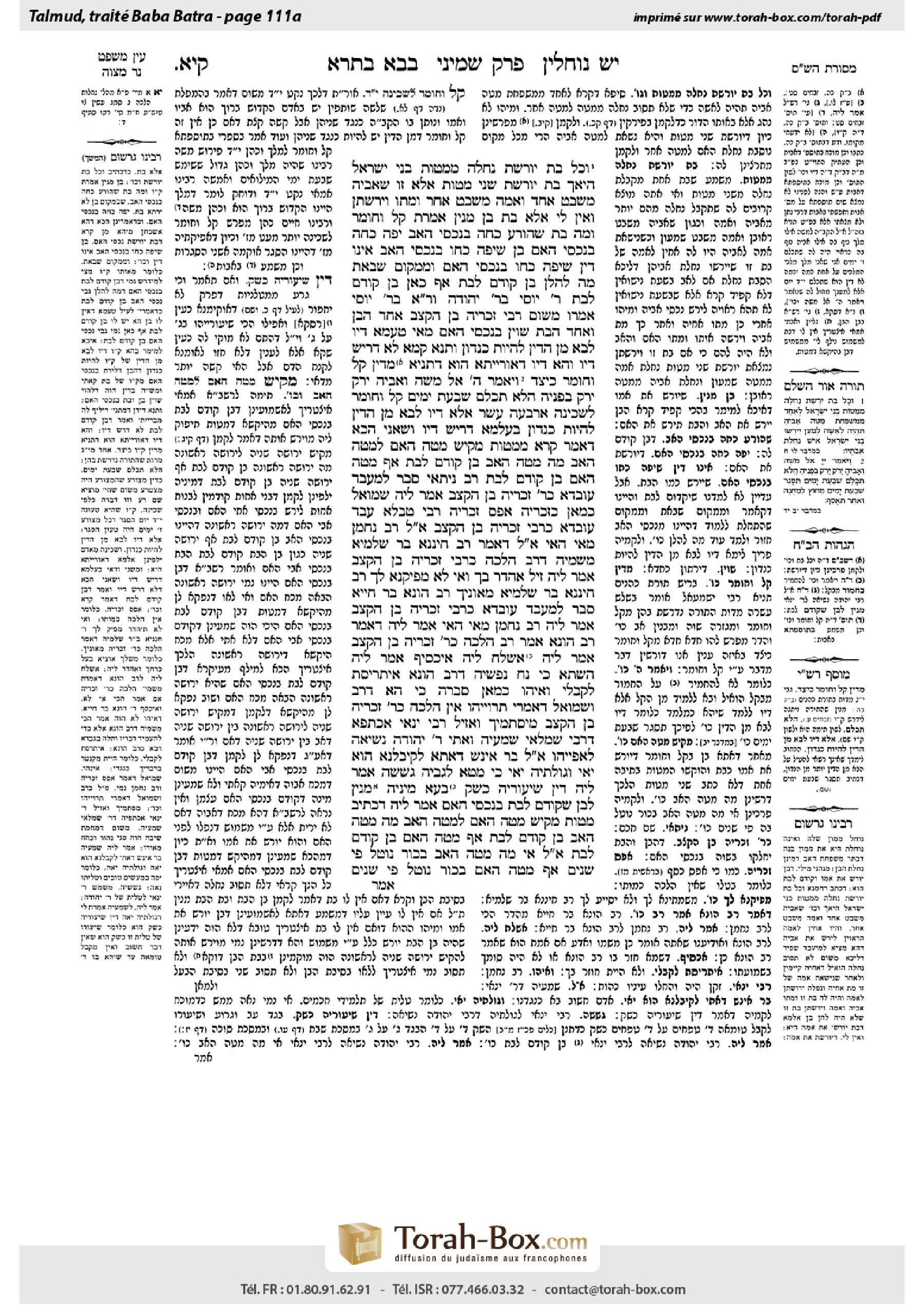
Bava Batra 111a: Talmud study for Daf Yomi
Study the Talmud for Daf Yomi with scanned pages, Hebrew text, English translations from Sefaria and AI-generated French translations.
Passage selection and English or AI-generated French translation are available where the scan has annotations. Daf Study is independent of Torah-Box and Sefaria.
Browse Bava Batra · בבא בתרא · All tractatesBava Batra 111a text and translations
This page of Bava Batra includes the Aramaic text, an English translation and an AI-generated French translation, alongside the scan above.
בבא בתרא קי״א א · Aramaic and Hebrew text
״וְכׇל בַּת יֹרֶשֶׁת נַחֲלָה מִמַּטּוֹת בְּנֵי יִשְׂרָאֵל״ – הֵיאַךְ בַּת יוֹרֶשֶׁת שְׁנֵי מַטּוֹת? אֶלָּא זוֹ שֶׁאָבִיהָ מִשֵּׁבֶט אֶחָד וְאִמָּהּ מִשֵּׁבֶט אַחֵר, וּמֵתוּ, וִירָשָׁתַן.
וְאֵין לִי אֶלָּא בַּת, בֵּן מִנַּיִן? אָמַרְתָּ קַל וָחוֹמֶר: וּמָה בַּת, שֶׁהוֹרַע כֹּחָהּ בְּנִכְסֵי הָאָב – יִפָּה כֹּחָהּ בְּנִכְסֵי הָאֵם; בֵּן, שֶׁיִּפָּה כֹּחוֹ בְּנִכְסֵי הָאָב – אֵינוֹ דִּין שֶׁיִּפָּה כֹּחוֹ בְּנִכְסֵי הָאֵם? וּמִמָּקוֹם שֶׁבָּאתָ – מָה לְהַלָּן בֵּן קוֹדֵם לַבַּת, אַף כָּאן בֵּן קוֹדֵם לַבַּת.
רַבִּי יוֹסֵי בְּרַבִּי יְהוּדָה וְרַבִּי אֶלְעָזָר בְּרַבִּי יוֹסֵי אָמְרוּ, מִשּׁוּם רַבִּי זְכַרְיָה בֶּן הַקַּצָּב: אֶחָד הַבֵּן וְאֶחָד הַבַּת, שָׁוִין בְּנִכְסֵי הָאֵם. מַאי טַעְמָא? דַּיּוֹ לַבָּא מִן הַדִּין לִהְיוֹת כַּנִּדּוֹן.
וְתַנָּא קַמָּא – לָא דָּרֵישׁ ״דַּיּוֹ״?! וְהָא ״דַּיּוֹ״ דְּאוֹרָיְיתָא הוּא!
דְּתַנְיָא: מִדִּין קַל וָחוֹמֶר כֵּיצַד? ״וַיֹּאמֶר ה׳ אֶל מֹשֶׁה: וְאָבִיהָ יָרֹק יָרַק בְּפָנֶיהָ, הֲלֹא תִכָּלֵם שִׁבְעַת יָמִים?״ קַל וָחוֹמֶר לַשְּׁכִינָה – אַרְבָּעָה עָשָׂר!
אֶלָּא דַּיּוֹ לַבָּא מִן הַדִּין לִהְיוֹת כַּנִּדּוֹן.
בְּעָלְמָא דָּרֵישׁ ״דַּיּוֹ״; וְשָׁאנֵי הָכָא, דְּאָמַר קְרָא: ״מִמַּטּוֹת״ – מַקִּישׁ מַטֵּה הָאֵם לְמַטֵּה הָאָב; מָה מַטֵּה הָאָב – בֵּן קוֹדֵם לַבַּת, אַף מַטֵּה הָאֵם – בֵּן קוֹדֵם לַבַּת.
רַב נִיתַּאי סָבַר לְמֶעְבַּד עוֹבָדָא כְּרַבִּי זְכַרְיָה בֶּן הַקַּצָּב; אֲמַר לֵיהּ שְׁמוּאֵל: כְּמַאן – כִּזְכַרְיָה? אָפֵס זְכַרְיָה. רַבִּי טַבְלָא עֲבַד עוֹבָדָא כְּרַבִּי זְכַרְיָה בֶּן הַקַּצָּב. אֲמַר לֵיהּ רַב נַחְמָן: מַאי הַאי? אֲמַר לֵיהּ, דְּאָמַר רַב חִינָּנָא בַּר שֶׁלֶמְיָא מִשְּׁמֵיהּ דְּרַב: הֲלָכָה כְּרַבִּי זְכַרְיָה בֶּן הַקַּצָּב. אֲמַר לֵיהּ: זִיל אַהְדַּר (בָּךְ), וְאִי לָא – מַפֵּיקְנָא לָךְ רַב חִינָּנָא בַּר שֶׁלֶמְיָא מֵאוּנָּיךְ!
רַב הוּנָא בַּר חִיָּיא סָבַר לְמֶעְבַּד עוֹבָדָא כְּרַבִּי זְכַרְיָה בֶּן הַקַּצָּב; אֲמַר לֵיהּ רַב נַחְמָן: מַאי הַאי? אֲמַר לֵיהּ, דְּאָמַר רַב הוּנָא אָמַר רַב: הֲלָכָה כְּרַבִּי זְכַרְיָה בֶּן הַקַּצָּב. אֲמַר לֵיהּ: אֶשְׁלַח לֵיהּ? אִיכְּסִיף. אֲמַר לֵיהּ: הַשְׁתָּא כִּי נָח נַפְשֵׁיהּ דְּרַב הוּנָא, אַיתְרֵיסְתְּ לְקִבְלִי.
וְאִיהוּ כְּמַאן סַבְרַהּ? כִּי הָא דְּרַב וּשְׁמוּאֵל, דְּאָמְרִי תַּרְוַיְיהוּ: אֵין הֲלָכָה כְּרַבִּי זְכַרְיָה בֶּן הַקַּצָּב.
מִיסְתְּמִיךְ וְאָזֵיל רַבִּי יַנַּאי אַכַּתְפָּא דְּרַבִּי שִׂמְלַאי שַׁמָּעֵיהּ, וְאָתֵי רַבִּי יְהוּדָה נְשִׂיאָה לְאַפַּיְיהוּ. אֲמַר לֵיהּ: בַּר אִינָשׁ דַּאֲתָא לְקִיבְלַנָא, הוּא יָאֵי, וְגוּלְּתֵיהּ יָאֵי. כִּי מְטָא לְגַבֵּיהּ, גַּשְּׁשַׁהּ, אֲמַר לֵיהּ: דֵּין – שִׁיעוּרֵיהּ כְּשַׂק.
בְּעָא מִינֵּיהּ: מִנַּיִן לְבֵן שֶׁקּוֹדֵם לַבַּת בְּנִכְסֵי הָאֵם? אָמַר לֵיהּ, דִּכְתִיב: ״מַטּוֹת״ – מַקִּישׁ מַטֵּה הָאֵם לְמַטֵּה הָאָב; מָה מַטֵּה הָאָב – בֵּן קוֹדֵם לַבַּת, אַף מַטֵּה הָאֵם – בֵּן קוֹדֵם לַבַּת. אֲמַר לֵיהּ: אִי – מָה מַטֵּה הָאָב, בְּכוֹר נוֹטֵל פִּי שְׁנַיִם; אַף מַטֵּה הָאֵם, בְּכוֹר נוֹטֵל פִּי שְׁנַיִם?!
Bava Batra 111a · English translation
The verse states: “And every daughter who possesses an inheritance from the tribes of the children of Israel” (Numbers 36:8). Noting the plural in the phrase “from the tribes of the children of Israel,” the baraita asks: How can a daughter inherit land from two tribes? Rather, this is referring to a daughter whose father is from one tribe but her mother is from another tribe, and they both died, and she inherited from both of them. Therefore, it can be seen in this verse that a daughter inherits from her mother.
The baraita continues: I have derived only that a daughter inherits from her mother; from where do I derive that a son inherits from his mother as well? You can say an a fortiori inference: And just as a daughter, whose power is diminished with regard to her father’s property in that she does not inherit it when there is a son, yet her power is enhanced with regard to her mother’s property in that she inherits it; with regard to a son, whose power is enhanced with regard to his father’s property in that he is first in the order of inheritance, is it not logical that his power is enhanced with regard to his mother’s property? The baraita continues: And from the place that you came, i.e., from the inference that was just stated, one can say the following: Just as there, with regard to a father’s property, a son precedes a daughter, so too here, with regard to a mother’s property, a son precedes a daughter. This is the opinion of the first tanna.
The baraita continues: Rabbi Yosei, son of Rabbi Yehuda, and Rabbi Elazar, son of Rabbi Yosei, said in the name of Rabbi Zekharya ben Hakatzav: Both the son and the daughter are equal with regard to the mother’s property. What is the reason for his ruling? It is sufficient for the conclusion that emerges from an a fortiori inference to be like its source. According to this principle, a halakha derived by means of an a fortiori inference cannot go beyond the halakhot of the source from which it is derived. Since the halakha that a son inherits from his mother was derived via an a fortiori inference from the halakha that a daughter inherits from her mother, it cannot be that this inference should lead to the conclusion that a son precedes a daughter in inheriting from their mother.
The Gemara asks: And doesn’t the first tanna also interpret verses employing the principle of: It is sufficient for the conclusion that emerges from an a fortiori inference to be like its source? But the principle of: It is sufficient, which limits the extent of a fortiori inference, is found in the Torah, so how could he disagree with it?
As it is taught in a baraita that explains the hermeneutical principles: How does an a fortiori inference work? The verse states with regard to Miriam, after she spoke ill of her brother Moses: “And the Lord said to Moses: If her father had but spit in her face, should she not hide in shame seven days?” (Numbers 12:14). The verse is saying that if a father spits in the face of his daughter and reprimands her, she would feel shame for seven days. By an a fortiori inference it is derived that Miriam, who suffered the more severe reprimand of the Divine Presence, should be ostracized for fourteen days. Why then, was Miriam ostracized for only seven days?
Rather, it is sufficient for the conclusion that emerges from an a fortiori inference to be like its source, so her punishment cannot be for longer than the punishment of one who is reprimanded by a father. In any event, the principle the begins with: It is sufficient, can be seen in this verse, so how does the first tanna rule that a son precedes a daughter with regard to a mother’s property?
The Gemara answers: Generally, the first tanna also interprets verses employing the principle that begins with: It is sufficient, but it is different here with regard to inheritance, as the verse states: “And every daughter who possesses an inheritance from the tribes of the children of Israel” (Numbers 36:8). The verse juxtaposes the tribe of the mother to the tribe of the father. Therefore, the first tanna holds that just as with regard to the tribe of the father, i.e., inheriting from one’s father, a son precedes a daughter, so too, with regard to the tribe of the mother, i.e., inheriting from one’s mother, a son precedes a daughter.
The Gemara relates: Rav Nittai thought to perform an action, i.e., issue a ruling, in accordance with the opinion of Rabbi Zekharya ben HaKatzav, who taught that a son and daughter are equal with regard to inheriting from their mother. Shmuel said to him: In accordance with whose opinion do you wish to issue this ruling, in accordance with the opinion of Zekharya? Zekharya is nil [afes], i.e., his statement was not accepted as halakha. Rabbi Tavla performed an action, i.e., issued a ruling, in accordance with the opinion of Rabbi Zekharya ben HaKatzav. Rav Naḥman said to him: What is this? Rabbi Tavla said to him: As Rav Ḥinnana bar Shelamya says in the name of Rav: The halakha is in accordance with the opinion of Rabbi Zekharya ben HaKatzav. Rav Naḥman said to him: Go retract your ruling, and if you do not, I will take Rav Ḥinnana bar Shelamya out of your ear, i.e., I will punish you severely for ruling against the accepted halakha.
The Gemara relates further: Rav Huna bar Ḥiyya thought to perform an action, i.e., issue a ruling, in accordance with the opinion of Rabbi Zekharya ben HaKatzav. Rav Naḥman said to him: What is this? Rav Huna bar Ḥiyya said to him: As Rav Huna says that Rav says: The halakha is in accordance with the opinion of Rabbi Zekharya ben HaKatzav. Rav Naḥman said to him: Shall I send a messenger to Rav Huna to ask him if that is indeed what he said? Rav Huna bar Ḥiyya was embarrassed, as he was not certain that Rav Huna actually said this ruling. Rav Naḥman said to him: Now, if Rav Huna were to have died, you would have been brazen enough to say before me that this is what he said, but since he is still alive, you cannot be so brazen.
The Gemara asks: And he, Rav Naḥman, in accordance with whose opinion does he hold? As there were various sages who ruled in accordance with the opinion of Rabbi Zekharya ben HaKatzav, why did Rav Naḥman not agree? The Gemara answers: He holds in accordance with this statement of Rav and Shmuel, who both say: The halakha is not in accordance with the opinion of Rabbi Zekharya ben HaKatzav.
The Gemara relates: Rabbi Yannai, who had already grown old and whose eyes were dim, would walk leaning on the shoulder of Rabbi Simlai, his attendant, and Rabbi Yehuda Nesia came toward them. Rabbi Simlai said to Rabbi Yannai: The person who is coming toward us is handsome and his cloak is handsome. When Rabbi Yehuda Nesia reached him, Rabbi Yannai felt his cloak and said to Rabbi Simlai: Concerning this cloak, its measurement with regard to the halakhot of ritual impurity is like the measurement of sackcloth, meaning it was a cloak of inferior quality, as it was thick and rough.
When Rabbi Yehuda Nesia met Rabbi Yannai he asked him: From where is it derived that a son precedes a daughter with regard to the mother’s property? Rabbi Yannai said to him: As it is written: “And every daughter who possesses an inheritance from the tribes of the children of Israel” (Numbers 36:8). The verse juxtaposes the tribe of the mother to the tribe of the father. This teaches that just as with regard to the tribe of the father a son precedes a daughter, so too, with regard to the tribe of the mother, a son precedes a daughter. Rabbi Yehuda Nesia said to him: If so, if these two halakhot are in fact juxtaposed, the following should also be derived: Just as with regard to the inheritance of the father’s tribe a firstborn takes a double portion, so too, with regard to inheritance from the mother’s tribe, when he inherits from his mother a firstborn takes a double portion.
Bava Batra 111a · Traduction française (IA)
La parabole dit : « Et toute fille qui possède une part de terrain parmi les tribus des enfants d'Israël » (Nombres 36,8). En remarquant le pluriel dans la phrase « des tribus des enfants d'Israël », la baraïta pose la question : comment une fille peut-elle hériter de terrain de deux tribus ? En réalité, il s'agit d'une fille dont le père appartient à une tribu et sa mère à une autre, et qui ont tous les deux décédé, et elle a hérité des deux. On peut ainsi voir dans cette parabole que la fille hérite de sa mère.
La baraïta continue : j'ai déduit seulement que la fille hérite de sa mère ; d'où déduis-je que le fils hérite de sa mère également ? On peut dire une déduction par analogie : et justement, la fille, dont la puissance est diminuée par rapport à la propriété de son père, car elle ne l'hérite pas en présence d'un fils, mais sa puissance est renforcée par rapport à la propriété de sa mère, car elle l'hérite ; quant au fils, dont la puissance est renforcée par rapport à la propriété de son père, car il est le premier dans l'ordre d'héritage, n'est-il pas logique que sa puissance soit renforcée par rapport à la propriété de sa mère ? La baraïta continue : et d'après l'endroit d'où tu viens, c'est-à-dire d'après l'inférence que tu viens de dire, on peut dire ceci : justement, là, par rapport à la propriété du père, le fils précède la fille, de même ici, par rapport à la propriété de la mère, le fils précède la fille. C'est l'opinion du premier tanna.
La baraïta continue : Rabbi Yosei, fils de Rabbi Yéhuda, et Rabbi Eléazar, fils de Rabbi Yosei, dirent au nom de Rabbi Zékhaïa ben HaKatzav : le fils et la fille sont égaux par rapport à la propriété de leur mère. Quelle est la raison de cette décision ? Il suffit que la conclusion tirée d'une déduction par analogie soit semblable à sa source. Selon ce principe, une halakha déduite par une déduction par analogie ne peut pas aller au-delà des halakhot de la source d'où elle est tirée. Puisque la halakha selon laquelle le fils hérite de sa mère a été déduite par une déduction par analogie à partir de la halakha selon laquelle la fille hérite de sa mère, il ne peut pas être que cette déduction mène à la conclusion que le fils précède la fille dans l'héritage de leur mère.
La Guemara pose la question : ne dit-on pas que le premier tanna interprète également les versets selon le principe : il suffit que la conclusion tirée d'une déduction par analogie soit semblable à sa source ? Mais le principe : il suffit, qui limite l'étendue d'une déduction par analogie, est trouvé dans la Torah, donc comment pourrait-il être en désaccord avec lui ?
Comme il est enseigné dans une baraïta qui explique les principes d'interprétation : comment fonctionne une déduction par analogie ? La parabole dit concernant Miriam, après qu'elle ait parlé mal de son frère Moïse : « Et l'Éternel dit à Moïse : Si son père avait seulement craché sur son visage, ne devrait-elle pas se cacher en honte sept jours ? » (Nombres 12,14). La parabole dit que si un père crache sur le visage de sa fille et la réprimande, elle ressent de la honte pendant sept jours. Par une déduction par analogie, on en déduit que Miriam, qui a subi une réprimande plus sévère de la part de la Présence divine, devrait être exclue pendant quatorze jours. Pourquoi alors Miriam a-t-elle été exclue pendant sept jours seulement ?
En effet, il suffit que la conclusion tirée d'une déduction par analogie soit semblable à sa source, donc sa punition ne peut pas durer plus longtemps que celle d'une personne réprimandée par un père. En tout cas, le principe qui commence par : il suffit, peut être vu dans cette versette, donc comment le premier tanna peut-il décider que le fils précède la fille concernant la propriété de leur mère ?
La Guemara répond : généralement, le premier tanna interprète également les versets selon le principe qui commence par : il suffit, mais ici, concernant l'héritage, c'est différent, car la versette dit : « Et toute fille qui possède une part de terrain parmi les tribus des enfants d'Israël » (Nombres 36,8). La versette juxtapose la tribu de la mère à la tribu du père. Ainsi, le premier tanna considère que justement, par rapport à la tribu du père, c'est-à-dire l'héritage du père, le fils précède la fille, de même, par rapport à la tribu de la mère, c'est-à-dire l'héritage de la mère, le fils précède la fille.
La Guemara rapporte : Rav Nittai voulait agir, c'est-à-dire émettre un jugement, conformément à l'opinion de Rabbi Zekharya ben HaKatzav, qui enseignait que le fils et la fille sont égaux concernant l'héritage de leur mère. Shmuel lui dit : selon l'opinion de qui veux-tu émettre ce jugement, selon celle de Zekharya ? Zekharya est afes, c'est-à-dire que ses propos n'ont pas été retenus comme halakha. Rabbi Tavla agissait, c'est-à-dire émettait un jugement, conformément à l'opinion de Rabbi Zekharya ben HaKatzav. Rav Naḥman lui dit : qu'est-ce que c'est ? Rabbi Tavla lui dit : comme Rav Ḥinnana bar Shelamya dit au nom de Rav : la halakha est selon l'opinion de Rabbi Zekharya ben HaKatzav. Rav Naḥman lui dit : retire ce jugement, et si tu n'y arrives pas, je sortirai Rav Ḥinnana bar Shelamya de ton oreille, c'est-à-dire je te punirai sévèrement pour avoir jugé contre la halakha retenue.
La Guemara rapporte davantage : Rav Huna bar Ḥiyya voulait agir, c'est-à-dire émettre un jugement, conformément à l'opinion de Rabbi Zekharya ben HaKatzav. Rav Naḥman lui dit : qu'est-ce que c'est ? Rav Huna bar Ḥiyya lui dit : comme Rav Huna dit que Rav dit : la halakha est selon l'opinion de Rabbi Zekharya ben HaKatzav. Rav Naḥman lui dit : est-ce que je dois envoyer un messager à Rav Huna pour lui demander si c'est bien ce qu'il a dit ? Rav Huna bar Ḥiyya s'est senti honteux, car il n'était pas certain que Rav Huna ait vraiment dit ce jugement. Rav Naḥman lui dit : maintenant, si Rav Huna était mort, tu aurais eu le courage de dire devant moi que c'est ce qu'il a dit, mais comme il est encore vivant, tu ne peux pas être aussi audacieux.
La Guemara pose la question : Et lui, Rav Naḥman, selon l'opinion de qui est-il ? Comme il existait divers sages qui suivaient l'opinion de Rabbi Zekharya ben HaKatzav, pourquoi Rav Naḥman n'était-il pas d'accord ? La Guemara répond : Il suit l'opinion de cette déclaration de Rav et de Shmuel, qui disent tous les deux : La halakha ne suit pas l'opinion de Rabbi Zekharya ben HaKatzav.
La Guemara rapporte : Rabbi Yannai, qui avait déjà vieilli et dont les yeux étaient voilés, marchait appuyé sur l'épaule de Rabbi Simlai, son serviteur, et Rabbi Yehuda Nesia s'approchait d'eux. Rabbi Simlai dit à Rabbi Yannai : La personne qui vient vers nous est belle et sa cape est belle. Lorsque Rabbi Yehuda Nesia arriva jusqu'à lui, Rabbi Yannai sentit sa cape et dit à Rabbi Simlai : Concernant cette cape, sa mesure en matière de halakhot de souillure rituelle est comme la mesure de la toile de sac, c'est-à-dire qu'il s'agissait d'une cape de qualité inférieure, car elle était épaisse et rugueuse.
Lorsque Rabbi Yehuda Nesia rencontra Rabbi Yannai, il lui demanda : D'où est tiré le fait qu'un fils précède une fille en ce qui concerne la propriété de sa mère ? Rabbi Yannai lui répondit : Comme il est écrit : « Et toute fille qui possède une part d'héritage des tribus des enfants d'Israël » (Nombres 36:8). La versette juxtapose la tribu de la mère à la tribu du père. Cela enseigne que justement, en ce qui concerne la tribu du père, le fils précède la fille, de même, en ce qui concerne la tribu de la mère, le fils précède la fille. Rabbi Yehuda Nesia dit à Rabbi Yannai : Si c'est ainsi, et que ces deux halakhot sont effectivement juxtaposées, on devrait aussi tirer la conséquence suivante : Justement, en ce qui concerne l'héritage de la tribu du père, le premier-né reçoit une part double, de même, en ce qui concerne l'héritage de la tribu de la mère, lorsqu'il hérite de sa mère, le premier-né reçoit une part double.
Traduction française générée par IA à partir de l’édition anglaise de Sefaria. Vérifie toujours un passage avec le texte source.
Text from Sefaria: William Davidson Edition - Vocalized Aramaic (CC BY NC); William Davidson Edition - English (CC BY NC).