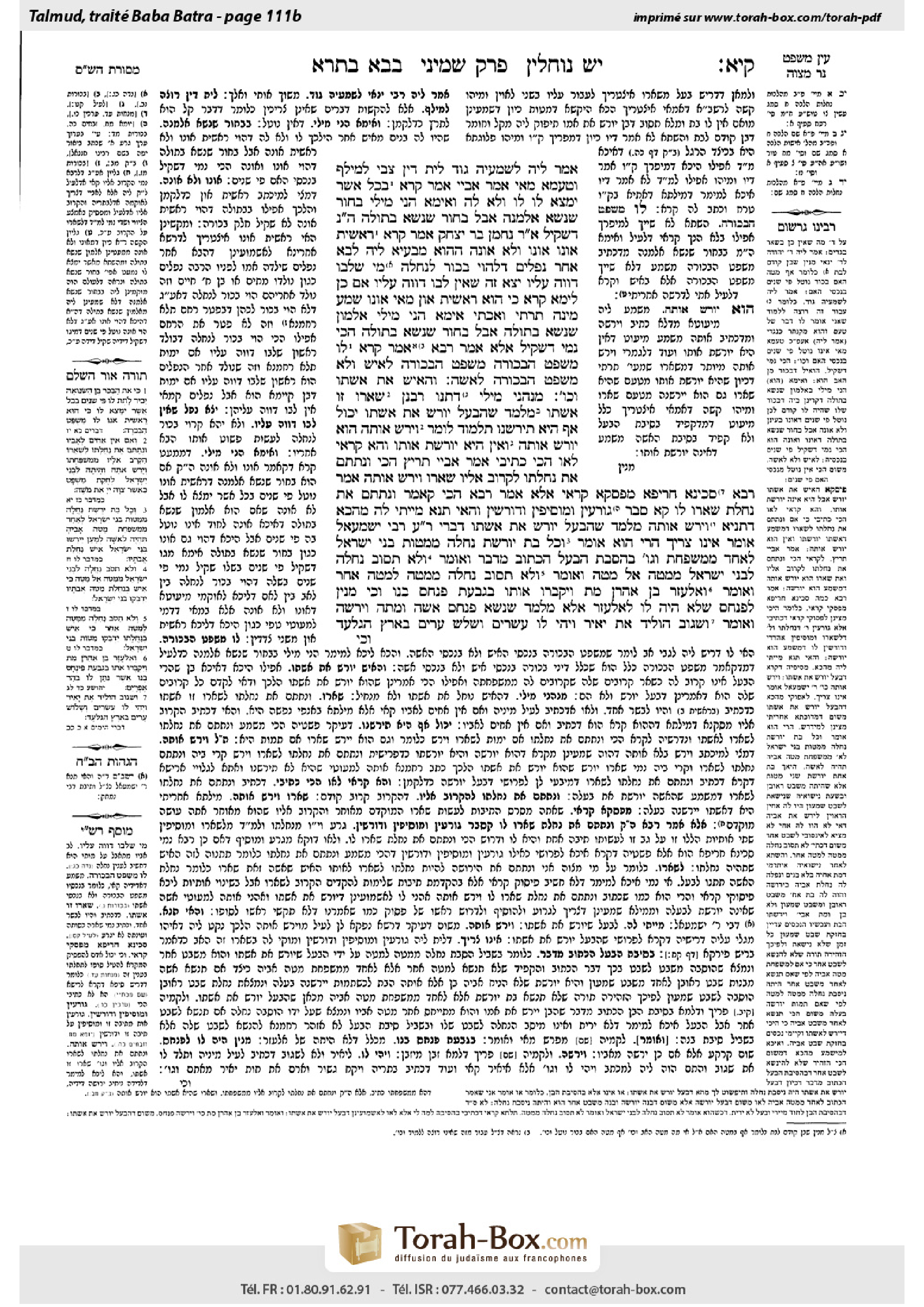
Bava Batra 111b: Talmud study for Daf Yomi
Study the Talmud for Daf Yomi with scanned pages, Hebrew text, English translations from Sefaria and AI-generated French translations.
Passage selection and English or AI-generated French translation are available where the scan has annotations. Daf Study is independent of Torah-Box and Sefaria.
Browse Bava Batra · בבא בתרא · All tractatesBava Batra 111b text and translations
This page of Bava Batra includes the Aramaic text, an English translation and an AI-generated French translation, alongside the scan above.
בבא בתרא קי״א ב · Aramaic and Hebrew text
אֲמַר לֵיהּ לְשַׁמָּעֵיהּ: גּוּד, לֵית דֵּין צָבֵי לְמֵילַף. וְטַעְמָא מַאי? אָמַר אַבָּיֵי, אָמַר קְרָא: ״בְּכֹל אֲשֶׁר יִמָּצֵא לוֹ״; ״לוֹ״ – וְלֹא לָהּ.
וְאֵימָא: הָנֵי מִילֵּי בָּחוּר שֶׁנָּשָׂא אַלְמָנָה, אֲבָל בָּחוּר שֶׁנָּשָׂא בְּתוּלָה – הָכִי נָמֵי דְּשָׁקֵיל!
אָמַר רַב נַחְמָן בַּר יִצְחָק, אָמַר קְרָא: ״רֵאשִׁית אֹנוֹ״; ״אוֹנוֹ״ – וְלֹא אוֹנָהּ.
הָהוּא מִבַּעְיָא לֵיהּ לַבָּא אַחַר נְפָלִים, דְּלֶהֱוֵי בְּכוֹר לְנַחֲלָה – מִי שֶׁלִּבּוֹ דָּוֶוה עָלָיו, יָצָא זֶה שֶׁאֵין לִבּוֹ דָּוֶוה עָלָיו!
אִם כֵּן, לֵימָא קְרָא: ״כִּי הוּא רֵאשִׁית אוֹן״ – מַאי ״אוֹנוֹ״? שְׁמַע מִינַּהּ תַּרְתֵּי.
וְאַכַּתִּי, אֵימָא הָנֵי מִילֵּי אַלְמוֹן שֶׁנָּשָׂא בְּתוּלָה, אֲבָל בָּחוּר שֶׁנָּשָׂא בְּתוּלָה – הָכִי נָמֵי דְּשָׁקֵיל!
אֶלָּא אָמַר רָבָא, אָמַר קְרָא: ״לוֹ מִשְׁפַּט הַבְּכֹרָה״ – מִשְׁפַּט הַבְּכוֹרָה לָאִישׁ, וְלֹא מִשְׁפַּט הַבְּכוֹרָה לָאִשָּׁה.
וְהָאִישׁ אֶת אִשְׁתּוֹ וְכוּ׳. מְנָהָנֵי מִילֵּי? דְּתָנוּ רַבָּנַן: ״שְׁאֵרוֹ״ – זוֹ אִשְׁתּוֹ, מְלַמֵּד שֶׁהַבַּעַל יוֹרֵשׁ אֶת אִשְׁתּוֹ. יָכוֹל אַף הִיא תִּירָשֶׁנּוּ? תַּלְמוּד לוֹמַר: ״וְיָרַשׁ אוֹתָהּ״ – הוּא יוֹרֵשׁ אוֹתָהּ, וְאֵין הִיא יוֹרֶשֶׁת אוֹתוֹ.
וְהָא קְרָאֵי לָאו הָכִי כְּתִיבִי! אָמַר אַבָּיֵי, תָּרֵיץ הָכִי: ״וּנְתַתֶּם אֶת נַחֲלָתוֹ לַקָּרוֹב אֵלָיו, שְׁאֵרוֹ וְיָרַשׁ אֹתָהּ״.
אָמַר רָבָא: סַכִּינָא חֲרִיפָא מַפְסְקָא קְרָאֵי?! אֶלָּא אָמַר רָבָא, הָכִי קָאָמַר: ״וּנְתַתֶּם אֶת נַחֲלַת שְׁאֵרוֹ לוֹ״ – קָא סָבַר גּוֹרְעִין וּמוֹסִיפִין, וְדוֹרְשִׁין.
וְהַאי תַּנָּא מַיְיתֵי לַהּ מֵהָכָא – דְּתַנְיָא: ״וְיָרַשׁ אוֹתָהּ״, מְלַמֵּד שֶׁהַבַּעַל יוֹרֵשׁ אֶת אִשְׁתּוֹ; דִּבְרֵי רַבִּי עֲקִיבָא.
רַבִּי יִשְׁמָעֵאל אוֹמֵר: אֵינוֹ צָרִיךְ, הֲרֵי הוּא אוֹמֵר: ״וְכׇל בַּת יֹרֶשֶׁת נַחֲלָה מִמַּטּוֹת בְּנֵי יִשְׂרָאֵל, לְאֶחָד מִמִּשְׁפַּחַת וְגוֹ׳״ – בַּהֲסָבַת הַבַּעַל הַכָּתוּב מְדַבַּר.
וְאוֹמֵר: ״וְלֹא תִסֹּב נַחֲלָה לִבְנֵי יִשְׂרָאֵל מִמַּטֶּה אֶל מַטֶּה״. וְאוֹמֵר: ״וְלֹא תִסֹּב נַחֲלָה מִמַּטֶּה לְמַטֶּה אַחֵר״.
וְאוֹמֵר: ״וְאֶלְעָזָר בֶּן אַהֲרֹן מֵת, וַיִּקְבְּרוּ אֹתוֹ בְּגִבְעַת פִּנְחָס בְּנוֹ״ – וְכִי מִנַּיִן לְפִנְחָס שֶׁלֹּא הָיָה לוֹ לְאֶלְעָזָר? אֶלָּא מְלַמֵּד שֶׁנָּשָׂא פִּנְחָס אִשָּׁה וּמֵתָה, וִירָשָׁהּ.
וְאוֹמֵר: ״וּשְׂגוּב הוֹלִיד אֶת יָאִיר, וַיְהִי לוֹ עֶשְׂרִים וְשָׁלֹשׁ עָרִים בְּאֶרֶץ הַגִּלְעָד״ –
Bava Batra 111b · English translation
He said to his attendant: Take me away from here, as this man, Rabbi Yehuda Nesia, does not desire to learn but is instead raising difficulties that are easily resolved. And what is the reason he does not receive a double portion? Abaye said: The verse concerning the double portion received by a firstborn son states: “By giving him a double portion of all that he has” (Deuteronomy 21:17), indicating that he receives a double portion in all that he has, but not in all that she has.
The Gemara asks: And why not say that this statement applies in the case of a bachelor who married a widow, i.e., a man who marries a woman who already has children from another man, so that the firstborn son is his firstborn but not hers, but in the case of a bachelor who married a virgin, so too the halakha will be that their firstborn son will take a double portion of his mother’s inheritance?
Rav Naḥman bar Yitzḥak said: There is a different derivation teaching that halakha, as the same verse states: “For he is the first fruits of his strength [ono]” (Deuteronomy 21:17), indicating that the halakha of the double portion is stated with regard to his strength, but not her strength, thereby excluding a son who is the firstborn of his mother alone.
The Gemara challenges: But that verse is required to derive the halakha of a child who came into the world after his mother gave birth to non-viable newborns who did not reach the full term of nine months. This verse teaches that such a firstborn son should be a firstborn with regard to inheritance, even though he is not a firstborn with regard to the mitzva to redeem one’s firstborn son. How is this halakha derived from the verse? The term “his strength [ono]” is understood as referring to acute mourning [aninut], in the following manner: A firstborn son for the purpose of inheritance of land is only one whose father’s heart is pained about him when he dies, i.e., a son who lives beyond birth, excluding this non-viable newborn whose father’s heart is not pained about him when he dies. Therefore, the next viable son to be born after a non-viable newborn is considered the firstborn.
The Gemara answers: If so, that the sole purpose of the term: “His strength” is to teach that halakha, let the verse say: For he is the first fruit of strength [on], omitting the possessive “his,” represented by the letter vav. What is derived from the more expanded term: “His strength [ono],” which indicates specifically the father’s strength? Conclude two conclusions from it, both with regard to mourning and with regard to the status of the firstborn as the father’s heir specifically.
The Gemara raises a difficulty: But one can still say that this statement applies in a case of a widower who married a virgin, so that he already has a firstborn from his previous marriage who is the first fruit of his strength. And the son born to him and his second wife is not the first fruit of his strength, and it is this type of firstborn who does not inherit a double portion of his mother’s estate. But in a case of a bachelor who married a virgin, so too the halakha will be that their shared firstborn son will take a double portion of his mother’s inheritance.
Rather, Rava said: There is a different derivation teaching that halakha, as the same verse states: “The right of the firstborn is his” (Deuteronomy 21:17). The emphasis on “his” indicates that the primogeniture applies specifically to a man, and the primogeniture does not apply to a woman, whether the woman is the one inheriting or is the legator.
§ The mishna teaches: And a man with regard to his wife inherits but does not bequeath. The Gemara asks: From where are these matters derived? The Gemara explains: As the Sages taught in a baraita: The verse concerning inheritance states: “And if his father has no brothers, then you shall give his inheritance to his kinsman [she’ero] who is next to him of his family, and he shall inherit it” (Numbers 27:11). This kinsman is one’s wife, and the Torah teaches that a husband inherits from his wife, as the Gemara will explain later. One might have thought that she would also inherit from him; therefore, the verse states: “And he shall inherit it,” with the word “it” written in the feminine “otah,” which can also be translated as: Her. This teaches that it is he who inherits from her, but she does not inherit from him.
The Gemara questions this explanation: But the verses are not written like this. The verse states that “his kinsman” inherits from the deceased, so that if that term is referring to one’s wife, a wife should inherit from her husband. Abaye said: Answer like this, i.e., as if the verse were split into two parts. The first part is: Then you shall give his inheritance to he who is next to him, which is a general statement with regard to the inheritance of relatives. The second is: His kinsman, and he shall inherit it, meaning that a husband inherits from his kinsman, referring to his wife.
Rava said: Does a sharp knife cut verses? How can you split the verse, rearrange it and omit letters from its words? Abaye’s derivation rearranges the words and omits the letter lamed from the term “to his kinsman [leshe’ero].” Rather, Rava said: This is what the verse is saying: And you shall give the inheritance of his kinsman [she’ero] to him. The letters should be arranged differently, removing the letter lamed from the word leshe’ero and the letter vav from the word naḥalato and combining them to form the word lo, meaning: To him. Accordingly, the verse teaches that a husband inherits from his wife. The Gemara explains that Rava holds that the Sages subtract and add and interpret homiletically, meaning that letters can be removed from words and appended to each other, and a halakha can be derived from the new word formed by the combination of letters.
The Gemara comments: And this tanna cites the halakha that a husband inherits from his wife from here, as it is taught in a baraita: “And he shall inherit it,” with the word “it” written in the feminine “otah,” which can also be translated as: Her. This teaches that a husband inherits from his wife; this is the statement of Rabbi Akiva, similar to the derivation cited in the baraita above.
The baraita quotes another tanna. Rabbi Yishmael says: This derivation is not necessary, as the verse states: “And every daughter who possesses an inheritance from the tribes of the children of Israel shall be wife to one of the family of the tribe of her father” (Numbers 36:8). The purpose of this mitzva was so that the land she inherited from her father’s tribe will not be transferred to another tribe upon her death. The verse speaks of a transfer of inheritance from one tribe to another by means of the husband, i.e., she must not marry a man from another tribe so that the land will not be transferred to that tribe when her husband inherits from her upon her death. This indicates that a husband inherits from his wife.
Rabbi Yishmael continues: And another verse states: “So shall no inheritance of the children of Israel transfer from tribe to tribe” (Numbers 36:7), and another verse states: “So shall no inheritance transfer from one tribe to another tribe” (Numbers 36:9), also indicating that a husband inherits from his wife.
Rabbi Yishmael continues: And the verse in the Prophets states: “And Elazar, the son of Aaron, died; and they buried him in the Hill of Pinehas his son, which was given him in Mount Ephraim” (Joshua 24:33). And from where did Pinehas have land that his father, Elazar, did not have? Rather, this teaches that Pinehas married a woman who inherited her father’s land, and she died and he inherited from her so that he had his own land. This also indicates that a husband inherits from his wife.
Rabbi Yishmael continues. And the verse in the Writings states: “And Seguv begot Yair, who had twenty-three cities in the land of Gilead” (I Chronicles 2:22).
Bava Batra 111b · Traduction française (IA)
Il dit à son serviteur : Emporte-moi d'ici, car ce homme, Rabbi Yehuda Nesia, ne désire pas apprendre mais soulève des difficultés qui sont facilement résolues. Et pourquoi est-ce qu'il ne reçoit pas une double portion ? Abaye dit : La versette concernant la double portion reçue par un premier-né dit : « En lui donnant une double portion de tout ce qu'il a » (Deutéronome 21:17), indiquant qu'il reçoit une double portion de tout ce qu'il a, mais pas de tout ce qu'elle a.
La Guemara demande : Et pourquoi ne pas dire que cette déclaration s'applique au cas d'un homme qui épouse une veuve, c'est-à-dire un homme qui épouse une femme ayant déjà des enfants d'un autre homme, de sorte que le premier-né est le premier-né de celui-ci mais pas de celle-ci, mais au cas d'un homme qui épouse une vierge, de même la halakha sera que leur premier-né prendra une double portion de l'héritage de sa mère ?
Rav Naḥman bar Yitzḥak dit : Il y a une autre dérivation enseignant la halakha, car la même versette dit : « Car il est le premier fruit de sa force [ono] » (Deutéronome 21:17), indiquant que la halakha de la double portion est énoncée concernant sa force, mais pas celle de sa mère, excluant ainsi un fils qui est le premier-né de sa mère seule.
La Guemara soulève un défi : Mais cette versette est nécessaire pour déduire la halakha concernant un enfant né après que sa mère ait donné naissance à des nouveau-nés non viables qui n'ont pas atteint la pleine durée de neuf mois. Cette versette enseigne que ce premier-né fils devrait être considéré comme un premier-né concernant l'héritage, même s'il n'est pas un premier-né concernant la mitsva de racheter son premier-né. Comment cette halakha est-elle déduite de la versette ? Le terme « sa force [ono] » est compris comme faisant référence à la douleur aiguë [aninut], de la manière suivante : Un premier-né pour l'héritage de la terre est celui dont le cœur du père est touché lorsqu'il meurt, c'est-à-dire un fils qui vit au-delà de la naissance, excluant ce nouveau-né non viable dont le cœur du père n'est pas touché lorsqu'il meurt. Ainsi, le prochain enfant viable né après un nouveau-né non viable est considéré comme le premier-né.
La Guemara répond : Si tel est le cas, que le seul but du terme : « Sa force » est d'enseigner cette halakha, laisse la versette dire : « Car il est le premier fruit de la force [on] », en omettant le possessif « sa », représenté par la lettre vav. Qu'est-ce qui est déduit du terme plus développé : « Sa force [ono] », qui indique spécifiquement la force du père ? Conclure deux conclusions à partir de cela, toutes deux concernant la douleur et le statut de premier-né comme héritier spécifique du père.
La Guemara soulève une difficulté : Mais on peut encore dire que cette déclaration s'applique au cas d'un veuf qui a épousé une vierge, de sorte qu'il a déjà un premier-né de son précédent mariage qui est le premier fruit de sa force. Et le fils né de lui et de sa deuxième épouse n'est pas le premier fruit de sa force, et c'est ce type de premier-né qui ne reçoit pas une double portion de l'héritage de sa mère. Mais dans le cas d'un célibataire qui a épousé une vierge, de même la halakha sera que leur premier-né commun prendra une double portion de l'héritage de sa mère.
Plutôt, Rava dit : Il y a une autre dérivation enseignant la halakha, car la même versette dit : « Le droit du premier-né est le sien » (Deutéronome 21:17). L'insistance sur « son » indique que la primogeniture s'applique spécifiquement à un homme, et la primogeniture ne s'applique pas à une femme, que ce soit celle qui hérite ou celle qui légue.
§ La michna enseigne : Et un homme concernant sa femme hérite mais ne légue pas. La Guemara demande : D'où sont dérivés ces points ? La Guemara explique : Comme les Sages ont enseigné dans une baraïta : La versette concernant l'héritage dit : « Et si son père n'a pas de frères, alors tu lui donneras son héritage à son parent [she'ero] qui est proche de lui dans sa famille, et il héritera de cela » (Nombres 27:11). Ce parent est son épouse, et la Torah enseigne qu'un mari hérite de sa femme, comme la Guemara l'expliquera plus tard. On pouvait penser qu'elle hériterait aussi de lui ; donc, la versette dit : « Et il héritera de cela », avec le mot « cela » écrit en féminin « otah », qui peut aussi être traduit comme : Elle. Cela enseigne que c'est lui qui hérite d'elle, mais elle ne hérite pas de lui.
La Guemara questionne cette explication : Mais les versets ne sont pas écrits ainsi. La versette dit que « son parent » hérite du défunt, de sorte que si ce terme fait référence à son épouse, l'épouse devrait hériter de son mari. Abaye dit : Réponds ainsi, c'est-à-dire comme si la versette était divisée en deux parties. La première partie est : « Alors tu lui donneras son héritage à celui qui est proche de lui », ce qui est une déclaration générale concernant l'héritage des parents. La seconde est : « Son parent, et il héritera de cela », signifiant qu'un mari hérite de son parent, faisant référence à son épouse.
Rava dit : Un couteau aigu coupe-t-il les versets ? Comment peut-on diviser la versette, la réorganiser et omettre des lettres de ses mots ? La dérivation d'Abaye réorganise les mots et omet la lettre lamed du terme « à son parent [leshe'ero] ». Plutôt, Rava dit : C'est ce que la versette dit : « Et tu donneras l'héritage de son parent [she'ero] à lui ». Les lettres devraient être réorganisées différemment, enlevant la lettre lamed du mot leshe'ero et la lettre vav du mot naḥalato et en les combinant pour former le mot lo, signifiant : À lui. Ainsi, la versette enseigne qu'un mari hérite de sa femme. La Guemara explique que Rava considère que les Sages suppriment et ajoutent, et interprètent homiletiquement, c'est-à-dire que des lettres peuvent être retirées des mots et ajoutées les unes aux autres, et une halakha peut être déduite du nouveau mot formé par la combinaison des lettres.
La Guemara commente : Et ce tanna cite la halakha selon laquelle le mari hérite de sa femme, comme il est enseigné dans une baraïta : « Et il héritera d'elle », avec le mot « elle » écrit au féminin « otah », ce qui peut aussi être traduit par « elle ». Cela enseigne que le mari hérite de sa femme ; c’est la déclaration de Rabbi Akiva, semblable à la dérivation citée dans la baraïta ci-dessus.
La baraïta cite un autre tanna. Rabbi Yishmael dit : Cette dérivation n’est pas nécessaire, car la Parashah dit : « Et toute fille qui possède une héritage des tribus des enfants d’Israël sera épouse d’un des membres de la famille de la tribu de son père » (Nombres 36,8). L’objet de cette mitsva était de ce que la terre qu’elle avait héritée de la tribu de son père ne passe pas à une autre tribu lors de sa mort. La Parashah parle d’un transfert d’héritage d’une tribu à une autre par le biais du mari, c’est-à-dire qu’elle ne doit pas épouser un homme d’une autre tribu afin que la terre ne passe pas à cette tribu lorsqu’elle mourra et que son mari hérite d’elle.
Rabbi Yishmael continue : Et une autre Parashah dit : « Ainsi, aucun héritage des enfants d’Israël ne passera d’une tribu à une autre » (Nombres 36,7), et une autre Parashah dit : « Ainsi, aucun héritage ne passera d’une tribu à une autre tribu » (Nombres 36,9), indiquant également que le mari hérite de sa femme.
Rabbi Yishmael continue : Et la Parashah dans les Prophètes dit : « Et Eléazar, fils d’Aaron, mourut ; et ils le firent enterrer sur la montagne de Pinchas son fils, qui était donnée à lui dans la montagne d’Éphraïm » (Josué 24,33). Et d’où Pinchas avait-il une terre que son père Eléazar n’avait pas ? Plutôt, cela enseigne que Pinchas épousa une femme qui avait hérité de la terre de son père, et elle mourut et il hérita d’elle afin d’avoir sa propre terre. Cela montre également que le mari hérite de sa femme.
Rabbi Yishmael continue. Et la Parashah dans les Ecritures dit : « Et Seguv engendra Yair, qui avait vingt-trois villes dans la terre de Gilead » (Chroniques I, 22).
Traduction française générée par IA à partir de l’édition anglaise de Sefaria. Vérifie toujours un passage avec le texte source.
Text from Sefaria: William Davidson Edition - Vocalized Aramaic (CC BY NC); William Davidson Edition - English (CC BY NC).