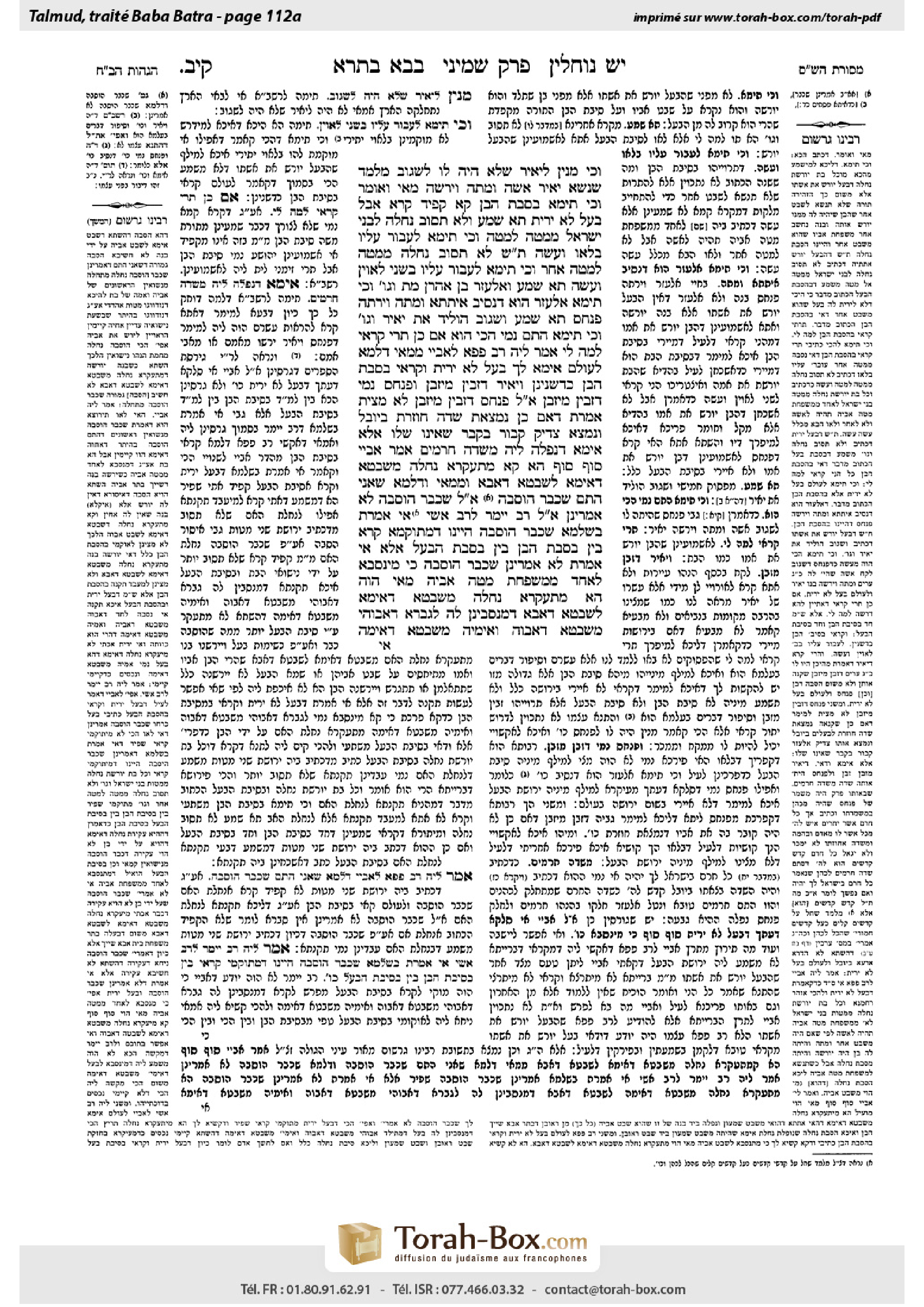
Bava Batra 112a: Talmud study for Daf Yomi
Study the Talmud for Daf Yomi with scanned pages, Hebrew text, English translations from Sefaria and AI-generated French translations.
Passage selection and English or AI-generated French translation are available where the scan has annotations. Daf Study is independent of Torah-Box and Sefaria.
Browse Bava Batra · בבא בתרא · All tractatesBava Batra 112a text and translations
This page of Bava Batra includes the Aramaic text, an English translation and an AI-generated French translation, alongside the scan above.
בבא בתרא קי״ב א · Aramaic and Hebrew text
וְכִי מִנַּיִן לְיָאִיר שֶׁלֹּא הָיָה לוֹ לִשְׂגוּב? מְלַמֵּד שֶׁנָּשָׂא יָאִיר אִשָּׁה וּמֵתָה, וִירָשָׁהּ.
מַאי ״וְאוֹמֵר״? וְכִי תֵּימָא, בְּסִבַּת הַבֵּן קָא קָפֵיד קְרָא, אֲבָל בַּעַל לָא יָרֵית – תָּא שְׁמַע: ״וְלֹא תִסֹּב נַחֲלָה לִבְנֵי יִשְׂרָאֵל מִמַּטֶּה לְמַטֶּה״.
וְכִי תֵּימָא, לַעֲבוֹר עָלָיו בְּלָאו וַעֲשֵׂה – תָּא שְׁמַע: ״לֹא תִסֹּב נַחֲלָה מִמַּטֶּה לְמַטֶּה אַחֵר״.
וְכִי תֵּימָא, לַעֲבוֹר עָלָיו בִּשְׁנֵי לָאוִין וַעֲשֵׂה – תָּא שְׁמַע: ״וְאֶלְעָזָר בֶּן אַהֲרֹן מֵת וְגוֹ׳״.
וְכִי תֵּימָא, אֶלְעָזָר הוּא דִּנְסֵיב אִיתְּתָא וּמֵתָה, וְיַרְתַהּ פִּנְחָס – תָּא שְׁמַע: ״וּשְׂגוּב הוֹלִיד אֶת יָאִיר וְגוֹ׳״.
וְכִי תֵּימָא, הָתָם נָמֵי הָכִי הוּא – אִם כֵּן, תְּרֵי קְרָאֵי לְמָה לִי?
אֲמַר לֵיהּ רַב פָּפָּא לְאַבָּיֵי: מִמַּאי? דִּלְמָא לְעוֹלָם אֵימָא לָךְ: בַּעַל לָא יָרֵית; וּקְרָאֵי – בְּסִבַּת הַבֵּן, כִּדְשַׁנִּינַן; וְיָאִיר, דִּזְבַן מִיזְבָּן; וּפִנְחָס נָמֵי, דִּזְבַן מִיזְבָּן!
אֲמַר לֵיהּ: פִּנְחָס דִּזְבַן מִיזְבָּן לָא מָצֵית אָמְרַתְּ; דְּאִם כֵּן, נִמְצֵאת שָׂדֶה חוֹזֶרֶת בַּיּוֹבֵל, וְנִמְצָא צַדִּיק קָבוּר בְּקֶבֶר שֶׁאֵינוֹ שֶׁלּוֹ.
אֶלָּא אֵימָא דִּנְפַלָה לֵיהּ מִשְּׂדֵה חֲרָמִים!
אָמַר אַבָּיֵי: סוֹף סוֹף, הָא קָא מִתְעַקְרָא נַחֲלָה מִשִּׁבְטָא דְאִימָּא לְשִׁבְטָא דְאַבָּא!
וּמִמַּאי? וְדִלְמָא שָׁאנֵי הָתָם, שֶׁכְּבָר הוּסַבָּה! אֲמַר לֵיהּ: ״שֶׁכְּבָר הוּסַבָּה״ לָא אָמְרִינַן.
אֲמַר לֵיהּ רַב יֵימַר לְרַב אָשֵׁי: אִי אָמְרַתְּ בִּשְׁלָמָא שֶׁכְּבָר הוּסַבָּה, הַיְינוּ דְּמִתּוֹקְמָא קְרָא בֵּין בְּסִבַּת הַבֵּן, בֵּין בְּסִבַּת הַבַּעַל.
אֶלָּא אִי אָמְרַתְּ לָא אָמְרִינַן שֶׁכְּבָר הוּסַבָּה, כִּי מִינַּסְבָא לְאֶחָד מִמִּשְׁפַּחַת מַטֵּה אָבִיהָ, מַאי הָוֵה? הָא מִתְעַקְרָא נַחֲלָה מִשִּׁבְטָא דְאִימָּא לְשִׁבְטָא דְאַבָּא!
דְּמַנְסְבִינַן לַהּ לְגַבְרָא דַּאֲבוּהִי מִשִּׁבְטָא דַאֲבוּהָ וְאִימֵּיהּ מִשִּׁבְטָא דְּאִימֵּיהּ.
Bava Batra 112a · English translation
And from where did Yair have land that his father, Seguv, did not have? Rather, this teaches that Yair married a woman who inherited her father’s land, and she died and he inherited from her so that he had his own land. This also indicates that a husband inherits from his wife.
The Gemara proceeds to explain this baraita. What is the meaning of: And it states? Why is it necessary to provide additional proofs beyond the first verse? The Gemara explains: The first verse seems to prove the halakha that a husband inherits from his wife. And if you would say that the verse that rules that a woman who inherited land from her father cannot marry a man from another tribe is not concerned that he will inherit from her, but rather the verse is concerned about a transfer of inheritance from one tribe to another by means of the son who will inherit from his mother, as he belongs to his father’s tribe, but a husband does not inherit from his wife; therefore, come and hear another verse that is seemingly superfluous: “So shall no inheritance of the children of Israel transfer from tribe to tribe” (Numbers 36:7). This teaches that a transfer of land could occur by means of the husband inheriting from her.
And if you would say that this verse is also concerned with the transfer of the inheritance by means of the son, and that the seemingly superfluous verse is stated for another purpose, i.e., in order to establish that a woman who inherited land from her father and marries a man from another tribe will violate for that act a prohibition, namely: “So shall no inheritance of the children of Israel transfer,” and a positive mitzva, namely: “Shall be wife to one of the family of the tribe of her father”; therefore, come and hear another verse that is seemingly superfluous: “So shall no inheritance transfer from one tribe to another tribe” (Numbers 36:9), which teaches that a transfer can occur by means of the husband inheriting from his wife.
And if you would say that this verse is also concerned with the transfer of the inheritance by means of the son, and that the seemingly superfluous verse is stated for another purpose, i.e., in order to establish that a woman who inherited land from her father and marries a man from another tribe violates for that act two prohibitions and a positive mitzva; therefore, come and hear another proof that a husband inherits from his wife, from the verse: “And Elazar, the son of Aaron, died” (Joshua 24:33).
And if you would say that Pinehas did not inherit this land from his wife, but from his mother, as it was Elazar, his father, who married a woman who inherited land, and she subsequently died, and her son Pinehas inherited from her so that this verse proves the inheritance of a son and not that of a husband; therefore, come and hear a proof from the verse: “And Seguv begot Yair” (I Chronicles 2:22).
And if you would say: That is the case there as well, that it was Yair who inherited it from his deceased mother, if so, why do I need two verses to teach the same halakha? This concludes the Gemara’s explanation of the baraita.
Rav Pappa said to Abaye: From where do you know that this is how the verse should be understood? Perhaps I could actually say to you: A husband does not inherit from his wife, and the verses are concerned about a transfer of inheritance from one tribe to another by means of the son, as we explained, teaching that one who does so violates two prohibitions and a positive mitzva. And with regard to Yair, one could say that he purchased it from a third party and did not inherit it. And with regard to Pinehas as well, one could say that he purchased it from a third party.
Abaye said to him: You cannot say that Pinehas purchased the land where he buried his father, as if so, the field would return to its original owner in the Jubilee Year (see Leviticus, chapter 25), and it would be found that this righteous man, i.e., Elazar, is buried in a grave in land that is not his.
Rav Pappa asked further: Rather, say that in his capacity as a priest he came into possession of this land as a dedicated field. Pinehas, as a priest, may have owned the land by that means. Therefore, one can still say that a husband does not inherit from his wife, and the verses are concerned about a transfer of inheritance from one tribe to another by means of the son.
Abaye said: Even if you say that her son and not her husband inherits from her, ultimately the inheritance is uprooted from the tribe of the mother and is moved to the tribe of the father, and the prohibition against her marrying a man from another tribe is not effective in achieving its goal. The verse speaks of a woman who inherited the land from her mother who is of a different tribe from her father (see 111a). Even if she marries a man from her own tribe, the inheritance will be transferred from her mother’s tribe to that of her, the woman’s, husband, as even if the woman’s son inherits, he is of his father’s tribe.
Rav Pappa rejects this: And from where do you raise your challenge? But perhaps it is different there, as the inheritance had already been transferred by the mother of the woman when she married the father, so that the Torah is no longer concerned with the continued transfer. When the parents of this now-deceased woman married, the land that her mother would eventually inherit was already thought of as being transferred away from the ownership of her mother’s tribe. Therefore, the fact that even if this woman’s son inherits from her, the fact that the land will permanently belong to a member of her husband’s tribe is of no concern. Abaye said to him: We do not say, i.e., employ, the logic of: As it had already been transferred, since as long as this woman owned it, it still belonged to a person of the first tribe.
Rav Yeimar said to Rav Ashi: Even according to Abaye, who holds the verses teach that the husband inherits, there is still a difficulty. Granted, if you say the logic of: As it has already been transferred, this is how it can be understood that the verse is established as referring to both scenarios: The verse can be understood either with regard to a transfer by means of the son or with regard to a transfer by means of the husband. In both of these scenarios, the daughter’s marriage to a man from her father’s tribe is effective in ensuring that land she will inherit will not leave the tribe, because if she inherited it from her father it remains within the same tribe, and if she inherited it from her mother it had already been transferred when her mother married her father.
But if you say that we do not say the logic of: As it has already been transferred, then even when she gets married to one of the family of the tribe of her father, what of it? But an inheritance is uprooted from the tribe of her mother, who had inherited land from her, the mother’s, father, to the tribe of her father, as her husband is from her father’s tribe.
Rav Ashi said to him: There is a way that the transfer to another tribe can be avoided: Where we marry her to a man whose father is from her father’s tribe and his mother is from her mother’s tribe, the transfer is avoided as the land retains the exact status as it had when it was in the woman’s possession.
Bava Batra 112a · Traduction française (IA)
Et d'où Yair a-t-il eu une terre que son père, Seguv, n'avait pas ? Plutôt, cela enseigne que Yair a épousé une femme qui avait hérité de la terre de son père, et elle est décédée, et il a hérité d'elle, de sorte qu'il avait sa propre terre. Cela montre également que le mari hérite de sa femme.
La Guemara poursuit pour expliquer cette baraïta. Quelle est la signification de : Et il est dit ? Pourquoi est-il nécessaire de fournir des preuves supplémentaires au-delà du premier verset ? La Guemara explique : Le premier verset semble prouver la halakha que le mari hérite de sa femme. Et si l'on disait que le verset qui règle que la femme qui a hérité d'une terre de son père ne peut pas épouser un homme d'une autre tribu n'est pas concerné par le fait qu'il hérite d'elle, mais plutôt le verset est concerné par un transfert d'héritage d'une tribu à une autre par le biais du fils qui héritera de sa mère, car il appartient à la tribu de son père, mais le mari ne hérite pas de sa femme ; donc, viens écouter un autre verset qui semble superflu : « Ainsi, aucun héritage des enfants d'Israël ne passera d'une tribu à une autre » (Nombres 36:7). Cela enseigne que le transfert de terre peut avoir lieu par le biais de l'héritage du mari.
Et si l'on disait que ce verset est également concerné par le transfert de l'héritage par le biais du fils, et que le verset qui semble superflu est mentionné pour une autre raison, à savoir afin d'établir que la femme qui a hérité d'une terre de son père et épouse un homme d'une autre tribu viole par cet acte une interdiction, à savoir : « Ainsi, aucun héritage des enfants d'Israël ne passera d'une tribu à une autre », et un commandement positif, à savoir : « Doit être épouse d'un des membres de la tribu de son père » ; donc, viens écouter un autre verset qui semble superflu : « Ainsi, aucun héritage ne passera d'une tribu à une autre tribu » (Nombres 36:9), qui enseigne que le transfert peut avoir lieu par le biais de l'héritage du mari.
Et si l'on disait que ce verset est également concerné par le transfert de l'héritage par le biais du fils, et que le verset qui semble superflu est mentionné pour une autre raison, à savoir afin d'établir que la femme qui a hérité d'une terre de son père et épouse un homme d'une autre tribu viole par cet acte deux interdictions et un commandement positif ; donc, viens écouter une autre preuve que le mari hérite de sa femme, du verset : « Et Eléazar, fils d'Aaron, mourut » (Josué 24:33).
Et si l'on disait que Pinehas n'a pas hérité cette terre de sa femme, mais de sa mère, car c'était Eléazar, son père, qui avait épousé une femme qui avait hérité d'une terre, et elle est décédée ensuite, et son fils Pinehas avait hérité d'elle, de sorte que ce verset prouve l'héritage du fils et non celui du mari ; donc, viens écouter une preuve du verset : « Et Seguv engendra Yair » (Chroniques I 2:22).
Et si l'on disait que c'est le cas là aussi, à savoir que c'était Yair qui avait hérité de sa mère décédée, si tel est le cas, pourquoi ai-je besoin de deux versets pour enseigner la même halakha ? Cela conclut l'explication de la Guemara sur la baraïta.
Rav Pappa dit à Abaye : D'où sais-tu que c'est ainsi que le verset doit être compris ? Peut-être pourrais-je en réalité dire à toi : Le mari n'hérite pas de sa femme, et les versets sont concernés par un transfert d'héritage d'une tribu à une autre par le biais du fils, comme nous l'avons expliqué, enseignant que celui qui le fait viole deux interdictions et un commandement positif. Et concernant Yair, l'on pourrait dire qu'il l'a acheté auprès d'une tierce personne et n'a pas hérité de cette terre. Et concernant Pinehas également, l'on pourrait dire qu'il l'a acheté auprès d'une tierce personne.
Abaye dit à lui : Tu ne peux pas dire que Pinehas a acheté la terre où il a enterré son père, car si c'était le cas, la terre retournerait à son propriétaire originel lors de l'année du jubilé (voir Lévitique, chapitre 25), et on découvrirait que ce justicier, c'est-à-dire Eléazar, est enterré dans une tombe dans une terre qui n'est pas la sienne.
Rav Pappa demande ensuite : Plutôt, disons qu'en tant que prêtre, il a acquis cette terre comme un champ dédié. Pinehas, en tant que prêtre, pouvait avoir possédé cette terre par ce moyen. Donc, l'on peut encore dire que le mari n'hérite pas de sa femme, et les versets sont concernés par un transfert d'héritage d'une tribu à une autre par le biais du fils.
Abaye dit : Même si l'on dit que c'est son fils et non son mari qui hérite d'elle, finalement l'héritage est arraché de la tribu de la mère et transféré à la tribu du père, et l'interdiction de se marier avec un homme d'une autre tribu n'atteint pas son objectif. Le verset parle d'une femme qui a hérité de la terre de sa mère, qui appartient à une tribu différente de celle de son père (voir 111a). Même si elle épouse un homme de sa propre tribu, l'héritage sera transféré de la tribu de sa mère à celle de son mari, car même si son fils hérite, il appartient à la tribu de son père.
Rav Pappa rejette cela : Et d'où tiens-tu ce défi ? Mais peut-être c'est différent là, car l'héritage avait déjà été transféré par la mère de la femme lorsqu'elle a épousé le père, de sorte que la Torah n'est plus concernée par le transfert continu. Lorsque les parents de cette femme décédée se sont mariés, la terre que sa mère allait hériter avait déjà été considérée comme transférée hors de la propriété de la tribu de sa mère. Donc, le fait que même si l'héritage de cette femme est transféré à son fils, le fait que la terre appartienne définitivement à un membre de la tribu de son mari n'est pas un problème. Abaye dit à lui : Nous ne disons pas, c'est-à-dire que nous n'employons pas, la logique de : Comme il avait déjà été transféré, car tant que cette femme l'avait, il appartenait encore à une personne de la première tribu.
Rav Yeimar a dit à Rav Ashi : Même selon Abaye, qui considère que les versets enseignent que le mari hérite, il reste une difficulté. En effet, si vous dites que la logique est : Comme cela a déjà été transféré, on peut comprendre que le verset est établi pour les deux cas : le verset peut être compris soit par rapport à un transfert par le fils, soit par rapport à un transfert par le mari. Dans les deux cas, le mariage de la fille avec un homme de la tribu de son père assure que la terre qu'elle héritera restera dans la tribu, car si elle l'hérite de son père, elle reste dans la même tribu, et si elle l'hérite de sa mère, elle avait déjà été transférée lorsqu'elle a épousé son père.
Mais si vous dites que nous ne disons pas la logique : Comme cela a déjà été transféré, alors même lorsqu'elle se marie avec l'un des membres de la tribu de son père, qu'y a-t-il ? Mais l'héritage est enlevé de la tribu de sa mère, qui avait hérité de la terre de son père, vers la tribu de son père, car son mari est de la tribu de son père.
Rav Ashi a dit à lui : Il existe un moyen d'éviter le transfert vers une autre tribu : là où l'on épouse la femme avec un homme dont le père est de la tribu de son père et dont la mère est de la tribu de sa mère, le transfert est évité, car la terre conserve exactement le statut qu'elle avait lorsqu'elle était en possession de la femme.
Traduction française générée par IA à partir de l’édition anglaise de Sefaria. Vérifie toujours un passage avec le texte source.
Text from Sefaria: William Davidson Edition - Vocalized Aramaic (CC BY NC); William Davidson Edition - English (CC BY NC).