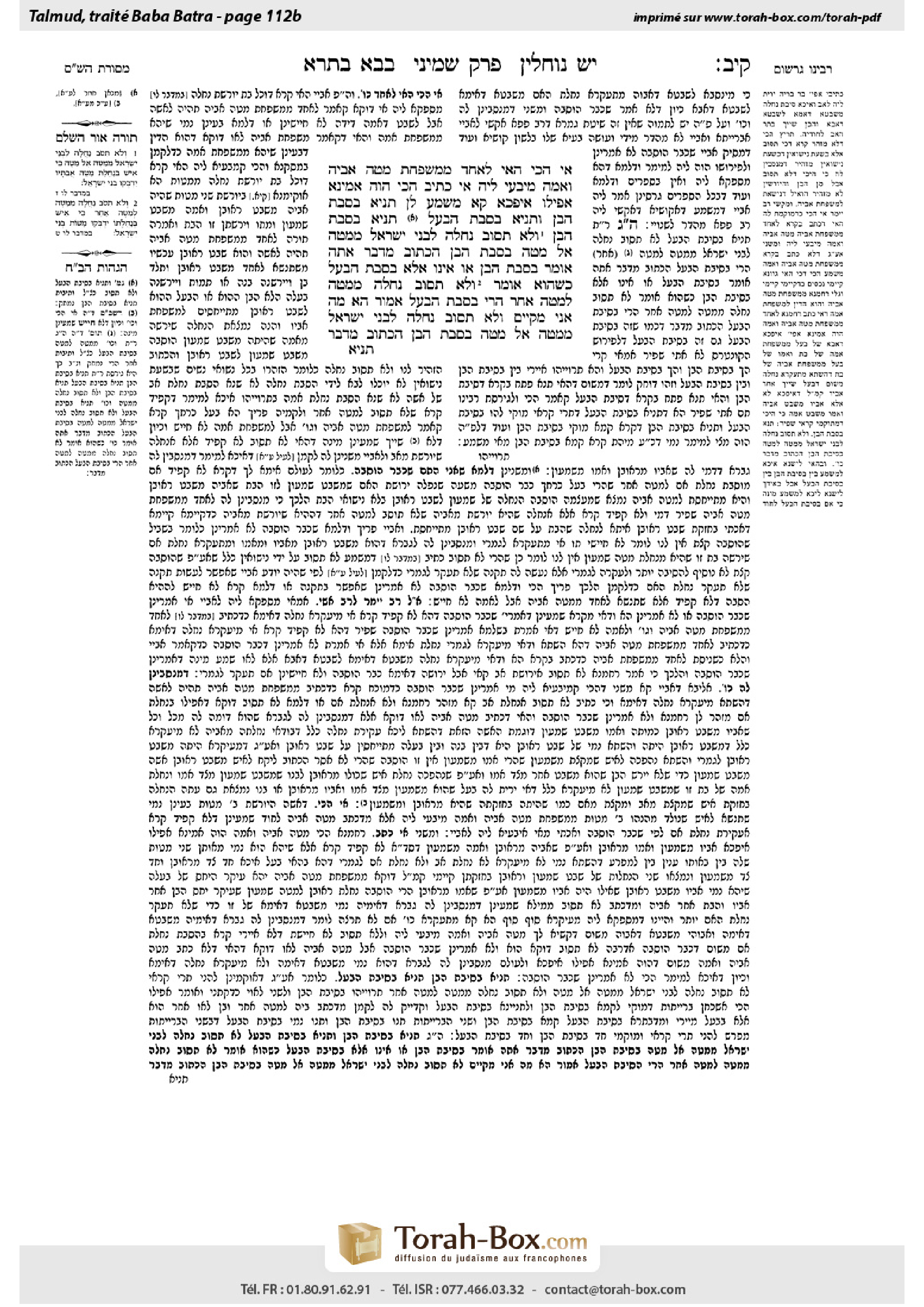
Bava Batra 112b: Talmud study for Daf Yomi
Study the Talmud for Daf Yomi with scanned pages, Hebrew text, English translations from Sefaria and AI-generated French translations.
Passage selection and English or AI-generated French translation are available where the scan has annotations. Daf Study is independent of Torah-Box and Sefaria.
Browse Bava Batra · בבא בתרא · All tractatesBava Batra 112b text and translations
This page of Bava Batra includes the Aramaic text, an English translation and an AI-generated French translation, alongside the scan above.
בבא בתרא קי״ב ב · Aramaic and Hebrew text
אִי הָכִי, הַאי ״לְאֶחָד מִמִּשְׁפַּחַת מַטֵּה אָבִיהָ וְאִמָּהּ״ מִיבְּעֵי לֵיהּ! אִי כְּתִיב הָכִי, הֲוָה אָמֵינָא אֲפִילּוּ אִיפְּכָא, קָא מַשְׁמַע לַן.
תַּנְיָא בְּסִבַּת הַבֵּן, וְתַנְיָא בְּסִבַּת הַבַּעַל; תַּנְיָא בְּסִבַּת הַבֵּן: ״וְלֹא תִסֹּב נַחֲלָה לִבְנֵי יִשְׂרָאֵל מִמַּטֶּה אֶל מַטֶּה״ – בְּסִבַּת הַבֵּן הַכָּתוּב מְדַבַּר.
אַתָּה אוֹמֵר: בְּסִבַּת הַבֵּן; אוֹ אֵינוֹ אֶלָּא בְּסִבַּת הַבַּעַל? כְּשֶׁהוּא אוֹמֵר: ״וְלֹא תִסֹּב נַחֲלָה מִמַּטֶּה לְמַטֶּה אַחֵר״, הֲרֵי בְּסִבַּת הַבַּעַל אָמוּר; הָא מָה אֲנִי מְקַיֵּים ״וְלֹא תִסֹּב נַחֲלָה לִבְנֵי יִשְׂרָאֵל מִמַּטֶּה אֶל מַטֶּה״ – בְּסִבַּת הַבֵּן הַכָּתוּב מְדַבֵּר.
Bava Batra 112b · English translation
The Gemara asks: If so, if a daughter who inherits land from both of her parents must marry a man whose father is from her father’s tribe and whose mother is from her mother’s tribe, this verse: “Shall be a wife to one of the family of the tribe of her father” (Numbers 36:8), should have said: Shall be a wife to one of the family of the tribe of her father and her mother. The Gemara replies: If it were written like this, I would say that even the opposite is permitted, that she may marry a man whose mother is from her father’s tribe and whose father is from her mother’s tribe. As long as she marries someone who is connected to both tribes, it is permitted. The verse therefore teaches us that the opposite is not permitted.
The Gemara comments: Concerning the marriage of a woman who inherited land, it is taught in a baraita with regard to the transfer of the inheritance by means of the son, and it is taught in a baraita with regard to the transfer of the inheritance by means of the husband. The Gemara presents the baraitot: A baraita is taught with regard to the transfer of the inheritance by means of the son, as follows: “So shall no inheritance of the children of Israel transfer from tribe to tribe” (Numbers 36:7); that verse speaks of the transfer of the inheritance by means of the son. The Torah prohibits the woman from marrying a man from a different tribe since her son will inherit from her and thereby the inheritance will transfer away from its original tribe.
Do you say that this is with regard to the transfer of the inheritance by means of the son, or is it only with regard to the transfer of the inheritance by means of the husband? When it says: “So shall no inheritance transfer from one tribe to another tribe” (Numbers 36:9), the verse is speaking with regard to the transfer of the inheritance by means of the husband. How do I realize the meaning of the verse: “So shall no inheritance of the children of Israel transfer from tribe to tribe” (Numbers 36:7)? That verse speaks of the transfer of the inheritance by means of the son.
Bava Batra 112b · Traduction française (IA)
La Guemara pose la question : Si tel est le cas, une fille qui hérite de terres à la fois de ses deux parents doit épouser un homme dont le père appartient à la tribu de son père et dont la mère appartient à la tribu de sa mère. Cette versette : « Doit être la femme d’un des membres de la famille de la tribu de son père » (Nombres 36:8), aurait dû dire : « Doit être la femme d’un des membres de la famille de la tribu de son père et de sa mère ». La Guemara répond : Si ce verset avait été ainsi formulé, je dirais que même l’inverse est permis, à savoir qu’elle peut épouser un homme dont la mère appartient à la tribu de son père et dont le père appartient à la tribu de sa mère. Tant que l’époux est lié à toutes les deux tribus, cela est permis. Le verset nous apprend donc que l’inverse n’est pas permis.
La Guemara commente : En ce qui concerne le mariage d’une femme qui a hérité de terres, il est enseigné dans une baraïta concernant la transmission de l’héritage par le fils, et il est enseigné dans une baraïta concernant la transmission de l’héritage par l’époux. La Guemara présente les baraitot : une baraïta est enseignée concernant la transmission de l’héritage par le fils, comme suit : « Ainsi n’ira-t-il aucun héritage des enfants d’Israël d’une tribu à une autre » (Nombres 36:7) ; ce verset parle de la transmission de l’héritage par le fils. La Torah interdit à la femme de se marier avec un homme d’une autre tribu, car son fils héritera d’elle et ainsi l’héritage quittera alors la tribu originale.
Dis-tu que cela concerne la transmission de l’héritage par le fils, ou est-ce uniquement concernant la transmission de l’héritage par l’époux ? Lorsqu’il dit : « Ainsi n’ira-t-il aucun héritage des enfants d’Israël d’une tribu à une autre » (Nombres 36:9), le verset parle de la transmission de l’héritage par l’époux. Comment comprendre le sens du verset : « Ainsi n’ira-t-il aucun héritage des enfants d’Israël d’une tribu à une autre » (Nombres 36:7) ? Ce verset parle de la transmission de l’héritage par le fils.
Traduction française générée par IA à partir de l’édition anglaise de Sefaria. Vérifie toujours un passage avec le texte source.
Text from Sefaria: William Davidson Edition - Vocalized Aramaic (CC BY NC); William Davidson Edition - English (CC BY NC).