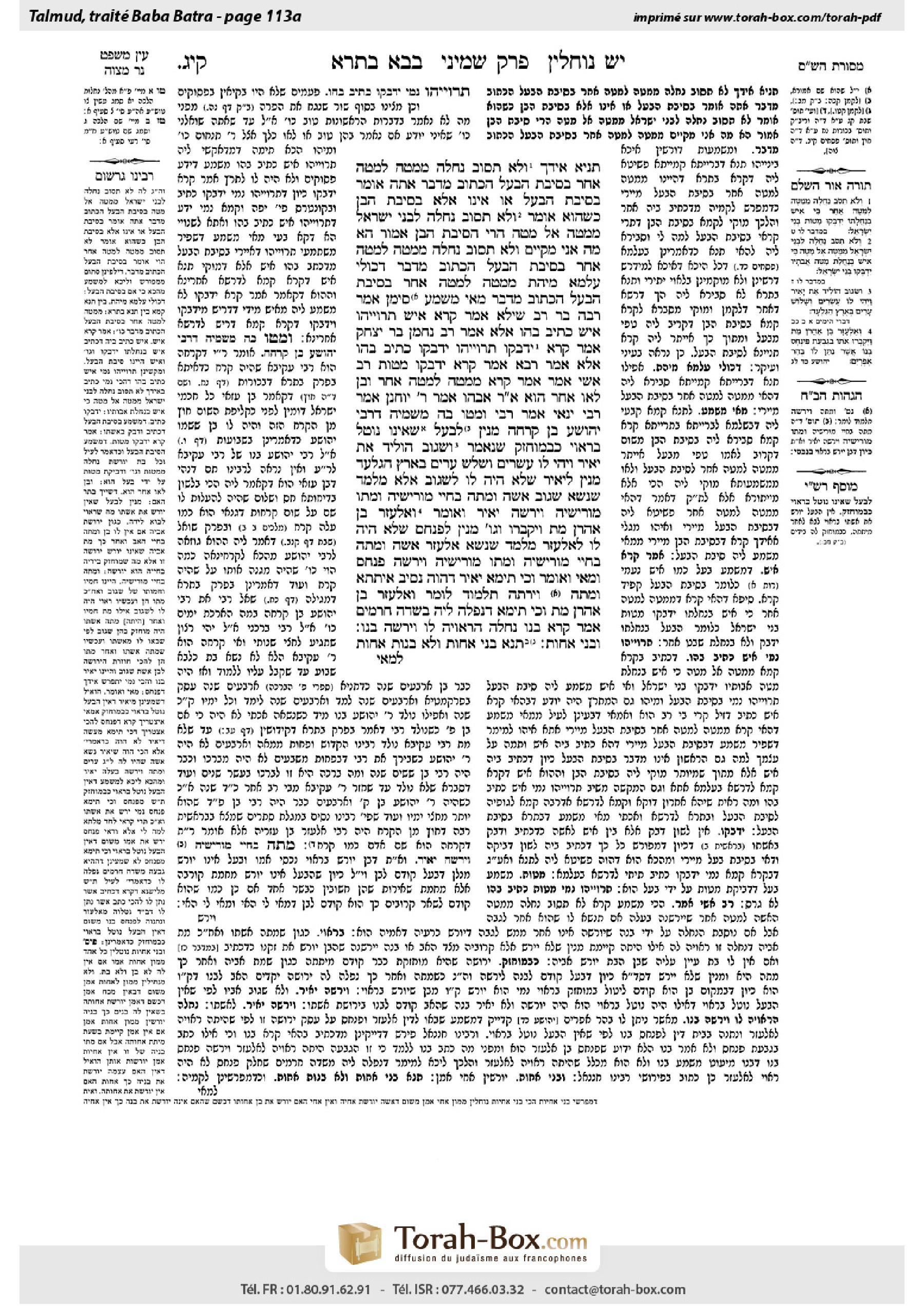
Bava Batra 113a: Talmud study for Daf Yomi
Study the Talmud for Daf Yomi with scanned pages, Hebrew text, English translations from Sefaria and AI-generated French translations.
Passage selection and English or AI-generated French translation are available where the scan has annotations. Daf Study is independent of Torah-Box and Sefaria.
Browse Bava Batra · בבא בתרא · All tractatesBava Batra 113a text and translations
This page of Bava Batra includes the Aramaic text, an English translation and an AI-generated French translation, alongside the scan above.
בבא בתרא קי״ג א · Aramaic and Hebrew text
תַּנְיָא אִידַּךְ: ״וְלֹא תִסֹּב נַחֲלָה מִמַּטֶּה לְמַטֶּה אַחֵר״ – בְּסִיבַּת הַבַּעַל הַכָּתוּב מְדַבֵּר.
אַתָּה אוֹמֵר בְּסִיבַּת הַבַּעַל; אוֹ אֵינוֹ אֶלָּא בְּסִיבַּת הַבֵּן? כְּשֶׁהוּא אוֹמֵר: ״וְלֹא תִסֹּב נַחֲלָה לִבְנֵי יִשְׂרָאֵל מִמַּטֶּה אֶל מַטֶּה״ – הֲרֵי הֲסִיבַּת הַבֵּן אָמוּר; הָא מָה אֲנִי מְקַיֵּים ״וְלֹא תִסֹּב נַחֲלָה מִמַּטֶּה לְמַטֶּה אַחֵר״? בְּסִיבַּת הַבַּעַל הַכָּתוּב מְדַבֵּר.
דְּכוּלֵּי עָלְמָא מִיהַת, ״מִמַּטֶּה לְמַטֶּה אַחֵר״ – בְּסִיבַּת הַבַּעַל הַכָּתוּב מְדַבֵּר; מַאי מַשְׁמַע? סִימָן אָמַר רַבָּה בַּר רַב שֵׁילָא, אָמַר קְרָא: ״אִישׁ״. תַּרְוַיְיהוּ ״אִישׁ״ כְּתִיב בְּהוּ!
אֶלָּא אָמַר רַב נַחְמָן בַּר יִצְחָק, אָמַר קְרָא: ״יִדְבְּקוּ״. תַּרְוַיְיהוּ ״יִדְבְּקוּ״ כְּתִיב בְּהוּ!
אֶלָּא אָמַר רָבָא, אָמַר קְרָא: ״יִדְבְּקוּ מַטּוֹת״. רַב אָשֵׁי אָמַר, אָמַר קְרָא: ״מִמַּטֶּה לְמַטֶּה אַחֵר״ – וּבֵן לָאו אַחֵר הוּא.
אָמַר רַבִּי אֲבָהוּ אָמַר רַבִּי יוֹחָנָן אָמַר רַבִּי יַנַּאי אָמַר רַבִּי; וּמָטוּ בָּהּ מִשְּׁמֵיהּ דְּרַבִּי יְהוֹשֻׁעַ בֶּן קׇרְחָה: מִנַּיִן לְבַעַל שֶׁאֵינוֹ נוֹטֵל בָּרָאוּי כִּבְמוּחְזָק? שֶׁנֶּאֱמַר: ״וּשְׂגוּב הוֹלִיד אֶת יָאִיר, וַיְהִי לוֹ עֶשְׂרִים וְשָׁלוֹשׁ עָרִים בְּאֶרֶץ הַגִּלְעָד״. מִנַּיִן לְיָאִיר – שֶׁלֹּא הָיָה לוֹ לִשְׂגוּב? אֶלָּא מְלַמֵּד שֶׁנָּשָׂא שְׂגוּב אִשָּׁה, וּמֵתָה בְּחַיֵּי מוֹרִישֶׁיהָ; וּמֵתוּ מוֹרִישֶׁיהָ, וִירָשָׁהּ יָאִיר.
וְאוֹמֵר: ״וְאֶלְעָזָר בֶּן אַהֲרֹן מֵת וַיִּקְבְּרוּ וְגוֹ׳״. מִנַּיִן לְפִנְחָס – שֶׁלֹּא הָיָה לוֹ לְאֶלְעָזָר? מְלַמֵּד שֶׁנָּשָׂא אֶלְעָזָר אִשָּׁה, וּמֵתָה בְּחַיֵּי מוֹרִישֶׁיהָ; וּמֵתוּ מוֹרִישֶׁיהָ, וִירָשָׁהּ פִּנְחָס.
וּמַאי ״וְאוֹמֵר״? וְכִי תֵּימָא, יָאִיר – דַּהֲוָה נְסִיב אִיתְּתָא וּמֵתָה, וְיַרְתַהּ; תַּלְמוּד לוֹמַר: וְאֶלְעָזָר בֶּן אַהֲרֹן מֵת״. וְכִי תֵּימָא דִּנְפַלָה לֵיהּ בִּשְׂדֵה חֲרָמִים, אָמַר קְרָא: ״בְּנוֹ״ – נַחֲלָה הָרְאוּיָה לוֹ, וִירָשָׁהּ בְּנוֹ.
וּבְנֵי אָחוֹת. תָּנָא: בְּנֵי אָחוֹת, וְלֹא בְּנוֹת אָחוֹת.
Bava Batra 113a · English translation
It is taught in another baraita: “So shall no inheritance transfer from one tribe to another tribe” (Numbers 36:9); the verse speaks of the transfer of the inheritance by means of the husband. The Torah prohibits the woman from marrying a man from a different tribe since her husband will inherit from her, thereby transferring her inheritance away from its original tribe.
Do you say that this is with regard to the transfer of the inheritance by means of the husband, or is it only with regard to the transfer of the inheritance by means of the son? When it says: “So shall no inheritance of the children of Israel transfer from tribe to tribe” (Numbers 36:7), the verse is speaking with regard to the transfer of the inheritance by means of the son. How do I realize the meaning of the verse: “So shall no inheritance transfer from one tribe to another tribe” (Numbers 36:9)? That verse speaks of the transfer of the inheritance by means of the husband.
The Gemara comments: In any event, according to everyone, i.e., according to both baraitot, the phrase in the verse “from one tribe to another tribe” speaks of the transfer of the inheritance by means of the husband. The Gemara asks: From where is this inferred? The Gemara supplies a mnemonic. Rabba bar Rav Sheila said that the latter part of the verse states: “So shall no inheritance transfer from one tribe to another tribe; for the tribes of the children of Israel shall cleave each one [ish] to its own inheritance,” alluding to the transfer by means of the husband, as the word “ish” means husband, in the context of: “Elimelech the husband [ish] of Naomi” (Ruth 1:3). The Gemara asks: But the word “ish” is written in both of the verses. Therefore, both verses should be interpreted with regard to the transfer of the inheritance by means of the husband.
Rather, Rav Naḥman bar Yitzḥak said a different explanation. The verse states: “Shall cleave,” and this term alludes to marriage, as in the context of: “And he shall cleave to his wife” (Genesis 2:24). The Gemara raises a difficulty: But the term “shall cleave” is written in both of the verses. Therefore, both verses should be interpreted with regard to the transfer of the inheritance by means of the husband.
Rather, Rava said a different explanation: The verse states: “The tribes of the children of Israel shall cleave,” and tribes cleave to one another through marriage. Rav Ashi said another explanation: The verse states: “From one tribe to another tribe,” and a son is not considered “another,” as he is an extension of his mother.
§ Rabbi Abbahu says that Rabbi Yoḥanan says that Rabbi Yannai says that Rabbi Yehuda HaNasi says, and some determined it was in the name of Rabbi Yehoshua ben Korḥa: From where is it derived that a husband who inherits from his wife does not take in inheritance the property due to the deceased as he does the property she possessed? Instead of the husband inheriting the property that was due to her, that property is inherited by her other relatives, such as her son, or other relatives of her father. As it is stated: “And Seguv begot Yair, who had twenty three cities in the land of Gilead” (I Chronicles 2:22). The Gemara asks: From where did Yair have land that his father, Seguv, did not have? Rather, this teaches that Seguv married a woman and she died in the lifetime of her potential legators, and her legators then died, and Yair, her son, not Seguv, her husband, inherited these inheritances from her.
And it is stated: “And Elazar, the son of Aaron, died; and they buried him in the Hill of Pinehas his son” (Joshua 24:33). From where did Pinehas have land that his father, Elazar, did not have? Rather, this teaches that Elazar married a woman and she died in the lifetime of her potential legators, and her legators then died, and Pinehas her son, not Elazar her husband, inherited the property from her.
And what is the meaning of: And it is stated? Why is it necessary to provide an additional proof beyond the first verse? The Gemara explains. And if you would say: In the verse concerning Seguv and Yair, it is Yair, not Seguv, who married a woman and she died and he inherited from her, and he did not inherit from his mother, the verse states: “And Elazar, the son of Aaron, died; and they buried him in the Hill of Pinehas his son” (Joshua 24:33), teaching that Pinehas inherited the land of those from whom his mother inherited, and Elazar did not. And if you would say that this land came into the possession of Pinehas as a dedicated field, as he was a priest, and he did not inherit it from his mother, the verse states: “His son,” indicating that it was an inheritance that was fitting for him, i.e., Elazar, had his wife not predeceased her legators, and his son inherited it.
§ The mishna teaches: And sons of sisters, i.e., nephews born to the sisters of the deceased, inherit from their maternal uncles but do not bequeath to them. It is taught in a baraita: This halakha applies to sons of sisters but not to daughters of sisters.
Bava Batra 113a · Traduction française (IA)
Il est enseigné dans une autre baraïta : « Ainsi n'aura pas de transmission d'héritage d'une tribu à une autre tribu » (Nombres 36,9) ; la versette parle de la transmission de l'héritage par le moyen du mari. La Torah interdit à la femme de se marier avec un homme d'une autre tribu, car son mari héritera d'elle, ce qui transférerait ainsi son héritage hors de sa tribu originelle.
Dis-tu que cela concerne la transmission de l'héritage par le moyen du mari, ou est-ce uniquement en ce qui concerne la transmission de l'héritage par le moyen du fils ? Lorsqu'il est dit : « Ainsi n'aura pas de transmission d'héritage des enfants d'Israël d'une tribu à une autre tribu » (Nombres 36,7), la versette parle de la transmission de l'héritage par le moyen du fils. Comment comprendre la signification de la versette : « Ainsi n'aura pas de transmission d'héritage d'une tribu à une autre tribu » (Nombres 36,9) ? Cette versette parle de la transmission de l'héritage par le moyen du mari.
La Guemara commente : En tout cas, selon tout le monde, c'est-à-dire selon les deux baraïtotes, la phrase dans la versette « d'une tribu à une autre tribu » parle de la transmission de l'héritage par le moyen du mari. La Guemara pose la question : D'où cela est-il inféré ? La Guemara fournit un mnémotechnique. Rabba bar Rav Sheila a dit que la fin de la versette stipule : « Ainsi n'aura pas de transmission d'héritage d'une tribu à une autre tribu ; car les tribus des enfants d'Israël s'attacheront chacune à son héritage », ce qui fait allusion à la transmission par le moyen du mari, car le mot « ish » signifie mari, dans le contexte de : « Elimelech le mari [ish] de Naomi » (Ruth 1,3). La Guemara pose la question : Mais le mot « ish » est écrit dans les deux versettes. Par conséquent, les deux versettes devraient être interprétées en ce qui concerne la transmission de l'héritage par le moyen du mari.
Plutôt, Rav Naḥman bar Yitzḥak a dit une autre explication. La versette stipule : « S'attacheront », et ce terme fait allusion au mariage, comme dans le contexte de : « Et il s'attachera à sa femme » (Genèse 2,24). La Guemara soulève une difficulté : Mais le terme « s'attacheront » est écrit dans les deux versettes. Par conséquent, les deux versettes devraient être interprétées en ce qui concerne la transmission de l'héritage par le moyen du mari.
Plutôt, Rava a dit une autre explication : La versette stipule : « Les tribus des enfants d'Israël s'attacheront », et les tribus s'attachent les unes aux autres par le mariage. Rav Ashi a dit une autre explication : La versette stipule : « D'une tribu à une autre tribu », et un fils n'est pas considéré comme « un autre », car il est une extension de sa mère.
§ Rabbi Abbahu dit que Rabbi Yoḥanan dit que Rabbi Yannai dit que Rabbi Yehuda HaNasi dit, et certains ont déterminé qu'il était dans le nom de Rabbi Yehoshua ben Korḥa : D'où est tiré le fait qu'un mari qui hérite de sa femme ne prend pas en héritage la propriété due au défunt, comme il le ferait pour la propriété qu'elle possédait ? Au lieu que le mari hérite de la propriété qui était due à elle, cette propriété est héritée par ses autres parents, tels que son fils, ou d'autres parents de son père. Comme il est dit : « Et Seguv engendra Yair, qui avait vingt-trois villes dans la terre de Gilead » (I Chroniques 2,22). La Guemara pose la question : D'où Yair avait-il des terres que son père, Seguv, n'avait pas ? Plutôt, cela enseigne que Seguv épousa une femme et elle mourut pendant la vie de ses héritiers potentiels, et ses héritiers potentiels moururent, et Yair, son fils, et non Seguv, son mari, héritèrent de ces héritages d'elle.
Et il est dit : « Et Elazar, le fils d'Aaron, mourut ; et on le mit en sépulture sur la colline de Pinehas son fils » (Josué 24,33). D'où Pinehas avait-il des terres que son père, Elazar, n'avait pas ? Plutôt, cela enseigne que Elazar épousa une femme et elle mourut pendant la vie de ses héritiers potentiels, et ses héritiers potentiels moururent, et Pinehas, son fils, et non Elazar, son mari, héritèrent de la propriété d'elle.
Et que signifie : Et il est dit ? Pourquoi est-il nécessaire de fournir une preuve supplémentaire en dehors de la première versette ? La Guemara explique. Et si tu dis : Dans la versette concernant Seguv et Yair, c'est Yair, et non Seguv, qui épousa une femme et elle mourut et il héritait d'elle, et il n'héritait pas de sa mère, la versette stipule : « Et Elazar, le fils d'Aaron, mourut ; et on le mit en sépulture sur la colline de Pinehas son fils » (Josué 24,33), enseignant que Pinehas héritait de la terre de ceux d'où sa mère avait hérité, et Elazar n'en héritait pas. Et si tu dis que cette terre est entrée en possession de Pinehas comme un champ dédié, car il était un prêtre, et qu'il n'héritait pas de sa mère, la versette stipule : « Son fils », indiquant que c'était un héritage qui convenait à lui, c'est-à-dire à Elazar, s'il n'avait pas précedé ses héritiers, et son fils l'héritait.
§ La mishna enseigne : Et les fils de sœurs, c'est-à-dire les neveux nés des sœurs du défunt, héritent de leurs oncles maternels mais ne les léguaient pas. Il est enseigné dans une baraïta : Cette halakha s'applique aux fils de sœurs mais pas aux filles de sœurs.
Traduction française générée par IA à partir de l’édition anglaise de Sefaria. Vérifie toujours un passage avec le texte source.
Text from Sefaria: William Davidson Edition - Vocalized Aramaic (CC BY NC); William Davidson Edition - English (CC BY NC).