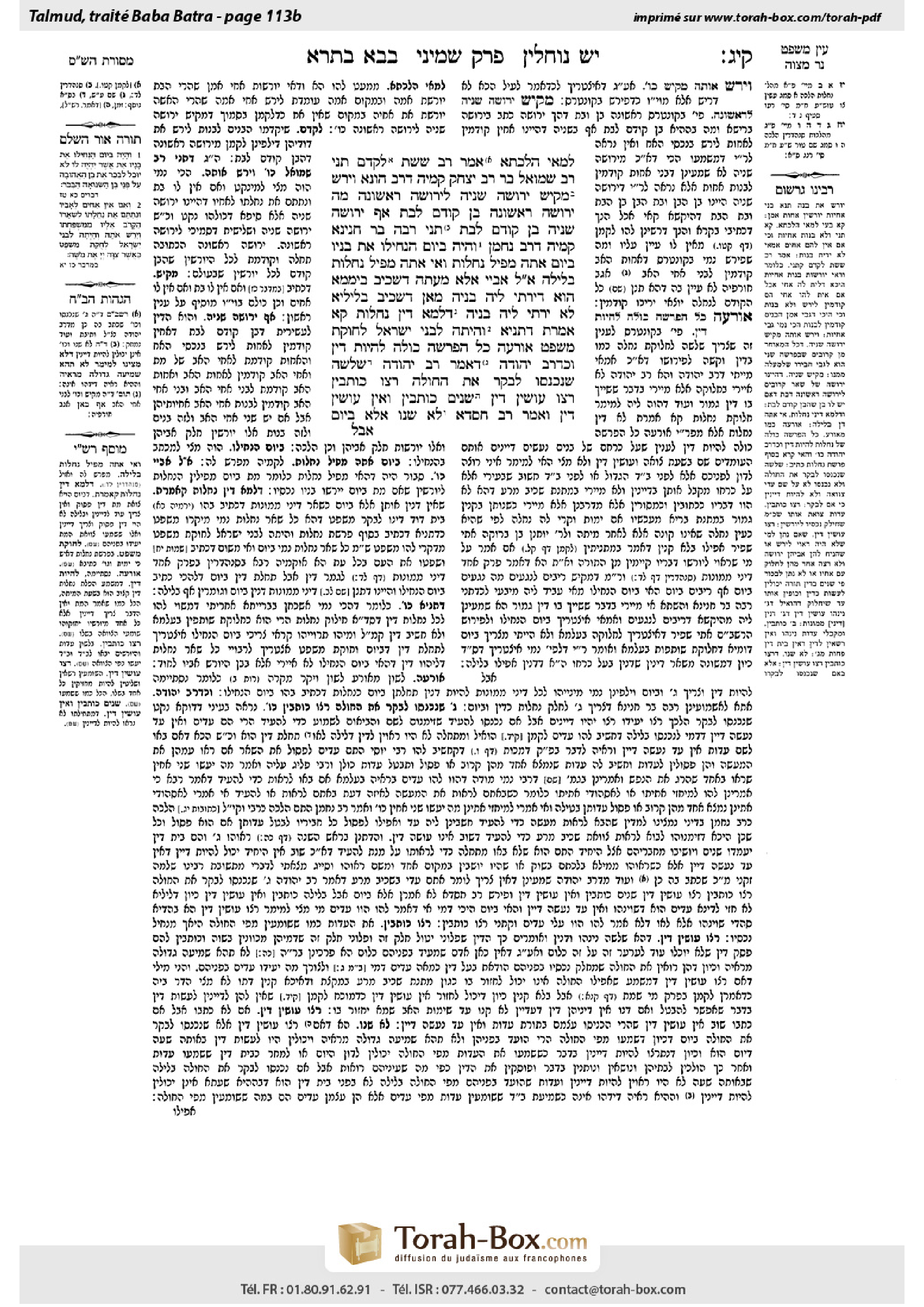
Bava Batra 113b: Talmud study for Daf Yomi
Study the Talmud for Daf Yomi with scanned pages, Hebrew text, English translations from Sefaria and AI-generated French translations.
Passage selection and English or AI-generated French translation are available where the scan has annotations. Daf Study is independent of Torah-Box and Sefaria.
Browse Bava Batra · בבא בתרא · All tractatesBava Batra 113b text and translations
This page of Bava Batra includes the Aramaic text, an English translation and an AI-generated French translation, alongside the scan above.
בבא בתרא קי״ג ב · Aramaic and Hebrew text
לְמַאי הִלְכְתָא? אָמַר רַב שֵׁשֶׁת: לְקַדֵּם.
תָּנֵי רַב שְׁמוּאֵל בַּר רַב יִצְחָק קַמֵּיהּ דְּרַב הוּנָא: ״וְיָרַשׁ״ – מַקִּישׁ יְרוּשָּׁה שְׁנִיָּה לִירוּשָּׁה רִאשׁוֹנָה; מָה יְרוּשָּׁה רִאשׁוֹנָה – בֵּן קוֹדֵם לַבַּת, אַף יְרוּשָּׁה שְׁנִיָּה – בֵּן קוֹדֵם לַבַּת.
תָּנֵי רַבָּה בַּר חֲנִינָא קַמֵּיהּ דְּרַב נַחְמָן: ״וְהָיָה בְּיוֹם הַנְחִילוֹ אֶת בָּנָיו״ – בַּיוֹם אַתָּה מַפִּיל נַחֲלוֹת, וְאִי אַתָּה מַפִּיל נַחֲלוֹת בַּלַּיְלָה. אָמַר לֵיהּ אַבָּיֵי: אֶלָּא מֵעַתָּה, דְּשָׁכֵיב בִּימָמָא הוּא דְּיָרְתִי לֵיהּ בְּנֵיהּ, מַאן דְּשָׁכֵיב בְּלֵילְיָא לָא יָרְתִי לֵיהּ בְּנֵיהּ?!
דִּלְמָא דִּין נַחֲלוֹת קָא אָמְרַתְּ? דְּתַנְיָא: ״וְהָיְתָה לִבְנֵי יִשְׂרָאֵל לְחֻקַּת מִשְׁפָּט״ – אוֹרְעָה כָּל הַפָּרָשָׁה כּוּלָּהּ לִהְיוֹת דִּין.
וְכִדְרַב יְהוּדָה, דְּאָמַר רַב יְהוּדָה: שְׁלֹשָׁה שֶׁנִּכְנְסוּ לְבַקֵּר אֶת הַחוֹלֶה, רָצוּ – כּוֹתְבִין, רָצוּ – עוֹשִׂין דִּין. שְׁנַיִם – כּוֹתְבִין וְאֵין עוֹשִׂין דִּין. וְאָמַר רַב חִסְדָּא: לֹא שָׁנוּ אֶלָּא בַּיּוֹם;
Bava Batra 113b · English translation
With regard to what halakha was this said? It is obvious that in principle daughters have the right to inherit from their maternal uncle, as the mother inherits from him. Rav Sheshet said: It is said to teach that where there are sons as well, they precede the daughters in inheriting from their maternal uncle.
Rav Shmuel bar Rav Yitzḥak taught a baraita before Rav Huna: At the end of the passage discussing inheritance of land, the verse states: “Then you shall give his inheritance to his kinsman who is next to him of his family, and he shall inherit it” (Numbers 27:11). The verse juxtaposes a secondary inheritance, that of one inheriting from other relatives, to a primary inheritance, that of a child inheriting from a parent. This teaches that just as with regard to a primary inheritance a son precedes a daughter, so too, with regard to a secondary inheritance a son precedes a daughter.
§ Rabba bar Ḥanina taught a baraita before Rav Naḥman: A verse in the passage concerning the double portion inherited by a firstborn states: “Then it shall be on the day that he causes his sons to inherit that which he has” (Deuteronomy 21:16). The addition of the phrase “on the day” teaches that it is specifically during the day that you may distribute inheritances, but you may not distribute inheritances at night. Abaye said to him: That cannot be the halakha, as, if that is so, it ought to be that only one who dies during the day is the one from whom his children inherit, but with regard to one who dies at night, his children do not inherit from him, and this is not the case.
Abaye suggests a different interpretation of Rabba bar Ḥanina’s statement: Perhaps you said a distinction between day and night with regard to the adjudication of inheritances, as judges are permitted to sit only during the day. A proof for this distinction is as it is taught in a baraita: A verse in the passage concerning inheritance states: “And it shall be for the children of Israel a statute of judgment” (Numbers 27:11), teaching that the entire portion was placed [ure’a] together to be considered a matter of judgment, subject to the procedural rules of a court matter.
Abaye continues: And this is in accordance with the statement of Rav Yehuda, as Rav Yehuda says: In a case where there were three men who entered a room to visit a sick person and the sick person desired to write a will in order to distribute his property following his death, if the visitors wish to do so they may write his will and sign it as witnesses. And if they wish, they may act in judgment, i.e., they may act as a court in the matter, since there are three of them. Therefore, they can determine that the will has the validity of an act of court and transfer the property to the heirs in their capacity as a court. But if only two came to visit the sick person, they may write the will and sign it as witnesses, but they may not act in judgment, since three are required to form a court. And Rav Ḥisda says: This halakha was taught only in a case where the three came to visit him during the day,
Bava Batra 113b · Traduction française (IA)
Concernant quelle halakha a-t-on dit cela ? Il est évident en principe que les filles ont le droit d'hériter de leur oncle maternel, comme la mère hérite de lui. Rav Sheshet a dit : Cela est dit pour enseigner que lorsqu'il y a des fils également, ceux-ci précèdent les filles dans l'héritage de leur oncle maternel.
Rav Shmuel bar Rav Yitzḥak a enseigné une baraïta devant Rav Huna : À la fin du passage concernant l'héritage de la terre, la versette dit : « Alors tu donneras son héritage à son parent proche qui est à côté de lui dans sa famille, et il héritera de lui » (Nombres 27:11). La versette juxtapose un héritage secondaire, celui d'une personne héritant d'autres parents, à un héritage principal, celui d'un enfant héritant d'un père. Cela enseigne que tout comme, concernant un héritage principal, le fils précède la fille, ainsi, concernant un héritage secondaire, le fils précède la fille.
§ Rabba bar Ḥanina a enseigné une baraïta devant Rav Naḥman : Une versette dans le passage concernant la double portion héritée par le premier-né dit : « Alors il sera le jour où il fera hériter ses fils ce qu'il a » (Deutéronome 21:16). L'ajout de la phrase « le jour » enseigne que c'est spécifiquement pendant la journée que l'on peut distribuer des héritages, mais on ne peut pas distribuer des héritages la nuit. Abaye a dit à lui : Cela ne peut pas être la halakha, car, si c'était le cas, il devrait être que seul celui qui meurt pendant la journée est celui dont ses enfants héritent, mais concernant celui qui meurt la nuit, ses enfants n'héritent pas de lui, ce qui n'est pas le cas.
Abaye suggère une autre interprétation de l'affirmation de Rabba bar Ḥanina : Peut-être que vous avez établi une distinction entre la journée et la nuit concernant l'adjudication des héritages, car les juges ne sont autorisés à siéger qu'en journée. Une preuve de cette distinction est comme il est enseigné dans une baraïta : Une versette dans le passage concernant l'héritage dit : « Et cela sera pour les enfants d'Israël une loi de jugement » (Nombres 27:11), enseignant que toute cette portion a été placée ensemble pour être considérée comme une affaire de jugement, soumise aux règles procédurales d'une affaire judiciaire.
Abaye continue : Et cela correspond à l'affirmation de Rav Yehuda, car Rav Yehuda dit : Dans un cas où trois hommes sont entrés dans une pièce pour visiter une personne malade et que la personne malade souhaitait écrire un testament afin de distribuer ses biens après sa mort, si les visiteurs souhaitent le faire, ils peuvent écrire le testament et le signer comme témoins. Et s'ils le souhaitent, ils peuvent agir en jugement, c'est-à-dire agir comme un tribunal dans cette affaire, car il y a trois d'entre eux. Ainsi, ils peuvent déterminer que le testament a la validité d'un acte de tribunal et transférer les biens aux héritiers dans leur capacité de tribunal. Mais si seulement deux sont venus visiter la personne malade, ils peuvent écrire le testament et le signer comme témoins, mais ils ne peuvent pas agir en jugement, car trois sont requis pour former un tribunal. Et Rav Ḥisda dit : Cette halakha a été enseignée uniquement dans un cas où les trois sont venus le visiter pendant la journée,
Traduction française générée par IA à partir de l’édition anglaise de Sefaria. Vérifie toujours un passage avec le texte source.
Text from Sefaria: William Davidson Edition - Vocalized Aramaic (CC BY NC); William Davidson Edition - English (CC BY NC).