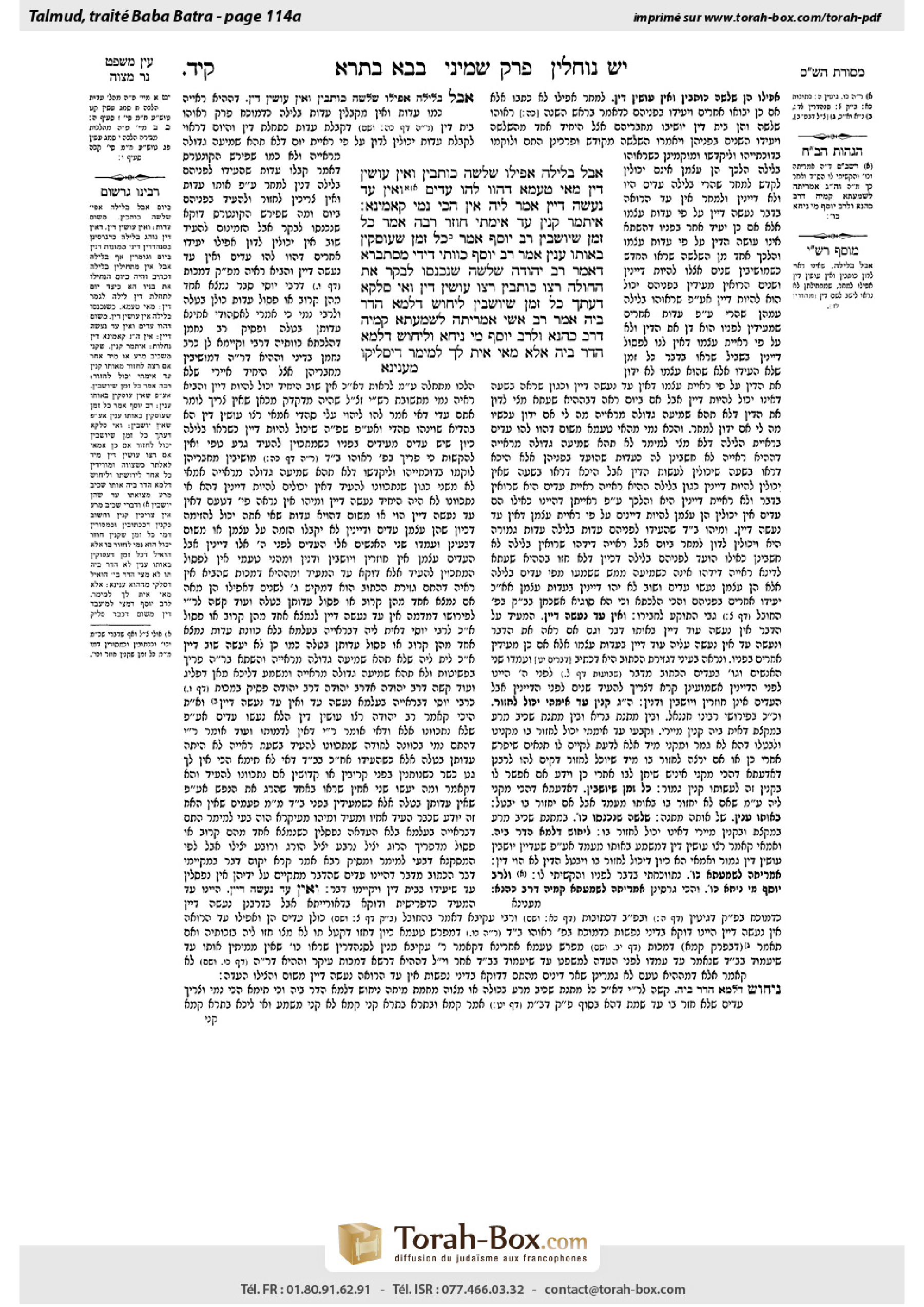
Bava Batra 114a: Talmud study for Daf Yomi
Study the Talmud for Daf Yomi with scanned pages, Hebrew text, English translations from Sefaria and AI-generated French translations.
Passage selection and English or AI-generated French translation are available where the scan has annotations. Daf Study is independent of Torah-Box and Sefaria.
Browse Bava Batra · בבא בתרא · All tractatesBava Batra 114a text and translations
This page of Bava Batra includes the Aramaic text, an English translation and an AI-generated French translation, alongside the scan above.
בבא בתרא קי״ד א · Aramaic and Hebrew text
אֲבָל בַּלַּיְלָה, אֲפִילּוּ שְׁלֹשָׁה – כּוֹתְבִין וְאֵין עוֹשִׂין דִּין. מַאי טַעְמָא? דְּהָווּ לְהוּ עֵדִים, וְאֵין עֵד נַעֲשֶׂה דַּיָּין. אֲמַר לֵיהּ: אִין, הָכִי נָמֵי קָאָמֵינָא.
אִיתְּמַר: קִנְיָן, עַד אֵימָתַי חוֹזֵר? רַבָּה אָמַר: כׇּל זְמַן שֶׁיּוֹשְׁבִין. רַב יוֹסֵף אָמַר: כׇּל זְמַן שֶׁעוֹסְקִין בְּאוֹתוֹ עִנְיָן.
אָמַר רַב יוֹסֵף: כְּווֹתִי דִּידִי מִסְתַּבְּרָא, דְּאָמַר רַב יְהוּדָה: שְׁלֹשָׁה שֶׁנִּכְנְסוּ לְבַקֵּר אֶת הַחוֹלֶה – רָצוּ כּוֹתְבִין, רָצוּ עוֹשִׂין דִּין. וְאִי סָלְקָא דַּעְתָּךְ כׇּל זְמַן שֶׁיּוֹשְׁבִין, לֵיחוּשׁ דִּלְמָא הֲדַר בֵּיהּ!
אָמַר רַב אָשֵׁי: אַמְרִיתַהּ לִשְׁמַעְתָּא קַמֵּיהּ דְּרַב כָּהֲנָא; וּלְרַב יוֹסֵף מִי נִיחָא?! וְלֵיחוּשׁ דִּלְמָא הָדַר בֵּיהּ! אֶלָּא מַאי אִית לָךְ לְמֵימַר – דִּיסְלִיקוּ
Bava Batra 114a · English translation
but if they came at night, even if three men came to visit the sick person, they may write the will and sign it as witnesses but they may not act in judgment. What is the reason that they may not act in judgment the next day? It is because they are already witnesses to the will of the deceased, and there is a principle that a witness cannot become a judge, i.e., one who acts as a witness in a particular matter cannot become a judge with regard to that same matter? Rabba bar Ḥanina said to Abaye: Yes, it is indeed so; this is what I was saying.
§ After mentioning Rav Yehuda’s ruling the Gemara cites a related dispute. It was stated: With regard to a transaction, until when may one of the parties renege on the transaction? Rabba says: As long as they are seated in the same location they may renege on the transaction. Rav Yosef says: As long as they are dealing with that matter, i.e., they are still discussing that transaction, they may renege on it.
Rav Yosef said: It stands to reason in accordance with my opinion, as Rav Yehuda says: In a case where there were three men who entered a room to visit a sick person and the sick person desires to write a will in order to distribute his property following his death, if the visitors wish to do so they may write his will and sign it as witnesses. And if they wish, they may act in judgment. And if it enters your mind that one may renege on a deal as long as they are seated in the same location, then let us be concerned that perhaps he will renege on his decision. How can the visitors act in judgment in a case where the matter has not been resolved, as the sick person may still change his mind?
Rav Ashi said: I stated this halakha before Rav Kahana and I asked him: And according to the opinion of Rav Yosef, does it work out well? But even according to his opinion there should be a concern that perhaps he will renege on his decision, as Rav Yosef holds that one may renege on a transaction as long as the two parties are still dealing with that matter. Rather, what have you to say? That according to Rav Yosef, Rav Yehuda’s ruling applies where they withdrew
Bava Batra 114a · Traduction française (IA)
mais si ils sont arrivés la nuit, même si trois hommes sont venus rendre visite à la personne malade, ils peuvent rédiger le testament et le signer en tant que témoins, mais ils ne peuvent pas rendre un jugement. Pourquoi ne peuvent-ils pas rendre un jugement le lendemain ? C'est parce qu'ils sont déjà témoins du testament de l'individu décédé, et il y a un principe selon lequel un témoin ne peut pas devenir juge, c'est-à-dire qu'une personne qui agit en tant que témoin dans une affaire particulière ne peut pas devenir juge concernant cette même affaire. Rabba bar Ḥanina a dit à Abaye : Oui, c'est effectivement ainsi ; c'est ce que je disais auparavant.
§ Après avoir mentionné la décision de Rav Yehuda, le Guemara cite un débat lié. Il a été dit : Concernant une transaction, jusqu'à quand peut l'un des parties renoncer à la transaction ? Ravba dit : Aussi longtemps qu'ils sont assis dans la même localité, ils peuvent renoncer à la transaction. Rav Yosef dit : Aussi longtemps qu'ils traitent de cette affaire, c'est-à-dire qu'ils continuent encore à discuter de cette transaction, ils peuvent renoncer à celle-ci.
Rav Yosef a dit : Cela est logique selon mon opinion, car Rav Yehuda dit : Dans le cas où trois hommes sont entrés dans une pièce pour rendre visite à une personne malade et que la personne malade désire rédiger un testament afin de distribuer ses biens après sa mort, si les visiteurs souhaitent le faire, ils peuvent rédiger son testament et le signer en tant que témoins. Et si cela leur plaît, ils peuvent rendre un jugement. Et si vous pensez que l'on peut renoncer à une transaction aussi longtemps que les deux parties sont dans la même localité, alors nous devons avoir peur qu'il renonce à sa décision. Comment les visiteurs peuvent-ils rendre un jugement dans un cas où l'affaire n'a pas été résolue, puisque la personne malade peut encore changer d'avis ?
Rav Ashi a dit : J'ai déjà évoqué cette halakha devant Rav Kahana et j'ai demandé : Et selon l'opinion de Rav Yosef, cela fonctionne-t-il bien ? Mais même selon son opinion, il devrait y avoir une préoccupation qu'il puisse renoncer à sa décision, car Rav Yosef considère que l'on peut renoncer à une transaction aussi longtemps que les deux parties continuent à traiter de cette affaire. Et puis, que dis-tu ? Que selon l'opinion de Rav Yosef, la décision de Rav Yehuda s'applique lorsque les parties se sont retirées
Traduction française générée par IA à partir de l’édition anglaise de Sefaria. Vérifie toujours un passage avec le texte source.
Text from Sefaria: William Davidson Edition - Vocalized Aramaic (CC BY NC); William Davidson Edition - English (CC BY NC).