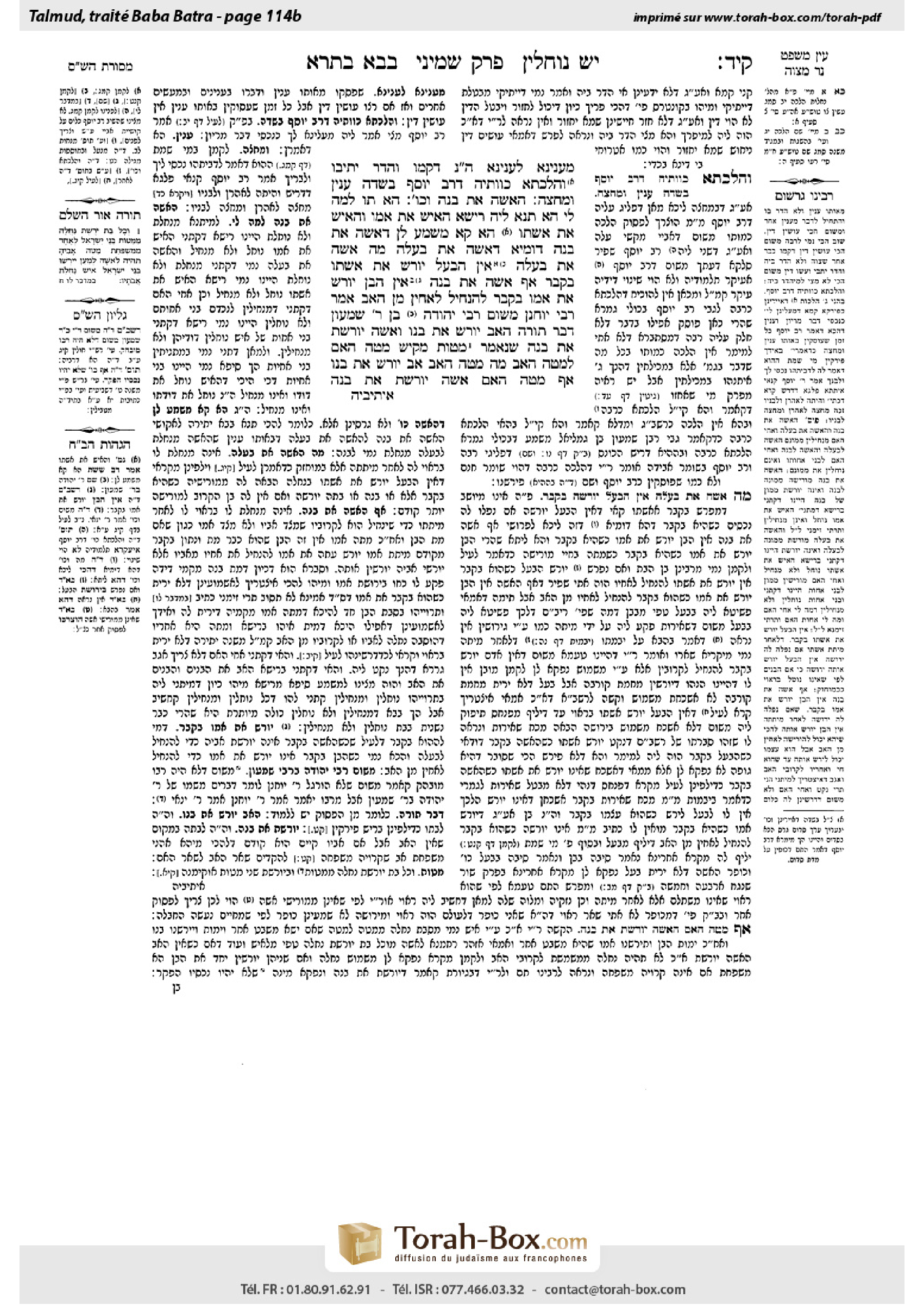
Bava Batra 114b: Talmud study for Daf Yomi
Study the Talmud for Daf Yomi with scanned pages, Hebrew text, English translations from Sefaria and AI-generated French translations.
Passage selection and English or AI-generated French translation are available where the scan has annotations. Daf Study is independent of Torah-Box and Sefaria.
Browse Bava Batra · בבא בתרא · All tractatesBava Batra 114b text and translations
This page of Bava Batra includes the Aramaic text, an English translation and an AI-generated French translation, alongside the scan above.
בבא בתרא קי״ד ב · Aramaic and Hebrew text
מֵעִנְיָנָא לְעִנְיָנָא; הָכִי נָמֵי, דְּקָמוּ וַהֲדַר יְתִיבוּ. וְהִלְכְתָא כְּווֹתֵיהּ דְּרַב יוֹסֵף בְּשָׂדֶה, עִנְיָן וּמֶחֱצָה.
הָאִשָּׁה אֶת בְּנָהּ וְכוּ׳. הָא תּוּ לְמָה לִי? הָא תְּנָא לֵיהּ רֵישָׁא: הָאִישׁ אֶת אִמּוֹ, וְהָאִישׁ אֶת אִשְׁתּוֹ!
הָא קָא מַשְׁמַע לַן – דְּאִשָּׁה אֶת בְּנָהּ, דּוּמְיָא דְּאִשָּׁה אֶת בַּעְלָהּ; מָה אִשָּׁה אֶת בַּעְלָהּ – אֵין הַבַּעַל יוֹרֵשׁ אֶת אִשְׁתּוֹ בַּקֶּבֶר, אַף אִשָּׁה אֶת בְּנָהּ – אֵין הַבֵּן יוֹרֵשׁ אֶת אִמּוֹ בַּקֶּבֶר, לְהַנְחִיל לָאַחִין מִן הָאָב.
אָמַר רַבִּי יוֹחָנָן מִשּׁוּם רַבִּי יְהוּדָה בֶּן רַבִּי שִׁמְעוֹן: דְּבַר תּוֹרָה – הָאָב יוֹרֵשׁ אֶת בְּנוֹ, וְאִשָּׁה יוֹרֶשֶׁת אֶת בְּנָהּ; שֶׁנֶּאֱמַר: ״מַטּוֹת״ – מַקִּישׁ מַטֵּה הָאֵם לְמַטֵּה הָאָב, מָה מַטֵּה הָאָב – אָב יוֹרֵשׁ אֶת בְּנוֹ, אַף מַטֵּה הָאֵם – אִשָּׁה יוֹרֶשֶׁת אֶת בְּנָהּ.
Bava Batra 114b · English translation
from discussing that matter to discuss a different matter, so he can no longer renege on his decision. So too, according to Rabba, one can explain that Rav Yehuda was referring to a case where they arose and then sat down again. Although no support for Rav Yosef’s opinion was adduced from Rav Yehuda’s ruling, the Gemara nevertheless states: And the halakha is in accordance with the opinion of Rav Yosef in the disputes concerning the division of a field, discussed above (12b), reneging while they are discussing the same matter, discussed here, and a half of one’s property, discussed below (143a).
§ The mishna teaches that a woman bequeaths to her son, her husband, and her maternal uncles, but she does not inherit from them. The Gemara asks: Why do I need this as well? But it is already taught in the former clause: A man inherits from his mother and a man inherits from his wife. The halakha stated in this clause seems to be the same as that of the other clause.
The Gemara answers: This teaches us that the halakha of a woman who bequeaths to her son is similar to that of a woman who bequeaths to her husband: Just as with regard to a woman who bequeaths to her husband, the husband does not inherit property through his wife while he is in the grave, i.e., if a husband predeceases his wife, then his relatives, such as children from another marriage, do not inherit the wife’s property through him but rather the wife’s own relatives inherit her property, so too, the same halakha applies with regard to a woman who bequeaths to her son, that the son does not inherit property through his mother while he is in the grave in order to bequeath to his paternal brothers. In both cases, the woman’s own relatives inherit her property.
§ With regard to the halakha that a mother inherits from her son, the Gemara notes that Rabbi Yoḥanan says in the name of Rabbi Yehuda ben Rabbi Shimon: By Torah law a father inherits from his son, and a woman inherits from her son if the father is no longer alive, as it is stated with regard to a woman receiving inheritance: “And every daughter who possesses an inheritance from the tribes of the children of Israel” (Numbers 36:8). Since the plural term “tribes” includes both her father’s tribe and her mother’s tribe, the verse juxtaposes the tribe of the mother to the tribe of the father, in that just as with regard to the father’s tribe a father inherits from his son, so too, with regard to the mother’s tribe, a woman inherits from her son if the father is deceased.
Bava Batra 114b · Traduction française (IA)
De la discussion d'une matière à la discussion d'une autre matière, il ne peut plus revenir sur sa décision. De même, selon Rabba, on peut expliquer que Rav Yehuda faisait référence à un cas où ils se sont levés et sont ensuite revenus s'asseoir. Bien que aucun soutien pour l'opinion de Rav Yosef n'ait été évoqué à partir de la décision de Rav Yehuda, la Guemara affirme cependant : Et la halakha suit l'opinion de Rav Yosef dans les débats concernant la division d'un champ, discuté ci-dessus (12b), le renoncement pendant qu'ils discutent la même matière, discuté ici, et la moitié de la propriété d'une personne, discuté ci-dessous (143a).
§ La Michna enseigne qu'une femme légue à son fils, à son mari et à ses oncles maternels, mais elle ne hérite pas d'eux. La Guemara demande : Pourquoi ai-je besoin de cela aussi ? Mais cela est déjà enseigné dans la clause précédente : Un homme hérite de sa mère et un homme hérite de sa femme. La halakha énoncée dans cette clause semble être la même que celle de la clause précédente.
La Guemara répond : Cela nous apprend que la halakha d'une femme qui légue à son fils est semblable à celle d'une femme qui légue à son mari : Tout comme, concernant une femme qui légue à son mari, le mari ne hérite de la propriété de sa femme pendant qu'il est au cimetière, c'est-à-dire si un mari précede son épouse, alors ses parents, tels que ses enfants d'une autre union, ne héritent de la propriété de l'épouse à travers lui, mais plutôt les parents de l'épouse héritent de sa propriété, de même, la même halakha s'applique concernant une femme qui légue à son fils, que le fils ne hérite de la propriété de sa mère pendant qu'il est au cimetière afin de léguer à ses frères paternels. Dans les deux cas, les parents de la femme héritent de sa propriété.
§ Concernant la halakha selon laquelle une mère hérite de son fils, la Guemara note que Rabbi Yoḥanan cite Rabbi Yehuda ben Rabbi Shimon : Selon la Loi divine, un père hérite de son fils, et une femme hérite de son fils si le père n’est plus vivant, comme il est dit concernant une femme recevant une héritage : « Et toute fille qui possède une héritage des tribus des enfants d’Israël » (Nombres 36:8). Puisque le terme pluriel « tribus » inclut à la fois la tribu de son père et la tribu de sa mère, la Sainte Écriture juxtapose la tribu de la mère à la tribu du père, dans le sens que tout comme concernant la tribu du père, un père hérite de son fils, de même, concernant la tribu de la mère, une femme hérite de son fils si le père est décédé.
Traduction française générée par IA à partir de l’édition anglaise de Sefaria. Vérifie toujours un passage avec le texte source.
Text from Sefaria: William Davidson Edition - Vocalized Aramaic (CC BY NC); William Davidson Edition - English (CC BY NC).