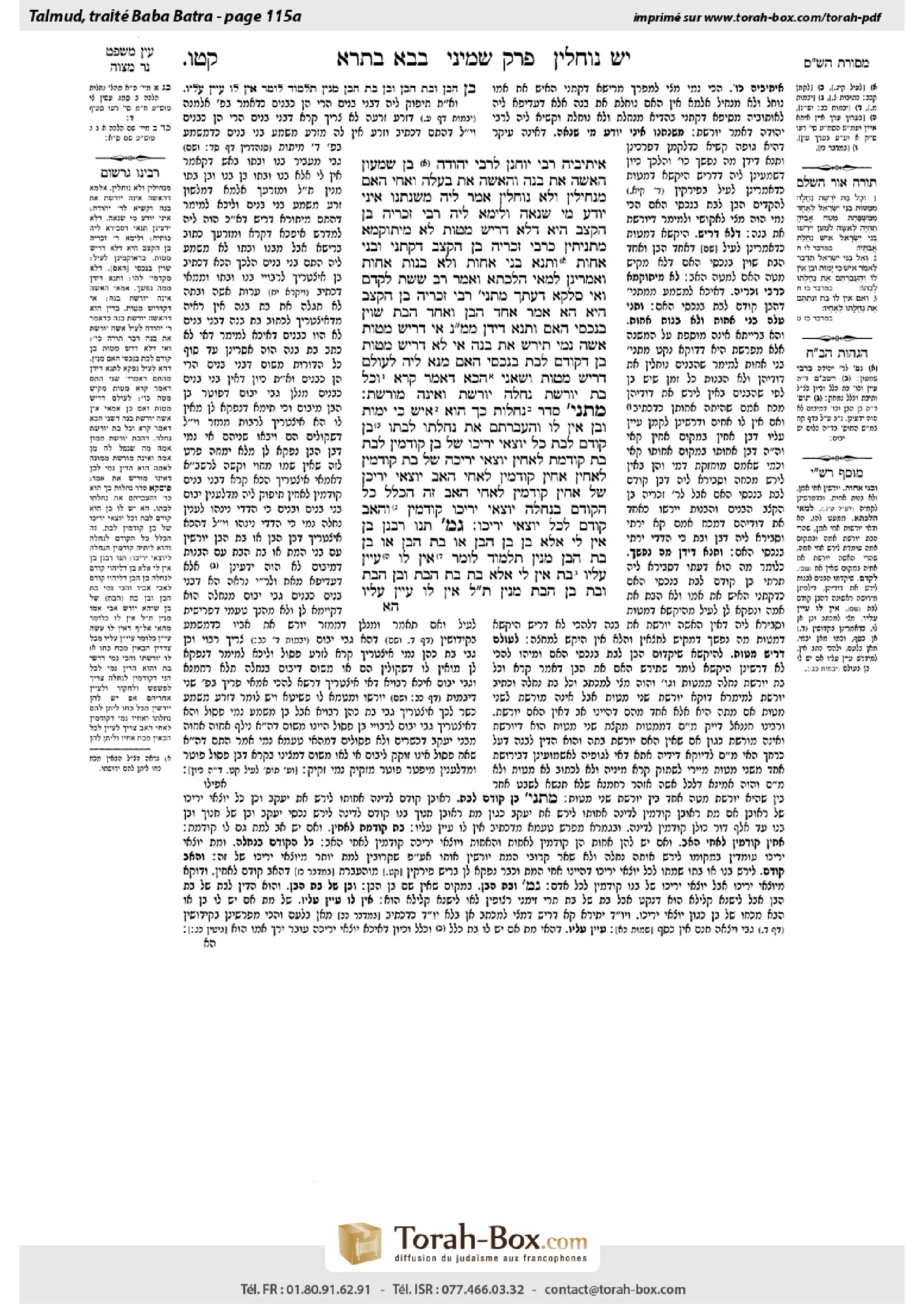
Bava Batra 115a: Talmud study for Daf Yomi
Study the Talmud for Daf Yomi with scanned pages, Hebrew text, English translations from Sefaria and AI-generated French translations.
Passage selection and English or AI-generated French translation are available where the scan has annotations. Daf Study is independent of Torah-Box and Sefaria.
Browse Bava Batra · בבא בתרא · All tractatesBava Batra 115a text and translations
This page of Bava Batra includes the Aramaic text, an English translation and an AI-generated French translation, alongside the scan above.
בבא בתרא קי״ה א · Aramaic and Hebrew text
אֵיתִיבֵיהּ רַבִּי יוֹחָנָן לְרַבִּי יְהוּדָה בֶּן שִׁמְעוֹן: הָאִשָּׁה אֶת בְּנָהּ, וְהָאִשָּׁה אֶת בַּעְלָהּ, וַאֲחֵי הָאֵם – מַנְחִילִין וְלֹא נוֹחֲלִין! אֲמַר לֵיהּ: מִשְׁנָתֵנוּ, אֵינִי יוֹדֵעַ מִי שְׁנָאָהּ.
וְלֵימָא לֵיהּ: רַבִּי זְכַרְיָה בֶּן הַקַּצָּב הִיא, דְּלָא דָּרֵישׁ ״מַטּוֹת״!
לָא מִיתּוֹקְמָא מַתְנִיתִין כְּרַבִּי זְכַרְיָה בֶּן הַקַּצָּב; דְּקָתָנֵי: ״וּבְנֵי אָחוֹת״, וְתָנָא: ״בְּנֵי אָחוֹת״ – וְלֹא בְּנוֹת אָחוֹת. וְאָמְרִינַן: לְמַאי הִלְכְתָא? וְאָמַר רַב שֵׁשֶׁת: לְקַדֵּם.
וְאִי סָלְקָא דַּעְתָּךְ מַתְנִיתִין רַבִּי זְכַרְיָה בֶּן הַקַּצָּב הִיא, הָא אָמַר: אֶחָד הַבֵּן וְאֶחָד הַבַּת שָׁוִין בְּנִכְסֵי הָאֵם!
וְתַנָּא דִּידַן – מִמָּה נַפְשָׁךְ; אִי דָּרֵישׁ ״מַטּוֹת״, אִשָּׁה נָמֵי תִּירַשׁ אֶת בְּנָהּ; אִי לָא דָּרֵישׁ ״מַטּוֹת״, בֵּן דְּקוֹדֵם לַבַּת בְּנִכְסֵי הָאֵם – מְנָא לֵיהּ?
לְעוֹלָם דָּרֵישׁ ״מַטּוֹת״; וְשָׁאנֵי הָכָא, דְּאָמַר קְרָא: ״וְכׇל בַּת יֹרֶשֶׁת נַחֲלָה״ – יוֹרֶשֶׁת, וְאֵינָהּ מוֹרֶשֶׁת.
מַתְנִי׳ סֵדֶר נַחֲלוֹת כָּךְ הוּא: ״אִישׁ כִּי יָמוּת וּבֵן אֵין לוֹ, וְהַעֲבַרְתֶּם אֶת נַחֲלָתוֹ לְבִתּוֹ״ – בֵּן קוֹדֵם לַבַּת, כׇּל יוֹצְאֵי יְרֵיכוֹ שֶׁל בֵּן קוֹדְמִין לַבַּת. בַּת קוֹדֶמֶת לָאַחִין, יוֹצְאֵי יְרֵיכָהּ שֶׁל בַּת קוֹדְמִין לָאַחִין. אַחִין קוֹדְמִין לַאֲחֵי הָאָב, יוֹצְאֵי יְרֵיכָן שֶׁל אַחִין קוֹדְמִין לַאֲחֵי הָאָב.
זֶה הַכְּלָל: כׇּל הַקּוֹדֵם בַּנַּחֲלָה – יוֹצְאֵי יְרֵיכוֹ קוֹדְמִין. וְהָאָב קוֹדֵם לְכׇל יוֹצְאֵי יְרֵיכוֹ.
גְּמָ׳ תָּנוּ רַבָּנַן: ״בֵּן״ – אֵין לִי אֶלָּא בֵּן; בֶּן הַבֵּן, אוֹ בַּת הַבֵּן, אוֹ בֶּן בַּת הַבֵּן – מִנַּיִן? תַּלְמוּד לוֹמַר: ״אֵין לוֹ״ – עַיֵּין עָלָיו.
״בַּת״ – אֵין לִי אֶלָּא בַּת; בַּת הַבַּת, וּבֶן הַבַּת, וּבַת בֶּן הַבַּת – מִנַּיִן? תַּלְמוּד לוֹמַר: ״אֵין לוֹ״ – עַיֵּין עָלָיו.
Bava Batra 115a · English translation
Rabbi Yoḥanan raised an objection to the opinion of Rabbi Yehuda ben Shimon from the mishna, which teaches: A woman with regard to her son, a woman with regard to her husband, and maternal uncles all bequeath to their respective relatives but do not inherit from them. The mishna states explicitly that a mother does not inherit her son’s property. Rabbi Yehuda ben Shimon said to him: With regard to our mishna, I do not know who taught it, i.e., I am not aware of any tanna who concurs with its ruling and it is not the accepted halakha.
The Gemara asks: But let Rabbi Yoḥanan say to Rabbi Yehuda ben Shimon that the mishna is written in accordance with the opinion of Rabbi Zekharya ben HaKatzav, who, as noted on page 111a, does not derive the halakha that sons precede daughters with regard to the inheritance of their mother from the word “tribes.” Since Rabbi Yehuda ben Shimon’s ruling is based on a derivation from the word “tribes,” it stands to reason that Rabbi Zekharya disagrees with Rabbi Yehuda ben Shimon, and the ruling of the mishna is in accordance with Rabbi Zekharya’s opinion.
The Gemara answers: The mishna cannot be interpreted in accordance with the opinion of Rabbi Zekharya ben HaKatzav, as it teaches: And the sons of a sister inherit but do not bequeath, and a Sage taught that the mishna is referring only to sons of a sister and not to daughters of a sister, and we say: With regard to what halakha is there a distinction between the sons and daughters of a sister? And Rav Sheshet said: The distinction is meant to teach that where there are sons as well, they precede the daughters in inheriting from their maternal uncle.
The Gemara continues: And if it enters your mind that the mishna is written in accordance with the opinion of Rabbi Zekharya ben HaKatzav, doesn’t he say: Both the son and the daughter are equal with regard to the mother’s property, as they inherit equally? The mishna stands in contraposition to Rabbi Zekharya’s ruling, and therefore it cannot be written in accordance with his opinion.
The Gemara asks: And the tanna of our mishna, whichever way you look at it, is inconsistent: If he interprets the word “tribes,” then a woman also should inherit from her son, as noted above (114b). And if he does not interpret the word “tribes,” then from where is it clear to him that a son precedes a daughter with regard to the property of the mother? Both halakhot are derived from the same source, so how can the tanna accept one and reject the other?
The Gemara explains: Actually, the tanna of the mishna interprets the word “tribes,” but it is different here, with regard to a woman inheriting from her son, as the verse states: “And every daughter who possesses [yoreshet] an inheritance from the tribes” (Numbers 36:8), which teaches that a daughter inherits [yoreshet] from two tribes, but she does not bequeath to two tribes. She bequeaths only to her father’s tribe.
MISHNA: The order of precedence with regard to inheritances is this: The verse states: “If a man dies, and has no son, then you shall pass his inheritance to his daughter” (Numbers 27:8). This teaches that a son precedes a daughter. Additionally, all descendants of a son precede a daughter. A daughter precedes the brothers of the deceased. Additionally, the descendants of a daughter precede the brothers of the deceased. Brothers of the deceased precede the uncles of the deceased. Additionally, the descendants of the brothers precede the uncles.
This is the principle: Concerning anyone who precedes another with regard to inheritance, his descendants precede the other as well, and a father who inherits precedes all of his descendants.
GEMARA: The Sages taught: The verse states: “If a man dies, and has no son, then you shall pass his inheritance to his daughter” (Numbers 27:8). I have derived only that a son precedes others with regard to the inheritance of the deceased; from where do I derive that a son of a son, or a daughter of a son, or a son of a daughter of a son also precedes the deceased’s other relatives? The verse states: “If a man dies, and he has no [ein lo] son.” The word ein is written aleph, yod, nun. Therefore, the Sages read it as if it states: Investigate with regard to him [ayyein alav], to search for descendants of his son, and give the inheritance to them if they are found.
The next verse states: “And if he has no daughter, then you shall give his inheritance to his brothers” (Numbers 27:9). I have derived only that a daughter precedes others, except a son and his descendants, with regard to the inheritance of the deceased, from where then do I derive that a daughter’s daughter, or a son of a daughter, or a daughter of a son of a daughter also precede the deceased’s other relatives? The verse states: “And if he has no [ein lo] daughter.” The word ein is written aleph, yod, nun. Therefore, the Sages read it as if it states: Investigate with regard to him [ayyein alav], to search for descendants of his daughter, and give the inheritance to them if they are found.
Bava Batra 115a · Traduction française (IA)
Rabbi Yoḥanan a soulevé une objection contre l'opinion de Rabbi Yehuda ben Shimon, tirée de la michna, qui enseigne : Une femme concernant son fils, une femme concernant son mari, et les oncles maternels léguent à leurs proches respectifs mais ne les héritent pas. La michna stipule explicitement que la mère ne hérite pas de la propriété de son fils. Rabbi Yehuda ben Shimon lui a répondu : Concernant notre michna, je ne sais pas qui l'a enseignée, c'est-à-dire je ne suis pas conscient d'un tanna qui s'accorde avec sa décision et cela n'est pas la halakha acceptée.
Le Guemara demande : Mais laissez Rabbi Yoḥanan dire à Rabbi Yehuda ben Shimon que la michna est écrite selon l'opinion de Rabbi Zekharya ben HaKatzav, qui, comme noté à la page 111a, ne dérive pas la halakha selon laquelle les fils précèdent les filles concernant l'héritage de leur mère à partir du mot « tribus ». Puisque l'opinion de Rabbi Yehuda ben Shimon est basée sur une dérivation du mot « tribus », il est logique que Rabbi Zekharya s'oppose à Rabbi Yehuda ben Shimon, et la décision de la michna est selon l'opinion de Rabbi Zekharya.
Le Guemara répond : La michna ne peut pas être interprétée selon l'opinion de Rabbi Zekharya ben HaKatzav, car elle enseigne : Et les fils d'une sœur héritent mais ne léguent pas, et un Sage a enseigné que la michna fait référence uniquement aux fils d'une sœur et non aux filles d'une sœur, et nous disons : Concernant quelle halakha y a-t-il une distinction entre les fils et les filles d'une sœur ? Et Rav Sheshet a dit : La distinction est destinée à enseigner que, lorsqu'il y a des fils, ils précèdent les filles dans l'héritage de leur oncle maternel.
Le Guemara continue : Et si cela vous vient à l'esprit que la mitsva est écrite selon l'opinion de Rabbi Zekharya ben HaKatzav, n'est-ce pas qu'il dit : Les fils et les filles sont égaux concernant la propriété de leur mère, car ils héritent de la même manière ? La mitsva est en opposition avec l'opinion de Rabbi Zekharya, et par conséquent elle ne peut pas être écrite selon son opinion.
Le Guemara demande : Et le tanna de notre mitsva, quel que soit l'angle sous lequel on le considère, est incohérent : Si il interprète le mot « tribus », alors la femme devrait aussi hériter de son fils, comme noté ci-dessus (114b). Et si il ne l'interprète pas, alors d'où sait-il que le fils précède la fille concernant la propriété de la mère ? Les deux halakhot sont dérivées de la même source, donc comment le tanna peut-il accepter l'une et rejeter l'autre ?
Le Guemara explique : En réalité, le tanna de la mitsva interprète le mot « tribus », mais c'est différent ici, concernant l'héritage d'une femme de son fils, car la parabole dit : « Et toute fille qui possède [yoreshet] une héritage des tribus » (Nombres 36:8), ce qui enseigne que la fille hérite [yoreshet] de deux tribus, mais elle ne léguera pas à deux tribus. Elle léguera seulement à la tribu de son père.
MICHNA : L'ordre de priorité concernant les héritages est le suivant : La parabole dit : « Si un homme meurt, et n'a pas de fils, alors vous donnerez son héritage à sa fille » (Nombres 27:8). Cela enseigne que le fils précède la fille. De plus, tous les descendants d'un fils précèdent la fille. La fille précède les frères du défunt. De plus, les descendants de la fille précèdent les frères du défunt. Les frères du défunt précèdent les oncles du défunt. De plus, les descendants des frères précèdent les oncles.
C'est le principe : Concernant quiconque précède un autre concernant l'héritage, ses descendants précèdent l'autre également, et le père qui hérite précède tous ses descendants.
GUEMARA : Les Sages ont enseigné : La parabole dit : « Si un homme meurt, et n'a pas de fils, alors vous donnerez son héritage à sa fille » (Nombres 27:8). J'ai dérivé seulement que le fils précède les autres concernant l'héritage du défunt ; d'où dérive-t-on que le fils d'un fils, ou la fille d'un fils, ou le fils de la fille d'un fils précède également les autres parents du défunt ? La parabole dit : « Et s'il n'a pas de [ein lo] fils. » Le mot ein est écrit aleph, yod, nun. Par conséquent, les Sages le lisent comme si elle disait : Recherchez concernant lui [ayyein alav], pour chercher les descendants de son fils, et donnez l'héritage à ceux-ci s'ils sont trouvés.
La prochaine versette dit : « Et s'il n'a pas de [ein lo] fille, alors vous donnerez son héritage à ses frères » (Nombres 27:9). J'ai dérivé seulement que la fille précède les autres, sauf le fils et ses descendants, concernant l'héritage du défunt, d'où dérive-t-on que la fille de la fille, ou le fils de la fille, ou la fille du fils de la fille précède également les autres parents du défunt ? La versette dit : « Et s'il n'a pas de [ein lo] fille. » Le mot ein est écrit aleph, yod, nun. Par conséquent, les Sages le lisent comme si elle disait : Recherchez concernant lui [ayyein alav], pour chercher les descendants de sa fille, et donnez l'héritage à ceux-ci s'ils sont trouvés.
Traduction française générée par IA à partir de l’édition anglaise de Sefaria. Vérifie toujours un passage avec le texte source.
Text from Sefaria: William Davidson Edition - Vocalized Aramaic (CC BY NC); William Davidson Edition - English (CC BY NC).