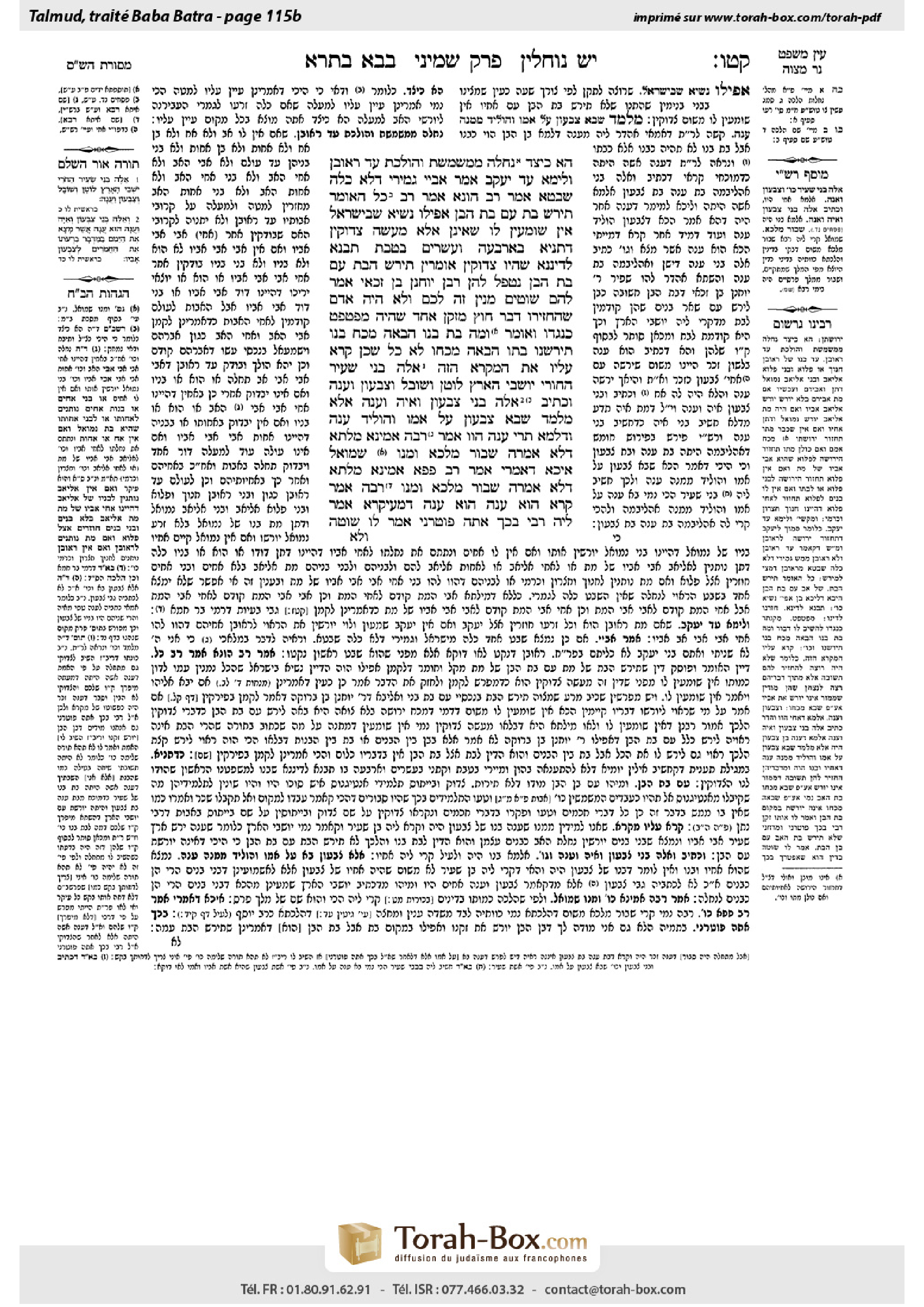
Bava Batra 115b: Talmud study for Daf Yomi
Study the Talmud for Daf Yomi with scanned pages, Hebrew text, English translations from Sefaria and AI-generated French translations.
Passage selection and English or AI-generated French translation are available where the scan has annotations. Daf Study is independent of Torah-Box and Sefaria.
Browse Bava Batra · בבא בתרא · All tractatesBava Batra 115b text and translations
This page of Bava Batra includes the Aramaic text, an English translation and an AI-generated French translation, alongside the scan above.
בבא בתרא קי״ה ב · Aramaic and Hebrew text
הָא כֵּיצַד? נַחֲלָה מְמַשְׁמֶשֶׁת וְהוֹלֶכֶת, עַד רְאוּבֵן. וְלֵימָא עַד יַעֲקֹב! אָמַר אַבָּיֵי: גְּמִירִי דְּלָא כָּלֵה שִׁבְטָא.
אָמַר רַב הוּנָא אָמַר רַב: כׇּל הָאוֹמֵר תִּירַשׁ בַּת עִם בַּת הַבֵּן, אֲפִילּוּ נָשִׂיא שֶׁבְּיִשְׂרָאֵל – אֵין שׁוֹמְעִין לוֹ, שֶׁאֵינָן אֶלָּא מַעֲשֵׂה צָדוֹקִין. דְּתַנְיָא: בְּאַרְבָּעָה וְעֶשְׂרִים בְּטֵבֵת תַּבְנָא לְדִינַנָא. שֶׁהָיוּ צָדוֹקִין אוֹמְרִין: תִּירַשׁ הַבַּת עִם בַּת הַבֵּן.
נִטְפַּל לָהֶן רַבָּן יוֹחָנָן בֶּן זַכַּאי, אָמַר לָהֶם: שׁוֹטִים, מִנַּיִן זֶה לָכֶם? וְלֹא הָיָה אָדָם שֶׁהֶחְזִירוֹ דָּבָר, חוּץ מִזָּקֵן אֶחָד שֶׁהָיָה מְפַטְפֵּט כְּנֶגְדּוֹ, וְאוֹמֵר: וּמָה בַּת בְּנוֹ הַבָּאָה מִכֹּחַ בְּנוֹ – תִּירָשֶׁנּוּ; בִּתּוֹ הַבָּאָה מִכֹּחוֹ – לֹא כׇּל שֶׁכֵּן?
קָרָא עָלָיו אֶת הַמִּקְרָא הַזֶּה: ״אֵלֶּה בְנֵי שֵׂעִיר הַחֹרִי יֹשְׁבֵי הָאָרֶץ: לוֹטָן וְשׁוֹבָל וְצִבְעוֹן וַעֲנָה״, וּכְתִיב: ״אֵלֶּה בְּנֵי צִבְעוֹן, וְאַיָּה וַעֲנָה״! אֶלָּא מְלַמֵּד שֶׁבָּא צִבְעוֹן עַל אִמּוֹ, וְהוֹלִיד עֲנָה.
וְדִלְמָא תְּרֵי עֲנָה הֲווֹ! אָמַר רַבָּה: אָמֵינָא מִלְּתָא דְּלָא אַמְרַהּ שַׁבּוּר מַלְכָּא; וּמַנּוּ? שְׁמוּאֵל. אִיכָּא דְאָמְרִי, אָמַר רַב פָּפָּא: אָמֵינָא מִלְּתָא דְּלָא אַמְרַהּ שַׁבּוּר מַלְכָּא; וּמַנּוּ? רַבָּה. אָמַר קְרָא: ״הוּא עֲנָה״ – הוּא עֲנָה דְּמֵעִיקָּרָא.
אֲמַר לֵיהּ: רַבִּי, בְּכָךְ אַתָּה פּוֹטְרֵנִי?! אָמַר לוֹ: שׁוֹטֶה,
Bava Batra 115b · English translation
The Gemara asks: How so, i.e., how is the investigation performed when he has no offspring at all? The Gemara answers: The family lineage that determines the inheritance is successively examined up to Reuben, son of Jacob, i.e., the heirs are determined by investigating the family genealogy, and that investigation can extend all the way to Reuben, son of our forefather Jacob. The Gemara asks: And let it say: Until Jacob himself, rather than until Reuben, since if none of Reuben’s descendants survive, one would have to examine Jacob’s descendants. Abaye said in reply: It is learned as a tradition that a tribe will not be eliminated entirely, and some descendants will always remain.
§ Rav Huna says that Rav says: With regard to anyone who says that a daughter of the deceased should inherit the estate of her father along with the daughter of the son of the deceased, even if he is a prince of the Jewish people, one should not listen to him, as this is nothing other than an act of the Sadducees, and runs counter to the ruling of the mishna that the descendants of a son inherit before a daughter. As it is taught in a baraita in Megillat Ta’anit, which describes various minor holidays on which it is forbidden to fast or eulogize: On the twenty-fourth of Tevet, we returned to our law, i.e., the halakha was reestablished in accordance with the opinion of the Sages after having been dictated by the Sadducees. As the Sadducees would say: A daughter should inherit the estate of her father along with the daughter of the son of the deceased.
The baraita continues: Rabban Yoḥanan ben Zakkai joined them to discuss their ruling, and said to them: Imbeciles, from where do you derive this ruling? And there was no person that answered him anything, except for one old man who was chattering at him and saying that it is an a fortiori inference: And just as a daughter of the deceased’s son, who comes to claim her inheritance from her grandfather by virtue of his son, inherits her grandfather’s property, so too, with regard to the deceased’s own daughter, who comes to inherit by virtue of the deceased, all the more so is it not clear that she should inherit his property?
Rabban Yoḥanan ben Zakkai recited this verse about him: “These are the sons of Seir the Horite, the inhabitants of the land: Lotan and Shobal and Zibeon and Anah” (Genesis 36:20), and it is written: “And these are the children of Zibeon: Aiah and Anah” (Genesis 36:24). The first verse portrays Zibeon and Anah as brothers, while the second states that they are father and son. Rather, this teaches that Zibeon engaged in sexual intercourse with his mother and begot Anah, so that he was both Anah’s father and his brother. From the fact that the first verse equates Zibeon and Anah by referring to both of them as Seir’s sons despite Anah being a grandson of Seir, it is clear that grandchildren are equal to children, contrary to the Sadducees’ assertion.
The Gemara interrupts the recounting of the baraita and questions Rabban Yoḥanan ben Zakkai’s inference: But perhaps there were two people named Anah, so that one Anah was Zibeon’s son, and the other his brother? Rabba said: I will state a matter that even King Shapur did not state. And who is this King Shapur? This cannot be a reference to Shapur, king of Persia; rather, it must be a moniker for someone else. He is Shmuel, whose legal rulings were accepted by the public like the edicts of a king by his subjects. Some state a different version, that it was Rav Pappa who said: I will state a matter that even King Shapur did not state. And who is this King Shapur? He is Rabba. The verse goes on to state: “This is Anah” (Genesis 36:24), indicating that he is the same Anah mentioned initially, earlier in the verse. Accordingly, there was only one Anah, who was both Zibeon’s brother and Zibeon’s son.
The baraita continues: The Sadducee said to Rabban Yoḥanan ben Zakkai: My teacher, you dismiss me with this retort? I agree that the son of a son precedes a daughter, as the verse you quoted suggests; I am asserting that a daughter inherits together with the daughter of a son, and the verse you quoted has no bearing on that claim. Rabban Yoḥanan ben Zakkai said to him: Imbecile,
Bava Batra 115b · Traduction française (IA)
La Guemara pose la question : Comment cela se passe-t-il, c'est-à-dire comment l'enquête est-elle menée lorsqu'il n'a aucun descendant ? La Guemara répond : La lignée familiale qui détermine l'héritage est examinée successivement jusqu'à Rouben, fils de Jacob, c'est-à-dire les héritiers sont déterminés en investiguant la généalogie familiale, et cette investigation peut s'étendre jusqu'à Rouben, fils de notre père Jacob. La Guemara pose la question : Et qu'on dise : Jusqu'à Jacob lui-même, plutôt que jusqu'à Rouben, car si aucun des descendants de Rouben ne survit, il faudrait examiner les descendants de Jacob. Abaye répondit en disant : On apprend comme une tradition que la tribu ne sera pas entièrement éliminée, et des descendants resteront toujours.
§ Rav Huna dit que Rav dit : Concernant celui qui affirme qu'une fille du défunt doit hériter de l'immobilier de son père ainsi que la fille du fils du défunt, même s'il est un prince du peuple juif, on ne doit pas l'écouter, car cela n'est autre chose qu'une action des Sadducéens, et contredit la décision du mitsva selon laquelle les descendants d'un fils héritent avant une fille. Comme il est enseigné dans une baraïta de Megillat Ta'anit, qui décrit diverses fêtes mineures où il est interdit de jeûner ou de faire des funérailles : Le vingt-quatrième de Tévét, nous sommes revenus à notre loi, c'est-à-dire la halakha a été rétablie conformément à l'opinion des Sages après avoir été dictée par les Sadducéens. Comme les Sadducéens disaient : Une fille doit hériter de l'immobilier de son père ainsi que la fille du fils du défunt.
La baraïta continue : Rabban Yoḥanan ben Zakkai s'est joint à eux pour discuter de leur décision, et a dit à ceux-ci : Des imbéciles, d'où tirez-vous cette décision ? Et personne n'a répondu à cela, sauf un vieil homme qui bavardait avec lui et disait qu'il s'agit d'une déduction a fortiori : Et tout comme une fille du fils du défunt, qui vient réclamer son héritage auprès de son grand-père par le biais de son fils, hérite de la propriété de son grand-père, de même, concernant la fille du défunt, qui vient hériter par le défunt lui-même, encore plus clairement est-ce que celle-ci doit hériter de sa propriété ?
Rabban Yoḥanan ben Zakkai a récité cette versette à son sujet : « Ces sont les fils de Séir l'Horite, les habitants de la terre : Lotan et Shobal et Zibeon et Anah » (Genèse 36:20), et il est écrit : « Et ces sont les enfants de Zibeon : Aiah et Anah » (Genèse 36:24). Le premier verset présente Zibeon et Anah comme frères, tandis que le second indique qu'ils sont père et fils. En réalité, cela enseigne que Zibeon a eu des relations sexuelles avec sa mère et a engendré Anah, de sorte qu'il était à la fois le père et le frère d'Anah. Du fait que le premier verset égale Zibeon et Anah en les désignant tous deux comme les fils de Séir, malgré le fait que Anah est un petit-fils de Séir, il est clair que les petits-fils sont égaux aux enfants, contrairement à l'affirmation des Sadducéens.
La Guemara interrompt le récit de la baraïta et questionne l'inférence de Rabban Yoḥanan ben Zakkai : Mais peut-être y avait-il deux personnes nommées Anah, de sorte qu'un Anah était le fils de Zibeon, et l'autre son frère ? Rabba dit : Je vais énoncer une affaire que même le roi Shapur n'a pas énoncée. Et qui est ce roi Shapur ? Cela ne peut pas faire référence au roi Shapur, roi de Perse ; il doit plutôt faire référence à quelqu'un d'autre. Il s'agit de Shmuel, dont les décisions juridiques ont été acceptées par le public comme les édits d'un roi par ses sujets. Certains affirment une version différente, selon laquelle c'était Rav Pappa qui a dit : Je vais énoncer une affaire que même le roi Shapur n'a pas énoncée. Et qui est ce roi Shapur ? Il s'agit de Rabba. Le verset continue en disant : « C'est Anah » (Genèse 36:24), indiquant qu'il s'agit du même Anah mentionné précédemment, plus tôt dans le verset. Ainsi, il n'y avait qu'un seul Anah, qui était à la fois le frère et le fils de Zibeon.
La baraïta continue : Le Sadducéen a dit à Rabban Yoḥanan ben Zakkai : Mon maître, vous me réduisez à l'absurde avec cette réplique ? Je conviens que le fils d'un fils précède la fille, comme le verset que vous avez cité le suggère ; je maintiens que la fille hérite en même temps que la fille du fils, et le verset que vous avez cité n'a aucun lien avec cette affirmation. Rabban Yoḥanan ben Zakkai a dit à lui : Imbécile,
Traduction française générée par IA à partir de l’édition anglaise de Sefaria. Vérifie toujours un passage avec le texte source.
Text from Sefaria: William Davidson Edition - Vocalized Aramaic (CC BY NC); William Davidson Edition - English (CC BY NC).