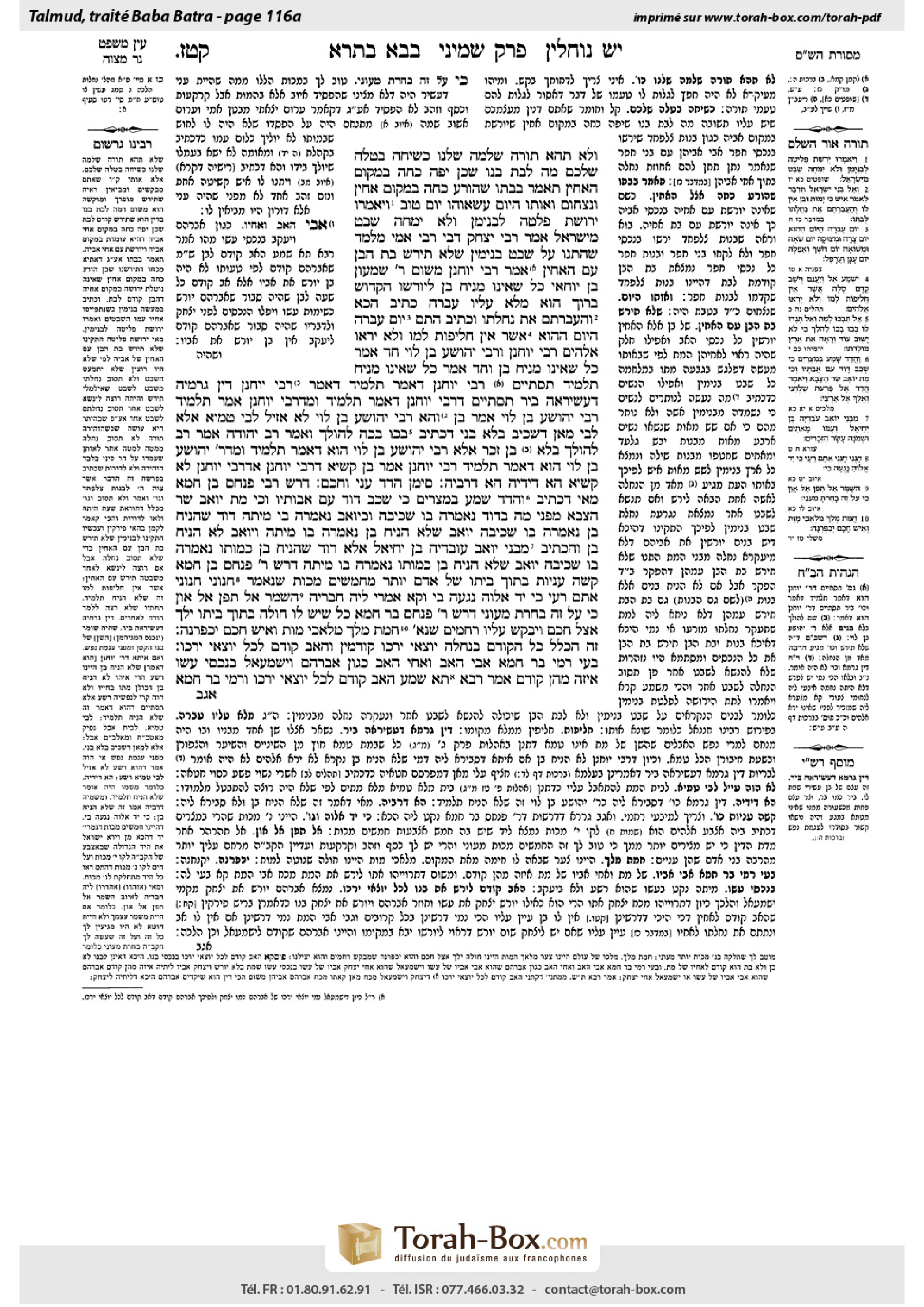
Bava Batra 116a: Talmud study for Daf Yomi
Study the Talmud for Daf Yomi with scanned pages, Hebrew text, English translations from Sefaria and AI-generated French translations.
Passage selection and English or AI-generated French translation are available where the scan has annotations. Daf Study is independent of Torah-Box and Sefaria.
Browse Bava Batra · בבא בתרא · All tractatesBava Batra 116a text and translations
This page of Bava Batra includes the Aramaic text, an English translation and an AI-generated French translation, alongside the scan above.
בבא בתרא קי״ו א · Aramaic and Hebrew text
וְלֹא תְּהֵא תּוֹרָה שְׁלֵמָה שֶׁלָּנוּ, כְּשִׂיחָה בְּטֵלָה שֶׁלָּכֶם. מָה לְבַת בְּנוֹ – שֶׁכֵּן יִפָּה כֹּחָהּ בִּמְקוֹם הָאַחִין; תֹּאמַר בְּבִתּוֹ – שֶׁהוֹרַע כֹּחָהּ בִּמְקוֹם אַחִין. וְנִצְּחוּם, וְאוֹתוֹ הַיּוֹם עֲשָׂאוּהוּ יוֹם טוֹב.
״וַיֹּאמְרוּ יְרֻשַּׁת פְּלֵטָה לְבִנְיָמִן, וְלֹא יִמָּחֶה שֵׁבֶט מִיִּשְׂרָאֵל״ –
אָמַר רַבִּי יִצְחָק דְּבֵי רַבִּי אַמֵּי: מְלַמֵּד שֶׁהִתְנוּ עַל שֵׁבֶט בִּנְיָמִין, שֶׁלֹּא תִּירַשׁ בַּת הַבֵּן עִם הָאַחִין.
אָמַר רַבִּי יוֹחָנָן מִשּׁוּם רַבִּי שִׁמְעוֹן בֶּן יוֹחַאי: כֹּל שֶׁאֵינוֹ מַנִּיחַ בֵּן לְיוֹרְשׁוֹ – הַקָּדוֹשׁ בָּרוּךְ הוּא מָלֵא עָלָיו עֶבְרָה. כְּתִיב הָכָא: ״וְהַעֲבַרְתֶּם אֶת נַחֲלָתוֹ״, וּכְתִיב הָתָם: ״יוֹם עֶבְרָה הַיּוֹם הַהוּא״.
״אֲשֶׁר אֵין חֲלִיפוֹת לָמוֹ וְלֹא יָרְאוּ אֱלֹהִים״ – רַבִּי יוֹחָנָן וְרַבִּי יְהוֹשֻׁעַ בֶּן לֵוִי, חַד אָמַר: כֹּל שֶׁאֵינוֹ מַנִּיחַ בֵּן. וְחַד אָמַר: כֹּל שֶׁאֵינוֹ מַנִּיחַ תַּלְמִיד.
תִּסְתַּיֵּים רַבִּי יוֹחָנָן דְּאָמַר תַּלְמִיד – דְּאָמַר רַבִּי יוֹחָנָן: דֵּין גַּרְמֵיהּ דַּעֲשִׂירָאָה בִּיר. תִּסְתַּיֵּים דְּרַבִּי יוֹחָנָן דְּאָמַר תַּלְמִיד.
וּמִדְּרַבִּי יוֹחָנָן אָמַר תַּלְמִיד – רַבִּי יְהוֹשֻׁעַ בֶּן לֵוִי אָמַר בֵּן?!
וְהָא רַבִּי יְהוֹשֻׁעַ בֶּן לֵוִי לָא אָזֵיל לְבֵי טַמְיָא אֶלָּא לְבֵי מַאן דְּשָׁכֵיב בְּלָא בְּנֵי, דִּכְתִיב: ״בְּכוּ בָכֹה לַהֹלֵךְ״, וְאָמַר רַב יְהוּדָה אָמַר רַב: לַהוֹלֵךְ בְּלֹא בֵּן זָכָר! אֶלָּא רַבִּי יְהוֹשֻׁעַ בֶּן לֵוִי הוּא דְּאָמַר תַּלְמִיד.
וּמִדְּרַבִּי יְהוֹשֻׁעַ בֶּן לֵוִי הוּא דְּאָמַר תַּלְמִיד – רַבִּי יוֹחָנָן אָמַר בֵּן?!
קַשְׁיָא דְּרַבִּי יוֹחָנָן אַדְּרַבִּי יוֹחָנָן! לָא קַשְׁיָא, הָא דִידֵיהּ, הָא דְרַבֵּיהּ.
(סִימָן: הֲדַד, עָנִי וְחָכָם.)
דָּרַשׁ רַבִּי פִּנְחָס בֶּן חָמָא, מַאי דִּכְתִיב: ״וַהֲדַד שָׁמַע בְּמִצְרַיִם כִּי שָׁכַב דָּוִד עִם אֲבוֹתָיו, וְכִי מֵת יוֹאָב שַׂר הַצָּבָא״? מִפְּנֵי מָה בְּדָוִד נֶאֶמְרָה בּוֹ ״שְׁכִיבָה״, וּבְיוֹאָב נֶאֶמְרָה בּוֹ ״מִיתָה״? דָּוִד, שֶׁהִנִּיחַ בֵּן – נֶאֶמְרָה בּוֹ שְׁכִיבָה. יוֹאָב, שֶׁלֹּא הִנִּיחַ בֵּן – נֶאֶמְרָה בּוֹ מִיתָה.
וְיוֹאָב לֹא הִנִּיחַ בֵּן?! וְהָכְתִיב: ״מִבְּנֵי יוֹאָב – עֹבַדְיָה בֶּן יְחִיאֵל״! אֶלָּא: דָּוִד, שֶׁהִנִּיחַ בֵּן כְּמוֹתוֹ – נֶאֶמְרָה בּוֹ ״שְׁכִיבָה״. יוֹאָב, שֶׁלֹּא הִנִּיחַ בֵּן כְּמוֹתוֹ – נֶאֶמְרָה בּוֹ ״מִיתָה״.
דָּרַשׁ רַבִּי פִּנְחָס בֶּן חָמָא: קָשָׁה עֲנִיּוּת בְּתוֹךְ בֵּיתוֹ שֶׁל אָדָם, יוֹתֵר מֵחֲמִשִּׁים מַכּוֹת – שֶׁנֶּאֱמַר: ״חׇנֻּנִי חׇנֻּנִי אַתֶּם רֵעָי, כִּי יַד אֱלוֹהַּ נָגְעָה בִּי״, וְקָא אָמְרִי לֵיהּ חַבְרֵיהּ: ״הִשָּׁמֶר אַל תֵּפֶן אֶל אָוֶן, כִּי עַל זֶה בָּחַרְתָּ מֵעֹנִי״.
דָּרַשׁ רַבִּי פִּנְחָס בַּר חָמָא: כֹּל שֶׁיֵּשׁ לוֹ חוֹלֶה בְּתוֹךְ בֵּיתוֹ, יֵלֵךְ אֵצֶל חָכָם וִיבַקֵּשׁ עָלָיו רַחֲמִים – שֶׁנֶּאֱמַר: ״חֲמַת מֶלֶךְ מַלְאֲכֵי מָוֶת, וְאִישׁ חָכָם יְכַפְּרֶנָּה״.
זֶה הַכְּלָל: כׇּל הַקּוֹדֵם בַּנַּחֲלָה – יוֹצְאֵי יְרֵכוֹ קוֹדְמִין, וְהָאָב קוֹדֵם לְכׇל יוֹצְאֵי יְרֵכוֹ. בָּעֵי רָמֵי בַּר חָמָא: אֲבִי הָאָב וַאֲחֵי הָאָב – כְּגוֹן אַבְרָהָם וְיִשְׁמָעֵאל בְּנִכְסֵי עֵשָׂו, אֵיזֶה מֵהֶן קוֹדֵם? אָמַר רָבָא, תָּא שְׁמַע: הָאָב קוֹדֵם לְכׇל יוֹצְאֵי יְרֵכוֹ. וְרָמֵי בַּר חָמָא –
Bava Batra 116a · English translation
but will our perfect Torah not be as worthy as your frivolous speech, as your inference is fallacious: What is notable about the inheritance of a daughter of the deceased’s son? It is notable in that her right is enhanced in that she inherits from her paternal grandfather together with the brothers of her father. Would you say that the same applies with regard to the deceased’s daughter, whose right to inherit is diminished in that she does not inherit from her father together with her brothers? The Sadducee’s a fortiori inference is thereby disproved. The Gemara concludes: And since the Sadducees had no counterargument, the Sages were victorious over them, and they established that day, the twenty-fourth of Tevet, as a minor festival to celebrate the establishment of the halakha in accordance with the opinion of the Sages.
Having discussed the halakha of a son’s daughter’s right to inheritance, the Gemara cites a verse that relates to the matter. After the incident known as: The concubine in Gibeah, the men of the tribe of Benjamin numbered only six hundred, and each of these men had inherited large plots of land from their deceased relatives. The verse states: “And they said: They that are escaped must be as an inheritance for Benjamin, that a tribe be not blotted out from Israel” (Judges 21:17).
Rabbi Yitzḥak of the house of Rabbi Ami says: This teaches that the elders of that generation stipulated with regard to the tribe of Benjamin that a daughter of a son shall not inherit with the brothers of her father. Since the daughter of a son who inherits her grandfather’s property may later bequeath it to her husband, who may be from another tribe, the elders instituted this temporary ordinance in order to ensure that other tribes would not inherit large quantities of land belonging to the tribe of Benjamin, lest the tribe of Benjamin be left with little land of its own.
§ The Gemara presents a related statement. Rabbi Yoḥanan says in the name of Rabbi Shimon ben Yoḥai: Concerning anyone who does not leave behind a son to inherit from him, the Holy One, Blessed be He, is filled with wrath [evra] toward him, as it is written here: “If a man die, and he has no son, then you shall pass his inheritance [veha’avartem] to his daughter” (Numbers 27:8), and it is written there: “That day is a day of wrath [evra]” (Zephaniah 1:15). The words “veha’avartem” and “evra” share common root letters, whereby Rabbi Shimon ben Yoḥai interprets that God’s wrath may be the result of the inheritance passing to a daughter rather than a son.
The Gemara presents a related statement. Concerning the verse: “God shall hear, and humble them, even He that is enthroned of old, Selah; those that have no exchange, and fear not God” (Psalms 55:20), Rabbi Yoḥanan and Rabbi Yehoshua ben Levi each interpret the verse in a different manner. One says that this is a reference to anyone who does not leave behind a son to inherit from him, as he does not leave anyone to serve in exchange, i.e., as a replacement, for him; and one says that this is a reference to anyone who does not leave behind a student to serve in exchange for him.
The Gemara suggests: It may be concluded that it was Rabbi Yoḥanan who says that the verse is referring to one who does not leave behind a student, for Rabbi Yoḥanan, whose ten sons died in his lifetime, said to those he would console: This is the bone of my tenth son, to encourage them not to succumb to their sorrow. Since Rabbi Yoḥanan knew that he would not leave any sons to inherit his property, it is reasonable to assume that he interpreted the verse as meaning that God is full of wrath toward one who does not leave behind a student. The Gemara comments that it may be concluded that it was Rabbi Yoḥanan who says that the verse is referring to one who does not leave behind a student.
The Gemara notes: And from this, that Rabbi Yoḥanan is the one who says that the verse is referring to one who does not leave behind a student, it follows that Rabbi Yehoshua ben Levi says the verse is referring to one who does not leave behind a son.
The Gemara asks: But this cannot be, as Rabbi Yehoshua ben Levi would not go to a house of mourning [bei tamya] to console the bereaved so as not to interrupt his studies, except to the house of one who died without any sons, as it is written: “Weep not for the dead, neither bemoan him; but weep sore for him that goes away” (Jeremiah 22:10), and Rabbi Yehuda says that Rav says that the verse is referring to one who departs from this world without leaving behind a male child. From the fact that Rabbi Yehoshua ben Levi would console specifically one who died without leaving a son, it is apparent that he does not hold that God is full of wrath toward such an individual. Rather, it must be that Rabbi Yehoshua ben Levi is the Sage who says that the verse is referring to one who does not leave behind a student.
The Gemara notes: And from this that Rabbi Yehoshua ben Levi is the one who says that the verse is referring to one who does not leave behind a student, it follows that Rabbi Yoḥanan says it is referring to one who does not leave behind a son.
The Gemara asks: This poses a difficulty from one statement of Rabbi Yoḥanan, that the verse is referring to one who does not leave behind a son, to another statement of Rabbi Yoḥanan, as he would say: This is the bone of my tenth son. The Gemara answers: It is not difficult: This statement, with regard to the bone of his son, is his, while that statement, with regard to the verse, is his teacher’s.
§ The Gemara continues with three homiletic interpretations by Rabbi Pineḥas ben Ḥama, and provides a mnemonic to facilitate the memorization of these expositions: Hadad, poverty, and sage.
The Gemara presents the first homiletic interpretation: Rabbi Pineḥas ben Ḥama interpreted a verse homiletically: What is the meaning of that which is written: “And when Hadad heard in Egypt that David slept with his fathers, and that Joab the captain of the host was dead” (I Kings 11:21)? For what reason is it that in the case of King David, sleeping was stated with regard to his demise, and in the case of Joab, death was stated with regard to his demise? He answers: Concerning King David, who left a son behind, sleeping was stated with regard to his demise, as it was not a complete death, while concerning Joab, who did not leave a son behind, death was stated with regard to his demise, as he left no son to succeed him.
The Gemara asks: And is it so that Joab did not leave a son behind; but isn’t it written: “Of the sons of Joab: Obadiah, son of Jehiel” (Ezra 8:9)? Rather, concerning King David, who left a son as great as himself, sleeping was stated with regard to his demise, but concerning Joab, who did not leave a son as great as himself, death was stated with regard to his demise.
The Gemara presents the second homiletic interpretation: Rabbi Pineḥas ben Ḥama interpreted a verse homiletically, and derived that poverty in a person’s household is more difficult than fifty plagues, as it is stated: “Have pity upon me, have pity upon me, O you my friends; for the hand of God has touched me” (Job 19:21), and his friends were saying to him: “Take heed, regard not iniquity; for this have you chosen rather than poverty” (Job 36:21). Job, who suffered many plagues, was told by his friends that his suffering was preferable to poverty.
The Gemara presents the third homiletic interpretation: Rabbi Pineḥas bar Ḥama interpreted a verse homiletically: Anyone who has a sick person in his home should go to a sage, and the sage will ask for mercy on the sick person’s behalf, as it is stated: “The wrath of a king is as messengers of death; but a wise man will pacify it” (Proverbs 16:14).
§ The mishna teaches that this is the principle: Concerning anyone who precedes another with regard to inheritance, his descendants precede the other as well, and a father precedes all of his descendants. Rami bar Ḥama raises a dilemma: With regard to the claim of a father of the deceased’s father and the claim of the brother of the deceased’s father, such as the claims of Abraham and Ishmael to the property of Esau, who was Abraham’s grandson and Ishmael’s nephew, which of them precedes the other and inherits the property? Rava said: Come and hear a proof from the mishna: A father precedes all of his descendants, therefore, Abraham would inherit, as Ishmael was his descendant. The Gemara asks: And why did Rami bar Ḥama have a dilemma; was he not aware of the statement of the mishna?
Bava Batra 116a · Traduction française (IA)
mais notre Torah parfaite ne sera-t-elle pas aussi méritoire que vos paroles légères, votre raisonnement étant faux : Qu’est-ce qui est notable dans l’héritage d’une fille du fils du défunt ? C’est que son droit est renforcé dans la mesure où elle hérite de son grand-père paternel avec les frères de son père. Direz-vous que c’est pareil pour la fille du défunt, dont le droit d’héritage est diminué dans la mesure où elle ne hérite pas de son père avec ses frères ? Le raisonnement a fortiori des Sadducéens est ainsi réfuté. La Guemara conclut : Et puisque les Sadducéens n’avaient pas de contre-argument, les Sages ont triomphé d’eux, et ils ont institué ce jour, le vingt-quatrième de Téveth, comme un petit festival pour célébrer l’établissement de la halakha conformément à l’opinion des Sages.
Après avoir discuté de la halakha concernant le droit d’héritage d’une fille d’un fils, la Guemara cite un verset qui est lié à cette question. Après l’incident connu sous le nom de : La concubine de Gibéa, les hommes du tribu de Benjamin ne comptaient que six cents, et chacun de ces hommes avait hérité de grandes parcelles de terre de leurs parents décédés. Le verset dit : « Et ils dirent : Ceux qui sont échappés doivent être comme une héritage pour Benjamin, afin qu’une tribu ne soit pas effacée d’Israël » (Juges 21:17).
Rabbi Yitzḥak de la maison de Rabbi Ami dit : Cela enseigne que les anciens de cette génération ont stipulé concernant la tribu de Benjamin que la fille d’un fils ne héritera pas avec les frères de son père. Puisque la fille d’un fils qui hérite de la propriété de son grand-père peut plus tard la léguer à son mari, qui peut être d’une autre tribu, les anciens ont institué cette ordonnance temporaire afin d’assurer que d’autres tribus ne héritent pas de grandes quantités de terre appartenant à la tribu de Benjamin, de peur que la tribu de Benjamin ne reste avec peu de terre propre.
§ La Guemara présente une déclaration liée. Rabbi Yoḥanan en nom de Rabbi Shimon ben Yoḥai dit : Concernant celui qui ne laisse pas d’enfant pour hériter de lui, le Saint, le Très Haut, est rempli de colère [evra] envers lui, comme il est écrit ici : « Si un homme meurt et qu’il n’ait pas d’enfant, vous passerez son héritage [veha’avartem] à sa fille » (Nombres 27:8), et il est écrit là : « Ce jour est un jour de colère [evra] » (Zephaniah 1:15). Les mots « veha’avartem » et « evra » partagent des lettres de racine commune, et Rabbi Shimon ben Yoḥai interprète que la colère de Dieu peut résulter de l’héritage passant à une fille plutôt qu’à un fils.
Concernant le verset : « Dieu entendra, et humiliera, même celui qui est assis sur le trône d’antan, Selah ; ceux qui n’ont pas d’échange, et craignent Dieu » (Psaumes 55:20), Rabbi Yoḥanan et Rabbi Yehoshua ben Levi interprètent ce verset différemment. L’un dit que cela fait référence à celui qui ne laisse pas d’enfant pour hériter de lui, car il ne laisse personne pour le remplacer ; l’autre dit que cela fait référence à celui qui ne laisse pas d’élève pour le remplacer.
La Guemara suggère : On peut conclure que c’est Rabbi Yoḥanan qui dit que le verset fait référence à celui qui ne laisse pas d’élève, car Rabbi Yoḥanan, dont dix fils sont morts durant sa vie, disait à ceux qu’il consolait : C’est l’os de mon dixième fils, pour encourager ceux-ci à ne pas sombrer dans leur chagrin. Puisque Rabbi Yoḥanan savait qu’il ne laisserait aucun fils pour hériter de ses biens, il est raisonnable d’assumer qu’il interprétait le verset comme signifiant que Dieu est plein de colère envers celui qui ne laisse pas d’élève. La Guemara commente que l’on peut conclure que c’est Rabbi Yoḥanan qui dit que le verset fait référence à celui qui ne laisse pas d’élève.
La Guemara note : Et puisque Rabbi Yoḥanan est celui qui dit que le verset fait référence à celui qui ne laisse pas d’élève, il suit que Rabbi Yehoshua ben Levi dit que le verset fait référence à celui qui ne laisse pas d’enfant.
La Guemara pose la question : Mais cela ne peut pas être, car Rabbi Yehoshua ben Levi ne se rendrait pas à une maison de deuil [bei tamya] pour consoler les veuves sans perturber ses études, sauf à la maison de celui qui est mort sans avoir d’enfants, comme il est écrit : « Ne pleurez pas pour le mort, ni ne l’affligez, mais pleurez fort pour celui qui s’en va » (Jérémie 22:10), et Rabbi Yehuda dit que Rav dit que le verset fait référence à celui qui quitte ce monde sans avoir laissé un fils masculin. Du fait que Rabbi Yehoshua ben Levi consolait spécifiquement celui qui est mort sans avoir laissé un fils, il est évident qu’il ne considère pas que Dieu soit plein de colère envers un tel individu. Au contraire, il faut plutôt dire que Rabbi Yehoshua ben Levi est le Sage qui dit que le verset fait référence à celui qui ne laisse pas d’élève.
La Guemara note : Et puisque Rabbi Yehoshua ben Levi est celui qui dit que le verset fait référence à celui qui ne laisse pas d’élève, il suit que Rabbi Yoḥanan dit qu’il fait référence à celui qui ne laisse pas d’enfant.
La Guemara pose la question : Cela pose un problème entre l'une des déclarations de Rabbi Yoḥanan, selon laquelle le verset fait référence à celui qui ne laisse pas d'enfant, et une autre déclaration de Rabbi Yoḥanan, comme il le dit : « C'est l'os de mon dixième fils ». La Guemara répond : Ce n'est pas difficile : cette déclaration, concernant l'os de son fils, est la sienne, tandis que celle concernant le verset est celle de son maître.
§ La Guemara continue avec trois interprétations homilétiques de Rabbi Pineḥas ben Ḥama, et fournit un mnémonique pour faciliter la mémorisation de ces explications : Hadad, la pauvreté et le sage.
La Guemara présente la première interprétation homilettique : Rabbi Pinḥas ben Ḥama interprète un verset de manière homilettique : Quel est le sens de ce qui est écrit : « Et quand Hadad entendit en Égypte que David dormait avec ses pères, et que Joab, chef de l’armée, était mort » (I Rois 11:21) ? Pourquoi, dans le cas du roi David, on a dit « dormir » concernant sa mort, et dans le cas de Joab, on a dit « mourir » concernant sa mort ? Il répond : Concernant le roi David, qui a laissé un fils derrière lui, on a dit « dormir » concernant sa mort, car ce n’était pas une mort complète, tandis que concernant Joab, qui n’a pas laissé un fils derrière lui, on a dit « mourir » concernant sa mort, car il n’avait pas de fils pour le succéder.
La Guemara demande : Et est-ce que Joab n’a pas laissé un fils derrière lui ; mais n’est-il pas écrit : « Des fils de Joab : Obadiah, fils de Jéhiel » (Esdras 8:9) ? Plutôt, concernant le roi David, qui a laissé un fils aussi grand que lui-même, on a dit « dormir » concernant sa mort, mais concernant Joab, qui n’a pas laissé un fils aussi grand que lui-même, on a dit « mourir » concernant sa mort.
La Guemara présente la deuxième interprétation homilettique : Rabbi Pinḥas ben Ḥama interprète un verset de manière homilettique, et déduit que la pauvreté dans la maison d’une personne est plus difficile que cinquante malédictions, comme il est dit : « Pitié pour moi, pitié pour moi, ô mes amis ; car la main de Dieu m’a touché » (Job 19:21), et ses amis disaient à lui : « Prends garde, ne regarde pas à l’iniquité ; car c’est cela que tu as choisi plutôt que la pauvreté » (Job 36:21). Job, qui souffrait de nombreuses malédictions, était dit par ses amis que son souffrance était préférable à la pauvreté.
La Guemara présente l’interprétation homilettique troisième : Rabbi Pinḥas bar Ḥama interprète un verset de manière homilettique : Quiconque a un malade chez lui devrait aller chez un sage, et le sage demandera la miséricorde en son nom, comme il est dit : « La colère d’un roi est comme des messagers de la mort ; mais un homme sage apaiserait cela » (Proverbes 16:14).
§ La mitsva enseigne que c’est le principe : Concernant celui qui précède un autre en matière d’héritage, ses descendants précèdent l’autre également, et le père précède tous ses descendants. Rami bar Ḥama soulève un dilemme : En matière de revendication du père du défunt et de la revendication du frère du père du défunt, comme les revendications d’Abraham et d’Ismaël sur la propriété d’Ésaü, qui était le petit-fils d’Abraham et le neveu d’Ismaël, lequel des deux précède l’autre et hérite de la propriété ? Rava dit : Viens écouter une preuve à partir de la mitsva : Le père précède tous ses descendants, donc Abraham hériterait, car Ismaël était son descendant. La Guemara demande : Et pourquoi Rami bar Ḥama a-t-il eu un dilemme ; n’était-il pas conscient de l’affirmation de la mitsva ?
Traduction française générée par IA à partir de l’édition anglaise de Sefaria. Vérifie toujours un passage avec le texte source.
Text from Sefaria: William Davidson Edition - Vocalized Aramaic (CC BY NC); William Davidson Edition - English (CC BY NC).