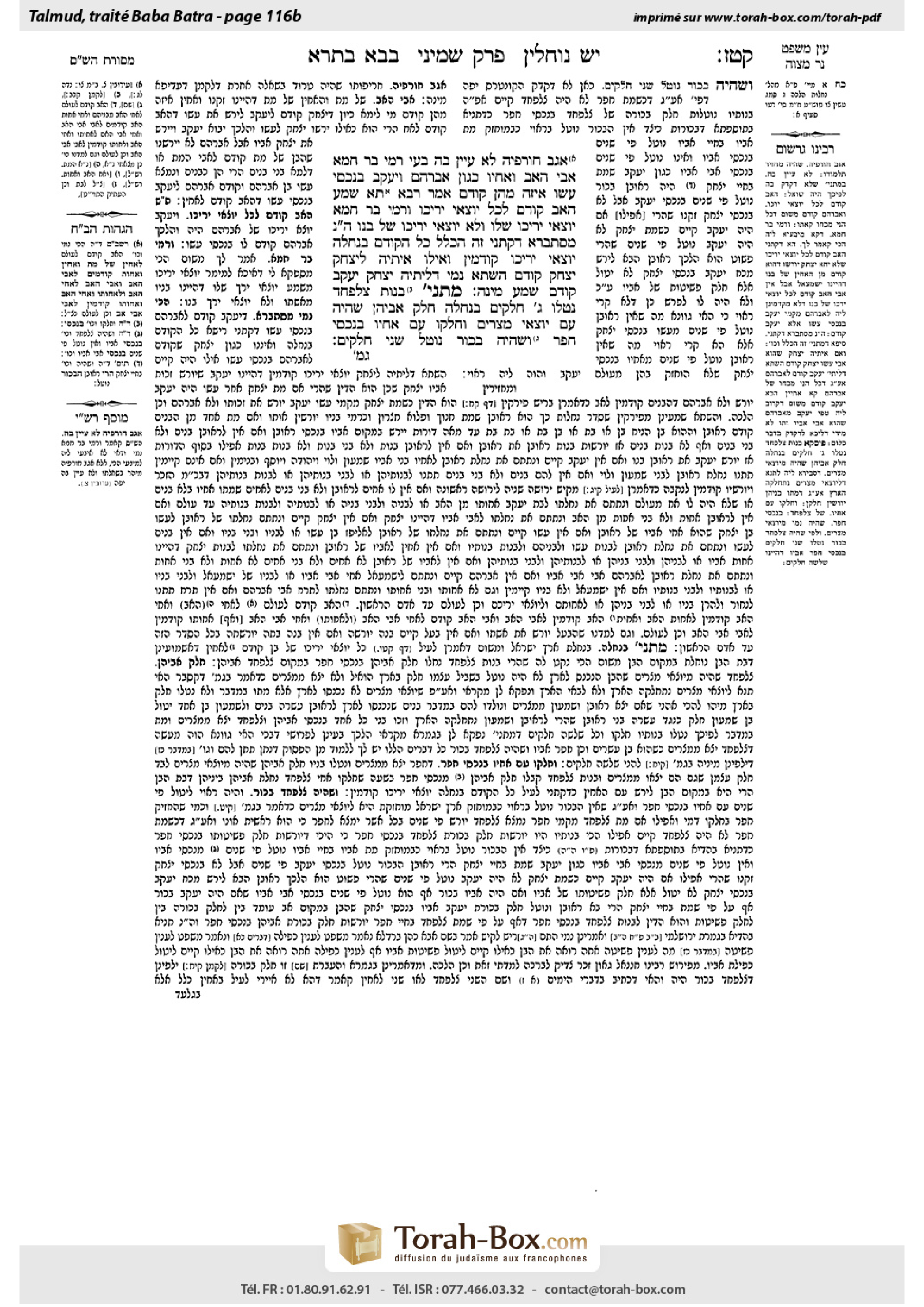
Bava Batra 116b: Talmud study for Daf Yomi
Study the Talmud for Daf Yomi with scanned pages, Hebrew text, English translations from Sefaria and AI-generated French translations.
Passage selection and English or AI-generated French translation are available where the scan has annotations. Daf Study is independent of Torah-Box and Sefaria.
Browse Bava Batra · בבא בתרא · All tractatesBava Batra 116b text and translations
This page of Bava Batra includes the Aramaic text, an English translation and an AI-generated French translation, alongside the scan above.
בבא בתרא קי״ו ב · Aramaic and Hebrew text
אַגַּב חוּרְפֵּיהּ לָא עַיֵּין בָּהּ.
בָּעֵי רָמֵי בַּר חָמָא: אֲבִי הָאָב וְאָחִיו – כְּגוֹן אַבְרָהָם וְיַעֲקֹב בְּנִכְסֵי עֵשָׂו, אֵיזֶה מֵהֶן קוֹדֵם? אֲמַר רָבָא, תָּא שְׁמַע: הָאָב קוֹדֵם לְכׇל יוֹצְאֵי יְרֵיכוֹ. וְרָמֵי בַּר חָמָא – יוֹצְאֵי יְרֵיכוֹ שֶׁלּוֹ, וְלֹא יוֹצְאֵי יְרֵיכוֹ שֶׁל בְּנוֹ.
הָכִי נָמֵי מִסְתַּבְּרָא, דְּקָתָנֵי: זֶה הַכְּלָל, כׇּל הַקּוֹדֵם בַּנַּחֲלָה – יוֹצְאֵי יְרֵיכוֹ קוֹדְמִין; וְאִילּוּ אִיתֵיהּ לְיִצְחָק – יִצְחָק קוֹדֵם, הַשְׁתָּא נָמֵי דְּלֵיתֵיהּ יִצְחָק – יַעֲקֹב קוֹדֵם; שְׁמַע מִינַּהּ.
מַתְנִי׳ בְּנוֹת צְלָפְחָד נָטְלוּ שְׁלֹשָׁה חֲלָקִים בַּנַּחֲלָה: חֵלֶק אֲבִיהֶן – שֶׁהָיָה עִם יוֹצְאֵי מִצְרַיִם, וְחֶלְקוֹ עִם אֶחָיו בְּנִכְסֵי חֵפֶר, וְשֶׁהָיָה בְּכוֹר נוֹטֵל שְׁנֵי חֲלָקִים.
Bava Batra 116b · English translation
The Gemara answers: Due to his keen mind, he did not analyze the mishna carefully.
Rami bar Ḥama raised a dilemma: With regard to the claim of a father of the deceased’s father and the claim of the deceased’s brother, such as the claims of Abraham and Jacob to the property of Esau, who was Abraham’s grandson and Jacob’s brother, which of them precedes the other and inherits the property? Rava said: Come and hear a proof from the mishna: A father precedes all of his descendants, therefore, Abraham would inherit, as Jacob was his descendant. The Gemara asks: And why did Rami bar Ḥama have a dilemma; presumably, he was aware of the statement of the mishna? The Gemara answers: Rami bar Ḥama understood that the mishna teaches that a father precedes only his own immediate descendants, but not the descendants of his son.
The Gemara notes that so too, it is reasonable to understand the mishna in that manner, as it teaches: This is the principle: Anyone who precedes another with regard to inheritance, his descendants precede the other as well. And if Isaac were alive, Isaac would precede Abraham and inherit Esau’s property. Now, also, when Isaac is not alive, Jacob should precede Abraham, because of the principle that the descendants of one who precedes another with regard to inheritance also precede the other. The Gemara affirms: Conclude from this clause of the mishna that the brother of the deceased precedes the grandfather.
MISHNA: Zelophehad’s daughters took three portions of land in the inheritance of Eretz Yisrael: Their father’s portion that he received because he was among those who left Egypt; and his portion that he received with his brothers in the property of Hepher, their father; and an additional portion that he received from Hepher because he was a firstborn, and a firstborn takes two portions of inheritance from his father.
Bava Batra 116b · Traduction française (IA)
Le Guemara répond : En raison de son esprit aigu, il n’a pas examiné la mitsna avec soin.
Rami bar Ḥama a posé un dilemme : En ce qui concerne la revendication du père du défunt et la revendication du frère du défunt, comme celles d’Abraham et de Jacob sur la propriété d’Ésaü, qui était le petit-fils d’Abraham et le frère de Jacob, laquelle des deux revendications a priorité et hérite de la propriété ? Rava a dit : Viens écouter une preuve dans la mitsna : Le père précède tous ses descendants, donc Abraham hériterait, car Jacob était son descendant. Le Guemara demande : Et pourquoi Rami bar Ḥama avait-il un dilemme ; peut-être était-il conscient de l’affirmation de la mitsna ? Le Guemara répond : Rami bar Ḥama comprenait que la mitsna enseigne que le père précède seulement ses descendants directs, mais pas les descendants de son fils.
Le Guemara note que de même, il est raisonnable de comprendre la mitsna ainsi, car elle enseigne : Ce principe est celui-ci : Quiconque précède un autre en matière d’héritage, ses descendants précèdent également l’autre. Et si Isaac était vivant, Isaac précéderait Abraham et hériterait de la propriété d’Ésaü. Maintenant, également, lorsque Isaac n’est pas vivant, Jacob devrait précéder Abraham, en raison du principe selon lequel les descendants de celui qui précède un autre en matière d’héritage précèdent également l’autre. Le Guemara affirme : Conclure de cette clause de la mitsna que le frère du défunt précède le grand-père.
MICHNA : Les filles de Zelophehad ont pris trois parts de terre dans l’héritage de la Terre d’Israël : La part de leur père qu’il avait reçue parce qu’il était parmi ceux qui sont sortis d’Égypte ; et la part qu’il avait reçue avec ses frères dans la propriété de Hepher, leur père ; et une part supplémentaire qu’il avait reçue de Hepher parce qu’il était le premier-né, et le premier-né prend deux parts d’héritage de son père.
Traduction française générée par IA à partir de l’édition anglaise de Sefaria. Vérifie toujours un passage avec le texte source.
Text from Sefaria: William Davidson Edition - Vocalized Aramaic (CC BY NC); William Davidson Edition - English (CC BY NC).