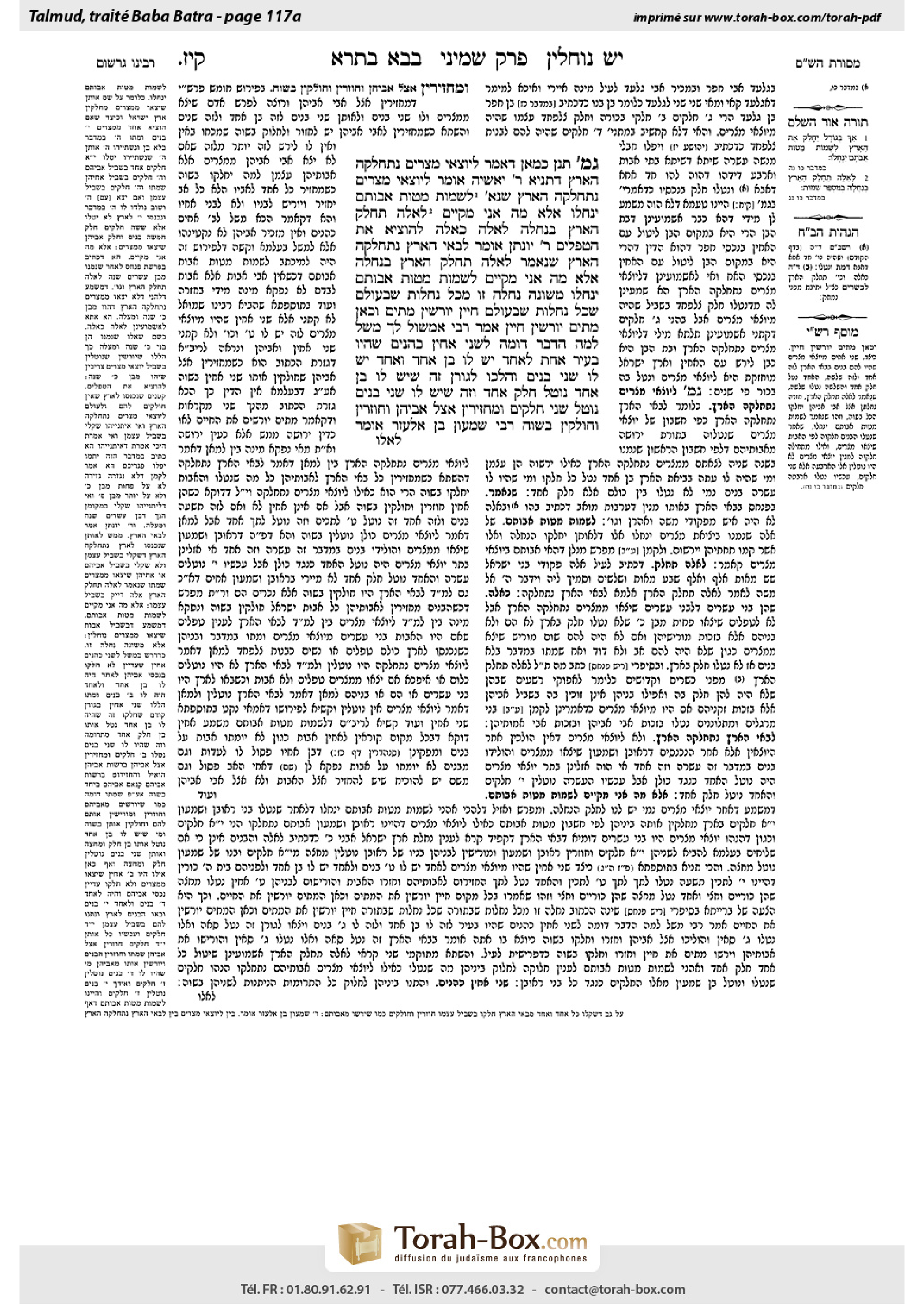
Bava Batra 117a: Talmud study for Daf Yomi
Study the Talmud for Daf Yomi with scanned pages, Hebrew text, English translations from Sefaria and AI-generated French translations.
Passage selection and English or AI-generated French translation are available where the scan has annotations. Daf Study is independent of Torah-Box and Sefaria.
Browse Bava Batra · בבא בתרא · All tractatesBava Batra 117a text and translations
This page of Bava Batra includes the Aramaic text, an English translation and an AI-generated French translation, alongside the scan above.
בבא בתרא קי״ז א · Aramaic and Hebrew text
גְּמָ׳ תְּנַן כְּמַאן דְּאָמַר לְיוֹצְאֵי מִצְרַיִם נִתְחַלְּקָה הָאָרֶץ –
דְּתַנְיָא, רַבִּי יֹאשִׁיָּה אוֹמֵר: לְיוֹצְאֵי מִצְרַיִם נִתְחַלְּקָה הָאָרֶץ, שֶׁנֶּאֱמַר: ״לִשְׁמוֹת מַטּוֹת אֲבֹתָם יִנְחָלוּ״. אֶלָּא מָה אֲנִי מְקַיֵּים ״לָאֵלֶּה תֵּחָלֵק הָאָרֶץ בְּנַחֲלָה״? ״לָאֵלֶּה״ – כָּאֵלֶּה, לְהוֹצִיא אֶת הַטְּפָלִים.
רַבִּי יוֹנָתָן אוֹמֵר: לְבָאֵי הָאָרֶץ נִתְחַלְּקָה הָאָרֶץ, שֶׁנֶּאֱמַר: ״לָאֵלֶּה תֵּחָלֵק הָאָרֶץ בְּנַחֲלָה״. אֶלָּא מָה אֲנִי מְקַיֵּים ״לִשְׁמוֹת מַטּוֹת אֲבֹתָם יִנְחָלוּ״? מְשׁוּנָּה נַחֲלָה זוֹ מִכׇּל נְחָלוֹת שֶׁבָּעוֹלָם; שֶׁכׇּל נְחָלוֹת שֶׁבָּעוֹלָם – חַיִּין יוֹרְשִׁין מֵתִים, וְכָאן – מֵתִים יוֹרְשִׁין חַיִּין.
אָמַר רַבִּי: אֶמְשׁוֹל לְךָ מָשָׁל, לְמָה הַדָּבָר דּוֹמֶה? לִשְׁנֵי אַחִין כֹּהֲנִים שֶׁהָיוּ בְּעִיר אַחַת, לְאֶחָד יֵשׁ לוֹ בֵּן אֶחָד, וְאֶחָד יֵשׁ לוֹ שְׁנֵי בָנִים, וְהָלְכוּ לַגּוֹרֶן. זֶה שֶׁיֵּשׁ לוֹ בֵּן אֶחָד – נוֹטֵל חֵלֶק אֶחָד, וְזֶה שֶׁיֵּשׁ לוֹ שְׁנֵי בָנִים – נוֹטֵל שְׁנֵי חֲלָקִים. וּמַחְזִירִין אֵצֶל אֲבִיהֶן, וְחוֹזְרִין וְחוֹלְקִין בְּשָׁוֶה.
רַבִּי שִׁמְעוֹן בֶּן אֶלְעָזָר אוֹמֵר:
Bava Batra 117a · English translation
GEMARA: The Gemara comments: In the mishna that teaches that Zelophehad and Hepher were entitled to portions in Eretz Yisrael, we learned in accordance with the opinion of the one who says: Eretz Yisrael was divided among those who left Egypt.
The Gemara cites a baraita that presents three opinions as to how Eretz Yisrael was divided. As it is taught in a baraita that Rabbi Yoshiya says: Eretz Yisrael was divided among those who left Egypt, as it is stated: “According to the names of the tribes of their fathers they shall inherit” (Numbers 26:55), which teaches that the Jewish people would inherit Eretz Yisrael according to the names of their fathers, i.e., those who left Egypt. Rabbi Yoshiya continues: But how do I realize the meaning of the verse: “Unto these the land shall be divided for an inheritance” (Numbers 26:53), which indicates that the land was to be divided among those recently counted in the wilderness, i.e., those who would enter Eretz Yisrael? He answers: “Unto these” teaches that the land will be divided among those who are like these people who were counted, in that they were adults above the age of twenty, to exclude the children, who were not entitled to a portion in Eretz Yisrael, as they were not of age at the time of the Exodus.
The baraita presents a second opinion. Rabbi Yonatan says: Eretz Yisrael was divided among those who entered Eretz Yisrael, as it is stated: “Unto these the land shall be divided for an inheritance” (Numbers 26:53). But how do I realize the meaning of the verse: “According to the names of the tribes of their fathers they shall inherit” (Numbers 26:55)? This teaches that this inheritance is different from all other inheritances in the world, for in all other inheritances in the world, the living inherit from the dead, but here, the dead inherit from the living. In other words, the portions of land received by those who entered Eretz Yisrael were transferred to their fathers who left Egypt, and then inherited by the current generation, as the Gemara will now explain.
Rabbi Yehuda HaNasi said: I will tell you a parable. To what is this matter comparable? To two brothers who were priests and who were in one town. One brother has one son, and one brother has two sons, and the sons all went to the threshing floor to collect teruma. This brother, who has one son, takes one portion of the teruma from his child, and that brother, who has two sons, takes two portions from his sons. And the brothers then return with the three portions to their father, and then redivide the portions among themselves equally, so that each brother receives one and one-half portions. When the brothers give their shares to their children, the son of the first brother will receive all that his father had received, while the sons of the other brother will divide what their father had received.
The baraita presents a third opinion. Rabbi Shimon ben Elazar says:
Bava Batra 117a · Traduction française (IA)
GUEMARA : La Guemara commente : Dans la mitsva qui enseigne que Zelophehad et Hepher avaient le droit à des portions en Eretz Yisrael, nous avons appris selon l'opinion de celui qui dit : Eretz Yisrael a été divisé parmi ceux qui sont sortis d'Égypte.
La Guemara cite une baraïta qui présente trois opinions sur la manière dont Eretz Yisrael a été divisé. Comme il est enseigné dans une baraïta que Rabbi Yoshiya dit : Eretz Yisrael a été divisé parmi ceux qui sont sortis d'Égypte, comme il est dit : « Selon les noms des tribus de leurs pères ils hériteront » (Nombres 26:55), ce qui enseigne que le peuple juif héritera d'Eretz Yisrael selon les noms de leurs pères, c'est-à-dire ceux qui sont sortis d'Égypte. Rabbi Yoshiya continue : Mais comment puis-je comprendre la signification de la parole : « À ces personnes la terre sera divisée pour héritage » (Nombres 26:53), qui indique que la terre devait être divisée parmi ceux qui ont été comptés dans le désert, c'est-à-dire ceux qui entreront en Eretz Yisrael ? Il répond : « À ces personnes » enseigne que la terre sera divisée parmi ceux qui sont comme ces personnes qui ont été comptés, c'est-à-dire ceux qui étaient adultes, au-delà de l'âge de vingt ans, pour exclure les enfants, qui n'avaient pas le droit à une portion en Eretz Yisrael, car ils n'étaient pas majeurs à l'époque de l'Exode.
La baraïta présente une deuxième opinion. Rabbi Yonatan dit : Eretz Yisrael a été divisé parmi ceux qui sont entrés en Eretz Yisrael, comme il est dit : « À ces personnes la terre sera divisée pour héritage » (Nombres 26:53). Mais comment puis-je comprendre la signification de la parole : « Selon les noms des tribus de leurs pères ils hériteront » (Nombres 26:55) ? Cela enseigne que cet héritage est différent de tous les autres héritages dans le monde, car dans tous les autres héritages dans le monde, les vivants héritent des morts, mais ici, les morts héritent des vivants. En d'autres termes, les portions de terre reçues par ceux qui sont entrés en Eretz Yisrael ont été transmises à leurs pères qui sont sortis d'Égypte, et ensuite héritées par la génération actuelle, comme le expliquera maintenant la Guemara.
Rabbi Yehuda HaNasi dit : Je vais te raconter un parabole. À quoi est-ce comparable ? À deux frères qui étaient des prêtres et qui étaient dans une même ville. Un frère a un fils, et l'autre frère a deux fils, et tous les fils sont allés au champ de blé pour récolter la terouma. Ce frère, qui a un fils, prend une portion de la terouma de son fils, et ce frère, qui a deux fils, prend deux portions de ses fils. Et les frères reviennent avec les trois portions à leur père, et puis redistribuent les portions entre eux de manière égale, de sorte que chaque frère reçoit une et demie portions. Lorsque les frères donnent leurs parts à leurs enfants, le fils du premier frère recevra tout ce que son père avait reçu, tandis que les fils de l'autre frère partageront ce que leur père avait reçu.
La baraïta présente une troisième opinion. Rabbi Shimon ben Elazar dit :
Traduction française générée par IA à partir de l’édition anglaise de Sefaria. Vérifie toujours un passage avec le texte source.
Text from Sefaria: William Davidson Edition - Vocalized Aramaic (CC BY NC); William Davidson Edition - English (CC BY NC).