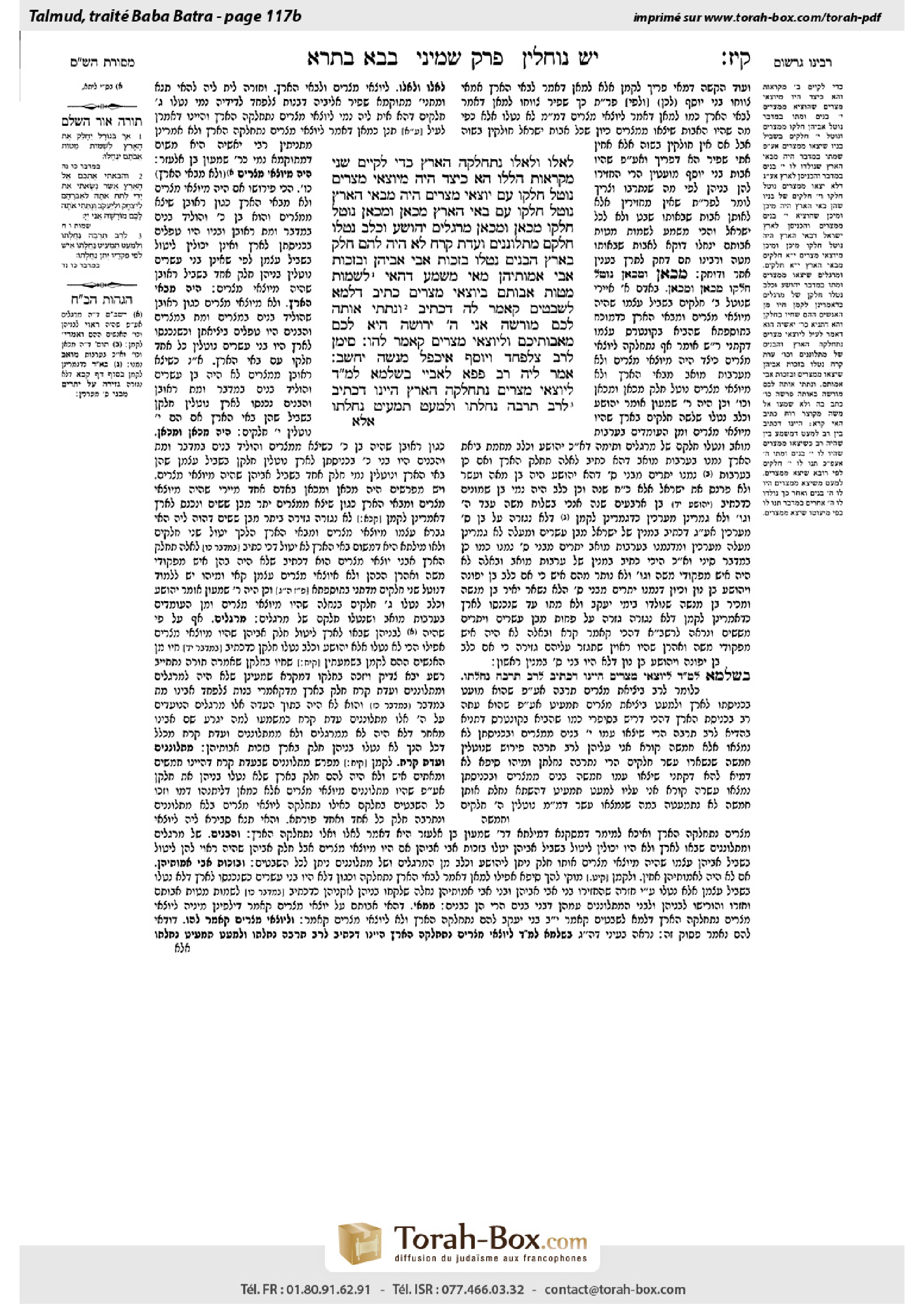
Bava Batra 117b: Talmud study for Daf Yomi
Study the Talmud for Daf Yomi with scanned pages, Hebrew text, English translations from Sefaria and AI-generated French translations.
Passage selection and English or AI-generated French translation are available where the scan has annotations. Daf Study is independent of Torah-Box and Sefaria.
Browse Bava Batra · בבא בתרא · All tractatesBava Batra 117b text and translations
This page of Bava Batra includes the Aramaic text, an English translation and an AI-generated French translation, alongside the scan above.
בבא בתרא קי״ז ב · Aramaic and Hebrew text
לְאֵלּוּ וּלְאֵלּוּ נִתְחַלְּקָה הָאָרֶץ, כְּדֵי לְקַיֵּים שְׁנֵי מִקְרָאוֹת הַלָּלוּ – הָא כֵּיצַד? הָיָה מִיּוֹצְאֵי מִצְרַיִם – נוֹטֵל חֶלְקוֹ עִם יוֹצְאֵי מִצְרַיִם, הָיָה מִבָּאֵי הָאָרֶץ – נוֹטֵל חֶלְקוֹ עִם בָּאֵי הָאָרֶץ, מִכָּאן וּמִכָּאן – נוֹטֵל חֶלְקוֹ מִכָּאן וּמִכָּאן.
מְרַגְּלִים – יְהוֹשֻׁעַ וְכָלֵב נָטְלוּ חֶלְקָם. מִתְלוֹנְנִים וַעֲדַת קֹרַח – לֹא הָיָה לָהֶם חֵלֶק בָּאָרֶץ; הַבָּנִים נָטְלוּ בִּזְכוּת אֲבִי אֲבִיהֶן, וּבִזְכוּת אֲבִי אִמּוֹתֵיהֶן.
מַאי מַשְׁמַע דְּהַאי: ״לִשְׁמוֹת מַטּוֹת אֲבֹתָם״ – בְּיוֹצְאֵי מִצְרַיִם כְּתִיב? דִּלְמָא לִשְׁבָטִים קָאָמַר לַהּ! דִּכְתִיב: ״וְנָתַתִּי אֹתָהּ לָכֶם מוֹרָשָׁה אֲנִי ה׳״ – יְרוּשָּׁה הִיא לָכֶם מֵאֲבוֹתֵיכֶם; וּלְיוֹצְאֵי מִצְרַיִם קָאָמַר לְהוּ.
(סִימָן: לָרַב, צְלָפְחָד, וְיוֹסֵף, אִיכְּפַל, מְנַשֶּׁה, יְחַשֵּׁב.)
אֲמַר לֵיהּ רַב פָּפָּא לְאַבָּיֵי: בִּשְׁלָמָא לְמַאן דְּאָמַר לְיוֹצְאֵי מִצְרַיִם נִתְחַלְּקָה הָאָרֶץ, הַיְינוּ דִּכְתִיב: ״לָרַב תַּרְבֶּה נַחֲלָתוֹ וְלַמְעַט תַּמְעִיט נַחֲלָתוֹ״.
Bava Batra 117b · English translation
Eretz Yisrael was divided to these and to those, so as to uphold these two verses. How so? If one was from among those who left Egypt, he takes his portion along with those who left Egypt. If one was from among those who entered Eretz Yisrael, he takes his portion along with those who entered Eretz Yisrael. If one was from both here and there, i.e., he was among those who left Egypt and also entered Eretz Yisrael himself, he takes his portion from here and there, as he is entitled to two portions.
The baraita continues: With regard to the twelve spies sent to survey Eretz Yisrael prior to the Jewish people’s entry into the land, Joshua and Caleb took all of the spies’ portions of the land. Additionally, the protesters and the assembly of Korah did not have a portion of Eretz Yisrael. Nevertheless, their sons took portions of the land in the merit of their paternal grandfathers and in the merit of their maternal grandfathers if they were among those who left Egypt. This concludes the Gemara’s citation of the baraita.
The Gemara asks: From where may it be inferred that this verse, which states: “According to the names of the tribes of their fathers they shall inherit” (Numbers 26:55), is written with regard to those who left Egypt; perhaps the verse was stated in reference to the progenitors of the tribes, and teaches that the land should be divided among the twelve tribes? The Gemara answers: The inference is from a verse, as it is written: “And I will bring you in to the land, concerning which I lifted up My hand to give it to Abraham, to Isaac, and to Jacob; and I will give it to you for a heritage: I am the Lord” (Exodus 6:8). This verse states that Eretz Yisrael is an inheritance for you from your forefathers, and this verse was told to those who left Egypt, indicating that those who left Egypt inherit the land.
The Gemara presents a mnemonic device for the following series of questions posed by Rav Pappa to Abaye relating to the division of Eretz Yisrael: To the more; Zelophehad; and Joseph; contested; Manasseh; will count.
The Gemara presents the first question. Rav Pappa said to Abaye: Granted, according to the one who says that Eretz Yisrael was divided among those who left Egypt, this is the meaning of that which is written: “To the more you shall give the more inheritance, and to the fewer you shall give the less inheritance” (Numbers 26:54). The verse may be understood as teaching the novelty that even though the number of Jewish people entering Eretz Yisrael differed from the number who left Egypt, the land is nevertheless divided according to the numbers at the time of the Exodus, not according to the count at the time they received the land.
Bava Batra 117b · Traduction française (IA)
L'Éretz Yisrael a été divisée entre ceux-ci et ceux-là, afin de respecter ces deux versets. Comment ? Si l'on était parmi ceux qui sont sortis d'Égypte, il prenait sa part avec ceux qui sont sortis d'Égypte. Si l'on était parmi ceux qui sont entrés en Éretz Yisrael, il prenait sa part avec ceux qui sont entrés en Éretz Yisrael. Si l'on était à la fois parmi ceux qui sont sortis d'Égypte et parmi ceux qui sont entrés en Éretz Yisrael, il prenait sa part ici et là, car il est dû à lui de deux parts.
La baraïta continue : En ce qui concerne les douze espions envoyés pour explorer l'Éretz Yisrael avant l'entrée du peuple juif dans la terre, Josué et Caleb ont pris toutes les parts des espions dans la terre. De plus, les récalcitrants et l'assemblée de Korah n'avaient pas de part en Éretz Yisrael. Cependant, leurs fils ont pris des parts dans la terre en mérite de leurs grands-pères paternels et en mérite de leurs grands-pères maternels, si ceux-ci étaient parmi ceux qui sont sortis d'Égypte. Cela conclut la citation de la baraïta par la Guemara.
La Guemara pose une question : D'où peut-on déduire que ce verset, qui dit : « Selon les noms des tribus de leurs pères ils hériteront » (Nombres 26:55), est dit concernant ceux qui sont sortis d'Égypte ; peut-être ce verset a-t-il été dit concernant les ancêtres des tribus, et enseigne que la terre doit être divisée parmi les douze tribus ? La Guemara répond : L'inférence est tirée d'un autre verset, car il est écrit : « Et je t'apporterai dans la terre dont j'ai levé ma main pour la donner à Abraham, à Isaac et à Jacob ; et je la donnerai à toi pour héritage : je suis le Seigneur » (Exode 6:8). Ce verset indique que l'Éretz Yisrael est un héritage pour vous à partir de vos pères, et ce verset a été dit à ceux qui sont sortis d'Égypte, ce qui signifie que ceux qui sont sortis d'Égypte héritent de la terre.
La Guemara présente un dispositif mnémotechnique pour la série de questions suivantes posées par Rav Pappa à Abaye concernant la division de l'Éretz Yisrael : Au plus ; Zelophehad ; et Joseph ; contesté ; Manasseh ; comptera.
La Guemara présente la première question. Rav Pappa dit à Abaye : C'est évident, selon celui qui dit que l'Éretz Yisrael a été divisée entre ceux qui sont sortis d'Égypte, c'est la signification de ce qui est écrit : « À celui qui est plus nombreux, on donnera une part plus grande, et à celui qui est moins nombreux, on donnera une part plus petite » (Nombres 26:54). Ce verset peut être compris comme enseignant une nouveauté, à savoir que même si le nombre des Juifs entrant en Éretz Yisrael diffère du nombre de ceux qui sont sortis d'Égypte, la terre est tout de même divisée selon les nombres au temps de l'Exode, et non selon le compte au moment où ils ont reçu la terre.
Traduction française générée par IA à partir de l’édition anglaise de Sefaria. Vérifie toujours un passage avec le texte source.
Text from Sefaria: William Davidson Edition - Vocalized Aramaic (CC BY NC); William Davidson Edition - English (CC BY NC).