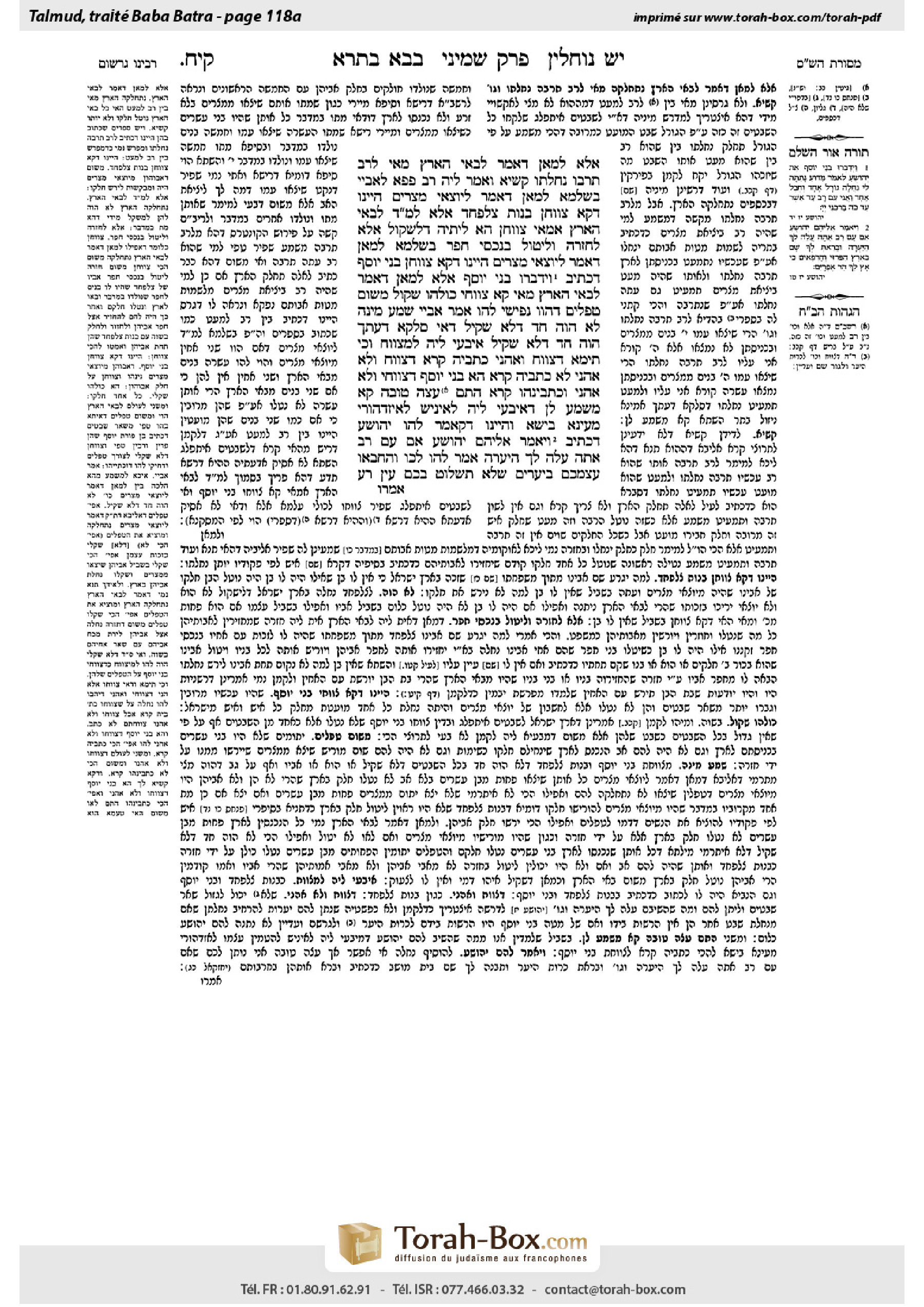
Bava Batra 118a: Talmud study for Daf Yomi
Study the Talmud for Daf Yomi with scanned pages, Hebrew text, English translations from Sefaria and AI-generated French translations.
Passage selection and English or AI-generated French translation are available where the scan has annotations. Daf Study is independent of Torah-Box and Sefaria.
Browse Bava Batra · בבא בתרא · All tractatesBava Batra 118a text and translations
This page of Bava Batra includes the Aramaic text, an English translation and an AI-generated French translation, alongside the scan above.
בבא בתרא קי״ח א · Aramaic and Hebrew text
אֶלָּא לְמַאן דְּאָמַר לְבָאֵי הָאָרֶץ, מַאי ״לָרַב תַּרְבּוּ נַחֲלָתוֹ״? קַשְׁיָא.
וַאֲמַר לֵיהּ רַב פָּפָּא לְאַבָּיֵי: בִּשְׁלָמָא לְמַאן דְּאָמַר לְיוֹצְאֵי מִצְרַיִם, הַיְינוּ דְּקָא צָוְוחָן בְּנוֹת צְלָפְחָד. אֶלָּא לְמַאן דְּאָמַר לְבָאֵי הָאָרֶץ, אַמַּאי צָוְוחָן? הָא לֵיתֵיהּ דְּלִשְׁקוֹל!
אֶלָּא לַחֲזָרָה, וְלִיטּוֹל בְּנִכְסֵי חֵפֶר.
בִּשְׁלָמָא לְמַאן דְּאָמַר לְיוֹצְאֵי מִצְרַיִם, הַיְינוּ דְּקָא צָוְוחָן בְּנֵי יוֹסֵף – דִּכְתִיב: ״וַיְדַבְּרוּ בְּנֵי יוֹסֵף״. אֶלָּא לְמַאן דְּאָמַר לְבָאֵי הָאָרֶץ, מַאי קָא צָוְוחִי? כּוּלְּהוּ שְׁקוּל!
מִשּׁוּם טְפָלִים דַּהֲווֹ נְפִישִׁי לְהוּ.
אָמַר אַבָּיֵי: שְׁמַע מִינַּהּ, לָא הֲוָה חַד דְּלָא שָׁקֵיל; דְּאִי סָלְקָא דַּעְתָּךְ הֲוָה חַד דְּלָא שָׁקֵיל, אִיבְּעִי לֵיהּ לְמִצְוַוח! וְכִי תֵּימָא: דִּצְוַוח וְאַהֲנִי – כַּתְבֵיהּ קְרָא, דִּצְוַוח וְלָא אַהֲנִי – לָא כַּתְבֵיהּ קְרָא; הָא בְּנֵי יוֹסֵף – דְּצָוְוחִי וְלָא אַהֲנִי, וְכַתְבִינְהוּ קְרָא!
הָתָם עֵצָה טוֹבָה קָא מַשְׁמַע לַן, דְּאִיבְּעִי לֵיהּ לְאִינִישׁ לְאִיזְדְּהוֹרֵי מֵעֵינָא בִּישָׁא. וְהַיְינוּ דְּקָאָמַר לְהוּ יְהוֹשֻׁעַ – דִּכְתִיב: ״וַיֹּאמֶר אֲלֵיהֶם יְהוֹשֻׁעַ, אִם עַם רַב אַתָּה, עֲלֵה לְךָ הַיַּעְרָה״. אֲמַר לְהוּ: לְכוּ וְהַחְבִּאוּ עַצְמְכֶם בִּיעָרִים, שֶׁלֹּא תִּשְׁלוֹט בָּכֶם עַיִן רַע.
Bava Batra 118a · English translation
But according to the one who says that Eretz Yisrael was divided among those who entered Eretz Yisrael, what does the verse: “To the more you shall give the more inheritance” teach? It is obvious that larger families will receive more land due to their greater numbers. The Gemara concludes: This poses a difficulty to one who holds that opinion.
The Gemara presents the second question. And Rav Pappa said to Abaye: Granted, according to the one who says that Eretz Yisrael was divided among those who left Egypt, this is why the daughters of Zelophehad cried out in protest of the fact that they would be denied their father’s portion, to which he was entitled as one who left Egypt. But according to the one who says that Eretz Yisrael was divided among those who entered Eretz Yisrael, why did they cry out in protest; after all, Zelophehad was not there to take his portion, so his daughters should have no claim to the land?
Abaye answers: Rather, according to this opinion, the protest of Zelophehad’s daughters was in reference to the returning of the portions from the generation that entered Eretz Yisrael to the generation that left Egypt, as described in the baraita above. And accordingly, Zelophehad’s daughters demanded to take their portion in the property of their grandfather Hepher, who received land posthumously through his children, their uncles.
The Gemara presents Rav Pappa’s third question: Granted, according to the one who says that Eretz Yisrael was divided among those who left Egypt, this is why the descendants of Joseph cried out in protest of the fact that they would receive an inadequate portion of land due to the fact that they had proliferated greatly in the wilderness. As it is written: “And the children of Joseph spoke to Joshua, saying: Why have you given me but one lot and one part for an inheritance, seeing I am a great people, because the Lord has blessed me thus” (Joshua 17:14). But according to the one who says that Eretz Yisrael was divided among those who entered Eretz Yisrael, what is the reason they were crying out? They were all entitled to take their own portion of land and should have had no cause for complaint.
The Gemara answers: They protested due to the children, as they had many children who were not entitled to a portion of the land.
Abaye said: Learn from the fact that the Bible records the complaints of only the daughters of Zelophehad and the descendants of Joseph that there was not one other individual who did not take a portion of land; as if it enters your mind that there was even one other who did not take a portion of land, he should have cried out in protest. And if you would say: The verse wrote about one who cried out and his protest was effective, and the verse did not write about one who cried out and his protest was not effective, that is difficult. But there is the counterexample of the descendants of Joseph, who cried out and their protest was not effective, and the verse wrote about them.
The Gemara rejects Abaye’s inference: Generally, the verse would not record an instance where one cried out if his protest was not effective, and there, the verse includes the protest of Joseph’s descendants in order to teach us a measure of good advice: That a person should be wary of the evil eye. And this is what Joshua said to them, as it is written: “And Joshua said unto them: If you be a great people, go up to the forest, and cut down for yourself there in the land of the Perizzites and of the Rephaim” (Joshua 17:15). Joshua said to them: Go and conceal yourselves in the forests so that the evil eye will not have dominion over you.
Bava Batra 118a · Traduction française (IA)
Mais selon celui qui affirme que la Terre d'Israël a été divisée entre ceux qui sont entrés en Terre d'Israël, à quoi la parole « À celui qui donnera plus, on donnera plus de part » enseigne-t-elle ? Il est évident que les familles plus nombreuses recevront plus de terre en raison de leur nombre. La Guemara conclut : cela pose un problème pour celui qui adopte cette opinion.
La Guemara présente la deuxième question. Et Rav Pappa dit à Abaye : D'accord, selon celui qui affirme que la Terre d'Israël a été divisée entre ceux qui sont sortis d'Égypte, c'est pourquoi les filles de Zelophehad ont crié en protestation du fait qu'elles seraient privées de la part de leur père, à laquelle il avait droit comme celui qui est sorti d'Égypte. Mais selon celui qui affirme que la Terre d'Israël a été divisée entre ceux qui sont entrés en Terre d'Israël, pourquoi ont-elles crié en protestation ; après tout, Zelophehad n'était pas là pour prendre sa part, donc ses filles ne devaient pas avoir droit à la terre ?
Abaye répond : Plutôt, selon cette opinion, la protestation des filles de Zelophehad faisait référence au retour des parts de la génération qui est entrée en Terre d'Israël à la génération qui est sortie d'Égypte, comme décrit dans la baraïta ci-dessus. Et ainsi, les filles de Zelophehad exigeaient de prendre leur part dans la propriété de leur grand-père Hepher, qui avait reçu une terre postérieurement à travers ses enfants, leurs oncles.
La Guemara présente la troisième question de Rav Pappa : D'accord, selon celui qui affirme que la Terre d'Israël a été divisée entre ceux qui sont sortis d'Égypte, c'est pourquoi les descendants de Joseph ont crié en protestation du fait qu'ils recevraient une part insuffisante de terre en raison du fait qu'ils avaient proliféré beaucoup dans le désert. Comme il est écrit : « Et les enfants de Joseph parlèrent à Josué, disant : Pourquoi as-tu donné à moi seulement une part et une portion pour héritage, sachant que je suis un peuple nombreux, car l'Éternel m'a béni ainsi » (Josué 17:14). Mais selon celui qui affirme que la Terre d'Israël a été divisée entre ceux qui sont entrés en Terre d'Israël, à quoi est-ce que leur protestation était due ? Ils avaient tous le droit de prendre leur propre part de terre et ne devaient pas avoir de motif de plainte.
La Guemara répond : Ils protestaient en raison des enfants, car ils avaient beaucoup d'enfants qui n'étaient pas dûs à une part de terre.
Abaye dit : Apprends de ce que la Bible mentionne seulement les plaintes des filles de Zelophehad et des descendants de Joseph, qu'il n'y avait pas un seul autre individu qui n'avait pas pris une part de terre ; comme si cela entrait dans ton esprit qu'il y avait même un seul autre qui n'avait pas pris une part de terre, il aurait dû protester. Et si tu disais : La parole a écrit sur celui qui a protesté et sa protestation a été efficace, et la parole n'a pas écrit sur celui qui a protesté et sa protestation n'a pas été efficace, cela est difficile. Mais il y a l'exemple contraire des descendants de Joseph, qui ont protesté et leur protestation n'a pas été efficace, et la parole a écrit sur eux.
La Guemara rejette l'inférence d'Abaye : Généralement, la parole ne mentionnerait pas un cas où l'on a crié si sa protestation n'était pas efficace, et là, la parole inclut la protestation des descendants de Joseph afin de nous enseigner une mesure de bon conseil : qu'une personne doive être prudent contre le regard mauvais. Et c'est ce que Josué a dit à eux, comme il est écrit : « Et Josué dit à eux : Si vous êtes un peuple nombreux, montez dans la forêt et coupez vous-même là dans la terre des Perizzites et des Rephaim » (Josué 17:15). Josué a dit à eux : Allez et cachez-vous dans les forêts afin que le regard mauvais n'ait pas prise sur vous.
Traduction française générée par IA à partir de l’édition anglaise de Sefaria. Vérifie toujours un passage avec le texte source.
Text from Sefaria: William Davidson Edition - Vocalized Aramaic (CC BY NC); William Davidson Edition - English (CC BY NC).