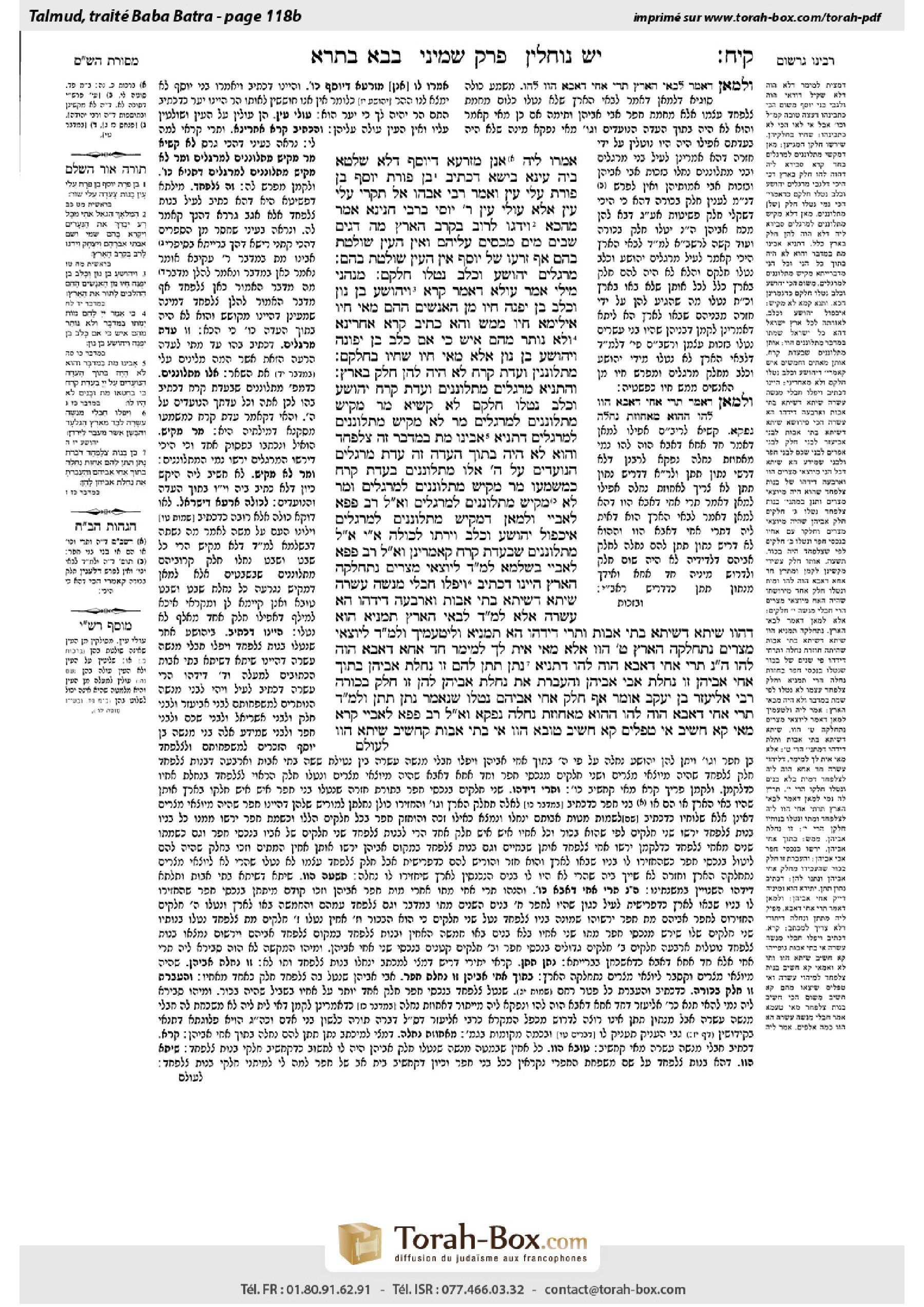
Bava Batra 118b: Talmud study for Daf Yomi
Study the Talmud for Daf Yomi with scanned pages, Hebrew text, English translations from Sefaria and AI-generated French translations.
Passage selection and English or AI-generated French translation are available where the scan has annotations. Daf Study is independent of Torah-Box and Sefaria.
Browse Bava Batra · בבא בתרא · All tractatesBava Batra 118b text and translations
This page of Bava Batra includes the Aramaic text, an English translation and an AI-generated French translation, alongside the scan above.
בבא בתרא קי״ח ב · Aramaic and Hebrew text
אֲמַרוּ לֵיהּ: אֲנַן מִזַּרְעָא דְּיוֹסֵף, דְּלָא שָׁלְטָא בֵּיהּ עֵינָא בִּישָׁא – דִּכְתִיב: ״בֵּן פֹּרָת יוֹסֵף, בֵּן פֹּרָת עֲלֵי עָיִן״, וְאָמַר רַבִּי אֲבָהוּ: אַל תִּקְרֵי ״עֲלֵי עָיִן״, אֶלָּא ״עוֹלֵי עָיִן״.
רַבִּי יוֹסֵי בְּרַבִּי חֲנִינָא אֲמַר מֵהָכָא: ״וְיִדְגּוּ לָרוֹב בְּקֶרֶב הָאָרֶץ״; מָה דָּגִים שֶׁבַּיָּם – מַיִם מְכַסִּים עֲלֵיהֶם וְאֵין הָעַיִן שׁוֹלֶטֶת בָּהֶם, אַף זַרְעוֹ שֶׁל יוֹסֵף – אֵין הָעַיִן שׁוֹלֶטֶת בָּהֶם.
מְרַגְּלִים – יְהוֹשֻׁעַ וְכָלֵב נָטְלוּ חֶלְקָם. מְנָהָנֵי מִילֵּי? אָמַר עוּלָּא, דְּאָמַר קְרָא: ״וִיהוֹשֻׁעַ בִּן נוּן וְכָלֵב בֶּן יְפֻנֶּה חָיוּ מִן הָאֲנָשִׁים הָהֵם״ – מַאי ״חָיוּ״? אִילֵּימָא חָיוּ מַמָּשׁ, וְהָא כְּתִיב קְרָא אַחֲרִינָא: ״וְלֹא נוֹתַר מֵהֶם אִישׁ, כִּי אִם כָּלֵב בֶּן יְפֻנֶּה וִיהוֹשֻׁעַ בִּן נוּן״! אֶלָּא מַאי ״חָיוּ״ – שֶׁחָיוּ בְּחֶלְקָם.
מִתְלוֹנְנִין וַעֲדַת קֹרַח – לֹא הָיָה לָהֶן חֵלֶק בָּאָרֶץ. וְהָתַנְיָא: מְרַגְּלִים, מִתְלוֹנְנִים וַעֲדַת קֹרַח – יְהוֹשֻׁעַ וְכָלֵב נָטְלוּ חֶלְקָם! לָא קַשְׁיָא; מָר מַקֵּישׁ מִתְלוֹנְנִים לִמְרַגְּלִים, מָר לָא מַקֵּישׁ מִתְלוֹנְנִים לִמְרַגְּלִים.
דְּתַנְיָא: ״אָבִינוּ מֵת בַּמִּדְבָּר״ – זֶה צְלָפְחָד. ״וְהוּא לֹא הָיָה בְּתוֹךְ הָעֵדָה״ – זֶה עֲדַת מְרַגְּלִים. ״הַנּוֹעָדִים עַל ה׳״ – אֵלּוּ מִתְלוֹנְנִים. ״בַּעֲדַת קֹרַח״ – כְּמַשְׁמָעוֹ.
מָר מַקֵּישׁ מִתְלוֹנְנִים לִמְרַגְּלִים, וּמָר לָא מַקֵּישׁ מִתְלוֹנְנִים לִמְרַגְּלִים.
וַאֲמַר לֵיהּ רַב פָּפָּא לְאַבָּיֵי: וּלְמַאן דְּמַקֵּישׁ מִתְלוֹנְנִים לִמְרַגְּלִים, אִיכְּפוּל יְהוֹשֻׁעַ וְכָלֵב וִירִתוּ לְכוּלַּהּ אֶרֶץ יִשְׂרָאֵל?! אֲמַר לֵיהּ: מִתְלוֹנְנִים שֶׁבַּעֲדַת קֹרַח קָאָמְרִינַן.
וַאֲמַר לֵיהּ רַב פָּפָּא לְאַבָּיֵי: בִּשְׁלָמָא לְמַאן דְּאָמַר לְיוֹצְאֵי מִצְרַיִם נִתְחַלְּקָה הָאָרֶץ, הַיְינוּ דִּכְתִיב: ״וַיִּפְּלוּ חַבְלֵי מְנַשֶּׁה עֲשָׂרָה״ – שִׁיתָּא דְּשִׁיתָּא בָּתֵּי אָבוֹת, וְאַרְבְּעָה דִּידְהוּ – הָא עֲשָׂרָה.
אֶלָּא לְמַאן דְּאָמַר לְבָאֵי הָאָרֶץ, תְּמָנְיָא הוּא דַּהֲווֹ – שִׁיתָּא דְּשִׁיתָּא בָּתֵּי אָבוֹת, וּתְרֵי דִּידְהוּ – הָא תְּמָנְיָא!
וְלִיטַעְמָיךְ, וּלְמַאן דְּאָמַר לְיוֹצְאֵי מִצְרַיִם נִתְחַלְּקָה הָאָרֶץ, תִּשְׁעָה הֲווֹ! אֶלָּא מַאי אִית לָךְ לְמֵימַר – חַד אַחָא דְאַבָּא הֲוָה לְהוּ; הָכִי נָמֵי, תְּרֵי אַחֵי דְאַבָּא הֲוָה לְהוּ –
דְּתַנְיָא: ״נָתֹן תִּתֵּן לָהֶם״ זוֹ נַחֲלַת אֲבִיהֶן. ״בְּתוֹךְ אֲחֵי אֲבִיהֶן״ – זוֹ נַחֲלַת אֲבִי אֲבִיהֶן. ״וְהַעֲבַרְתָּ אֶת נַחֲלַת אֲבִיהֶן לָהֶן״ – זוֹ חֵלֶק בְּכוֹרָה.
רַבִּי אֱלִיעֶזֶר בֶּן יַעֲקֹב אוֹמֵר: אַף חֵלֶק אֲחִי אֲבִיהֶם נָטְלוּ, שֶׁנֶּאֱמַר: ״נָתֹן תִּתֵּן״. וּלְמַאן דְּאָמַר תְּרֵי אַחֵי דְּאַבָּא הֲוָה לְהוּ, הַהוּא מֵ״אֲחֻזַּת נַחֲלָה״ נָפְקָא.
וַאֲמַר לֵיהּ רַב פָּפָּא לְאַבָּיֵי: קְרָא מַאי קָא חָשֵׁיב? אִי טְפָלִים קָא חָשֵׁיב, טוּבָא הֲווֹ! אִי בָּתֵּי אָבוֹת קָחָשֵׁיב, שִׁיתָּא הֲווֹ!
Bava Batra 118b · English translation
Joseph’s descendants said to him: We are of the descendants of Joseph, upon whom the evil eye had no dominion, as it is written: “Joseph is a fruitful vine, a fruitful vine by a fountain [alei ayin]” (Genesis 49:22), and Rabbi Abbahu states a homiletic interpretation: Do not read it as “alei ayin,” rather read it as olei ayin, above the eye, i.e., he transcended the influence of the evil eye. Joseph’s descendants were saying that they also do not need to be wary.
Rabbi Yosei, son of Rabbi Ḥanina, said that a proof for the notion that the evil eye holds no sway over Joseph and his descendants, is from here, Jacob’s blessing of Joseph’s sons, Ephraim and Manasseh: “The angel who has redeemed me from all evil, bless the lads; and let my name be named in them, and the name of my fathers, Abraham and Isaac; and let them grow into a multitude [veyidgu] in the midst of the earth” (Genesis 48:16). Veyidgu is related etymologically to the word for fish [dag]. Just as with regard to the fish in the sea, water covers them and the evil eye has no dominion over them, so too, the seed of Joseph, the evil eye has no dominion over them.
§ The Gemara analyzes the next section of the baraita, which states: With regard to the twelve spies sent to survey Eretz Yisrael prior to the Jewish people’s entry into the land, Joshua and Caleb took all of the spies’ portions of the land. The Gemara asks: From where is this matter derived? Ulla said: It is as the verse states: “But Joshua, son of Nun, and Caleb, son of Jephunneh, lived of those men that went to spy out the land” (Numbers 14:38). What does the term “lived” mean? If we say that it means literally that they lived, but there is another verse that states: “And there was not left a man of them, save Caleb, son of Jephunneh, and Joshua, son of Nun” (Numbers 26:65), so why would the Torah state it twice? Rather, what does the term “lived” mean? That Joshua and Caleb lived in the other spies’ portion of the land.
The baraita teaches that the protesters and the assembly of Korah did not possess a portion of Eretz Yisrael. The Gemara asks: But isn’t it taught otherwise in a baraita: With regard to the spies, the protesters, and the assembly of Korah, Joshua and Caleb took their portions of the land? Apparently, the protesters and the assembly of Korah were assigned portions in Eretz Yisrael, which were then given to Joshua and Caleb. The Gemara answers: It is not difficult: One Sage, the tanna of the baraita quoted earlier, juxtaposes the protesters to the spies, teaching that just as the spies were assigned a portion of Eretz Yisrael, so were the protesters. And one Sage, the tanna of the baraita quoted here, does not juxtapose the protesters to the spies. Although the spies were assigned a portion, the protesters were not.
The Gemara quotes a related baraita. As it is taught in a baraita that the verse quotes the daughters of Zelophehad: “Our father died in the wilderness, and he was not among the assembly of them that gathered themselves together against the Lord in the assembly of Korah, but he died in his own sin; and he had no sons” (Numbers 27:3), and the daughters of Zelophehad therefore claim they are entitled to his portion. “Our father died in the wilderness,” this is referring to Zelophehad. “And he was not among the assembly,” this is referring to the assembly of spies. “That gathered themselves together against the Lord,” these are the protesters. “In the assembly of Korah,” this is in accordance with its straightforward meaning. It is clear from this verse that those in these categories were not entitled to a portion in Eretz Yisrael.
The Gemara concludes: One Sage juxtaposes the protesters to the spies, so that Joshua and Caleb inherited the portions of both; and one Sage does not juxtapose the protesters to the spies.
The Gemara presents Rav Pappa’s fourth question. And Rav Pappa said to Abaye: And according to the one who juxtaposes the protesters to the spies, is it reasonable that Joshua and Caleb contested the spies and inherited all of Eretz Yisrael? Many of the Jewish people protested in the wilderness at one point or another, and it cannot be that Joshua and Caleb received all of their portions by virtue of not participating in the sin of the spies. Abaye said to him: We are referring to the protesters who were among the assembly of Korah. This term is not referring to all those who protested, but rather to the 250 individuals who protested along with Korah, and it is their portions of land that Joshua and Caleb received.
The Gemara returns to the baraita and presents the fifth question. And Rav Pappa said to Abaye: Granted, according to the one who says that Eretz Yisrael was divided among those who left Egypt, this is as it is written with regard to the inheritance of the tribe of Manasseh: “And ten parts fell to Manasseh, beside the land of Gilead and Bashan, which is beyond the Jordan; because the daughters of Manasseh had an inheritance among his sons” (Joshua 17:5–6). Six were the portions of the six fathers’ houses of Manasseh listed in a previous verse (Joshua 17:2), and four parts of the daughters of Zelophehad; that is ten parts.
But according to the one who says that Eretz Yisrael was divided among those who entered Eretz Yisrael, there were eight parts, as follows: Six were the portions of the six fathers’ houses, and two of theirs, which they received from the estate of their grandfather Hepher, of whom Zelophehad was the firstborn; that is eight. Zelophehad himself, by contrast, was not entitled to a portion, as he did not enter Eretz Yisrael.
The Gemara objects: And according to your reasoning, but even according to the one who says that Eretz Yisrael was divided among those who left Egypt, there are only nine parts, as the mishna (116b) states that Zelophehad’s daughters took three parts. Rather, what have you to say? How can the mishna be reconciled with the verse? One must say that according to the opinion that Eretz Yisrael was divided among those who left Egypt, they had one unmentioned paternal uncle who died without children, and Zelophehad’s estate received a share of his portion. So too, according to the opinion that Eretz Yisrael was divided among those who entered Eretz Yisrael, it could be said that they had two unmentioned paternal uncles, so that they received two additional portions of land.
The fact that they received a portion from an uncle may be derived from a verse. As it is taught in a baraita that the verse states: “You shall give [naton titten] them a possession of an inheritance” (Numbers 27:7). This is referring to the inheritance of their father. The verse continues: “Among their father’s brothers”; this is referring to the inheritance of their father’s father. The verse continues: “And you shall pass the inheritance of their father to them”; this is referring to the portion of the firstborn to which Zelophehad was entitled.
The baraita continues. Rabbi Eliezer ben Ya’akov says: They also took a portion of their father’s brother, as it is stated: “You shall give [naton titten].” The double expression indicates that they received an additional portion. The Gemara notes: And according to the one who says that they had two paternal uncles, that additional portion is derived from the phrase: “You shall give them a possession of an inheritance,” which would be superfluous were it not to indicate an additional portion.
The Gemara presents the sixth question. And Rav Pappa said to Abaye: In the verse quoted above, what portions is it counting? If the verse is counting children, i.e., the portions of those who inherited from their antecedents, as with the daughters of Zelophehad, there were many such portions, and the verse did not enumerate all portions inherited by all members of the tribe. And if the verse is counting fathers’ houses, there are only six, as Hepher is included among the six enumerated in Joshua 17:2. Why, then, does the verse count the portions of the daughters of Zelophehad separately?
Bava Batra 118b · Traduction française (IA)
Les descendants de Joseph dirent à lui : Nous sommes les descendants de Joseph, sur lesquels l'œil mauvais n'avait aucun pouvoir, comme il est écrit : « Joseph est une vigne fructueuse, une vigne fructueuse près d'une source [alei ayin] » (Genèse 49:22), et le Rabbi Abbahu énonce une interprétation allégorique : Ne le lisez pas comme « alei ayin », mais comme « olei ayin », c'est-à-dire au-dessus de l'œil, c'est-à-dire qu'il a transcendé l'influence de l'œil mauvais. Les descendants de Joseph disaient qu'ils n'avaient pas besoin non plus de craindre.
Le Rabbi Yosei, fils du Rabbi Ḥanina, dit que la preuve de la notion que l'œil mauvais n'a aucun pouvoir sur Joseph et ses descendants provient de là, de la bénédiction de Jacob sur les fils de Joseph, Éphraïm et Manassé : « L'ange qui m'a délivré de tout mal, bénis les enfants ; et que mon nom soit mentionné en eux, et le nom de mes pères, Abraham et Isaac ; et qu'ils deviennent nombreux [veyidgu] au milieu de la terre » (Genèse 48:16). « Veyidgu » est étymologiquement lié au mot « dag » (poisson). Tout comme les poissons dans la mer sont couverts par l'eau et l'œil mauvais n'a aucun pouvoir sur eux, de même les descendants de Joseph, l'œil mauvais n'a aucun pouvoir sur eux.
§ La Guemara analyse la prochaine section de la baraïta, qui stipule : Concernant les douze espions envoyés pour explorer la Terre d'Israël avant l'entrée du peuple juif dans la terre, Josué et Caleb ont pris toutes les parts de la terre des espions. La Guemara demande : D'où cette matière est-elle tirée ? Ulla dit : C'est comme le verset qui stipule : « Mais Josué, fils de Nun, et Caleb, fils de Jéphunné, vécurent parmi ceux qui allèrent espionner la terre » (Nombres 14:38). Quel est le sens du terme « vécurent » ? Si nous disons qu'il signifie littéralement qu'ils vécurent, mais il y a un autre verset qui stipule : « Et il ne resta pas un homme d'entre eux, sauf Caleb, fils de Jéphunné, et Joséph, fils de Nun » (Nombres 26:65), pourquoi alors le Tanakh le mentionne-t-il deux fois ? Plutôt, quel est le sens du terme « vécurent » ? Que Josué et Caleb vécurent dans les parts de la terre des espions.
La baraïta enseigne que les récalcitrants et l'assemblée de Korah n'avaient pas de part en Terre d'Israël. La Guemara demande : Mais n'est-il pas enseigné autrement dans une autre baraïta : Concernant les espions, les récalcitrants et l'assemblée de Korah, Josué et Caleb ont pris leurs parts de la terre ? Apparemment, les récalcitrants et l'assemblée de Korah avaient été assignés des parts en Terre d'Israël, qui ont ensuite été données à Josué et Caleb. La Guemara répond : Ce n'est pas difficile : Un sage, le tanna de la baraïta citée plus tôt, juxtapose les récalcitrants aux espions, enseignant que tout comme les espions avaient été assignés une part en Terre d'Israël, ainsi les récalcitrants. Et un autre sage, le tanna de la baraïta citée ici, ne juxtapose pas les récalcitrants aux espions. Bien que les espions aient été assignés une part, les récalcitrants n'étaient pas.
La Guemara cite une baraïta liée. Comme il est enseigné dans une baraïta que le verset cite les filles de Zelophehad : « Notre père est mort dans le désert, et il n'était pas parmi l'assemblée de ceux qui se sont rassemblés contre l'Éternel dans l'assemblée de Korah, mais il est mort dans son péché ; et il n'avait pas d'enfants » (Nombres 27:3), et les filles de Zelophehad revendiquent donc leur part. « Notre père est mort dans le désert », ceci fait référence à Zelophehad. « Et il n'était pas parmi l'assemblée », ceci fait référence à l'assemblée des espions. « Qui se sont rassemblés contre l'Éternel », ces sont les récalcitrants. « Dans l'assemblée de Korah », ceci est selon son sens littéral. Il est clair à partir de ce verset que ceux qui appartenaient à ces catégories n'étaient pas autorisés à avoir une part en Terre d'Israël.
La Guemara conclut : Un sage juxtapose les récalcitrants aux espions, de sorte que Josué et Caleb ont hérité des parts des deux ; et un autre sage ne juxtapose pas les récalcitrants aux espions.
La Guemara présente la quatrième question du Rabbi Pappa. Et le Rabbi Pappa dit au Rabbi Abaye : Et selon celui qui juxtapose les récalcitrants aux espions, est-il raisonnable que Josué et Caleb aient contesté les espions et aient hérité toute la Terre d'Israël ? Beaucoup du peuple juif ont protesté dans le désert à un moment ou à un autre, et il ne peut pas être que Josué et Caleb aient reçu toutes leurs parts en raison de ne pas avoir participé au péché des espions. Le Rabbi Abaye répond à lui : Nous parlons des récalcitrants qui étaient parmi l'assemblée de Korah. Ce terme ne fait pas référence à tous ceux qui ont protesté, mais plutôt aux 250 individus qui ont protesté avec Korah, et c'est leurs parts de terre que Josué et Caleb ont reçues.
La Guemara reprend la baraïta et présente la cinquième question. Et Rav Pappa dit à Abaye : D'accord, selon celui qui dit que la Terre d'Israël a été divisée parmi ceux qui sont sortis d'Égypte, c'est comme il est écrit concernant l'héritage de la tribu de Manassé : « Et dix parts tombèrent à Manassé, outre la terre de Gilead et de Bashan, qui est au-delà du Jourdain ; car les filles de Manassé avaient une part parmi ses fils » (Josué 17:5–6). Six furent les parts des six maisons des pères de Manassé listées dans un verset précédent (Josué 17:2), et quatre parts des filles de Zelophehad ; ce sont dix parts.
Mais selon celui qui dit que la Terre d'Israël a été divisée parmi ceux qui sont entrés en Terre d'Israël, il y avait huit parts, comme suit : Six furent les parts des six maisons des pères, et deux de leurs parts, qu'ils ont reçues de l'héritage de leur grand-père Hépher, dont Zelophehad était le premier-né ; ce sont huit. Zelophehad lui-même, par contraste, n'avait pas droit à une part, car il n'a pas entré en Terre d'Israël.
La Guemara s'oppose : Et selon votre raisonnement, mais même selon celui qui dit que la Terre d'Israël a été divisée entre ceux qui sont sortis d'Égypte, il n'y a que neuf parties, comme la mitsva (116b) dit que les filles de Zelophehad ont pris trois parts. Plutôt, que dites-vous ? Comment concilier la mitsva avec la parole ? On doit dire que selon l'opinion qui dit que la Terre d'Israël a été divisée entre ceux qui sont sortis d'Égypte, ils avaient un oncle paternel non mentionné qui est mort sans enfants, et la succession de Zelophehad a reçu une part de sa part. De même, selon l'opinion qui dit que la Terre d'Israël a été divisée entre ceux qui sont entrés en Terre d'Israël, on pourrait dire qu'ils avaient deux oncles paternels non mentionnés, de sorte qu'ils ont reçu deux portions supplémentaires de terre.
Le fait qu'ils aient reçu une part d'un oncle peut être tiré d'une parole. Comme il est enseigné dans une baraïta que la parole dit : « Vous donnerez [naton Tunisia] à eux une possession d'héritage » (Nombres 27:7). Cela fait référence à l'héritage de leur père. La parole continue : « Parmi les frères de leur père » ; cela fait référence à l'héritage de leur grand-père. La parole continue : « Et vous transmettrez l'héritage de leur père à eux » ; cela fait référence à la part du premier-né à laquelle Zelophehad avait droit.
La baraïta continue. Rabbi Eliezer ben Ya'akov dit : Ils ont aussi pris une part de leur oncle paternel, comme il est dit : « Vous donnerez [naton Tunisia] à eux une possession d'héritage ». L'expression double indique qu'ils ont reçu une part supplémentaire. La Guemara note : Et selon celui qui dit qu'ils avaient deux oncles paternels, cette part supplémentaire est tirée de la phrase : « Vous donnerez à eux une possession d'héritage », ce qui serait superflu si ce n'était pas pour indiquer une part supplémentaire.
La Guemara présente la sixième question. Et Rav Pappa a dit à Abaye : Dans la parole citée ci-dessus, quels héritages compte-t-elle ? Si la parole compte les enfants, c'est-à-dire les parts de ceux qui ont hérité de leurs aïeuls, comme les filles de Zelophehad, il y avait beaucoup de telles parts, et la parole n'a pas énuméré toutes les parts héritées par tous les membres du clan. Et si la parole compte les maisons des pères, il n'y en a que six, comme Hépher est inclus parmi les six énumérés dans Josué 17:2. Pourquoi, alors, la parole compte-t-elle séparément les parts des filles de Zelophehad ?
Traduction française générée par IA à partir de l’édition anglaise de Sefaria. Vérifie toujours un passage avec le texte source.
Text from Sefaria: William Davidson Edition - Vocalized Aramaic (CC BY NC); William Davidson Edition - English (CC BY NC).