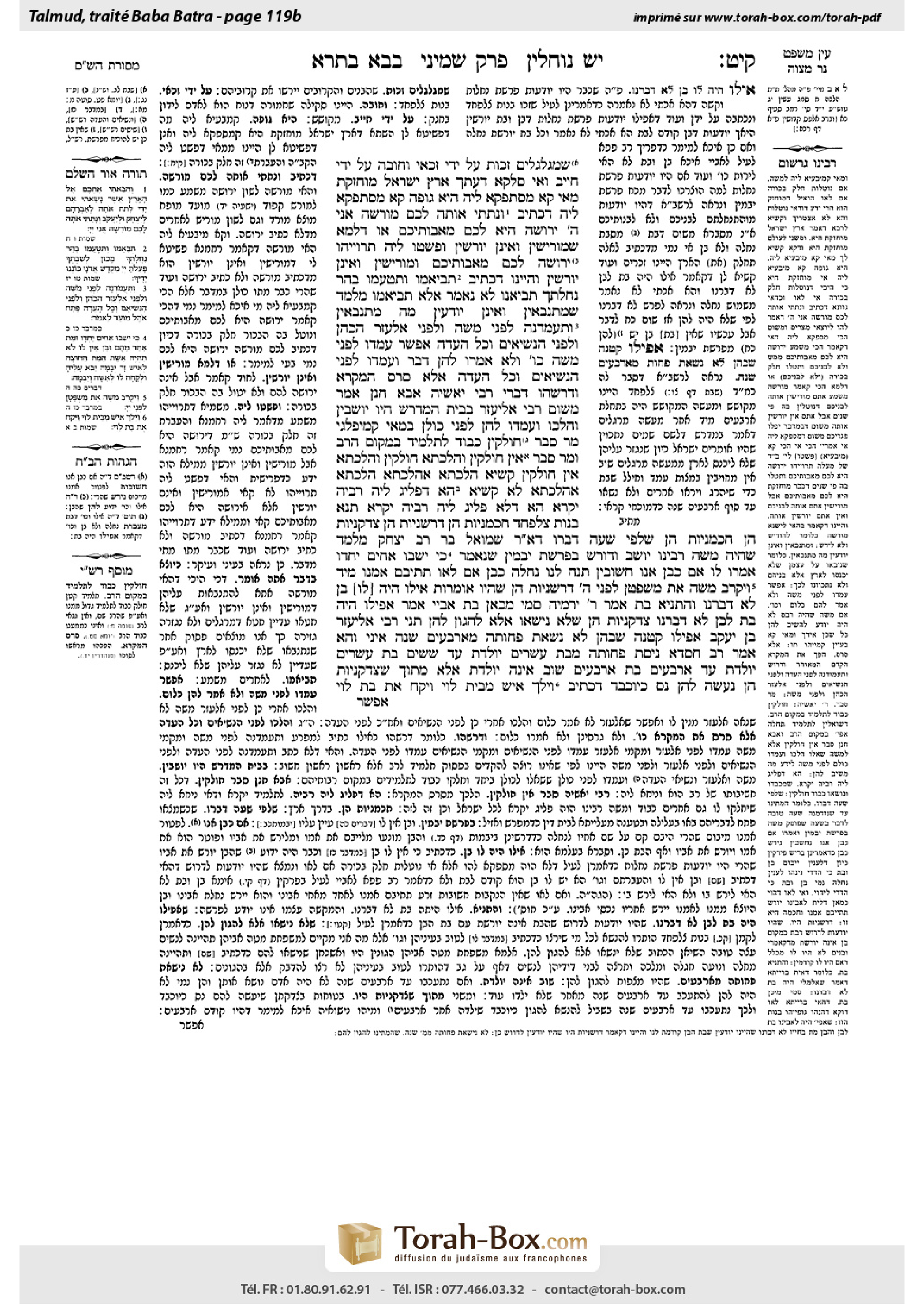
Bava Batra 119b: Talmud study for Daf Yomi
Study the Talmud for Daf Yomi with scanned pages, Hebrew text, English translations from Sefaria and AI-generated French translations.
Passage selection and English or AI-generated French translation are available where the scan has annotations. Daf Study is independent of Torah-Box and Sefaria.
Browse Bava Batra · בבא בתרא · All tractatesBava Batra 119b text and translations
This page of Bava Batra includes the Aramaic text, an English translation and an AI-generated French translation, alongside the scan above.
בבא בתרא קי״ט ב · Aramaic and Hebrew text
שֶׁמְּגַלְגְּלִים זְכוּת עַל יְדֵי זַכַּאי, וְחוֹבָה עַל יְדֵי חַיָּיב.
וְאִי סָלְקָא דַּעְתָּךְ אֶרֶץ יִשְׂרָאֵל מוּחְזֶקֶת, מַאי קָא מִסְתַּפְּקָא לֵיהּ?
הִיא גּוּפַהּ קָא מִסְתַּפְּקָא לֵיהּ – דִּכְתִיב: ״וְנָתַתִּי אֹתָהּ לָכֶם מוֹרָשָׁה אֲנִי ה׳״ – יְרוּשָּׁה הִיא לָכֶם מֵאֲבוֹתֵיכֶם; אוֹ דִלְמָא, שֶׁמּוֹרִישִׁין וְאֵינָן יוֹרְשִׁין?
וּפְשַׁטוּ לֵיהּ תַּרְוַיְיהוּ: יְרוּשָּׁה לָכֶם מֵאֲבוֹתֵיכֶם, וּמוֹרִישִׁין וְאֵינָן יוֹרְשִׁין. וְהַיְינוּ דִּכְתִיב: ״תְּבִיאֵמוֹ וְתִטָּעֵמוֹ בְּהַר נַחֲלָתְךָ״ – ״תְּבִיאֵנוּ״ לֹא נֶאֱמַר, אֶלָּא ״תְּבִיאֵמוֹ״; מְלַמֵּד שֶׁמִּתְנַבְּאִין, וְאֵינָן יוֹדְעִין מָה מִתְנַבְּאִין.
״וַתַּעֲמֹדְנָה לִפְנֵי מֹשֶׁה וְלִפְנֵי אֶלְעָזָר הַכֹּהֵן וְלִפְנֵי הַנְּשִׂיאִים וְכׇל הָעֵדָה״ – אֶפְשָׁר עָמְדוּ לִפְנֵי מֹשֶׁה כּוּ׳ וְלֹא אָמְרוּ לָהֶן דָּבָר, וְעָמְדוּ לִפְנֵי הַנְּשִׂיאִים וְכׇל הָעֵדָה?!
אֶלָּא סָרֵס הַמִּקְרָא וְדׇרְשֵׁהוּ, דִּבְרֵי רַבִּי יֹאשִׁיָּה. אַבָּא חָנָן אָמַר מִשּׁוּם רַבִּי אֱלִיעֶזֶר: בְּבֵית הַמִּדְרָשׁ הָיוּ יוֹשְׁבִין, וְהָלְכוּ וְעָמְדוּ לָהֶן לִפְנֵי כּוּלָּן.
בְּמַאי קָמִיפַּלְגִי? מָר סָבַר: חוֹלְקִין כָּבוֹד לְתַלְמִיד בִּמְקוֹם הָרַב, וּמַר סָבַר: אֵין חוֹלְקִין.
וְהִלְכְתָא: חוֹלְקִין, וְהִלְכְתָא: אֵין חוֹלְקִין. קַשְׁיָא הִלְכְתָא אַהִלְכְתָא! הִלְכְתָא אַהִלְכְתָא לָא קַשְׁיָא – הָא דִּפְלִיג לֵיהּ רַבֵּיהּ יְקָרָא, הָא דְּלָא פְּלִיג לֵיהּ רַבֵּיהּ יְקָרָא.
תָּנָא: בְּנוֹת צְלָפְחָד חַכְמָנִיּוֹת הֵן, דַּרְשָׁנִיּוֹת הֵן, צִדְקָנִיּוֹת הֵן.
חַכְמָנִיּוֹת הֵן – שֶׁלְּפִי שָׁעָה דִּבְּרוּ. דְּאָמַר רַבִּי שְׁמוּאֵל בַּר רַב יִצְחָק: מְלַמֵּד שֶׁהָיָה מֹשֶׁה רַבֵּינוּ יוֹשֵׁב וְדוֹרֵשׁ בְּפָרָשַׁת יְבָמִין, שֶׁנֶּאֱמַר: ״כִּי יֵשְׁבוּ אַחִים יַחְדָּו״. אָמְרוּ לוֹ: אִם כְּבֵן אָנוּ חֲשׁוּבִין – תְּנָה לָנוּ נַחֲלָה כְּבֵן; אִם לָאו – תִּתְיַבֵּם אִמֵּנוּ! מִיָּד – ״וַיַּקְרֵב מֹשֶׁה אֶת מִשְׁפָּטָן לִפְנֵי ה׳״.
דַּרְשָׁנִיּוֹת הֵן – שֶׁהָיוּ אוֹמְרוֹת: אִילּוּ הָיָה לוֹ בֵּן, לֹא דִּבַּרְנוּ. וְהָתַנְיָא: ״בַּת״! אָמַר רַבִּי יִרְמְיָה: סְמִי מִכָּאן ״בַּת״. אַבָּיֵי אָמַר: אֲפִילּוּ הָיָה בַּת לַבֵּן – לֹא דִּבַּרְנוּ.
צִדְקָנִיּוֹת הֵן – שֶׁלֹּא נִישְּׂאוּ אֶלָּא לְהָגוּן לָהֶן. תָּנֵי רַבִּי אֱלִיעֶזֶר בֶּן יַעֲקֹב: אֲפִילּוּ קְטַנָּה שֶׁבָּהֶן לֹא נִשֵּׂאת פְּחוּתָה מֵאַרְבָּעִים שָׁנָה.
אִינִי?! וְהָא אָמַר רַב חִסְדָּא: נִיסַּת פְּחוּתָה מִבַּת עֶשְׂרִים – יוֹלֶדֶת עַד שִׁשִּׁים, בַּת עֶשְׂרִים – יוֹלֶדֶת עַד אַרְבָּעִים, בַּת אַרְבָּעִים – שׁוּב אֵינָהּ יוֹלֶדֶת! אֶלָּא מִתּוֹךְ שֶׁצִּדְקָנִיּוֹת הֵן, נַעֲשָׂה לָהֶן נֵס – כְּיוֹכֶבֶד, דִּכְתִיב: ״וַיֵּלֶךְ אִישׁ מִבֵּית לֵוִי, וַיִּקַּח אֶת בַּת לֵוִי״ –
Bava Batra 119b · English translation
that merit is brought about by means of one who is meritorious and liability by means of one who is liable. Accordingly, the daughters of Zelophehad merited that the Torah portion concerning a positive matter be written through them, and the wood gatherer deserved that a portion concerning a negative matter be written through him. This concludes Rabbi Ḥideka’s citation of Rabbi Shimon HaShikmoni.
The Gemara states its objection: And if it enters your mind to say that Eretz Yisrael was already in possession of the Jewish people even before the land was assigned, what was Moses uncertain about with regard to the right of Zelophehad’s daughters to collect a double portion; after all, Hepher’s portion in the land was in his possession, and Zelophehad was the firstborn?
The Gemara answers: This matter itself is what Moses was uncertain about, as it is written: “And I will give it to you for a heritage [morasha]: I am the Lord” (Exodus 6:8). Moses was unsure if the verse should be understood: It is an inheritance [yerusha] for you from your fathers, such that it is considered in the possession of those who left Egypt; or perhaps the verse indicates another matter, that the generation of those who left Egypt bequeath [morishin] the portions to others but they do not inherit [yoreshin] the portions themselves, because they are destined to die in the wilderness.
The Gemara continues: And God resolved the question for him: The verse teaches both of them. It is an inheritance for you from your fathers and is considered in your possession; and also the generation that left Egypt bequeath but they do not inherit. And this is the meaning of that which is written in the song that the Jewish people sang after the splitting of the Red Sea: “You will bring them in, and plant them in the mountain of Your inheritance” (Exodus 15:17). It is not stated: You will bring us in, rather: “You will bring them in,” which teaches that in their song, the Jewish people were prophesying that their generation would never enter Eretz Yisrael, but they did not know what they were prophesying.
§ The Gemara continues its discussion of the incident involving Zelophehad’s daughters. The verse states: “And they stood before Moses, and before Eleazar the priest, and before the princes and all the congregation” (Numbers 27:2). The Gemara asks: Is it possible that Zelophehad’s daughters stood before Moses and then Eleazar to ask their question, and they said nothing to them; and then the daughters stood before the princes and all the congregation to ask them? How would the princes or the congregation know an answer if Moses and Eleazar did not?
The Gemara answers: Rather, transpose the verse and interpret it: First, the daughters went to the congregation and ultimately came to Moses, this is the statement of Rabbi Yoshiya. Abba Ḥanan says in the name of Rabbi Eliezer: Those enumerated in the verse were all sitting in the house of study, and Zelophehad’s daughters went and stood before all of them at once. They were not asked separately; rather, the order of the verse reflects their stature.
The Gemara clarifies: With regard to what do they disagree? One Sage, Abba Ḥanan, holds that one may show honor to a student in the presence of the teacher, such that the verse would mention all the others even though they were in the presence of Moses; and one Sage, Rabbi Yoshiya, holds one may not show honor to a student in the presence of the teacher, such that only Moses would have been mentioned if they were all in the same place.
The Gemara concludes: And the halakha is that one may show honor to a student, and the halakha is that one may not show honor. The Gemara asks: This is difficult, as there is a contradiction between the one halakha and the other halakha. The Gemara answers: The contradiction between the one halakha and the other halakha is not difficult, as this ruling, that one may show honor, was stated where his teacher himself accords the student honor. In such a case, others also may show the student honor. And that ruling, that one may not show honor, was stated where his teacher does not accord him honor.
§ The Sages taught: The daughters of Zelophehad are wise, they are interpreters of verses, and they are righteous.
The Gemara proves these assertions. That they are wise can be seen from the fact that they spoke in accordance with the moment, i.e., they presented their case at an auspicious time. As Rabbi Shmuel bar Rav Yitzḥak says: Tradition teaches that Moses our teacher was sitting and interpreting in the Torah portion about men whose married brothers had died childless, as it is stated: “If brothers dwell together, and one of them dies, and has no child, the wife of the dead shall not be married abroad to one not of his kin; her husband’s brother shall come to her, and take her for him as a wife” (Deuteronomy 25:5). The daughters of Zelophehad said to Moses: If we are each considered like a son, give us each an inheritance like a son; and if not, our mother should enter into levirate marriage. Immediately upon hearing their claim, the verse records: “And Moses brought their cause before the Lord” (Numbers 27:5).
That they are interpreters of verses can be seen from the fact that they were saying: If our father had had a son, we would not have spoken; but because he had no son, we are filling the role of the heir. The Gemara asks: But isn’t it taught in a baraita: They would say, if he had had a daughter, we would not have spoken? Rabbi Yirmeya said: Delete from the baraita here the word: Daughter. As they were themselves daughters, this cannot have been their claim. Abaye said that the baraita need not be emended, and should be understood as follows: Even if there was a daughter of a son of Zelophehad, we would not have spoken, for she would have been the heir.
That they are righteous can be seen from the fact that they did not rush to marry, but rather waited to marry those fit for them. Rabbi Eliezer ben Ya’akov teaches: Even the youngest to be married among them was not married at less than forty years of age.
The Gemara asks: Is that so? But doesn’t Rav Ḥisda say: If a woman marries when she is less than twenty years old, she is able to give birth until she reaches the age of sixty; if she marries when she is twenty years old or older, she is able to give birth until she reaches the age of forty; if she marries when she is forty years old or older, she is no longer able to give birth at all. If so, how could Zelophehad’s daughters have waited until the age of forty to marry? Rather, since they are righteous women, a miracle was performed for them, like the one done for Jochebed. As it is written: “And a man of the house of Levi went, and took as a wife a daughter of Levi” (Exodus 2:1).
Bava Batra 119b · Traduction française (IA)
que la mérite est obtenue par celui qui est méritoire et la responsabilité par celui qui est responsable. Ainsi, les filles de Zelophehad méritèrent que la portion de la Torah concernant une obligation positive soit écrite à travers elles, et le ramasseur de bois méritait que une portion concernant une interdiction soit écrite à travers lui. Cela conclut la citation du maître Ḥideka sur Rabbi Shimon HaShikmoni.
Le Guemara formule son objection : Et si cela entre dans votre pensée de dire que la Terre d'Israël était déjà en possession du peuple juif même avant que la terre ne soit assignée, que Moïse était incertain à propos du droit des filles de Zelophehad à réclamer une portion double ; après tout, la portion de Hepher dans la terre était en son possession, et Zelophehad était le premier-né ?
Le Guemara répond : Cette question même est ce que Moïse était incertain, car il est écrit : « Et je vous donnerai pour héritage [morasha] : je suis le Seigneur » (Exode 6:8). Moïse ne savait pas si cette verset devait être compris comme : C'est une héritage [yerusha] pour vous de vos pères, de sorte qu'il est considéré comme en possession de ceux qui sont sortis d'Egypte ; ou peut-être ce verset indique une autre chose, que la génération qui est sortie d'Egypte transmet [morishin] les portions à d'autres mais ne les hérite [yoreshin] pas eux-mêmes, car ils sont destinés à mourir dans le désert.
Le Guemara continue : Et Dieu a résolu la question pour lui : le verset enseigne les deux. C'est une héritage pour vous de vos pères et est considéré comme en votre possession ; et aussi la génération qui est sortie d'Égypte transmet mais ne hérite pas. Et c'est la signification de ce qui est écrit dans la chanson que le peuple juif a chanté après la division de la Mer Rouge : « Vous entrerez, et planterez dans la montagne de votre héritage » (Exode 15:17). Il n'est pas dit : « Vous entrerez », mais : « Vous entrerez », ce qui enseigne que dans leur chanson, le peuple juif prophétisait que leur génération ne rentrerait jamais en Terre d'Israël, mais ils ne savaient pas ce qu'ils prophétisaient.
§ Le Guemara continue sa discussion sur l'incident des filles de Zelophehad. Le verset dit : « Et elles se présentèrent devant Moïse, et devant Eléazar le prêtre, et devant les chefs et toute la congrégation » (Nombres 27:2). Le Guemara demande : Est-ce possible que les filles de Zelophehad se soient présentées devant Moïse et ensuite devant Eléazar pour poser leur question, et qu'elles n'aient rien dit à eux ; et ensuite les filles se soient présentées devant les chefs et toute la congrégation pour poser leur question ? Comment les chefs ou la congrégation pourraient-ils connaître une réponse si Moïse et Eléazar n'étaient pas là ?
Le Guemara répond : Plutôt, transposez le verset et interprétez-le : d'abord, les filles allèrent à la congrégation et finalement vinrent à Moïse, c'est la déclaration de Rabbi Yoshiya. Abba Ḥanan dit en nom de Rabbi Eliezer : ceux énumérés dans le verset étaient tous assis dans la maison d'étude, et les filles de Zelophehad allèrent et se présentèrent devant tous en même temps. Elles n'ont pas été interrogées séparément ; plutôt, l'ordre du verset reflète leur statut.
Le Guemara clarifie : à propos de quoi discutent-ils ? Un sage, Abba Ḥanan, maintient qu'on peut montrer de l'honneur à un élève en présence de son maître, de sorte que le verset mentionnerait tous les autres même s'ils étaient en présence de Moïse ; et un sage, Rabbi Yoshiya, maintient qu'on ne peut pas montrer de l'honneur à un élève en présence de son maître, de sorte que seul Moïse serait mentionné s'ils étaient tous dans le même lieu.
Le Guemara conclut : la halakha est que l'on peut montrer de l'honneur à un élève, et la halakha est que l'on ne peut pas montrer de l'honneur. Le Guemara demande : cela est difficile, car il y a une contradiction entre l'une et l'autre halakha. Le Guemara répond : la contradiction entre l'une et l'autre halakha n'est pas difficile, car cette décision, que l'on peut montrer de l'honneur, a été émise là où son maître lui-même accorde l'honneur à l'élève. Dans ce cas, d'autres peuvent aussi montrer l'honneur à l'élève. Et cette décision, que l'on ne peut pas montrer de l'honneur, a été émise là où son maître ne lui accorde pas l'honneur.
§ Les Sages enseignèrent : les filles de Zelophehad sont sages, interprètes de versets et justes.
Le Guemara démontre ces affirmations. Que ce sont des sages peut être vu du fait qu'elles parlaient en temps opportun, c'est-à-dire qu'elles présentaient leur cas à un moment favorable. Comme dit Rabbi Shmuel bar Rav Yitzḥak : la tradition enseigne que notre maître Moïse était assis et interprétait la portion de la Torah concernant les hommes dont les frères épousés avaient eu des enfants morts, comme il est dit : « Si des frères habitent ensemble, et qu'un d'entre eux meurt et n'a pas d'enfant, la femme du défunt ne sera pas mariée à un étranger ; son frère épousé viendra à elle et la prendra pour lui comme épouse » (Deutéronome 25:5). Les filles de Zelophehad dirent à Moïse : Si nous sommes chacune considérées comme un fils, donnez-nous chacune une part d'héritage comme un fils ; et si non, notre mère devrait entrer en levirate. Aussitôt que Moïse entendit leur revendication, le verset enregistre : « Et Moïse présenta leur cause devant le Seigneur » (Nombres 27:5).
Que ce sont des interprètes des versets peut être vu du fait qu'elles disaient : Si notre père avait eu un fils, nous n'aurions pas parlé ; mais parce qu'il n'avait pas de fils, nous remplissons le rôle de l'héritier. Le Guemara demande : Mais n'est-ce pas enseigné dans une baraïta : Ils disaient, si il avait eu une fille, nous n'aurions pas parlé ? Rabbi Yirmeya dit : supprimez le mot « fille » dans la baraïta. Comme elles étaient elles-mêmes des filles, cela ne pouvait pas être leur revendication. Abaye dit que la baraïta n'a pas besoin d'être corrigée, et devrait être comprise ainsi : même s'il y avait une fille d'un fils de Zelophehad, nous n'aurions pas parlé, car elle serait l'héritière.
On peut voir qu'ils sont justes du fait qu'ils n'ont pas couru se marier, mais ont attendu de se marier avec ceux qui leur convenaient. Rabbi Eliezer ben Ya'akov enseigne : Même le plus jeune parmi eux à être marié n'a pas été marié avant l'âge de quarante ans.
La Guemara demande : C'est ainsi ? Mais ne dit pas Rav Ḥisda : Si une femme se marie avant l'âge de vingt ans, elle peut accoucher jusqu'à l'âge de soixante ans ; si elle se marie à l'âge de vingt ans ou plus, elle peut accoucher jusqu'à l'âge de quarante ans ; si elle se marie à l'âge de quarante ans ou plus, elle ne peut plus accoucher du tout. Si c'est ainsi, comment les filles de Zelophehad ont-elles pu attendre l'âge de quarante ans pour se marier ? Plutôt, puisqu'elles sont des femmes justes, un miracle a été accompli pour elles, comme celui accompli pour Jochebed. Comme il est écrit : « Et un homme de la maison de Lévi alla prendre pour épouse une fille de Lévi » (Exode 2:1).
Traduction française générée par IA à partir de l’édition anglaise de Sefaria. Vérifie toujours un passage avec le texte source.
Text from Sefaria: William Davidson Edition - Vocalized Aramaic (CC BY NC); William Davidson Edition - English (CC BY NC).