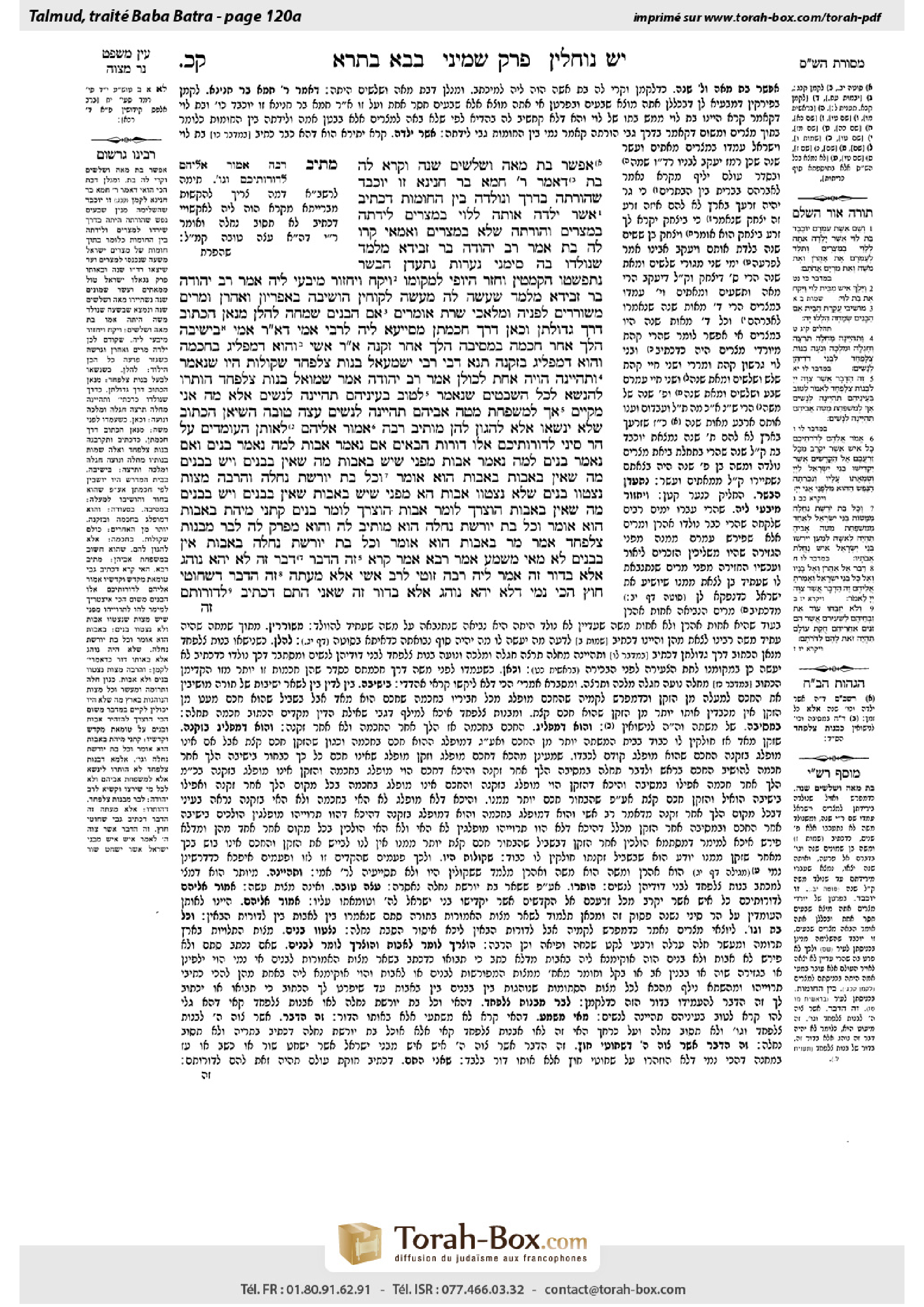
Bava Batra 120a: Talmud study for Daf Yomi
Study the Talmud for Daf Yomi with scanned pages, Hebrew text, English translations from Sefaria and AI-generated French translations.
Passage selection and English or AI-generated French translation are available where the scan has annotations. Daf Study is independent of Torah-Box and Sefaria.
Browse Bava Batra · בבא בתרא · All tractatesBava Batra 120a text and translations
This page of Bava Batra includes the Aramaic text, an English translation and an AI-generated French translation, alongside the scan above.
בבא בתרא ק״כ א · Aramaic and Hebrew text
אֶפְשָׁר בַּת מֵאָה וּשְׁלֹשִׁים שָׁנָה, וְקֹרֵא לָהּ: ״בַּת״?! דְּאָמַר רַבִּי חָמָא בַּר חֲנִינָא: זוֹ יוֹכֶבֶד; שֶׁהוֹרָתָהּ בַּדֶּרֶךְ, וְנוֹלְדָה בֵּין הַחוֹמוֹת – דִּכְתִיב: ״אֲשֶׁר יָלְדָה אֹתָהּ לְלֵוִי בְּמִצְרָיִם״ –
לֵידָתָהּ בְּמִצְרַיִם, וְהוֹרָתָהּ שֶׁלֹּא בְּמִצְרַיִם. וְאַמַּאי קָרוּ לַהּ ״בַּת״? אָמַר רַב יְהוּדָה בַּר זְבִידָא: מְלַמֵּד שֶׁנּוֹלְדוּ בָּהּ סִימָנֵי נַעֲרוּת, נִתְעַדֵּן הַבָּשָׂר, נִתְפַּשְּׁטוּ הַקְּמָטִין, וְחָזַר הַיּוֹפִי לִמְקוֹמוֹ.
״וַיִּקַּח״?! ״וַיַּחְזוֹר״ מִיבְּעֵי לֵיהּ! אָמַר רַב יְהוּדָה בַּר זְבִידָא: מְלַמֵּד שֶׁעָשָׂה לָהּ מַעֲשֵׂה לִקּוּחִין – הוֹשִׁיבָה בְּאַפִּרְיוֹן, וְאַהֲרֹן וּמִרְיָם מְשׁוֹרְרִים לְפָנֶיהָ, וּמַלְאֲכֵי שָׁרֵת אוֹמְרִים: ״אֵם הַבָּנִים שִׂמְחָה״.
לְהַלָּן מְנָאָן הַכָּתוּב דֶּרֶךְ גְּדוּלָּתָן, וְכָאן דֶּרֶךְ חׇכְמָתָן; מְסַיְּיעָא לֵיהּ לְרַבִּי אַמֵּי, דְּאָמַר רַבִּי אַמֵּי: בִּישִׁיבָה – הַלֵּךְ אַחַר חׇכְמָה. בִּמְסִיבָּה – הַלֵּךְ אַחַר זִקְנָה. אָמַר רַב אָשֵׁי: וְהוּא דְּמַפְלַיג בְּחׇכְמָה, וְהוּא דְּמַפְלַיג בְּזִקְנָה.
תָּנָא דְּבֵי רַבִּי יִשְׁמָעֵאל: בְּנוֹת צְלָפְחָד שְׁקוּלוֹת הָיוּ, שֶׁנֶּאֱמַר: ״וַתִּהְיֶינָה״ – הֲוָיָה אַחַת לְכוּלָּן.
אָמַר רַב יְהוּדָה אָמַר שְׁמוּאֵל: בְּנוֹת צְלָפְחָד הוּתְּרוּ לְהִנָּשֵׂא לְכׇל הַשְּׁבָטִים, שֶׁנֶּאֱמַר: ״לַטּוֹב בְּעֵינֵיהֶם תִּהְיֶינָה לְנָשִׁים״; אֶלָּא מָה אֲנִי מְקַיֵּים ״אַךְ לְמִשְׁפַּחַת מַטֵּה אֲבִיהֶם תִּהְיֶינָה לְנָשִׁים״? עֵצָה טוֹבָה הִשִּׂיאָן הַכָּתוּב, שֶׁלֹּא יִנָּשְׂאוּ אֶלָּא לְהָגוּן לָהֶן.
מוֹתֵיב רַבָּה: ״אֱמוֹר אֲלֵיהֶם״ – לְאוֹתָן הָעוֹמְדִים עַל הַר סִינַי, ״לְדֹרֹתֵיכֶם״ – אֵלּוּ דּוֹרוֹת הַבָּאִים. אִם נֶאֱמַר אָבוֹת – לָמָּה נֶאֱמַר בָּנִים? וְאִם נֶאֱמַר בָּנִים – לָמָּה נֶאֱמַר אָבוֹת? מִפְּנֵי שֶׁיֵּשׁ בָּאָבוֹת מַה שֶּׁאֵין בַּבָּנִים, וְיֵשׁ בַּבָּנִים מַה שֶּׁאֵין בָּאָבוֹת –
בָּאָבוֹת הוּא אוֹמֵר: ״וְכׇל בַּת יֹרֶשֶׁת נַחֲלָה״; וְהַרְבֵּה מִצְוֹת נִצְטַוּוּ בָּנִים, שֶׁלֹּא נִצְטַוּוּ אָבוֹת. הָא מִפְּנֵי שֶׁיֵּשׁ בָּאָבוֹת שֶׁאֵין בַּבָּנִים, וְיֵשׁ בַּבָּנִים מַה שֶּׁאֵין בָּאָבוֹת – הוּצְרַךְ לוֹמַר אָבוֹת, הוּצְרַךְ לוֹמַר בָּנִים.
קָתָנֵי מִיהַת, בָּאָבוֹת הוּא אוֹמֵר: ״וְכׇל בַּת יֹרֶשֶׁת נַחֲלָה״! הוּא מוֹתֵיב לַהּ וְהוּא מְפָרֵק לַהּ – לְבַר מִבְּנוֹת צְלָפְחָד.
אָמַר מָר, בָּאָבוֹת הוּא אוֹמֵר: ״וְכׇל בַּת יוֹרֶשֶׁת נַחֲלָה״ – בָּאָבוֹת אִין, בַּבָנִים לָא. מַאי מַשְׁמַע? אָמַר רָבָא, אָמַר קְרָא: ״זֶה הַדָּבָר״ – דָּבָר זֶה לֹא יְהֵא נוֹהֵג אֶלָּא בְּדוֹר זֶה.
אֲמַר לֵיהּ רַבָּה זוּטֵי לְרַב אָשֵׁי: אֶלָּא מֵעַתָּה, ״זֶה הַדָּבָר״ דִּשְׁחוּטֵי חוּץ – הָכִי נָמֵי דְּלָא יְהֵא נוֹהֵג אֶלָּא בְּדוֹר זֶה? שָׁאנֵי הָתָם, דִּכְתִיב: ״לְדֹרֹתָם״.
Bava Batra 120a · English translation
The Gemara asks: Is it possible that this is Jochebed? Jochebed was then 130 years old and the verse called her a daughter, indicating one who is very young. Jochebed’s age is established based on a tradition concerning the number of Jacob’s descendants who came to Egypt, as follows: While the verse states that Leah had thirty-three descendants (Genesis 46:15), only thirty-two were enumerated. This was explained as Rabbi Ḥama bar Ḥanina says: This “daughter of Levi” is Jochebed, whose conception occurred on the journey as the family of Jacob descended to Egypt, and she was born within the walls, i.e., having entered Egypt, as it is written: “And the name of Amram’s wife was Jochebed, the daughter of Levi, who was born to Levi in Egypt” (Numbers 26:59).
One can infer from the verse: Her birth was in Egypt, but her conception was not in Egypt. Since the Jewish people were in Egypt for 210 years and Moses was eighty years old at the time of the Exodus, Jochebed must have been 130 years old when Moses was born. The Gemara therefore asks: And why does the verse call her “a daughter”? Rav Yehuda bar Zevida says: This teaches that her signs of youth miraculously came into being again. The flesh became smooth, the wrinkles were straightened out, and the youthful beauty returned to its place.
The verse concerning Amram’s marriage to Jochebed states: “And a man of the house of Levi went, and took as a wife a daughter of Levi” (Exodus 2:1). The Gemara asks: Since Jochebed had already been married to Amram for some years, as Miriam and Aaron were already born, the verse should have stated: And he took back as a wife. Rav Yehuda bar Zevida says: The wording of the verse teaches that Amram performed for her a formal act of marriage as though he were marrying her for the first time. He seated her in a bridal palanquin [be’appiryon], and Aaron and Miriam were singing before her, and the ministering angels were saying: “A joyful mother of children” (Psalms 113:9).
§ The Gemara returns to discuss Zelophehad’s daughters: Later on, the verse lists them according to their age, stating: “For Mahlah, Tirzah, and Hoglah, and Milcah, and Noah, the daughters of Zelophehad, were married” (Numbers 36:11), and here the verse lists them in a different order, according to their wisdom: “And these are the names of his daughters: Mahlah, Noah, and Hoglah, and Milcah, and Tirzah” (Numbers 27:1). This supports the ruling of Rabbi Ami, as Rabbi Ami says: In the context of sitting in judgment or learning Torah, follow the participants’ wisdom in determining the seating, so that the wisest is granted the highest honor, and in the context of reclining for a meal, follow the participants’ age. Rav Ashi says: And this is so only when one is outstanding in wisdom, then wisdom trumps age; and this is so only when one of the participants is outstanding in age, i.e., particularly old, then age trumps wisdom.
The Gemara cites an alternative opinion: The school of Rabbi Yishmael taught: The daughters of Zelophehad were equal in stature, as it is stated: “For Mahlah, Tirzah, and Hoglah, and Milcah, and Noah, the daughters of Zelophehad, were [vatihyena] married.” The word “vatihyena” demonstrates: There was one uniform existence [havaya], i.e., spiritual level, for all of them.
§ Rav Yehuda says that Shmuel says: The daughters of Zelophehad were permitted to marry members of any of the tribes, as it is stated: “Let them be married to whom they think best” (Numbers 36:6). But how do I realize the meaning of the continuation of the same verse: “Only into the family of the tribe of their father shall they be married” (Numbers 36:6), according to which they were permitted to marry only members of their own tribe? The verse offered them good advice, that they should be married only to those fit for them, who were often men from within the family.
Rabba raised an objection from a baraita taught concerning the prohibition against eating consecrated foods while in a state of ritual impurity. Moses was commanded: “Say to them: Whoever will be of all your descendants throughout your generations, who approaches to the holy things, which the children of Israel consecrate to the Lord, having his uncleanness upon him, that soul shall be cut off from before Me” (Leviticus 22:3). Which people are referred to in the phrase “say to them”? It is referring to those standing at Mount Sinai. Which people are referred to in the phrase “throughout your generations”? These are the coming generations. If the halakha is stated to the fathers, why is it stated to the sons; and if the halakha is stated to the sons, why is it stated to the fathers? This is because there are mitzvot for the fathers that are not for the sons, and there are mitzvot for the sons that are not for the fathers.
The baraita continues: For the fathers, the verse states: “And every daughter who possesses an inheritance from the tribes of the children of Israel, shall be wife to one of the family of the tribe of her father” (Numbers 36:8). This mitzva, that the woman should marry a member of her own tribe, applied only to the first generation that received tribal portions of Eretz Yisrael. And, by contrast, there were many mitzvot, e.g., all the mitzvot that applied only from the time that Eretz Yisrael was settled, which the sons were commanded to fulfill but which the fathers were not commanded to fulfill. Because there are mitzvot for the fathers that are not for the sons, and there are mitzvot for the sons that are not for the fathers, the verse needed to state, i.e., to address, the fathers, and it needed to state, i.e., to address, the sons.
Rabba states his objection: In any event, the baraita teaches: For the fathers, the verse states: “And every daughter who possesses an inheritance from the tribes of the children of Israel, shall be wife to one of the family of the tribe of her father.” This indicates that this was a mitzva for that entire generation, including Zelophehad’s daughters, in contrast to the statement of Shmuel. The Gemara explains: He, Rabba, raised the objection, and he resolved it: This mitzva applied to everyone except for the daughters of Zelophehad, who were explicitly permitted to marry members of any tribe.
The Master says in the baraita cited above: For the fathers, the verse states: “And every daughter who possesses an inheritance from the tribes of the children of Israel, shall be wife to one of the family of the tribe of her father.” For the fathers, yes, this is the mitzva, but for the sons, it is not so. The Gemara asks: From where may it be inferred? Rava said that the verse states there: “This is the matter that the Lord has commanded” (Numbers 36:6), meaning: This matter will not be practiced except in this generation.
Rabba Zuti said to Rav Ashi: If that is so, then concerning the phrase “this is the matter” written with regard to an offering slaughtered outside the Tabernacle (see Leviticus 17:2–3), so too, is it the halakha that it will not be practiced except in this generation? Certainly that is not so, as that prohibition applies in all generations. What is the difference between the two passages? Rav Ashi answered: It is different there, with regard to offerings slaughtered outside the Tabernacle or Temple, as it is written: “Throughout their generations” (Leviticus 17:7), indicating that the prohibition is in effect in all generations.
Bava Batra 120a · Traduction française (IA)
Le Guemara pose la question : Est-ce possible que ce soit Jochebed ? Jochebed avait alors 130 ans et la versette l'appelait une fille, indiquant quelqu'un très jeune. L'âge de Jochebed est établi grâce à une tradition concernant le nombre de descendants de Jacob qui sont arrivés en Égypte, comme suit : Bien que la versette indique que Léa avait trente-trois descendants (Genèse 46:15), seulement trente-deux furent énumérés. Cela a été expliqué par Rabbi Ḥama bar Ḥanina : Ce « fille de Lévi » est Jochebed, dont la conception s'est produite lors du voyage de la famille de Jacob en Égypte, et elle est née à l'intérieur des murailles, c'est-à-dire après avoir entré en Égypte, comme il est écrit : « Et le nom de l'épouse d'Amran était Jochebed, la fille de Lévi, qui fut née à Lévi en Égypte » (Nombres 26:59).
On peut en déduire de la versette : Son naissance fut en Égypte, mais sa conception ne fut pas en Égypte. Puisque le peuple juif était en Égypte pendant 210 ans et que Moïse avait 80 ans à l'époque de l'Exode, Jochebed devait avoir 130 ans lors de la naissance de Moïse. Le Guemara pose donc la question : Et pourquoi la versette l'appelle-t-elle « une fille » ? Rav Yehuda bar Zevida dit : Cela enseigne que ses signes de jeunesse se sont miraculeusement rétablis. La chair est devenue lisse, les rides se sont redressées et la beauté juvénile est revenue à sa place.
La versette concernant le mariage d'Amran avec Jochebed dit : « Et un homme de la maison de Lévi alla, et prit comme épouse une fille de Lévi » (Exode 2:1). Le Guemara pose la question : Puisque Jochebed avait déjà été mariée à Amran pendant plusieurs années, comme Miriam et Aaron étaient déjà nés, la versette aurait dû dire : Et il prit à nouveau comme épouse. Rav Yehuda bar Zevida dit : L'expression de la versette enseigne que Amran a accompli pour elle un acte formel de mariage, comme s'il la mariait pour la première fois. Il l'a assise dans un palanquin nuptial [be’appiryon], et Aaron et Miriam chantaient devant elle, et les anges ministères disaient : « Une mère joyeuse d'enfants » (Psaumes 113:9).
§ Le Guemara reprend la discussion sur les filles de Zelophehad : Plus tard, la versette liste leurs noms selon leur âge, en disant : « Car Mahlah, Tirzah, et Hoglah, et Milcah, et Noah, les filles de Zelophehad, furent mariées » (Nombres 36:11), et ici la versette les liste dans un ordre différent, selon leur sagesse : « Et ces sont les noms de ses filles : Mahlah, Noah, et Hoglah, et Milcah, et Tirzah » (Nombres 27:1). Cela soutient la décision de Rabbi Ami, car Rabbi Ami dit : Dans le contexte de la décision ou de l'apprentissage de la Torah, on suit la sagesse des participants pour déterminer l'ordre de leur siège, de sorte que celui qui est le plus sage soit honoré, et dans le contexte de la dégustation d'un repas, on suit l'âge des participants. Rav Ashi dit : Et cela est ainsi seulement lorsque l'on est exceptionnellement sage, alors la sagesse l'emporte sur l'âge ; et cela est ainsi seulement lorsque l'un des participants est particulièrement âgé, alors l'âge l'emporte sur la sagesse.
Le Guemara cite un avis alternatif : La maison de Rabbi Yishmael enseignait : Les filles de Zelophehad étaient égales en stature, comme il est dit : « Pour Mahlah, Tirzah, et Hoglah, et Milcah, et Noah, les filles de Zelophehad, furent [vatihyena] mariées ». Le mot « vatihyena » démontre : Il y avait une existence unique [havaya], c'est-à-dire un niveau spirituel, pour toutes d'entre elles.
§ Rav Yehuda dit que Shmuel dit : Les filles de Zelophehad étaient autorisées à se marier avec des membres de n'importe quelle tribu, comme il est dit : « Qu'elles soient mariées à celui qu'elles jugent bon » (Nombres 36:6). Mais comment puis-je comprendre le sens de la continuation de la même versette : « Seulement dans la famille du clan de leur père devront-elles être mariées » (Nombres 36:6), selon lequel elles étaient autorisées à se marier uniquement avec des membres de leur propre tribu ? La versette leur offrait un bon conseil, qu'elles devaient être mariées uniquement avec ceux qui étaient appropriés, qui étaient souvent des hommes de leur propre famille.
Rabba a soulevé un objet à partir d'une baraïta concernant l'interdiction de manger des aliments consacrés lors d'un état d'impureté rituelle. Moïse a été commandé : « Dis-leur : Quiconque de tous vos descendants, à travers vos générations, approchera des choses saintes, qui sont consacrés par les enfants d'Israël au Seigneur, ayant sa souillure sur lui, cette âme sera coupée de devant moi » (Lévitique 22:3). Quel peuple est mentionné dans la phrase « dis-leur » ? C'est celui qui était présent au Mont Sinaï. Quel peuple est mentionné dans la phrase « à travers vos générations » ? Ce sont les générations futures. Si la halakha est déclarée aux pères, pourquoi est-elle déclarée aux fils ; et si la halakha est déclarée aux fils, pourquoi est-elle déclarée aux pères ? C'est parce qu'il y a des commandements pour les pères qui ne sont pas pour les fils, et des commandements pour les fils qui ne sont pas pour les pères.
La baraïta continue : Pour les pères, la versette dit : « Et toute fille qui possède une héritage des tribus des enfants d'Israël, sera épouse à l'un des membres de la famille du clan de son père » (Nombres 36:8). Cette mitsva, que la femme doive se marier avec un membre de sa propre tribu, s'appliquait uniquement à la première génération qui a reçu des portions de la Terre d'Israël. En revanche, il y avait de nombreux commandements, par exemple tous les commandements qui s'appliquaient à partir du moment où la Terre d'Israël était habitée, qui étaient commandés aux fils mais pas aux pères. Puisque des commandements existent pour les pères qui ne sont pas pour les fils, et des commandements existent pour les fils qui ne sont pas pour les pères, la versette avait besoin de déclarer, c'est-à-dire d'adresser, aux pères, et elle avait besoin de déclarer, c'est-à-dire d'adresser, aux fils.
Rabba énonce son objection : En tout cas, la baraïta enseigne : Pour les pères, la versette dit : « Et toute fille qui possède une héritage des tribus des enfants d'Israël, sera épouse à l'un des membres de la famille du clan de son père ». Cela indique que cette mitsva s'appliquait à toute cette génération, y compris les filles de Zelophehad, contrairement à l'affirmation de Shmuel. Le Guemara explique : Il, Rabba, a soulevé l'objection, et il l'a résolue : Cette mitsva s'appliquait à tous sauf les filles de Zelophehad, qui étaient explicitement autorisées à se marier avec des membres de toute tribu.
Le Maître dit dans la baraïta citée ci-dessus : Concernant les pères, la Parashah stipule : « Et toute fille qui possède une héritage parmi les tribus des enfants d'Israël, sera épouse à l'un des membres de la famille de la tribu de son père. » Concernant les pères, oui, c'est la Mitsva, mais concernant les fils, ce n'en est pas ainsi. La Guemara demande : D'où peut-on en déduire cela ? Rava dit que la Parashah stipule là : « C'est la chose que l'Éternel a commandée » (Nombres 36:6), c'est-à-dire : Cette chose ne sera pas pratiquée qu'à cette génération.
Rabba Zuti dit à Rav Ashi : Si c'est ainsi, alors concernant la phrase « c'est la chose » écrite en rapport avec un holocauste sacrifié en dehors du Tabernacle (voir Lévitique 17:2–3), est-ce que la halakha est aussi que cela ne sera pas pratiqué qu'à cette génération ? Certainement que non, car cette interdiction s'applique à toutes les générations. Quelle est la différence entre les deux passages ? Rav Ashi répondit : Il y a une différence là, concernant les holocaustes sacrifiés en dehors du Tabernacle ou du Temple, car il est écrit : « Dans toutes leurs générations » (Lévitique 17:7), indiquant que l'interdiction est en vigueur dans toutes les générations.
Traduction française générée par IA à partir de l’édition anglaise de Sefaria. Vérifie toujours un passage avec le texte source.
Text from Sefaria: William Davidson Edition - Vocalized Aramaic (CC BY NC); William Davidson Edition - English (CC BY NC).