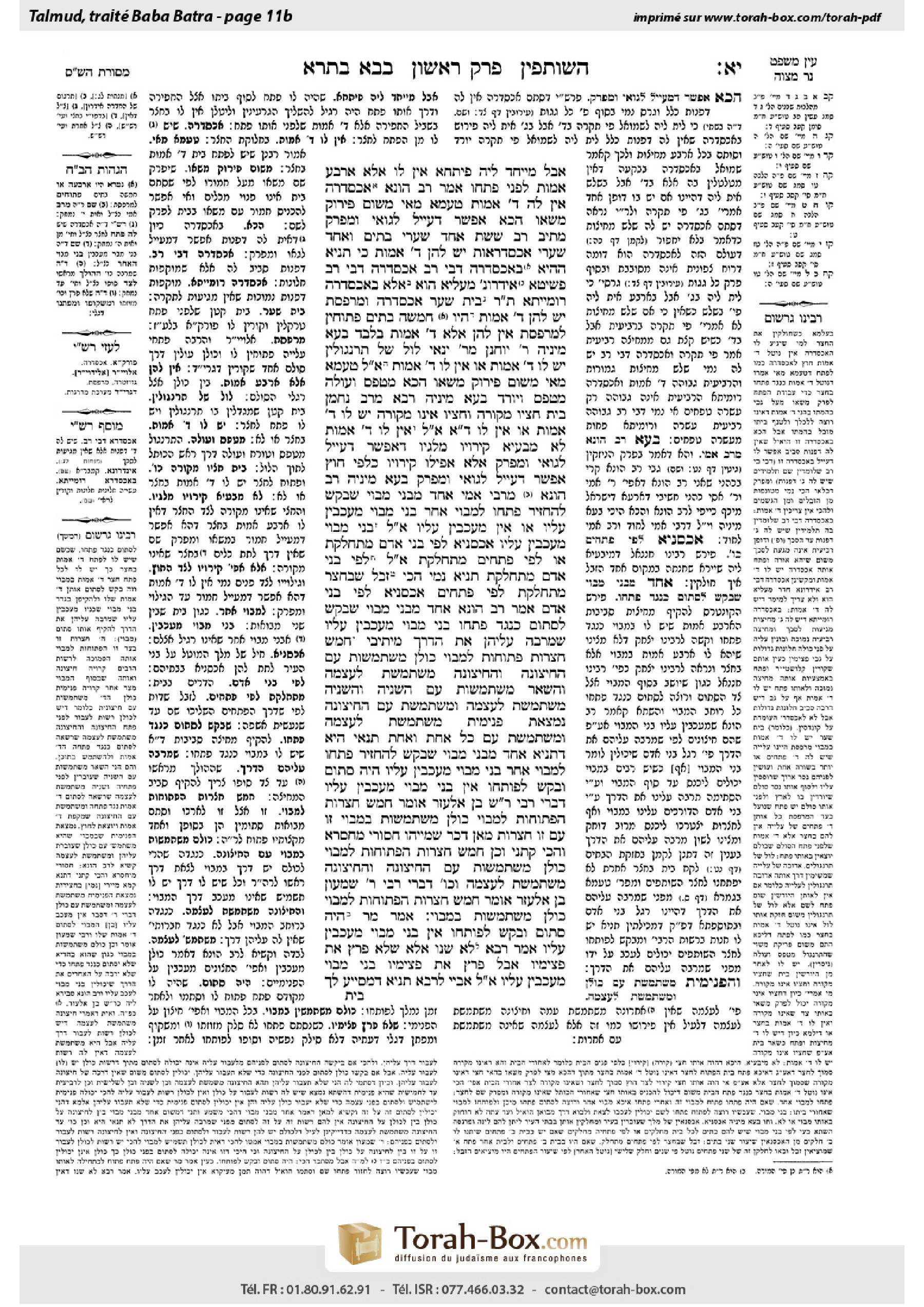
Bava Batra 11b: Talmud study for Daf Yomi
Study the Talmud for Daf Yomi with scanned pages, Hebrew text, English translations from Sefaria and AI-generated French translations.
Passage selection and English or AI-generated French translation are available where the scan has annotations. Daf Study is independent of Torah-Box and Sefaria.
Browse Bava Batra · בבא בתרא · All tractatesBava Batra 11b text and translations
This page of Bava Batra includes the Aramaic text, an English translation and an AI-generated French translation, alongside the scan above.
בבא בתרא י״א ב · Aramaic and Hebrew text
אֲבָל מְיַיחַד לֵיהּ פִּיתְחָא – אֵין לוֹ אֶלָּא אַרְבַּע אַמּוֹת לִפְנֵי פִתְחוֹ.
אָמַר רַב הוּנָא: אַכְסַדְרָה – אֵין לָהּ אַרְבַּע אַמּוֹת. טַעְמָא מַאי – מִשּׁוּם פֵּירוּק מַשָּׂאוֹ; הָכָא – אֶפְשָׁר דְּעָיֵיל לְגַוַּאי וּמְפָרַק. מֵתִיב רַב שֵׁשֶׁת: אֶחָד שַׁעֲרֵי בָתִּים, וְאֶחָד שַׁעֲרֵי אַכְסַדְרָאוֹת – יֵשׁ לָהֶן אַרְבַּע אַמּוֹת! כִּי תַּנְיָא הָהִיא, בְּאַכְסַדְרָה דְּבֵי רַב. אַכְסַדְרָה דְּבֵי רַב פְּשִׁיטָא – אִידְּרוֹנָא מְעַלְּיָא הוּא! אֶלָּא בְּאַכְסַדְרָה רוֹמָיְיֹתַא.
תָּנוּ רַבָּנַן: בֵּית שַׁעַר, אַכְסַדְרָה וּמִרְפֶּסֶת – יֵשׁ לָהֶן אַרְבַּע אַמּוֹת. הָיוּ חֲמִשָּׁה בָּתִּים פְּתוּחִין לְמִרְפֶּסֶת – אֵין לָהֶן אֶלָּא אַרְבַּע אַמּוֹת בִּלְבַד. בְּעָא מִינֵּיהּ רַבִּי יוֹחָנָן מֵרַבִּי יַנַּאי: לוּל שֶׁל תַּרְנְגוֹלִין – יֵשׁ לוֹ אַרְבַּע אַמּוֹת, אוֹ אֵין לוֹ אַרְבַּע אַמּוֹת? אֲמַר לֵיהּ: טַעְמָא מַאי – מִשּׁוּם פֵּירוּק מַשָּׂאוֹ; הָכָא – מְטַפֵּס וְעוֹלֶה, מְטַפֵּס וְיוֹרֵד.
בְּעָא מִינֵּיהּ רָבָא מֵרַב נַחְמָן: בַּיִת חֶצְיוֹ מְקוֹרֶה וְחֶצְיוֹ אֵינוֹ מְקוֹרֶה – יֵשׁ לוֹ אַרְבַּע אַמּוֹת, אוֹ אֵין לוֹ אַרְבַּע אַמּוֹת? אֲמַר לֵיהּ: אֵין לוֹ אַרְבַּע אַמּוֹת; לָא מִבַּעְיָא קֵירוּיוֹ מִלְּגָיו – דְּאֶפְשָׁר דְּעָיֵיל לְגַוַּאי וּמְפָרֵק; אֶלָּא אֲפִילּוּ קֵירוּיוֹ כְּלַפֵּי חוּץ – אֶפְשָׁר דְּעָיֵיל לְגַוַּאי וּמְפָרֵק.
בְּעָא מִינֵּיהּ רַב הוּנָא מֵרַבִּי אַמֵּי: אֶחָד מִבְּנֵי מָבוֹי, שֶׁבִּקֵּשׁ לְהַחֲזִיר פִּתְחוֹ לְמָבוֹי אַחֵר – בְּנֵי מָבוֹי מְעַכְּבִין עָלָיו, אוֹ אֵין מְעַכְּבִין עָלָיו? אֲמַר לֵיהּ: בְּנֵי מָבוֹי מְעַכְּבִין עָלָיו.
אַכְסַנְיָא – לְפִי בְּנֵי אָדָם מִתְחַלֶּקֶת, אוֹ לְפִי פְתָחִים מִתְחַלֶּקֶת? אֲמַר לֵיהּ: לְפִי בְּנֵי אָדָם מִתְחַלֶּקֶת. תַּנְיָא נָמֵי הָכִי: זֶבֶל שֶׁבֶּחָצֵר – מִתְחַלֶּקֶת לְפִי פְתָחִים. אַכְסַנְיָא – לְפִי בְּנֵי אָדָם.
אָמַר רַב הוּנָא: אֶחָד מִבְּנֵי מָבוֹי שֶׁבִּקֵּשׁ לִסְתּוֹם כְּנֶגֶד פִּתְחוֹ – בְּנֵי מָבוֹי מְעַכְּבִין עָלָיו, שֶׁמַּרְבֶּה עֲלֵיהֶן אֶת הַדֶּרֶךְ.
מֵיתִיבִי: חָמֵשׁ חֲצֵרוֹת פְּתוּחוֹת לְמָבוֹי – כּוּלָּן מִשְׁתַּמְּשׁוֹת עִם הַחִיצוֹנָה, וְהַחִיצוֹנָה מִשְׁתַּמֶּשֶׁת לְעַצְמָהּ. וְהַשְּׁאָר מִשְׁתַּמְּשׁוֹת עִם הַשְּׁנִיָּה; וְהַשְּׁנִיָּה מִשְׁתַּמֶּשֶׁת לְעַצְמָהּ וּמִשְׁתַּמֶּשֶׁת עִם הַחִיצוֹנָה.
נִמְצֵאת פְּנִימִית מִשְׁתַּמֶּשֶׁת לְעַצְמָהּ, וּמִשְׁתַּמֶּשֶׁת עִם כׇּל אַחַת וְאַחַת.
תַּנָּאֵי הִיא. דְּתַנְיָא: אֶחָד מִבְּנֵי מָבוֹי שֶׁבִּקֵּשׁ לְהַחֲזִיר פִּתְחוֹ לְמָבוֹי אַחֵר – בְּנֵי מָבוֹי מְעַכְּבִין עָלָיו. הָיָה סָתוּם וּבִקֵּשׁ לְפוֹתְחוֹ – אֵין בְּנֵי מָבוֹי מְעַכְּבִין עָלָיו; דִּבְרֵי רַבִּי. רַבִּי שִׁמְעוֹן בֶּן אֶלְעָזָר אוֹמֵר: חָמֵשׁ חֲצֵרוֹת הַפְּתוּחוֹת לְמָבוֹי – כּוּלָּן מִשְׁתַּמְּשׁוֹת בַּמָּבוֹי זוֹ עִם זוֹ.
חֲצֵרוֹת מַאן דְּכַר שְׁמַיְיהוּ? חַסּוֹרֵי מִחַסְּרָא, וְהָכִי קָתָנֵי: וְכֵן חָמֵשׁ חֲצֵרוֹת הַפְּתוּחוֹת לְמָבוֹי – כּוּלָּן מִשְׁתַּמְּשׁוֹת עִם הַחִיצוֹנָה, וְהַחִיצוֹנָה מִשְׁתַּמֶּשֶׁת לְעַצְמָהּ וְכוּ׳; דִּבְרֵי רַבִּי. רַבִּי שִׁמְעוֹן בֶּן אֶלְעָזָר אוֹמֵר: חָמֵשׁ חֲצֵרוֹת הַפְּתוּחוֹת לְמָבוֹי – כּוּלָּם מִשְׁתַּמְּשׁוֹת בַּמָּבוֹי.
אָמַר מָר: הָיָה סָתוּם וּבִקֵּשׁ לְפוֹתְחוֹ – אֵין בְּנֵי מָבוֹי מְעַכְּבִין עָלָיו. אָמַר רָבָא: לֹא שָׁנוּ אֶלָּא שֶׁלֹּא פָּרַץ אֶת פַּצִּימָיו, אֲבָל פָּרַץ אֶת פַּצִּימָיו – בְּנֵי מָבוֹי מְעַכְּבִין עָלָיו. אֲמַר לֵיהּ אַבָּיֵי לְרָבָא, תַּנְיָא דִּמְסַיַּיע לָךְ:
Bava Batra 11b · English translation
But if he designates an entrance leading to this pit and does not approach it from all sides, he has four cubits only in front of his entrance.
Rav Huna says: A portico [akhsadra] that opens onto a courtyard does not have the adjoining four cubits. The Gemara explains: What is the reason that four cubits were granted for each entrance? The four cubits were granted so that the owner would have room for unloading his animal of its burden. Here he can go inside the portico and unload. Rav Sheshet raises an objection from a baraita: Both gates of houses and gates of porticos have the adjoining four cubits for unloading. The Gemara answers: When that baraita is taught, it is specifically with regard to the portico of a study hall, which is closed and is not used for unloading burdens. The Gemara expresses surprise at this answer: It is obvious that this is the halakha governing the portico of a study hall, as it is a proper room. Rather, the baraita is referring to a Roman portico, which is more open than the portico of a study hall, but also not used for unloading.
The Sages taught in a baraita: A gatehouse, a portico, and a balcony with a staircase leading down to the courtyard have the adjoining four cubits for unloading. Even if five houses open onto the balcony, they only have four cubits in front of the entrance to the staircase that leads to the balcony. Rabbi Yoḥanan asked Rabbi Yannai: Does a chicken coop that also has a staircase have four cubits or does it not have four cubits? Rabbi Yannai said to him: What is the reason that four cubits are granted? It is so that the owner will have room for unloading the burden of his animal. Here this space is not needed, as the chickens climb up to get into the coop and climb down to get out. No additional place is required for the owner to stand alongside them.
Rava asked Rav Naḥman: If a house is half roofed and half unroofed, does it have the adjoining four cubits or does it not have the four cubits? Rav Naḥman said to him: It does not have the four cubits. The Gemara comments: It is not necessary to state this halakha when the house’s roofing is over the inside portion of the house, since it is possible for the owner to go inside and unload his animal. Rather, even when the house’s roofing is over the outside portion of the house, it is not given four cubits, as even in such a case it is possible for the owner to go inside and unload his animal there.
§ Rav Huna asked Rabbi Ami: If one of the residents of an alleyway onto which several courtyards open wishes to alter his entrance to a different alleyway, i.e., to make an entrance to his courtyard that will open onto a different alleyway, can the residents of the other alleyway prevent him from opening this entrance, or can they not prevent him from doing so? Rabbi Ami said to him: The residents of the other alleyway can prevent him from making the change.
Rav Huna further asked: When a king issues a billeting order to the residents of a courtyard, obligating them to house his soldiers in their homes, is the burden divided according to the number of people in each household, or is it divided according to the number of entrances that each house has opening into the courtyard? Rabbi Ami said to him: It is divided according to the number of people in each household. The Gemara comments: That opinion is also taught in a baraita: The dung in a courtyard which the residents wish to use is divided among them according to the number of entrances that open into the courtyard, whereas billeting is divided according to the number of people in each household.
Rav Huna says: If one of the residents of an alleyway wishes to close off an area adjacent to his entrance, i.e., to build a structure in the alleyway adjacent to the entrance to his courtyard, the residents of the alleyway can prevent him from doing so. This is because it will increase the way for them, since they will have to circumvent the structure when going to and from their homes.
The Gemara raises an objection from a baraita: If five courtyards open onto an alleyway, all the residents of the alleyway may use that part of the alleyway that faces the entrance to the outermost courtyard, and the residents of the outermost courtyard may use only that part of the alleyway adjacent to its own entrance. And similarly, the residents of the other courtyards may use that part of the alleyway that faces the second courtyard, i.e., the one next to the outermost courtyard, and the residents of the second courtyard may use that part of the alleyway adjacent to its own entrance and they may use that part of the alleyway facing the outermost courtyard.
The baraita continues: The outcome is that the residents of the innermost courtyard may use that part of the alleyway adjacent to its own entrance, and they may use that part of the alleyway facing each and every other courtyard as well. According to this analysis, it should be permitted for the owner of the innermost courtyard to close off the area in front of his courtyard, since he is the only one who has permission to use it.
The Gemara answers: It is a dispute between tanna’im, as it is taught in a baraita: If one of the residents of an alleyway wishes to alter his entrance to a different alleyway, the residents of the other alleyway can prevent him from doing so. If there had been an entrance there beforehand which is now sealed and he wishes to open it, the residents of the other alleyway cannot prevent him from doing so; this is the statement of Rabbi Yehuda HaNasi. Rabbi Shimon ben Elazar says: If there are five courtyards which open onto an alleyway, the residents of all the courtyards may all use the alleyway with each other.
The Gemara expresses surprise about this last ruling: Courtyards, who mentioned anything about them? Why are they mentioned, considering that the baraita is not discussing the halakhot of courtyards? The Gemara answers: The baraita is incomplete and this is what it is teaching: Additionally, if there are five courtyards which open onto an alleyway, the residents of all the courtyards may all use the area facing the outermost courtyard, and the residents of the outermost one may use only the area facing their own entrance; this is the statement of Rabbi Yehuda HaNasi. Rabbi Shimon ben Elazar says: If there are five courtyards which open onto an alleyway, the residents of all the courtyards may all use the alleyway.
The Gemara directs the discussion to the details mentioned in the baraita. The Master said: If there had been an entrance there beforehand that is now sealed and he wishes to open it, the residents of the other alleyway cannot prevent him from doing so. Rava says: This was taught only when he did not break its doorposts, i.e., when the doorposts remained intact even after the entrance was sealed. But if he sealed the entrance and broke its doorposts, thereby demonstrating that the entrance had been completely negated, the residents of the other alleyway can prevent him from opening a new entrance. Abaye said to Rava: A baraita is taught which supports you:
Bava Batra 11b · Traduction française (IA)
Mais s'il désigne une entrée menant à ce puits et ne s'approche pas de tous les côtés, il n'a que quatre cubits devant son entrée.
Rav Huna dit : Un portique qui s'ouvre sur un courtil n'a pas les quatre cubits adjacents. La Guemara explique : Pourquoi les quatre cubits sont-ils accordés pour chaque entrée ? C'est afin que l'propriétaire ait de la place pour décharger son animal de son fardeau. Ici, il peut entrer dans le portique et décharger. Rav Sheshet soulève un objection à partir d'une baraïta : Les portes des maisons et les portiques ont les quatre cubits adjacents pour décharger. La Guemara répond : Lorsque cette baraïta est enseignée, c'est spécifiquement concernant le portique d'une salle de étude, qui est fermé et ne sert pas à décharger les fardeaux. La Guemara exprime une surprise à ce sujet : Il est évident que c'est la halakha concernant le portique d'une salle de étude, car c'est une pièce appropriée. Plutôt, la baraïta fait référence à un portique romain, qui est plus ouvert que le portique d'une salle de étude, mais qui n'est pas non plus utilisé pour décharger les fardeaux.
Les Sages ont enseigné dans une baraïta : Une porte, un portique et un balcon avec une escalier menant vers le courtil ont les quatre cubits adjacents pour décharger. Même si cinq maisons s'ouvrent sur le balcon, elles n'ont que quatre cubits devant l'entrée de l'escalier menant vers le balcon. Rabbi Yoḥanan a demandé à Rabbi Yannai : Un poulaillère qui a aussi un escalier a-t-elle quatre cubits ou pas ? Rabbi Yannai a répondu à lui : Quel est le motif pour lequel les quatre cubits sont accordés ? C'est afin que l'propriétaire ait de la place pour décharger le fardeau de son animal. Ici, cet espace n'est pas nécessaire, car les poulets montent pour entrer dans le poulaillère et descendent pour en sortir. Aucun espace supplémentaire n'est requis pour que l'propriétaire se tienne à côté d'eux.
Rava demanda à Rav Naḥman : Si une maison est moitié toilée et moitié non toilée, a-t-elle les quatre cubits adjacents ou pas ? Rav Naḥman répondit à lui : Elle n'a pas les quatre cubits. La Guemara commente : Il n'est pas nécessaire d'énoncer cette halakha lorsque la toiture de la maison est sur la partie intérieure de la maison, car il est possible pour l'propriétaire d'entrer et de décharger son animal. Plutôt, même lorsque la toiture de la maison est sur la partie extérieure de la maison, elle n'est pas donnée quatre cubits, car même dans ce cas, il est possible pour l'propriétaire d'entrer et de décharger son animal là.
§ Rav Huna demanda à Rabbi Ami : Si l'un des habitants d'un passage où plusieurs courtils s'ouvrent souhaite modifier son entrée vers un autre passage, c'est-à-dire faire une entrée vers son courtil qui s'ouvre sur un autre passage, les habitants du passage opposé peuvent-ils l'empêcher de faire cette entrée, ou peuvent-ils ne pas l'empêcher ? Rabbi Ami répondit à lui : Les habitants du passage opposé peuvent l'empêcher de faire ce changement.
Rav Huna demanda davantage : Lorsqu'un roi émet un ordre de logement aux habitants d'un courtil, les obligeant à loger ses soldats dans leurs maisons, la charge est-elle divisée selon le nombre de personnes dans chaque maison, ou est-elle divisée selon le nombre d'entrées que chaque maison a qui s'ouvre sur le courtil ? Rabbi Ami répondit à lui : La charge est divisée selon le nombre de personnes dans chaque maison. La Guemara commente : Cette opinion est aussi enseignée dans une baraïta : La crottinage dans un courtil que les habitants souhaitent utiliser est divisé entre eux selon le nombre d'entrées qui s'ouvrent sur le courtil, tandis que le logement est divisé selon le nombre de personnes dans chaque maison.
Rav Huna dit : Si l'un des habitants d'un passage souhaite fermer une zone adjacente à son entrée, c'est-à-dire construire une structure dans le passage adjacent à l'entrée de son courtil, les habitants du passage peuvent l'empêcher de le faire. C'est parce que cela augmentera leur passage, car ils devront contourner la structure lorsqu'ils iront et viendront chez eux.
La Guemara soulève une objection tirée d'une baraïta : Si cinq courtils s'ouvrent sur un passage, tous les habitants du passage peuvent utiliser la partie du passage qui fait face à l'entrée du courtil le plus extérieur, et les habitants du courtil le plus extérieur peuvent utiliser seulement la partie du passage adjacente à son propre entrée. De même, les habitants des autres courtils peuvent utiliser la partie du passage qui fait face au deuxième courtil, c'est-à-dire celui qui est à côté du courtil le plus extérieur, et les habitants du deuxième courtil peuvent utiliser la partie du passage adjacente à son propre entrée et ils peuvent utiliser la partie du passage qui fait face au courtil le plus extérieur.
La baraïta continue : Le résultat est que les habitants du courtil le plus intérieur peuvent utiliser la partie du passage adjacente à son propre entrée, et ils peuvent utiliser la partie du passage qui fait face à chaque autre courtil également. Selon cette analyse, il devrait être permis à l'propriétaire du courtil le plus intérieur de fermer la zone devant son courtil, car il est le seul à avoir le droit d'utiliser cette zone.
La Guemara répond : C'est un débat entre les tannaïm, car il est enseigné dans une baraïta : Si l'un des habitants d'un passage souhaite modifier son entrée vers un autre passage, les habitants du passage opposé peuvent l'empêcher de le faire. Si une entrée existait auparavant qui est maintenant scellée et qu'il souhaite l'ouvrir, les habitants du passage opposé ne peuvent pas l'empêcher de le faire ; c'est la déclaration de Rabbi Yehuda HaNasi. Rabbi Shimon ben Elazar dit : Si cinq courtils s'ouvrent sur un passage, tous les habitants des courtils peuvent utiliser le passage les uns avec les autres.
La Guemara exprime une surprise quant à cette dernière décision : Les cours, qui mentionnent-ils quelque chose à leur sujet ? Pourquoi sont-elles mentionnées, sachant que la baraïta ne discute pas des halakhot des cours ? La Guemara répond : La baraïta est incomplète et ceci est ce qu'elle enseigne : De plus, si cinq cours s'ouvrent sur un passage, les habitants de toutes les cours peuvent tous utiliser la zone face à la cour la plus extérieure, et les habitants de la cour la plus extérieure peuvent utiliser uniquement la zone face à leur propre entrée ; c'est la déclaration de Rabbi Yéhuda HaNasi. Rabbi Shimon ben Elazar dit : Si cinq cours s'ouvrent sur un passage, les habitants de toutes les cours peuvent tous utiliser le passage.
La Guemara oriente la discussion vers les détails mentionnés dans la baraïta. Le Maître dit : Si une entrée avait existé auparavant et est maintenant scellée, et qu'il souhaite l'ouvrir, les habitants de l'autre passage ne peuvent pas l'en empêcher. Rava dit : Cela a été enseigné uniquement lorsqu'il n'avait pas brisé ses piliers, c'est-à-dire lorsqu'ils restaient intacts même après que l'entrée avait été scellée. Mais si l'entrée avait été scellée et que ses piliers avaient été brisés, démontrant ainsi que l'entrée avait été entièrement nulle, les habitants de l'autre passage peuvent empêcher qu'une nouvelle entrée ne soit ouverte. Abaye dit à Rava : Une baraïta est enseignée qui vous soutient :
Traduction française générée par IA à partir de l’édition anglaise de Sefaria. Vérifie toujours un passage avec le texte source.
Text from Sefaria: William Davidson Edition - Vocalized Aramaic (CC BY NC); William Davidson Edition - English (CC BY NC).