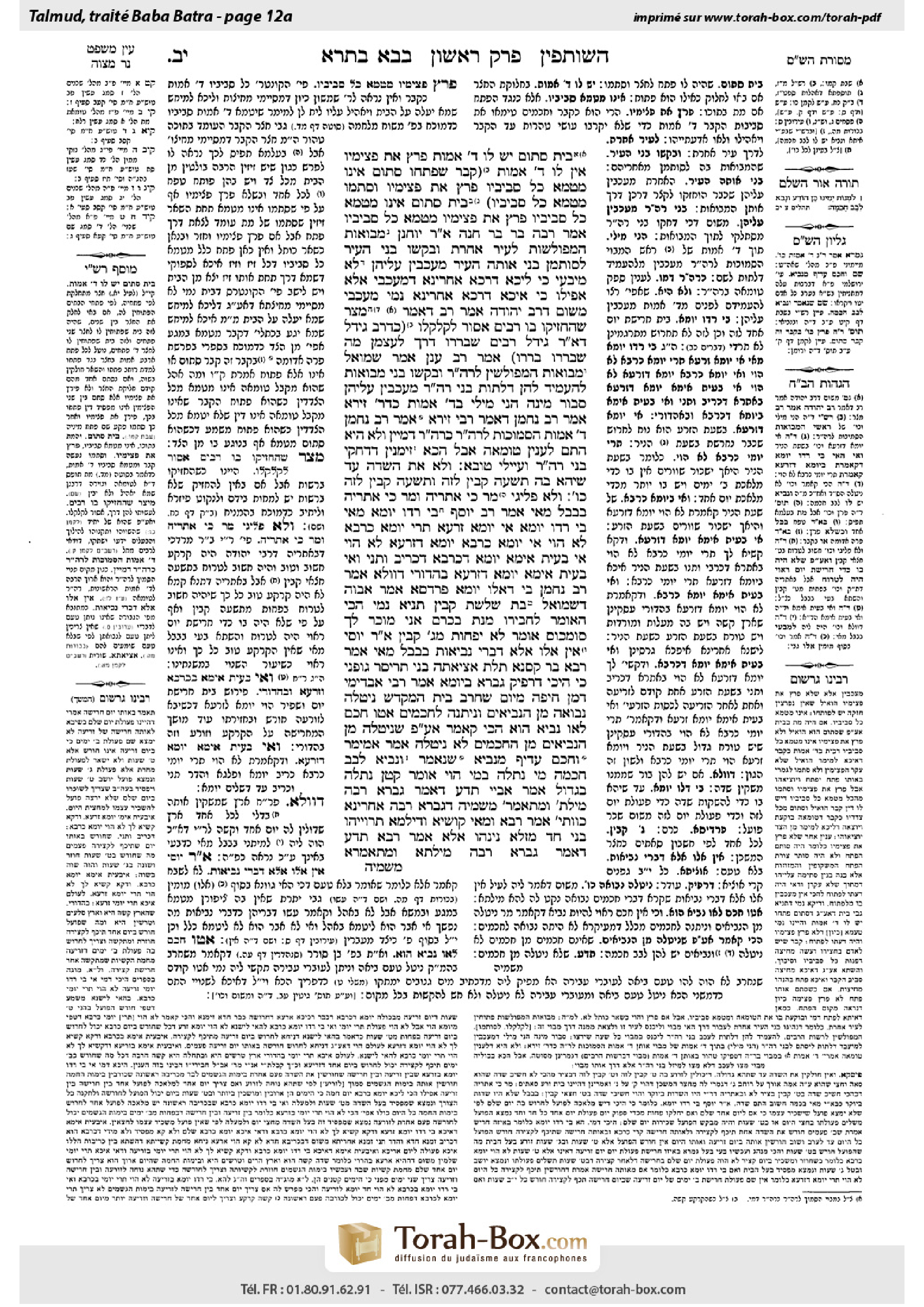
Bava Batra 12a: Talmud study for Daf Yomi
Study the Talmud for Daf Yomi with scanned pages, Hebrew text, English translations from Sefaria and AI-generated French translations.
Passage selection and English or AI-generated French translation are available where the scan has annotations. Daf Study is independent of Torah-Box and Sefaria.
Browse Bava Batra · בבא בתרא · All tractatesBava Batra 12a text and translations
This page of Bava Batra includes the Aramaic text, an English translation and an AI-generated French translation, alongside the scan above.
בבא בתרא י״ב א · Aramaic and Hebrew text
בַּיִת סָתוּם – יֵשׁ לוֹ אַרְבַּע אַמּוֹת; פָּרַץ אֶת פַּצִּימָיו – אֵין לוֹ אַרְבַּע אַמּוֹת.
קֶבֶר שֶׁפִּתְחוֹ סָתוּם – אֵינוֹ מְטַמֵּא כׇּל סְבִיבָיו; פָּרַץ אֶת פַּצִּימָיו, וּסְתָמוֹ – מְטַמֵּא כׇּל סְבִיבָיו. בַּיִת סָתוּם – אֵינוֹ מְטַמֵּא כׇּל סְבִיבָיו; פָּרַץ אֶת פַּצִּימָיו – מְטַמֵּא כׇּל סְבִיבָיו.
אָמַר רַבָּה בַּר בַּר חָנָה אָמַר רַבִּי יוֹחָנָן: מְבוֹאוֹת הַמְפוּלָּשׁוֹת לְעִיר אַחֶרֶת, וּבִקְּשׁוּ בְּנֵי הָעִיר לְסוֹתְמָן – בְּנֵי אוֹתָהּ הָעִיר מְעַכְּבִין עֲלֵיהֶן. לָא מִיבְּעֵי כִּי לֵיכָּא דַּרְכָּא אַחֲרִינָא – דִּמְעַכְּבִי, אֶלָּא אֲפִילּוּ כִּי אִיכָּא דַּרְכָּא אַחֲרִינָא, נָמֵי מְעַכְּבִי –
מִשּׁוּם דְּרַב יְהוּדָה אָמַר רַב, דְּאָמַר: מֶצֶר שֶׁהֶחֱזִיקוּ בּוֹ רַבִּים, אָסוּר לְקַלְקְלוֹ – כִּדְרַב גִּידֵּל, דְּאָמַר רַב גִּידֵּל: רַבִּים שֶׁבֵּרְרוּ דֶּרֶךְ לְעַצְמָן – מַה שֶּׁבֵּרְרוּ, בֵּרְרוּ.
אָמַר רַב עָנָן אָמַר שְׁמוּאֵל: מְבוֹאוֹת הַמְפוּלָּשִׁין לִרְשׁוּת הָרַבִּים, וּבִקְּשׁוּ בְּנֵי מְבוֹאוֹת לְהַעֲמִיד לָהֶן דְּלָתוֹת – בְּנֵי רְשׁוּת הָרַבִּים מְעַכְּבִין עֲלֵיהֶן.
סְבוּר מִינַּהּ – הָנֵי מִילֵּי בְּאַרְבַּע אַמּוֹת, כִּדְרַבִּי זֵירָא אָמַר רַב נַחְמָן – דְּאָמַר רַבִּי זֵירָא אָמַר רַב נַחְמָן: אַרְבַּע אַמּוֹת הַסְּמוּכוֹת לִרְשׁוּת הָרַבִּים, כִּרְשׁוּת הָרַבִּים דָּמְיָין; וְלָא הִיא, הָתָם – לְעִנְיַן טוּמְאָה, אֲבָל הָכָא – זִימְנִין דְּדָחֲקִי בְּנֵי רְשׁוּת הָרַבִּים, וְעָיְילִי טוּבָא.
וְלֹא אֶת הַשָּׂדֶה – עַד שֶׁיְּהֵא בָּהּ תִּשְׁעָה קַבִּין לָזֶה, וְתִשְׁעָה קַבִּין לָזֶה כּוּ׳. וְלָא פְּלִיגִי; מָר כִּי אַתְרֵיהּ, וּמָר כִּי אַתְרֵיהּ.
בְּבָבֶל מַאי? אָמַר רַב יוֹסֵף: בֵּי רָדוּ יוֹמָא.
מַאי ״בֵּי רָדוּ יוֹמָא״? אִי יוֹמָא זַרְעָא – תְּרֵי יוֹמָא כְּרָבָא לָא הָוֵי; אִי יוֹמָא כְּרָבָא – יוֹמָא דְּזַרְעָא לָא הָוֵי!
אִי בָּעֵית אֵימָא יוֹמָא דִּכְרָבָא – דְּכָרֵיב וְתָנֵי; וְאִי בָּעֵית אֵימָא יוֹמָא דְּזַרְעָא – בְּהָדוֹרֵי.
דַּוְולָא – אָמַר רַב נַחְמָן: בֵּי דָּאלוּ יוֹמָא. פַּרְדֵּסָא – אָמַר אֲבוּהּ דִּשְׁמוּאֵל: בַּת שְׁלֹשֶׁת קַבִּין.
תַּנְיָא נָמֵי הָכִי, הָאוֹמֵר לַחֲבֵירוֹ: ״מְנָת בַּכֶּרֶם אֲנִי מוֹכֵר לְךָ״ – סוֹמְכוֹס אוֹמֵר: לֹא יִפְחוֹת מִשְּׁלֹשָׁה קַבִּין. אָמַר רַבִּי יוֹסֵי: אֵין אֵלּוּ אֶלָּא דִּבְרֵי נְבִיאוּת. בְּבָבֶל מַאי? אָמַר רָבָא בַּר קִסְנָא: תְּלָת אַצְיָאתָה בְּנֵי תְּרֵיסַר גּוּפְנֵי – כִּי הֵיכִי דְּרָפֵיק גַּבְרָא בְּיוֹמָא.
אָמַר רַבִּי אַבְדִּימִי דְּמִן חֵיפָה: מִיּוֹם שֶׁחָרַב בֵּית הַמִּקְדָּשׁ, נִיטְּלָה נְבוּאָה מִן הַנְּבִיאִים וְנִיתְּנָה לַחֲכָמִים. אַטּוּ חָכָם לָאו נָבִיא הוּא? הָכִי קָאָמַר: אַף עַל פִּי שֶׁנִּיטְּלָה מִן הַנְּבִיאִים, מִן הַחֲכָמִים לֹא נִיטְּלָה.
אָמַר אַמֵּימָר: וְחָכָם עָדִיף מִנָּבִיא, שֶׁנֶּאֱמַר: ״וְנָבִא לְבַב חׇכְמָה״ – מִי נִתְלֶה בְּמִי? הֱוֵי אוֹמֵר: קָטָן נִתְלֶה בַּגָּדוֹל.
אָמַר אַבָּיֵי: תִּדַּע, דְּאָמַר גַּבְרָא רַבָּה מִילְּתָא, וּמִתְאַמְרָא מִשְּׁמֵיהּ דְּגַבְרָא רַבָּה אַחֲרִינָא כְּווֹתֵיהּ. אֲמַר רָבָא: וּמַאי קוּשְׁיָא? וְדִילְמָא תַּרְוַיְיהוּ בְּנֵי חַד מַזָּלָא נִינְהוּ! אֶלָּא אָמַר רָבָא: תִּדַּע, דְּאָמַר גַּבְרָא רַבָּה מִילְּתָא, וּמִתְאַמְרָא
Bava Batra 12a · English translation
A house that has a sealed entrance still has the four cubits adjoining that entrance because the entrance can be reopened. If one broke its doorposts and sealed the entrance, the entrance is completely negated, and it does not have the four cubits adjoining it.
There is a similar distinction with regard to the halakhot of ritual impurity. There is a halakha that a house in which there is a corpse transmits ritual impurity only through its doorways. The baraita continues: A grave whose entrance is sealed does not render all its surroundings ritually impure; the ritual impurity extends only to the area opposite the entrance. But if one broke its doorposts and sealed it, it is no longer considered an entrance, and the grave renders all its surroundings ritually impure, because impurity that has no egress bursts from all sides. Similarly, a house in which there is a corpse that has a sealed entrance does not render all its surroundings ritually impure. But if one broke its doorposts, it is no longer considered an entrance, and the corpse renders all of its surroundings ritually impure.
Rabba bar bar Ḥana says that Rabbi Yoḥanan says: With regard to alleyways that are open to another city, and through which one would ordinarily travel to reach that other city, if the residents of the city in which the alleyways are located wished to block them off, the residents of the city into which the alleyways open can prevent them from doing so, because they have a right to reach their city via those routes. The Gemara explains: It is not necessary to state that they can prevent them from blocking the alleyways when there is no alternative route to reach their town, but they can prevent them from blocking the alleyways even when there is an alternative route.
This is due to the reasoning that Rav Yehuda says that Rav says. As Rav says: One is prohibited from ruining a path that the public has established as a public thoroughfare, i.e., steps may not be taken to prevent people from using it. This is in accordance with the statement of Rav Giddel, as Rav Giddel says: If the public has chosen a route for itself and they walk on it, what they have chosen is chosen, and it cannot be taken away from them.
Rav Anan says that Shmuel says: With regard to alleyways that open onto a public thoroughfare, if the residents of the alleyways wished to put up doors at the entrance to their alleyways, the people who use the public thoroughfare can prevent them from doing so.
Some Sages understood from this that this statement applies specifically to the area within four cubits of the public thoroughfare, in accordance with the statement that Rabbi Zeira says that Rav Naḥman says, as Rabbi Zeira says that Rav Naḥman says: The four cubits in an alleyway that are adjacent to the public thoroughfare are considered like the public thoroughfare itself. Consequently, this area has the halakha of a public thoroughfare. But that is not so. There, the ruling of Rav Naḥman was stated with regard to the issue of ritual impurity, with regard to which only the first four cubits of the alleyway are considered like the public thoroughfare. But here, with regard to doors set up at the entrance to the alleyway, sometimes the public thoroughfare becomes crowded with people and they enter far into the alleyway, even farther than four cubits.
§ The mishna teaches: And the court does not divide a jointly owned field unless there is space in it to plant nine kav of seed for this one and nine kav of seed for that one. Rabbi Yehuda says: The court does not divide a field unless there is space in it to plant nine half-kav of seed for this one and nine half-kav of seed for that one. The Gemara comments: And they do not disagree with regard to the fundamental halakha, as this Sage ruled in accordance with the custom of his locale, and that Sage ruled in accordance with the custom of his locale. In Rabbi Yehuda’s locale, even a smaller parcel of land was considered a viable field.
The Gemara asks: The mishna was taught in Eretz Yisrael; what practice should be followed in Babylonia? Rav Yosef said: In Babylonia, a parcel of land the size of which is the area of a day’s plowing is considered a field; if each of the parties will receive less than that, the field should not be divided.
The Gemara asks: What is meant by a parcel of land the size of which is the area of a day’s plowing? If it means a day’s plowing in the planting season, i.e., the winter, when it is easy to plow, since the earth has already been turned over at the end of the summer, the field will not require two full days of plowing in the plowing season, i.e., at the end of the summer, when it is more difficult to plow, since the earth is hard and dry. In that case, he will have to pay his summer plowman two days’ wages for less than two days of work. And if it means a day’s plowing in the plowing season, the field will not require a full day of plowing in the planting season. In that case, he will have to pay his winter plowman a full day’s wages for less than a full day of work.
The Gemara answers: If you wish, say it is referring to a day’s plowing in the plowing season, and the field will still require a full day of plowing in the planting season since he plows once before he sows the seeds and then he repeats the plowing after the seeds are sown. And if you wish, say instead that it is referring to a day’s plowing in the planting season, and the field will in fact require two full days of plowing in the plowing season if it is rocky ground, on which plowing takes longer.
In connection with this discussion, the Gemara clarifies the conditions under which a cistern, from which its joint owners draw their water, is divided. Rav Naḥman said: It should be divided only if each party will receive the volume of water needed for a day’s irrigation work. As for an orchard, Shmuel’s father says: It should be divided only if each party will receive an area large enough to plant three kav, one-third of the measure required for a field.
That opinion is also taught in a baraita: With regard to one who says to another: I am selling you part of a vineyard, without specifying how much of the vineyard, Sumakhos says: He may not give him less than an area large enough to plant three kav. Rabbi Yosei said: These are nothing other than words of prophecy, i.e., I do not see the logic behind this statement, and it is as if based on prophecy and a heavenly decree, as the seller did not mention any area, but rather spoke in the most general of terms: Part of a vineyard. The Gemara asks: What is the measure with regard to this matter in Babylonia? Rava bar Kisna said: Three rows [atzyata] of twelve vines, which is the area a person can hoe in a single day.
§ In connection with Rabbi Yosei’s statement that Sumakhos’s words are nothing but words of prophecy, the Gemara reports that Rabbi Avdimi from Haifa says: From the day that the Temple was destroyed prophecy was taken from the prophets and given to the Sages. The Gemara expresses astonishment: Is that to say that a Sage is not fit to be a prophet? Rabbi Avdimi seems to say that these are two distinct categories of people. The Gemara explains: This is what Rabbi Avdimi is saying: Even though prophecy was taken from the prophets, it was not taken from the Sages.
Ameimar said: And a Sage is greater than a prophet, as it is stated: “And a prophet has a heart of wisdom” (Psalms 90:12), i.e., he is wise. When comparisons are drawn, who is compared to whom? You must say that the lesser is compared to the greater. Here too, prophecy is compared to wisdom, thus indicating that wisdom is greater than prophecy.
Abaye said: Know that this is so, that the Sages still enjoy the prophetic gift, as a great man makes a statement with regard to a point of halakha and the same statement is then cited in the name of a different great man in accordance with his statement, indicating that the Sages makes their statements by way of prophecy. Rava disagreed and said: And what is the difficulty with explaining this? Perhaps they were born under the same constellation, and since they are similar in their traits, they reach the same conclusions. Rather, Rava said: Know that this is so, as a great man makes a statement and the same statement is then cited
Bava Batra 12a · Traduction française (IA)
Une maison ayant une entrée scellée possède toutefois les quatre cubits adjacents à cette entrée, car l'entrée peut être réouverte. Si l'on a brisé ses poteaux et scellé l'entrée, l'entrée est entièrement annulée, et la maison ne possède pas les quatre cubits adjacents à l'entrée.
Il y a une distinction similaire concernant les halakhot de l'impureté rituelle. Il y a une halakha selon laquelle une maison dans laquelle il y a un cadavre transmet l'impureté rituelle uniquement à travers ses portes. La baraïta continue : Une tombe dont l'entrée est scellée ne rend pas l'ensemble de son environnement impur rituellement ; l'impureté s'étend uniquement à l'aire opposée à l'entrée. Mais si l'on a brisé ses poteaux et scellé la tombe, elle n'est plus considérée comme une entrée, et la tombe rend l'ensemble de son environnement impur rituellement, car l'impureté qui n'a pas de sortie s'échappe de tous les côtés. De même, une maison dans laquelle il y a un cadavre dont l'entrée est scellée ne rend pas l'ensemble de son environnement impur rituellement. Mais si l'on a brisé ses poteaux, elle n'est plus considérée comme une entrée, et le cadavre rend l'ensemble de son environnement impur rituellement.
Rabba bar bar Ḥana dit que Rabbi Yoḥanan dit : Concernant les ruelles ouvertes vers une autre ville, par lesquelles on traverse normalement pour rejoindre cette ville, si les habitants de la ville où ces ruelles sont situées souhaitent les bloquer, les habitants de la ville vers laquelle ces ruelles s'ouvrent peuvent les empêcher de le faire, car ils ont le droit d'accéder à leur ville via ces itinéraires. La Guemara explique : Il n'est pas nécessaire de préciser qu'ils peuvent les empêcher de bloquer les ruelles lorsqu'il n'y a pas d'autre itinéraire pour rejoindre leur ville, mais ils peuvent les empêcher de bloquer les ruelles même lorsqu'il existe un autre itinéraire.
Cela est dû à la raison donnée par Rav Yehuda, selon laquelle Rav dit. Comme Rav dit : On est interdit de détruire un chemin que le public a établi comme une voie publique, c'est-à-dire qu'on ne peut pas prendre des mesures pour empêcher son utilisation. Cela est conformément à la déclaration de Rav Giddel, comme Rav Giddel dit : Si le public a choisi un itinéraire et qu'ils marchent dessus, ce qu'ils ont choisi est choisi, et on ne peut pas le leur retirer.
Rav Anan dit que Shmuel dit : Concernant les ruelles qui s'ouvrent sur une voie publique, si les habitants des ruelles souhaitent installer des portes à l'entrée de leurs ruelles, les personnes qui utilisent la voie publique peuvent les empêcher de le faire.
Certains Sages ont compris de cette déclaration qu'elle s'applique spécifiquement à la zone située à quatre cubits de la voie publique, conformément à la déclaration que Rabbi Zeira dit que Rav Naḥman dit, comme Rabbi Zeira dit que Rav Naḥman dit : Les quatre cubits d'une ruelle qui sont adjacents à la voie publique sont considérés comme faisant partie de la voie publique elle-même. Ainsi, cette zone a la halakha d'une voie publique. Mais cela n'est pas vrai. Là, la déclaration de Rav Naḥman concernait la question de l'impureté rituelle, concernant laquelle seulement les quatre premiers cubits de la ruelle sont considérés comme faisant partie de la voie publique. Mais ici, concernant les portes installées à l'entrée de la ruelle, parfois la voie publique devient bondée de monde et les personnes entrent profondément dans la ruelle, même plus loin que quatre cubits.
§ La mitsna enseigne : Et la cour ne divise pas un champ partagé à moins qu'il y ait de la place pour planter neuf kav de grain pour celui-ci et neuf kav de grain pour celui-là. Rabbi Yehuda dit : La cour ne divise pas un champ à moins qu'il y ait de la place pour planter neuf demi-kav de grain pour celui-ci et neuf demi-kav de grain pour celui-là. La Guemara commente : Et ils ne s'opposent pas concernant la halakha fondamentale, car ce Sage a décidé selon la coutume de son lieu et celui-ci selon la coutume de son lieu. Dans le lieu de Rabbi Yehuda, même une petite parcelle de terre était considérée comme un champ viable.
La Guemara pose la question : La mitsna a été enseignée en Eretz Yisrael ; quelle pratique doit être suivie en Babylone ? Rav Yosef dit : En Babylone, une parcelle de terre dont la taille est égale à l'aire d'une journée de labour est considérée comme un champ ; si chaque partie reçoit moins de cela, le champ ne devrait pas être divisé.
La Guemara pose la question : Qu'entend-on par une parcelle de terre dont la taille est égale à l'aire d'une journée de labour ? Si cela signifie une journée de labour en saison de plantation, c'est-à-dire l'hiver, lorsque le labour est facile, puisque la terre a déjà été retournée à la fin de l'été, le champ ne nécessitera pas deux jours entiers de labour en saison de labour, c'est-à-dire à la fin de l'été, lorsque le labour est plus difficile, puisque la terre est dure et sèche. Dans ce cas, il faudra payer son laboureur d'été deux jours de salaire pour moins de deux jours de travail. Et si cela signifie une journée de labour en saison de labour, le champ ne nécessitera pas une journée entière de labour en saison de plantation. Dans ce cas, il faudra payer son laboureur d'hiver une journée de salaire pour moins d'une journée de travail.
La Guemara répond : Si vous le souhaitez, dites qu'il s'agit d'une journée de labour en saison de labour, et le champ nécessitera tout de même une journée entière de labour en saison de plantation, car il laboure une fois avant de semer les graines et ensuite il répète le labour après que les graines sont semées. Et si vous le souhaitez, dites plutôt qu'il s'agit d'une journée de labour en saison de plantation, et le champ nécessitera effectivement deux jours entiers de labour en saison de labour si le sol est rocheux, car le labour prend plus de temps sur ce type de sol.
En lien avec cette discussion, la Guemara clarifie les conditions sous lesquelles un cistern, dont les propriétaires communs tirent leur eau, est divisé. Rav Naḥman dit : Il devrait être divisé uniquement si chaque partie reçoit la quantité d'eau nécessaire pour un jour d'irrigation. Concernant un verger, le père de Shmuel dit : Il devrait être divisé uniquement si chaque partie reçoit une surface suffisante pour planter trois kav, soit un tiers de la mesure requise pour un champ.
Cette opinion est également enseignée dans une baraïta : Concernant celui qui dit à un autre : Je vends à toi une partie d'un domaine viticole, sans préciser la quantité, Sumakhos dit : Il ne peut lui donner moins d'une surface suffisante pour planter trois kav. Rabbi Yosei a dit : Ces paroles ne sont autre chose que des paroles de prophétie, c'est-à-dire que je ne perçois pas la logique derrière cette déclaration, et cela semble être basé sur la prophétie et un décret céleste, car le vendeur n'a pas mentionné une surface, mais plutôt a parlé de manière très générale : Une partie d'un domaine viticole. La Guemara demande : Quelle est la mesure concernant cette affaire en Babylonie ? Rava bar Kisna a dit : Trois rangées [atzyata] de douze vigne, c'est-à-dire la surface qu'une personne peut labourer en une seule journée.
§ En lien avec la déclaration de Rabbi Yosei selon laquelle les paroles de Sumakhos ne sont que des paroles de prophétie, la Guemara rapporte que Rabbi Avdimi de Haïfa a dit : Depuis la destruction du Temple, la prophétie a été enlevée des prophètes et donnée aux Sages. La Guemara exprime son étonnement : Est-ce que cela signifie qu'un Sage n'est pas digne d'être un prophète ? Rabbi Avdimi semble dire que ces sont deux catégories distinctes de personnes. La Guemara explique : C'est ce que Rabbi Avdimi dit : Même si la prophétie a été enlevée des prophètes, elle n'a pas été enlevée des Sages.
Ameimar a dit : Et un Sage est supérieur à un prophète, car il est dit : « Et un prophète a un cœur de sagesse » (Psaumes 90:12), c'est-à-dire qu'il est sage. Lorsque des comparaisons sont faites, à qui est-on comparé ? On doit dire que l'inférieur est comparé à l' supérieur. Ici aussi, la prophétie est comparée à la sagesse, ce qui indique que la sagesse est supérieure à la prophétie.
Abaye a dit : Sache que cela est ainsi, que les Sages conservent encore le don prophétique, car un grand homme fait une déclaration concernant un point de halakha et la même déclaration est ensuite citée sous le nom d'un autre grand homme conformément à sa déclaration, ce qui indique que les Sages font leurs déclarations par la voie de la prophétie. Rava a contesté et a dit : Et quelle est la difficulté à expliquer cela ? Peut-être qu'ils sont nés sous la même constellation, et puisque leurs traits sont semblables, ils parviennent aux mêmes conclusions. Plutôt, Rava a dit : Sache que cela est ainsi, car un grand homme fait une déclaration et la même déclaration est ensuite citée
Traduction française générée par IA à partir de l’édition anglaise de Sefaria. Vérifie toujours un passage avec le texte source.
Text from Sefaria: William Davidson Edition - Vocalized Aramaic (CC BY NC); William Davidson Edition - English (CC BY NC).