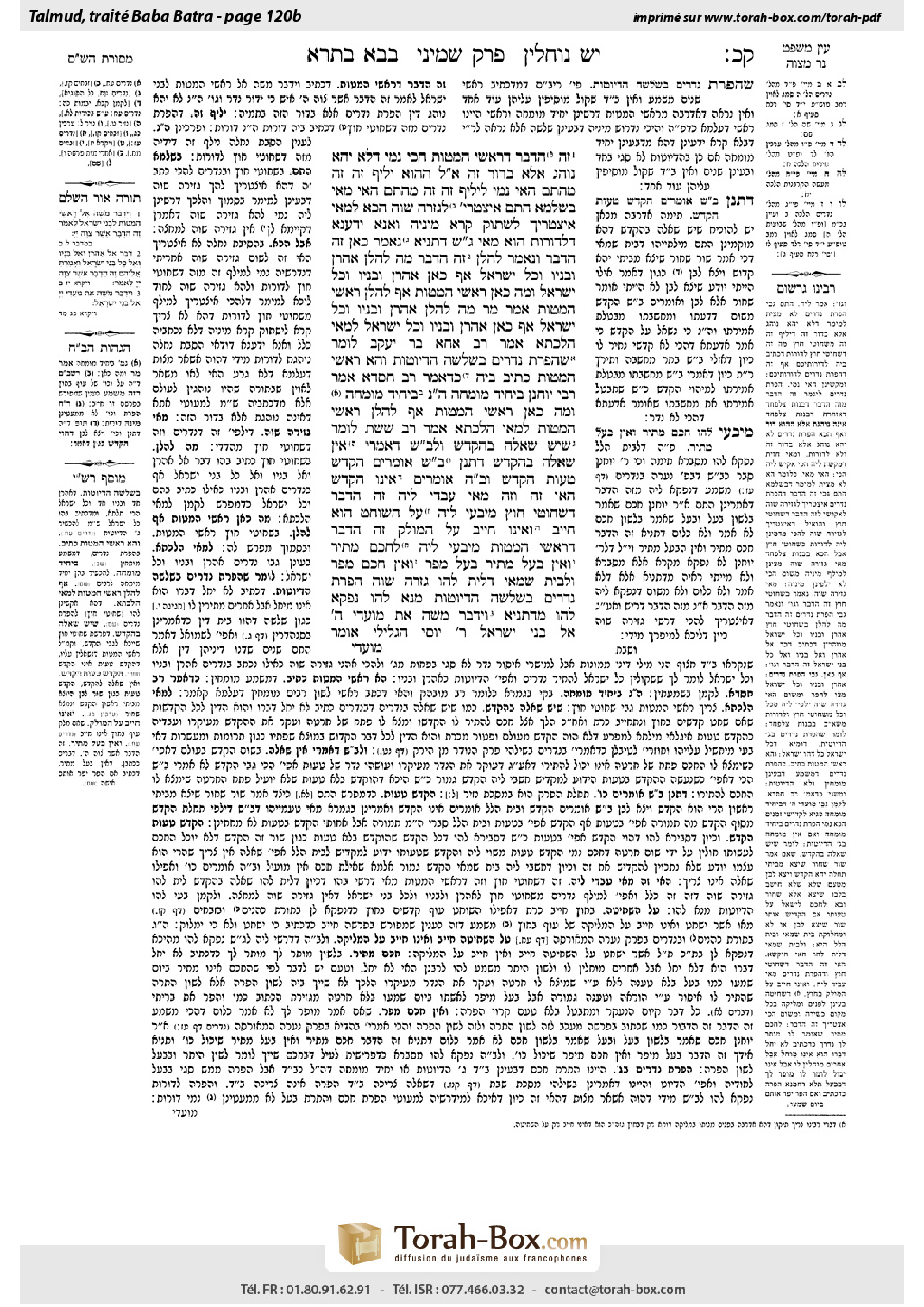
Bava Batra 120b: Talmud study for Daf Yomi
Study the Talmud for Daf Yomi with scanned pages, Hebrew text, English translations from Sefaria and AI-generated French translations.
Passage selection and English or AI-generated French translation are available where the scan has annotations. Daf Study is independent of Torah-Box and Sefaria.
Browse Bava Batra · בבא בתרא · All tractatesBava Batra 120b text and translations
This page of Bava Batra includes the Aramaic text, an English translation and an AI-generated French translation, alongside the scan above.
בבא בתרא ק״כ ב · Aramaic and Hebrew text
״זֶה הַדָּבָר״ דְּרָאשֵׁי הַמַּטּוֹת – הָכִי נָמֵי דְּלָא יְהֵא נוֹהֵג אֶלָּא בְּדוֹר זֶה? אֲמַר לֵיהּ: הָהוּא, יָלֵיף ״זֶה״–״זֶה״ מֵהָתָם.
הַאי נָמֵי, לֵילַיף ״זֶה״–״זֶה״ מֵהָתָם! הַאי מַאי? בִּשְׁלָמָא הָתָם, אִיצְטְרִיךְ לִגְזֵרָה שָׁוָה; הָכָא – לְמַאי אִיצְטְרִיךְ? לִשְׁתּוֹק קְרָא מִינֵּיהּ, וַאֲנָא יָדַעְנָא דִּלְדוֹרוֹת הוּא!
מַאי גְּזֵרָה שָׁוָה? דְּתַנְיָא: נֶאֱמַר כָּאן: ״זֶה הַדָּבָר״, וְנֶאֱמַר לְהַלָּן: ״זֶה הַדָּבָר״; מָה לְהַלָּן – אַהֲרֹן וּבָנָיו וְכׇל יִשְׂרָאֵל, אַף כָּאן – אַהֲרֹן וּבָנָיו וְכׇל יִשְׂרָאֵל. וּמָה כָּאן – רָאשֵׁי הַמַּטּוֹת, אַף לְהַלָּן – רָאשֵׁי הַמַּטּוֹת.
אָמַר מָר: מָה לְהַלָּן אַהֲרֹן וּבָנָיו וְכׇל יִשְׂרָאֵל, אַף כָּאן אַהֲרֹן וּבָנָיו וְכׇל יִשְׂרָאֵל. לְמַאי הִלְכְתָא? אָמַר רַב אַחָא בַּר יַעֲקֹב: לוֹמַר שֶׁהֲפָרַת נְדָרִים בִּשְׁלֹשָׁה הֶדְיוֹטוֹת.
וְהָא ״רָאשֵׁי הַמַּטּוֹת״ כְּתִיב בֵּיהּ! כִּדְאָמַר רַב חִסְדָּא אָמַר רַבִּי יוֹחָנָן: בְּיָחִיד מוּמְחֶה, הָכִי נָמֵי – בְּיָחִיד מוּמְחֶה.
וּמָה כָּאן רָאשֵׁי הַמַּטּוֹת, אַף לְהַלָּן רָאשֵׁי הַמַּטּוֹת. לְמַאי הִלְכְתָא? אָמַר רַב שֵׁשֶׁת: לוֹמַר שֶׁיֵּשׁ שְׁאֵלָה בְּהֶקְדֵּשׁ.
וּלְבֵית שַׁמַּאי, דְּאָמְרִי: אֵין שְׁאֵלָה בְּהֶקְדֵּשׁ – דִּתְנַן, בֵּית שַׁמַּאי אוֹמְרִים: הֶקְדֵּשׁ טָעוּת – הֶקְדֵּשׁ, וּבֵית הִלֵּל אוֹמְרִים: אֵינוֹ הֶקְדֵּשׁ; הַאי ״זֶה״ וְ״זֶה״ מַאי עָבְדִי לֵיהּ?
״זֶה הַדָּבָר״ דִּשְׁחוּטֵי חוּץ – מִיבְּעֵי לֵיהּ ״עַל הַשּׁוֹחֵט הוּא חַיָּיב, וְאֵינוֹ חַיָּיב עַל הַמּוֹלֵק״. ״זֶה הַדָּבָר״ דְּרָאשֵׁי הַמַּטּוֹת – מִיבְּעֵי לֵיהּ לְ״חָכָם מַתִּיר, וְאֵין בַּעַל מַתִּיר. בַּעַל מֵפֵר, וְאֵין חָכָם מֵפֵר״.
וּלְבֵית שַׁמַּאי דְּלֵית לְהוּ גְּזֵרָה שָׁוָה, הֲפָרַת נְדָרִים בִּשְׁלֹשָׁה הֶדְיוֹטוֹת מְנָא לְהוּ? נָפְקָא לְהוּ מִדְּתַנְיָא: ״וַיְדַבֵּר מֹשֶׁה אֶת מֹעֲדֵי ה׳ אֶל בְּנֵי יִשְׂרָאֵל״ – רַבִּי יוֹסֵי הַגְּלִילִי אוֹמֵר:
Bava Batra 120b · English translation
Rabba Zuti asked Rav Ashi about another instance of the same phrase. In the case of “this is the matter” written with regard to the heads of the tribes, in the introductory verse to the halakhot of vows: “And Moses spoke to the heads of the tribes of the children of Israel, saying: This is the matter that the Lord has commanded” (Numbers 30:2), is it also the case that the halakhot of vows will not be practiced except in this generation? Rav Ashi said to him: The halakha in that case, that of vows, is derived through a verbal analogy between the word “this” stated here, in the verse discussing vows, and the word “this” stated there, in the verse discussing offerings slaughtered outside the Tabernacle or Temple, which is applicable in all generations.
The Gemara asks: This halakha, concerning the daughter inheriting her father’s portion, let it be derived through a verbal analogy between the word “this” stated here, with regard to inheritance, and the word “this” stated there, in the verse discussing offerings, as well. The Gemara rejects that comparison: What is this suggestion? Granted, there, i.e., with regard to offerings slaughtered outside the Tabernacle or Temple and with regard to vows, the phrase “this is the matter” was necessary for deriving other halakhot through a verbal analogy, as will be explained later. Therefore, the term may also be employed to teach that the halakha applies in all generations. But here, with regard to a daughter’s inheritance, for what other halakha was this phrase necessary? If the halakha truly applies for posterity, let the verse be silent and refrain from addressing when this halakha applies by not stating “this is the matter,” and I would know that it is for all generations, as is the case with all other mitzvot.
The Gemara explains: What is the verbal analogy for which the phrase was necessary? As it is taught in a baraita: It is stated here, with regard to vows: “This is the matter,” and it is stated there, with regard to offerings slaughtered outside the Tabernacle or Temple: “This is the matter.” Just as there the mitzva applies to Aaron and his sons and all Israel, so too here, with regard to vows, the mitzva applies to Aaron and his sons and all Israel. And just as here the mitzva applies to the heads of the tribes, as explicitly stated in the verse cited above, so too there, with regard to offerings slaughtered outside the Tabernacle or Temple, there is particular relevance to the heads of the tribes.
The Gemara analyzes the cited baraita. The Master says: Just as there, with regard to offerings, the mitzva applies to Aaron and his sons and all Israel, so too here, with regard to vows, the mitzva applies to Aaron and his sons and all Israel. The Gemara asks: With regard to what halakha is this verbal analogy stated? Rav Aḥa bar Ya’akov says: This is written to say that the dissolution of vows can be performed by three laymen with no particular expertise in the halakhot of vows, just as the prohibition of offerings slaughtered outside the Tabernacle or Temple applies to all of the Jewish people, including laymen.
The Gemara objects: But the phrase “the heads of the tribes” is written explicitly in the portion of the vows, indicating that the matter is not entrusted to laymen. The Gemara answers: It is as Rav Ḥisda says that Rabbi Yoḥanan says in a different context: The mention of the heads of tribes teaches that vows may be dissolved by a single expert halakhic authority; so too here, this phrase teaches that vows can be nullified by a single expert halakhic authority.
The Gemara analyzes the next clause of the cited baraita: And just as here the mitzva applies to the heads of the tribes, so too there, with regard to offerings slaughtered outside the Tabernacle or Temple, there is particular relevance to the heads of the tribes. The Gemara asks: With regard to what halakha are the heads of the tribes linked to the prohibition of slaughtering offerings outside the Tabernacle or Temple? Rav Sheshet says: This is written to say that there is a concept of requesting dissolution of consecration of consecrated property, just as one can request dissolution of a vow.
The Gemara asks: And according to Beit Shammai, who say that there is no possibility of requesting that a halakhic authority dissolve a vow of consecrated property, this cannot explain the connection of the heads of the tribes to offerings slaughtered outside the Tabernacle or Temple. As we learned in a mishna (Nazir 30b): Beit Shammai say: Consecration that one performed in error is nevertheless effective as consecration, because one’s mindset does not supersede his verbal declaration; and Beit Hillel say: This is not consecration. Accordingly, in the opinion of Beit Shammai, what do they do with this seemingly analogous usage of “this” and “this,” in the portions of offerings slaughtered outside the Tabernacle or Temple and vows, respectively?
The Gemara answers: Beit Shammai require “this is the matter” written of offerings slaughtered outside the Tabernacle or Temple to teach that for the act of slaughtering, he is liable to receive excision from the World-to-Come [karet]; but he is not liable to receive karet for the act of pinching the neck of a consecrated bird outside the Tabernacle or Temple, which is excluded from the category of slaughtering in this mitzva. And Beit Shammai require “this is the matter” written of the heads of the tribes in the portion about vows to teach that only a halakhic authority can dissolve vows, but a husband cannot dissolve them. The halakhic authority can dissolve the vow for a petitioner, but a woman’s husband or father cannot dissolve her vow. And, conversely, a husband can nullify his wife’s or his daughter’s vows on the day that he hears the vow, regardless of her mindset, but a halakhic authority cannot nullify vows in this manner.
The Gemara asks: But according to Beit Shammai, who do not have this verbal analogy, meaning that they do not recognize as authoritative the verbal analogy that links vows to offerings slaughtered outside the Tabernacle or Temple, from where do they derive that dissolution of vows can be performed by three laymen? The Gemara answers: Beit Shammai derive it from that which is taught in a baraita: The verse states at the end of a passage relating to the halakhot of the Festivals: “And Moses declared to the children of Israel the appointed seasons of the Lord” (Leviticus 23:44). In explaining the verse, Rabbi Yosei HaGelili says:
Bava Batra 120b · Traduction française (IA)
Rabba Zuti demanda à Rav Ashi sur un autre exemple de la même phrase. Dans le cas de « c’est la chose » écrit concernant les chefs des tribus, dans la première versette des halakhot des vœux : « Et Moïse parla aux chefs des tribus des enfants d'Israël, disant : C’est la chose que l'Éternel a commandé » (Nombres 30:2), est-ce aussi le cas que les halakhot des vœux ne seront pratiquées qu'à cette génération ? Rav Ashi répondit à lui : La halakha dans ce cas, celle des vœux, est déduite par une analogie verbale entre le mot « c’est » dit ici, dans la versette concernant les vœux, et le mot « c’est » dit là, dans la versette concernant les offrandes sacrifiées en dehors du Tabernacle ou du Temple, qui s'applique à toutes les générations.
Le Guemara demande : Cette halakha, concernant la fille héritant de la part de son père, doit-elle être déduite par une analogie verbale entre le mot « c’est » dit ici, concernant l'héritage, et le mot « c’est » dit là, dans la versette concernant les offrandes, de même. Le Guemara rejette cette comparaison : Quelle est cette suggestion ? En effet, là, c'est-à-dire concernant les offrandes sacrifiées en dehors du Tabernacle ou du Temple et concernant les vœux, la phrase « c’est la chose » était nécessaire pour déduire d'autres halakhot par une analogie verbale, comme on le verra plus tard. Par conséquent, le terme peut aussi être utilisé pour enseigner que la halakha s'applique à toutes les générations. Mais ici, concernant l'héritage de la fille, pour quelle autre halakha cette phrase était-elle nécessaire ? Si la halakha s'applique véritablement aux générations futures, la versette doit rester muette et ne pas mentionner quand cette halakha s'applique en ne disant pas « c’est la chose », et je saurais alors qu'elle s'applique à toutes les générations, comme c'est le cas pour toutes les autres mitsvot.
Le Guemara explique : Quelle est l'analogie verbale pour laquelle cette phrase était nécessaire ? Comme il est enseigné dans une baraïta : Il est dit ici, concernant les vœux : « C’est la chose », et il est dit là, concernant les offrandes sacrifiées en dehors du Tabernacle ou du Temple : « C’est la chose ». Tout comme là, la mitsva s'applique à Aaron et à ses fils et à tout Israël, ainsi ici, concernant les vœux, la mitsva s'applique à Aaron et à ses fils et à tout Israël. Et tout comme ici la mitsva s'applique aux chefs des tribus, comme il est explicitement dit dans la versette citée ci-dessus, ainsi là, concernant les offrandes sacrifiées en dehors du Tabernacle ou du Temple, il y a une pertinence particulière aux chefs des tribus.
Le Guemara analyse la baraïta citée. Le Maître dit : Tout comme là, concernant les offrandes, la mitsva s'applique à Aaron et à ses fils et à tout Israël, ainsi ici, concernant les vœux, la mitsva s'applique à Aaron et à ses fils et à tout Israël. Le Guemara demande : Concernant quelle halakha cette analogie verbale est-elle énoncée ? Rav Aḥa bar Ya’akov dit : Cela est écrit pour dire que la dissolution des vœux peut être accomplie par trois laïcs sans expertise particulière en matière de halakhot des vœux, tout comme la prohibition des offrandes sacrifiées en dehors du Tabernacle ou du Temple s'applique à toute la communauté juive, y compris les laïcs.
Le Guemara s'oppose : Mais la phrase « les chefs des tribus » est explicitement écrite dans la portion des vœux, indiquant que la chose n'est pas confiée aux laïcs. Le Guemara répond : C'est comme Rav Ḥisda dit que Rabbi Yoḥanan dit dans un contexte différent : L' mention des chefs des tribus enseigne que les vœux peuvent être dissous par un seul autorité halakhique ; ainsi ici, cette phrase enseigne que les vœux peuvent être annulés par une seule autorité halakhique.
Le Guemara analyse la prochaine clause de la baraïta citée : Et tout comme ici la mitsva s'applique aux chefs des tribus, ainsi là, concernant les offrandes sacrifiées en dehors du Tabernacle ou du Temple, il y a une pertinence particulière aux chefs des tribus. Le Guemara demande : Concernant quelle halakha les chefs des tribus sont-ils liés à la prohibition des offrandes sacrifiées en dehors du Tabernacle ou du Temple ? Rav Sheshet dit : Cela est écrit pour dire qu'il y a un concept de demande de dissolution de la consécration de la propriété consacrée, tout comme on peut demander la dissolution d'un vœu.
Le Guemara demande : Et selon Beit Shammai, qui disent qu'il n'y a pas de possibilité de demander à une autorité halakhique de dissoudre un vœu de propriété consacrée, cela ne peut pas expliquer le lien entre les chefs des tribus et les offrandes sacrifiées en dehors du Tabernacle ou du Temple. Comme nous l'avons appris dans une mishna (Nazir 30b) : Beit Shammai disent : La consécration que l'on a accomplie par erreur est toutefois efficace comme consécration, car l'intention ne supersedé pas la déclaration verbale ; et Beit Hillel disent : Cela n'est pas une consécration. Ainsi, selon l'opinion de Beit Shammai, que font-ils avec cette utilisation apparemment analogue de « c’est » et « c’est », dans les portions des offrandes sacrifiées en dehors du Tabernacle ou du Temple et des vœux, respectivement ?
Le Guemara répond : Beit Shammai exigent que « c’est la chose » écrit des offrandes sacrifiées en dehors du Tabernacle ou du Temple enseigne que pour l'acte de sacrifice, il est puni par l'excision du monde à venir [karet] ; mais il n'est pas puni par karet pour l'acte de pincer le cou d'un oiseau consacré en dehors du Tabernacle ou du Temple, qui est exclu de la catégorie de sacrifice dans cette mitsva. Et Beit Shammai exigent que « c’est la chose » écrit des chefs des tribus dans la portion des vœux enseigne que seul une autorité halakhique peut dissoudre les vœux, mais un mari ne peut pas les dissoudre. L'autorité halakhique peut dissoudre le vœu pour un demandeur, mais le mari ou le père d'une femme ne peut pas dissoudre son vœu. Et inversement, un mari peut annuler les vœux de sa femme ou de sa fille le jour où il entend le vœu, indépendamment de son intention, mais une autorité halakhique ne peut pas annuler les vœux ainsi.
La Guemara pose la question : Mais selon Beit Shammai, qui n'ont pas ce parallèle verbal, c'est-à-dire qui ne reconnaissent pas comme autoritaire le parallèle verbal qui relie les vœux aux offrandes immolées en dehors du Tabernacle ou du Temple, d'où tirent-ils que la dissolution des vœux peut être accomplie par trois laïcs ? La Guemara répond : Beit Shammai tirent cela d'une baraïta : La parallèle mentionne à la fin d'un passage relatif aux halakhot des fêtes : « Et Moïse proclama aux enfants d'Israël les moments prescrits du Seigneur » (Lévitique 23:44). En expliquant cette versette, le Rabbi Yosei HaGelili dit :
Traduction française générée par IA à partir de l’édition anglaise de Sefaria. Vérifie toujours un passage avec le texte source.
Text from Sefaria: William Davidson Edition - Vocalized Aramaic (CC BY NC); William Davidson Edition - English (CC BY NC).