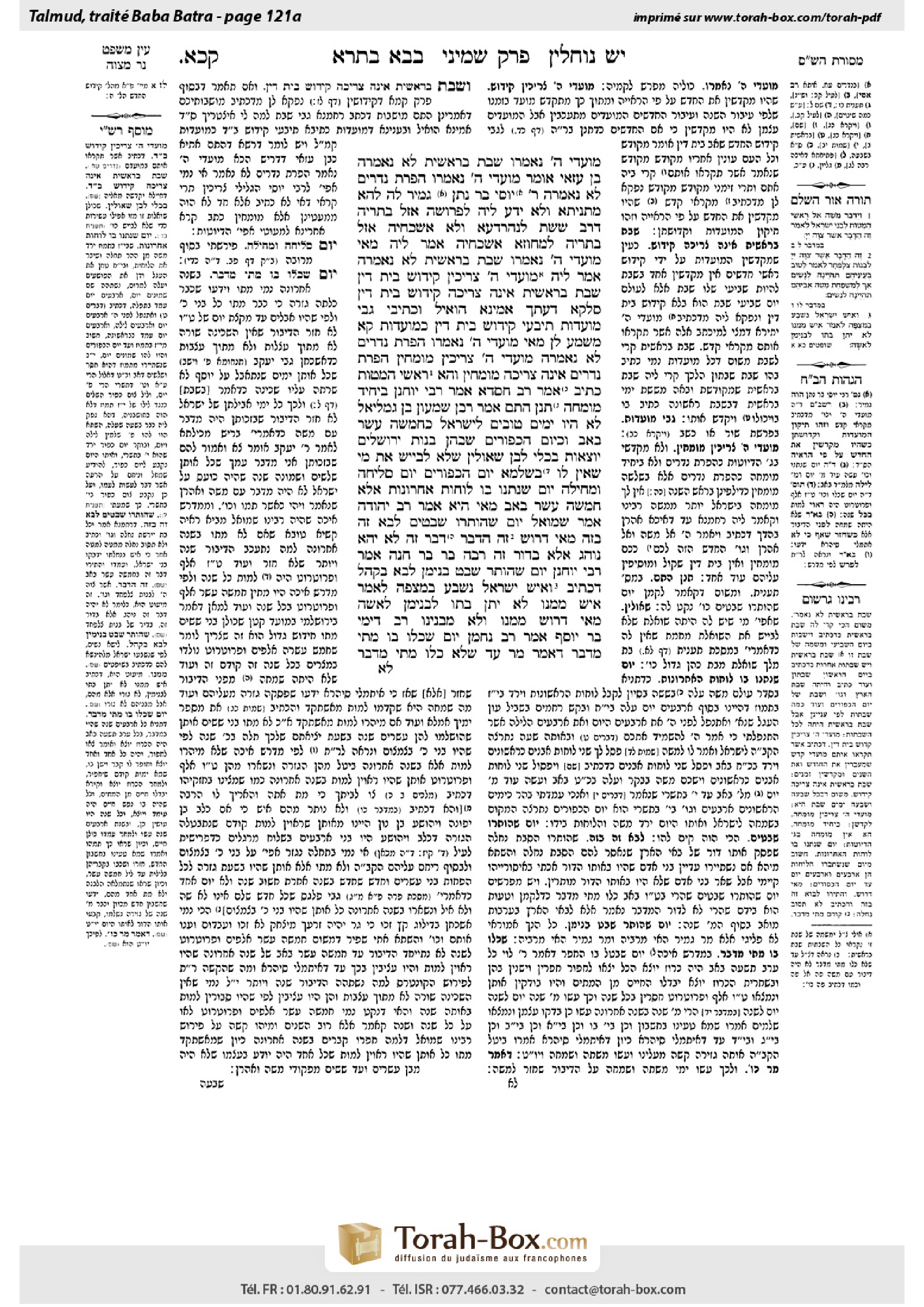
Bava Batra 121a: Talmud study for Daf Yomi
Study the Talmud for Daf Yomi with scanned pages, Hebrew text, English translations from Sefaria and AI-generated French translations.
Passage selection and English or AI-generated French translation are available where the scan has annotations. Daf Study is independent of Torah-Box and Sefaria.
Browse Bava Batra · בבא בתרא · All tractatesBava Batra 121a text and translations
This page of Bava Batra includes the Aramaic text, an English translation and an AI-generated French translation, alongside the scan above.
בבא בתרא קכ״א א · Aramaic and Hebrew text
מוֹעֲדֵי ה׳ נֶאֶמְרוּ, שַׁבַּת בְּרֵאשִׁית לֹא נֶאֶמְרָה. בֶּן עַזַּאי אוֹמֵר: מוֹעֲדֵי ה׳ נֶאֶמְרוּ, הֲפָרַת נְדָרִים לֹא נֶאֶמְרָה.
רַבִּי יוֹסֵי בַּר נָתָן גְּמִיר לַהּ לְהָא מַתְנִיתָא, וְלָא יָדַע לֵיהּ לְפָרוֹשַׁהּ. אֲזַל בָּתְרֵיהּ דְּרַב שֵׁשֶׁת לִנְהַרְדְּעָא, וְלָא אַשְׁכְּחֵיהּ. אֲזַל בָּתְרֵיהּ לְמָחוֹזָא, אַשְׁכְּחֵיהּ. אֲמַר לֵיהּ: מַאי ״מוֹעֲדֵי ה׳ נֶאֶמְרוּ, שַׁבַּת בְּרֵאשִׁית לֹא נֶאֶמְרָה״?
אֲמַר לֵיהּ: מוֹעֲדֵי ה׳ צְרִיכִין קִידּוּשׁ בֵּית דִּין, שַׁבַּת בְּרֵאשִׁית אֵינָהּ צְרִיכָה קִידּוּשׁ בֵּית דִּין. סָלְקָא דַּעְתָּךְ אָמֵינָא: הוֹאִיל וּכְתִיבִי גַּבֵּי מוֹעֲדוֹת, תִּיבְּעֵי קִידּוּשׁ בֵּית דִּין כְּמוֹעֲדוֹת; קָא מַשְׁמַע לַן.
מַאי ״מוֹעֲדֵי ה׳ נֶאֶמְרוּ, הֲפָרַת נְדָרִים לֹא נֶאֶמְרָה״? מוֹעֲדֵי ה׳ צְרִיכִין מוּמְחִין, הֲפָרַת נְדָרִים אֵינָהּ צְרִיכָה מוּמְחִין.
וְהָא ״רָאשֵׁי הַמַּטּוֹת״ כְּתִיב! אָמַר רַב חִסְדָּא אָמַר רַבִּי יוֹחָנָן: בְּיָחִיד מוּמְחֶה.
תְּנַן הָתָם, אָמַר רַבָּן שִׁמְעוֹן בֶּן גַּמְלִיאֵל: לֹא הָיוּ יָמִים טוֹבִים לְיִשְׂרָאֵל כַּחֲמִשָּׁה עָשָׂר בְּאָב וּכְיוֹם הַכִּפּוּרִים, שֶׁבָּהֶן בְּנוֹת יְרוּשָׁלַיִם יוֹצְאוֹת בִּכְלֵי לָבָן שְׁאוּלִין, שֶׁלֹּא לְבַיֵּישׁ אֶת מִי שֶׁאֵין לוֹ. בִּשְׁלָמָא יוֹם הַכִּפּוּרִים – יוֹם סְלִיחָה וּמְחִילָה, יוֹם שֶׁנִּתְּנוּ בּוֹ לוּחוֹת אַחֲרוֹנוֹת. אֶלָּא חֲמִשָּׁה עָשָׂר בְּאָב – מַאי הִיא?
אָמַר רַב יְהוּדָה אָמַר שְׁמוּאֵל: יוֹם שֶׁהוּתְּרוּ שְׁבָטִים לָבֹא זֶה בָּזֶה. מַאי דְּרוּשׁ? ״זֶה הַדָּבָר״ – דָּבָר זֶה לֹא יְהֵא נוֹהֵג אֶלָּא בְּדוֹר זֶה.
רַבָּה בַּר בַּר חָנָה אָמַר רַבִּי יוֹחָנָן: יוֹם שֶׁהוּתַּר שֵׁבֶט בִּנְיָמִן לָבֹא בַּקָּהָל, דִּכְתִיב: ״וְאִישׁ יִשְׂרָאֵל נִשְׁבַּע בַּמִּצְפָּה לֵאמֹר: אִישׁ מִמֶּנּוּ לֹא יִתֵּן בִּתּוֹ לְבִנְיָמִן לְאִשָּׁה״. מַאי דְּרוּשׁ? ״מִמֶּנּוּ״ – וְלֹא מִבָּנֵינוּ.
רַב דִּימִי בַּר יוֹסֵף אָמַר רַב נַחְמָן: יוֹם שֶׁכָּלוּ בּוֹ מֵתֵי מִדְבָּר; דְּאָמַר מָר: עַד שֶׁלֹּא כָּלוּ מֵתֵי מִדְבָּר,
Bava Batra 121a · English translation
The Festivals of the Lord were stated, but Shabbat, which commemorates Creation, was not stated. Ben Azzai says: The Festivals of the Lord were stated, but the dissolution of vows was not stated. This concludes the baraita.
The Gemara recounts: Rabbi Yosei bar Natan learned this baraita and did not know how to explain it. He followed Rav Sheshet to Neharde’a in order to ask him about it, but he did not find him there. He followed him to Meḥoza and found him, and he said to him: What is meant by Rabbi Yosei HaGelili’s statement: The Festivals of the Lord were stated, but Shabbat, which commemorates Creation, was not stated? What does he mean, as Shabbat of Creation is explicitly mentioned in that section of the Torah (Leviticus 23:3)?
Rav Sheshet said to him: The Festivals of the Lord require sanctification by the court. This means that the start of the month, which is dependent upon the appearance of the New Moon, which determines the Festivals, can be established only by a court composed of experts. Shabbat, which commemorates Creation, does not require sanctification by the court. Shabbat is sanctified every week independent of any court action. It may enter your mind to say: Since Shabbat is written adjacent to the Festivals, it should require sanctification by the court as do the Festivals. Rabbi Yosei HaGelili teaches us that Shabbat does not require this.
Rabbi Yosei bar Natan asked: What is meant by ben Azzai’s statement: The Festivals of the Lord were stated, but the dissolution of vows was not stated? After all, the Torah writes explicitly about the dissolution of vows. Rav Sheshet answered him: The Festivals of the Lord require experts to determine when the months begin and when the Festivals will be observed, but the dissolution of vows does not require experts.
The Gemara questions this explanation. But it is written: “The heads of the tribes” (Numbers 30:2), in the portion discussing the halakhot of vows. How, then, can it be said that vows can be dissolved by laymen? Rav Ḥisda says that Rabbi Yoḥanan says: The phrase teaches that vows can be dissolved by a single expert authority. In any event, the Gemara has established that Beit Shammai can derive that dissolution of vows can be performed by laymen in the manner stated by ben Azzai, as explained by Rav Sheshet.
§ The Gemara discusses a mishna that addresses the issue of inter-tribal marriages. We learned in a mishna there (Ta’anit 26b): Rabban Shimon ben Gamliel said: There were no days as joyous for the Jewish people as the fifteenth of Av and as Yom Kippur, as on these days the daughters of Jerusalem would emerge in white garments, which each woman borrowed from another. Why did they borrow garments? They did this so as not to embarrass one who did not have her own white garments. The Gemara analyzes the mishna: Granted that Yom Kippur is a day of joy, because it is a day of pardon and forgiveness, and moreover, it is the day on which the last Tablets of the Covenant were given. But what is the special joy of the fifteenth of Av?
Rav Yehuda says that Shmuel says: This was the day when the members of different tribes were permitted to marry into one another’s tribe. Such marriages were restricted for the first generation to enter Eretz Yisrael, as discussed above (120a). What verse did the sages of that time interpret in support of their conclusion that this halakha was no longer in effect? The verse states: “This is the matter” (Numbers 36:6), meaning, this matter shall be practiced only in this generation, in which Eretz Yisrael is being divided among the tribes.
Rabba bar bar Ḥana says that Rabbi Yoḥanan offered another explanation: The fifteenth of Av was the day when the tribe of Benjamin was permitted to enter into the congregation of the other tribes of Israel through marriage, after the other tribes found a way to dissolve the vow that had prohibited them from marrying a member of the tribe of Benjamin in the aftermath of the episode of the concubine in Gibeah (Judges, chapters 19–20). As it is written: “And the men of Israel had taken an oath in Mizpah, saying: None of us shall give his daughter to Benjamin as a wife” (Judges 21:1). The Gemara asks: What verse did the sages of that time interpret that enabled them to dissolve this vow? The verse states: “None of us,” and not: None of our children; therefore, the oath applied only to the generation that had taken the oath.
Rav Dimi bar Yosef says that Rav Naḥman says: The fifteenth of Av was the day on which those designated to perish in the wilderness stopped dying, as the entire generation that had left Egypt had died due to the sin of the spies (Numbers 14:29–30). As the Master says: As long as those designated to perish in the wilderness had not stopped dying,
Bava Batra 121a · Traduction française (IA)
Les fêtes du Seigneur ont été énoncées, mais le sabbat, qui commémore la Création, n'a pas été énoncé. Ben Azzai dit : Les fêtes du Seigneur ont été énoncées, mais la dissolution des vœux n'a pas été énoncée. Cela conclut la baraïta.
Le Guemara rapporte : Rabbi Yosei bar Natan a appris cette baraïta et ne savait pas comment l'expliquer. Il a suivi Rav Sheshet à Neharde’a pour lui demander à ce sujet, mais il ne l'a pas trouvé là. Il l'a suivi à Meḥoza et l'a trouvé, et lui a dit : Qu'entendait Rabbi Yosei HaGelili par son affirmation : Les fêtes du Seigneur ont été énoncées, mais le sabbat, qui commémore la Création, n'a pas été énoncé ? Que veut-il dire, puisque le sabbat de la Création est explicitement mentionné dans cette section de la Torah (Lévitique 23:3) ?
Rav Sheshet a dit à lui : Les fêtes du Seigneur nécessitent la sanctification par le tribunal. Cela signifie que le début du mois, dépendant de l'apparition de la Lune nouvelle, qui détermine les fêtes, peut être établi uniquement par un tribunal composé d'experts. Le sabbat, qui commémore la Création, ne nécessite pas la sanctification par le tribunal. Le sabbat est sanctifié chaque semaine indépendamment de toute action du tribunal. Il pourrait vous venir à l'esprit de dire : Puisque le sabbat est écrit à côté des fêtes, il devrait nécessiter la sanctification par le tribunal comme les fêtes. Rabbi Yosei HaGelili nous enseigne que le sabbat n'a pas besoin de cela.
Rabbi Yosei bar Natan demanda : Qu'entendait Ben Azzai par son affirmation : Les fêtes du Seigneur ont été énoncées, mais la dissolution des vœux n'a pas été énoncée ? Après tout, la Torah écrit explicitement sur la dissolution des vœux. Rav Sheshet répondit : Les fêtes du Seigneur nécessitent des experts pour déterminer quand les mois commencent et quand les fêtes seront célébrées, mais la dissolution des vœux n'exige pas d'experts.
Le Guemara questionne cette explication. Mais il est écrit : « Les chefs des tribus » (Nb 30:2), dans la portion discutant des halakhot des vœux. Comment alors peut-on dire que les vœux peuvent être dissous par des laïcs ? Rav Ḥisda dit que Rabbi Yoḥanan dit : Cette phrase enseigne que les vœux peuvent être dissous par une seule autorité experte. En tout cas, le Guemara a établi que Beit Shammai peut déduire que la dissolution des vœux peut être effectuée par des laïcs selon la manière évoquée par Ben Azzai, comme expliqué par Rav Sheshet.
§ Le Guemara discute d'une mitsna qui aborde la question des mariages inter-tribaux. Nous avons appris dans une mitsna là (Ta'anit 26b) : Rabban Shimon ben Gamliel dit : Il n'y a pas eu de jours aussi joyeux pour le peuple juif que le quinze d'Av et comme le Yom Kippour, car ces jours-là les filles de Jérusalem sortaient vêtues de robes blanches, que chaque femme empruntait à une autre. Pourquoi empruntaient-elles des robes ? Cela avait pour but de ne pas embarrasser celle qui n'avait pas ses propres robes blanches. Le Guemara analyse la mitsna : Cela étant dit, Yom Kippour est un jour de joie, car c'est un jour de pardon et d'indulgence, et de plus, c'est le jour où les dernières Tables de l'Alliance ont été données. Mais qu'est-ce qui rend spécial le quinze d'Av ?
Rav Yehuda dit que Shmuel dit : C'était le jour où les membres des tribus différentes pouvaient se marier entre eux. Ces mariages étaient restreints pour la première génération qui entrait en Eretz Yisrael, comme discuté ci-dessus (120a). Quel verset les sages de l'époque ont-ils interprété pour soutenir leur conclusion que cette halakha n'était plus en vigueur ? Le verset dit : « C'est la chose » (Nb 36:6), c'est-à-dire, cette chose doit être pratiquée seulement dans cette génération, celle où Eretz Yisrael est divisée entre les tribus.
Rabba bar bar Ḥana dit que Rabbi Yoḥanan a offert une autre explication : Le quinze d'Av était le jour où la tribu de Benjamin était autorisée à entrer dans la congrégation des autres tribus d'Israël par le mariage, après que les autres tribus avaient trouvé un moyen de dissoudre le vœu qui leur interdisait de se marier avec un membre de la tribu de Benjamin après l'événement de la concubine à Gibeah (Juges, chapitres 19–20). Comme il est écrit : « Et les hommes d'Israël ont pris un serment à Mizpah, disant : Aucun d'entre nous ne donnera sa fille à Benjamin comme épouse » (Juges 21:1). Le Guemara demande : Quel verset les sages de l'époque ont-ils interprété qui leur a permis de dissoudre ce serment ? Le verset dit : « Aucun d'entre nous », et non : Aucun de nos enfants ; donc, le serment s'appliquait uniquement à la génération qui avait pris le serment.
Rav Dimi bar Yosef dit que Rav Naḥman dit : Le quinze d'Av était le jour où ceux désignés pour périr dans le désert ont cessé de mourir, car toute la génération qui était sortie d'Égypte était morte à cause du péché des espions (Nb 14:29–30). Comme le Maître dit : Tant que ceux désignés pour périr dans le désert n'avaient pas cessé de mourir,
Traduction française générée par IA à partir de l’édition anglaise de Sefaria. Vérifie toujours un passage avec le texte source.
Text from Sefaria: William Davidson Edition - Vocalized Aramaic (CC BY NC); William Davidson Edition - English (CC BY NC).