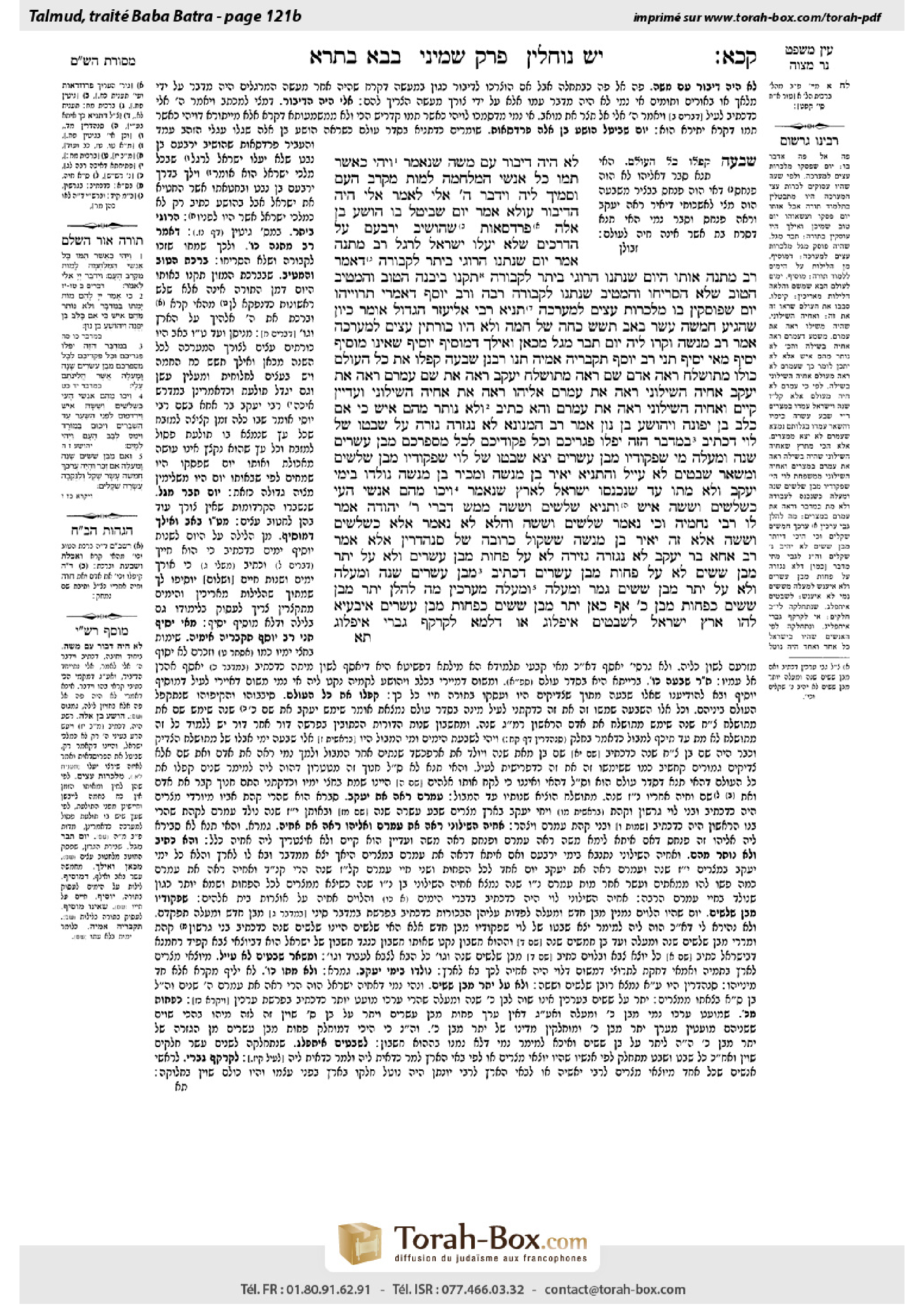
Bava Batra 121b: Talmud study for Daf Yomi
Study the Talmud for Daf Yomi with scanned pages, Hebrew text, English translations from Sefaria and AI-generated French translations.
Passage selection and English or AI-generated French translation are available where the scan has annotations. Daf Study is independent of Torah-Box and Sefaria.
Browse Bava Batra · בבא בתרא · All tractatesBava Batra 121b text and translations
This page of Bava Batra includes the Aramaic text, an English translation and an AI-generated French translation, alongside the scan above.
בבא בתרא קכ״א ב · Aramaic and Hebrew text
לֹא הָיָה דִּיבּוּר עִם מֹשֶׁה – שֶׁנֶּאֱמַר: ״וַיְהִי כַּאֲשֶׁר תַּמּוּ כׇּל אַנְשֵׁי הַמִּלְחָמָה לָמוּת מִקֶּרֶב הָעָם״, וּסְמִיךְ לֵיהּ: ״וַיְדַבֵּר ה׳ אֵלַי לֵאמֹר״ – אֵלַי הָיָה הַדִּיבּוּר.
עוּלָּא אָמַר: יוֹם שֶׁבִּיטֵּל בּוֹ הוֹשֵׁעַ בֶּן אֵלָה פַּרְדְּסָאוֹת שֶׁהוֹשִׁיב יָרׇבְעָם עַל הַדְּרָכִים, שֶׁלֹּא יַעֲלוּ יִשְׂרָאֵל לָרֶגֶל.
רַב מַתְנָה אָמַר: יוֹם שֶׁנִּתְּנוּ הֲרוּגֵי בֵיתָר לִקְבוּרָה. דְּאָמַר רַב מַתְנָה: אוֹתוֹ הַיּוֹם שֶׁנִּתְּנוּ הֲרוּגֵי בֵיתָר לִקְבוּרָה – תִּקְנוּ בְּיַבְנֶה ״הַטּוֹב וְהַמֵּטִיב״; ״הַטּוֹב״ – שֶׁלֹּא הִסְרִיחוּ, ״וְהַמֵּטִיב״ – שֶׁנִּתְּנוּ לִקְבוּרָה.
רַבָּה וְרַב יוֹסֵף דְּאָמְרִי תַּרְוַיְיהוּ: יוֹם שֶׁפּוֹסְקִין בּוֹ מִלִּכְרוֹת עֵצִים לַמַּעֲרָכָה. תַּנְיָא, רַבִּי אֱלִיעֶזֶר הַגָּדוֹל אוֹמֵר: כֵּיוָן שֶׁהִגִּיעַ חֲמִשָּׁה עָשָׂר בְּאָב – תָּשַׁשׁ כֹּחָהּ שֶׁל חַמָּה, וְלֹא הָיוּ כּוֹרְתִין עֵצִים לַמַּעֲרָכָה. אָמַר רַב מְנַשֶּׁה: וְקָרוּ לֵיהּ ״יוֹם תְּבַר מַגָּל״.
מִכָּאן וְאֵילָךְ, דְּמוֹסִיף – יוֹסִיף, שֶׁאֵינוֹ מוֹסִיף – יְסִיף. מַאי ״יְסִיף״? תָּנֵי רַב יוֹסֵף: תִּקְבְּרֵיהּ אִמֵּיהּ.
תָּנוּ רַבָּנַן: שִׁבְעָה קִפְּלוּ אֶת כָּל הָעוֹלָם כּוּלּוֹ – מְתוּשֶׁלַח רָאָה אָדָם, שֵׁם רָאָה מְתוּשֶׁלַח, יַעֲקֹב רָאָה אֶת שֵׁם, עַמְרָם רָאָה אֶת יַעֲקֹב, אֲחִיָּה הַשִּׁילוֹנִי רָאָה אֶת עַמְרָם, אֵלִיָּהוּ רָאָה אֶת אֲחִיָּה הַשִּׁילוֹנִי – וַעֲדַיִין קַיָּים.
וַאֲחִיָּה הַשִּׁילוֹנִי רָאָה אֶת עַמְרָם? וְהָא כְּתִיב: ״וְלֹא נוֹתַר מֵהֶם אִישׁ, כִּי אִם כָּלֵב בֶּן יְפֻנֶּה וִיהוֹשֻׁעַ בִּן נוּן״!
אָמַר רַב הַמְנוּנָא: לֹא נִגְזְרָה גְּזֵרָה עַל שִׁבְטוֹ שֶׁל לֵוִי, דִּכְתִיב: ״בַּמִּדְבָּר הַזֶּה יִפְּלוּ פִגְרֵיכֶם וְכׇל פְּקֻדֵיכֶם לְכׇל מִסְפַּרְכֶם מִבֶּן עֶשְׂרִים שָׁנָה וָמָעְלָה״ – מִי שֶׁפְּקוּדָיו מִבֶּן עֶשְׂרִים; יָצָא שִׁבְטוֹ שֶׁל לֵוִי, שֶׁפְּקוּדָיו מִבֶּן שְׁלֹשִׁים.
וּמִשְּׁאָר שְׁבָטִים לָא עֲיֻיל? וְהָתַנְיָא: יָאִיר בֶּן מְנַשֶּׁה וּמָכִיר בֶּן מְנַשֶּׁה נוֹלְדוּ בִּימֵי יַעֲקֹב, וְלֹא מֵתוּ עַד שֶׁנִּכְנְסוּ יִשְׂרָאֵל לָאָרֶץ – שֶׁנֶּאֱמַר: ״וַיַּכּוּ מֵהֶם אַנְשֵׁי הָעַי כִּשְׁלֹשִׁים וְשִׁשָּׁה אִישׁ״, וְתַנְיָא: שְׁלֹשִׁים וְשִׁשָּׁה מַמָּשׁ, דִּבְרֵי רַבִּי יְהוּדָה.
אָמַר לוֹ רַבִּי נְחֶמְיָה: וְכִי נֶאֱמַר ״שְׁלֹשִׁים וְשִׁשָּׁה״? וַהֲלֹא לֹא נֶאֱמַר אֶלָּא ״כִּשְׁלֹשִׁים וְשִׁשָּׁה״! אֶלָּא זֶה יָאִיר בֶּן מְנַשֶּׁה, שֶׁשָּׁקוּל כְּרוּבָּהּ שֶׁל סַנְהֶדְרִין!
אֶלָּא אָמַר רַב אַחָא בַּר יַעֲקֹב: לֹא נִגְזְרָה גְּזֵירָה לֹא עַל פָּחוּת מִבֶּן עֶשְׂרִים, וְלֹא עַל יָתֵר מִבֶּן שִׁשִּׁים. לֹא עַל פָּחוּת מִבֶּן עֶשְׂרִים – דִּכְתִיב: ״מִבֶּן עֶשְׂרִים שָׁנָה וּמַעְלָה״. וְלֹא עַל יָתֵר מִבֶּן שִׁשִּׁים – גָּמַר ״וּמַעְלָה״–״וּמַעְלָה״ מֵעֲרָכִין; מָה לְהַלָּן – יָתֵר מִבֶּן שִׁשִּׁים כְּפָחוּת מִבֶּן עֶשְׂרִים, אַף כָּאן – יָתֵר מִבֶּן שִׁשִּׁים כְּפָחוּת מִבֶּן עֶשְׂרִים.
אִיבַּעְיָא לְהוּ: אֶרֶץ יִשְׂרָאֵל – לִשְׁבָטִים אִיפְּלוּג, אוֹ דִּלְמָא לְקַרְקַף גַּבְרֵי אִיפְּלוּג?
Bava Batra 121b · English translation
God did not speak with Moses, as it is stated: “So it came to pass, when all the men of war were consumed and dead from among the people” (Deuteronomy 2:16), and juxtaposed to that verse it is written: “That the Lord spoke to me, saying” (Deuteronomy 2:17). Moses indicates: Only after the last of that generation had died, was the speech of God directed to me. When the Jewish people realized that the decree had been lifted, the day was established as a permanent day of rejoicing.
The Gemara continues to cite explanations for the significance of the fifteenth of Av. Ulla says: The fifteenth of Av was the day when King Hoshea, son of Ela, removed the guards [pardesaot] that Jeroboam, son of Nevat, placed on the roads so that Israel would not ascend to Jerusalem for the pilgrimage Festival. By doing so, King Hoshea renewed the access to Jerusalem for pilgrims.
Rav Mattana says: The fifteenth of Av was the day when the slain victims of Beitar were afforded burial, several years after they were killed and the Roman emperor Hadrian decreed that they were not to be buried (see Gittin 57a). As Rav Mattana says: On the day that the slain of Beitar were afforded burial, the Sages in Yavne instituted the blessing: Blessed is He Who is good and Who does good. The term: Who is good, is to give thanks that the corpses did not decompose despite the long delay; and the term: And Who does good, is to give thanks that the slain ones were ultimately afforded burial.
Rabba and Rav Yosef both say: The fifteenth of Av is the day when they stop cutting wood for the arrangement of wood on the altar. It is taught in a baraita that Rabbi Eliezer the Great says: Once the fifteenth of Av came, the force of the sun would weaken, and from this date they would not cut additional wood for the arrangement, because wood cut from then on would not dry properly and would be unfit for use in the Temple. Rav Menashe said: And the people called the fifteenth of Av: The day of the breaking of the sickle [maggal ], as they did not need the lumbering tools until the following year.
The Gemara adds: From this point forward, when the nights lengthen, one who adds [demosif ] to his nightly Torah study will add [yosif ] to his life, and he who does not add, that person is yesif. The Gemara asks: What is the meaning of the term yesif ? Rav Yosef teaches: It means that his mother will bury him, as he will die during his mother’s lifetime.
§ After discussing the generation of those who died in the wilderness, the Gemara mentions a tradition that relates to that generation. The Sages taught: Seven people spanned in their lifetimes the whole world in its entirety, i.e., their lives have spanned all of human history. Methuselah saw Adam in his lifetime; Shem saw Methuselah; Jacob saw Shem; Amram saw Jacob; Ahijah the Shilonite saw Amram; Elijah saw Ahijah the Shilonite; and Elijah is still alive.
The Gemara asks: And is it true that Ahijah the Shilonite saw Amram? But it is written: “And no man among them remained, save Caleb, son of Jephunneh, and Joshua, son of Nun” (Numbers 26:65). Since Amram died well before the Jewish people left Egypt, in order to have lived at the time of Amram, Ahijah would have had to be an adult at the time of the Exodus. How, then, could he have lived through the generation of those who died in the wilderness?
Rav Hamnuna says: The decree of death pronounced for the generation of the spies was not decreed upon the tribe of Levi, as it is written: “Your carcasses shall fall in this wilderness, and all those who were counted among you, according to your whole number, from twenty years old and upward” (Numbers 14:29). The verse is interpreted: The decree applies to one whose count in the census is from the age of twenty and up, excluding the tribe of Levi, whose count is from the age of thirty and up. Ahijah was a Levite, and he was not subject to the decree.
The Gemara asks: And is it true that no one from the other tribes entered Eretz Yisrael? But isn’t it taught in a baraita: Yair, son of Manasseh, and Machir, son of Manasseh, were born in the days of Jacob, and they did not die until the Jewish people entered Eretz Yisrael, as it is stated: “And the men of Ai killed of them about thirty-six men” (Joshua 7:5). And concerning this verse, it is taught: Literally thirty-six people were killed, this is the statement of Rabbi Yehuda.
Rabbi Neḥemya said to him: But is it stated that thirty-six were killed? Isn’t it stated nothing other than: “About thirty-six” were killed? Rather, this unusual term is referring to Yair, son of Manasseh, who was equivalent to the majority of the Sanhedrin, whose maximum number of judges is seventy-one, of which thirty-six is a slight majority. Evidently, then, Yair, son of Manasseh also survived the time in the wilderness.
Rather, Rav Aḥa bar Ya’akov said: The decree of death was not decreed either upon those less than twenty years old or upon those more than sixty years old at the time of the sin of the spies. The Gemara explains: Not upon those less than twenty years old, as it is written: “From twenty years old and upward” (Numbers 14:29). And not upon those more than sixty years old, because he learns that there is a verbal analogy between “and upward” in the verse cited, and “and upward” from the halakhot of valuations, in the phrase: “From sixty years old and upward” (Leviticus 27:7). Just as there, concerning valuations, more than sixty years old is comparable to less than twenty years old, as there is a distinct category of those between the ages of twenty and sixty, so too here, more than sixty years old is comparable to less than twenty years old insofar as those older were not subject to the sentence. Yair, son of Manasseh, who was already older, did not die in the wilderness.
§ A dilemma was raised before the Sages: Was Eretz Yisrael divided according to the tribes, meaning that each of the twelve tribes received an equal portion, and the members of each tribe divided these tribal portions according to their numbers; or perhaps Eretz Yisrael was divided according to men’s skulls, meaning that a certain area of land was given to each individual, and the size of the tribal allotments was a function of the tribe’s population?
Bava Batra 121b · Traduction française (IA)
Dieu n'a pas parlé à Moïse, comme il est dit : « Il arriva que tous les hommes de guerre furent consumés et moururent du peuple » (Deutéronome 2:16), et juxtaposé à cette parole, il est écrit : « Et le Seigneur parla à moi, disant » (Deutéronome 2:17). Moïse indique : Seulement après que le dernier de cette génération eut péri, la parole de Dieu s'est tournée vers moi. Lorsque le peuple juif réalisa que le décret avait été levé, la journée fut établie comme une journée permanente de joie.
La Guemara continue à citer des explications sur la signification du quinzième d'Av. Ulla dit : Le quinzième d'Av était la journée où le roi Hoshea, fils d'Ela, a retiré les gardes [pardesaot] que Jéroboam, fils de Névat, avait placés sur les routes afin que Israël ne montât pas à Jérusalem pour la fête de la Pèlerinage. En le faisant, le roi Hoshea a rétabli l'accès à Jérusalem pour les pèlerins.
Rav Mattana dit : Le quinzième d'Av était la journée où les victimes tuées à Béitar furent enterrées, plusieurs années après leur mort et après que l'empereur romain Hadrien eut décrété qu'elles ne devaient pas être enterrées (voir Gittin 57a). Comme Rav Mattana dit : Le jour où les victimes de Béitar furent enterrées, les Sages à Yavne ont institué la bénédiction : Béni soit Celui qui est bon et qui fait le bien. Le terme : Qui est bon, est pour remercier que les cadavres n'avaient pas pourri malgré le long délai ; et le terme : Et Qui fait le bien, est pour remercier que les victimes furent finalement enterrées.
Rabba et Rav Yosef disent tous les deux : Le quinzième d'Av est la journée où ils arrêtent de couper du bois pour l'empilement sur l'autel. Il est enseigné dans une baraïta que Rabbi Eliezer le Grand dit : Dès que le quinzième d'Av est arrivé, la force du soleil s'affaiblissait, et à partir de cette date, ils ne coupaient plus de bois pour l'empilement, car le bois coupé à partir de ce moment-là ne séchait pas correctement et était inutilisable dans le Temple. Rav Menashe dit : Et le peuple appelait le quinzième d'Av : Le jour de la rupture de la faux [maggal], car ils n'avaient plus besoin des outils de bois jusqu'à l'année suivante.
La Guemara ajoute : À partir de ce moment, lorsque les nuits s'allongent, celui qui ajoute [demosif] à son étude de Torah la nuit ajoutera [yosif] à sa vie, et celui qui n'ajoute pas, cette personne est yesif. La Guemara demande : Quelle est la signification du terme yesif ? Rav Yosef enseigne : Cela signifie que sa mère l'enterrera, car il mourra durant la vie de sa mère.
§ Après avoir discuté de la génération de ceux qui sont morts dans le désert, la Guemara mentionne une tradition qui se rapporte à cette génération. Les Sages enseignèrent : Sept personnes couvrirent, durant leur vie, l'ensemble du monde, c'est-à-dire que leurs vies couvrirent toute l'histoire humaine. Matusalab vit Adam durant sa vie ; Shem vit Matusalab ; Jacob vit Shem ; Amran vit Jacob ; Ahijah le Chilhonite vit Amran ; Eliehou vit Ahijah le Chilhonite ; et Eliehou est encore vivant.
La Guemara demande : Et est-ce vrai que Ahijah le Chilhonite ait vu Amran ? Mais il est écrit : « Et aucun homme parmi eux ne resta, sauf Caleb, fils de Jephunneh, et Josué, fils de Nun » (Nombres 26:65). Puisque Amran mourut bien avant que le peuple juif ne quitte l'Égypte, afin de vivre à l'époque d'Amran, Ahijah aurait dû être adulte au moment de l'Exode. Comment, alors, pouvait-il avoir vécu durant la génération de ceux qui moururent dans le désert ?
Rav Hamnuna dit : Le décret de mort prononcé pour la génération des espions ne fut pas appliqué au clan de Lévi, comme il est écrit : « Vos cadavres tomberont dans ce désert, et tous ceux qui furent comptés parmi vous, selon votre nombre total, de vingt ans et au-dessus » (Nombres 14:29). La parole est interprétée : Ce décret s'applique à celui dont le recensement est à partir de l'âge de vingt ans, excluant le clan de Lévi, dont le recensement est à partir de l'âge de trente ans. Ahijah était un Lévi, et il n'était pas soumis au décret.
La Guemara demande : Et est-ce vrai que personne des autres tribus n'entrât en Terre d'Israël ? Mais n'est-il pas enseigné dans une baraïta : Yair, fils de Manassé, et Machir, fils de Manassé, furent nés durant la vie de Jacob, et ils ne moururent pas jusqu'au moment où le peuple juif entra en Terre d'Israël, comme il est dit : « Et les hommes d'Ai tuèrent parmi eux environ trente-six hommes » (Josué 7:5). Et concernant cette parole, il est enseigné : Littéralement trente-six personnes furent tuées, c'est la déclaration de Rabbi Yéhouda.
Rabbi Néchemyah dit à lui : Mais est-il dit que trente-six furent tués ? N'est-il pas dit autre chose que : « Environ trente-six » furent tués ? Plutôt, ce terme inhabituel fait référence à Yair, fils de Manassé, qui était équivalent à la majorité du Sanhédrin, dont le nombre maximum de juges est soixante-et-onze, dont trente-six est une majorité légère. Évidemment, alors, Yair, fils de Manassé, a également survécu à la période du désert.
Plutôt, Rav Acha bar Ya'akov dit : Le décret de mort ne fut pas appliqué ni aux moins de vingt ans ni aux plus de soixante ans au moment du péché des espions. La Guemara explique : Pas aux moins de vingt ans, car il est écrit : « De vingt ans et au-dessus » (Nombres 14:29). Et pas aux plus de soixante ans, car il apprend qu'il y a une analogie verbale entre « et au-dessus » dans la parole citée et « et au-dessus » dans les halakhot des estimations, dans la phrase : « De soixante ans et au-dessus » (Lévitique 27:7). Comme là, concernant les estimations, plus de soixante ans est comparable à moins de vingt ans, car il y a une catégorie distincte entre vingt et soixante ans, ainsi aussi ici, plus de soixante ans est comparable à moins de vingt ans en ce qui concerne ceux qui étaient plus âgés, qui n'étaient pas soumis à la sentence. Yair, fils de Manassé, qui était déjà plus âgé, n'est pas mort dans le désert.
§ Un dilemme a été soulevé devant les Sages : La Terre d'Israël était-elle divisée selon les tribus, c'est-à-dire que chaque une des douze tribus recevait une part égale, et que les membres de chaque tribu partageaient ces portions tribales selon leur nombre ; ou bien la Terre d'Israël était-elle divisée selon les individus, c'est-à-dire qu'une certaine surface de terre était donnée à chaque individu, et que la taille des portions tribales était fonction de la population de la tribu ?
Traduction française générée par IA à partir de l’édition anglaise de Sefaria. Vérifie toujours un passage avec le texte source.
Text from Sefaria: William Davidson Edition - Vocalized Aramaic (CC BY NC); William Davidson Edition - English (CC BY NC).