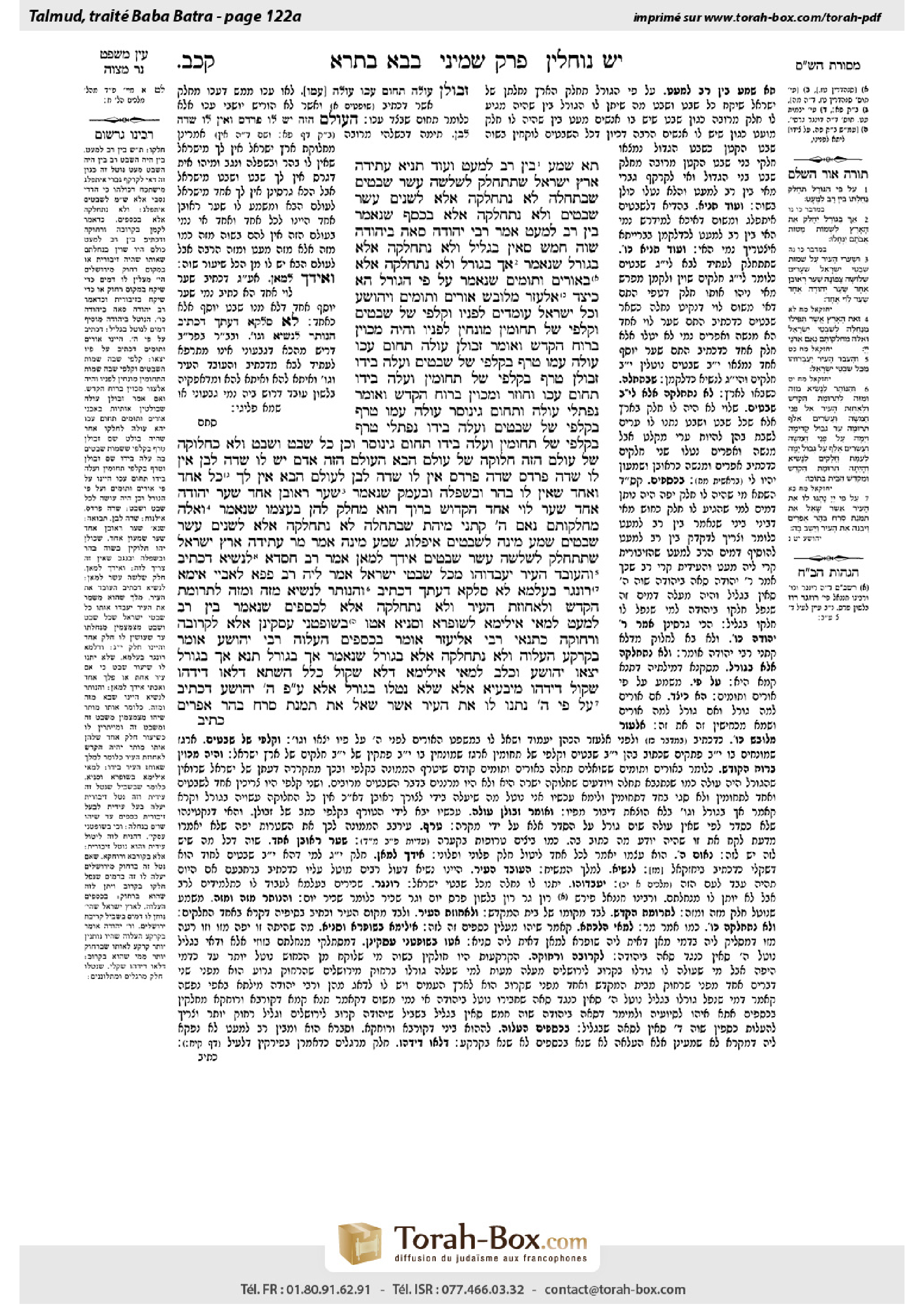
Bava Batra 122a: Talmud study for Daf Yomi
Study the Talmud for Daf Yomi with scanned pages, Hebrew text, English translations from Sefaria and AI-generated French translations.
Passage selection and English or AI-generated French translation are available where the scan has annotations. Daf Study is independent of Torah-Box and Sefaria.
Browse Bava Batra · בבא בתרא · All tractatesBava Batra 122a text and translations
This page of Bava Batra includes the Aramaic text, an English translation and an AI-generated French translation, alongside the scan above.
בבא בתרא קכ״ב א · Aramaic and Hebrew text
תָּא שְׁמַע: ״בֵּין רַב לִמְעָט״.
וְעוֹד, תַּנְיָא: עֲתִידָה אֶרֶץ יִשְׂרָאֵל שֶׁתִּתְחַלֵּק לִשְׁלֹשָׁה עָשָׂר שְׁבָטִים – שֶׁבַּתְּחִלָּה לֹא נִתְחַלְּקָה אֶלָּא לִשְׁנֵים עָשָׂר שְׁבָטִים. וְלֹא נִתְחַלְּקָה אֶלָּא בְּכֶסֶף – שֶׁנֶּאֱמַר: ״בֵּין רַב לִמְעָט״. אָמַר רַבִּי יְהוּדָה: סְאָה בִּיהוּדָה, שָׁוָה חָמֵשׁ סְאִין בַּגָּלִיל.
וְלֹא נִתְחַלְּקָה אֶלָּא בְּגוֹרָל – שֶׁנֶּאֱמַר: ״אַךְ בְּגוֹרָל״. וְלֹא נִתְחַלְּקָה אֶלָּא בְּאוּרִים וְתוּמִּים – שֶׁנֶּאֱמַר: ״עַל פִּי הַגּוֹרָל״.
הָא כֵּיצַד? אֶלְעָזָר מְלוּבָּשׁ אוּרִים וְתוּמִּים, וִיהוֹשֻׁעַ וְכׇל יִשְׂרָאֵל עוֹמְדִים לְפָנָיו; וְקַלְפִּי שֶׁל שְׁבָטִים וְקַלְפִּי שֶׁל תְּחוּמִין מוּנָּחִין לְפָנָיו;
וְהָיָה מְכַוֵּין בְּרוּחַ הַקֹּדֶשׁ וְאוֹמֵר: זְבוּלֻן עוֹלֶה, תְּחוּם עַכּוֹ עוֹלֶה עִמּוֹ. טָרַף בְּקַלְפִּי שֶׁל שְׁבָטִים – וְעָלָה בְּיָדוֹ זְבוּלֻן, טָרַף בְּקַלְפִּי שֶׁל תְּחוּמִין – וְעָלָה בְּיָדוֹ תְּחוּם עַכּוֹ.
וְחוֹזֵר וּמְכַוֵּין בְּרוּחַ הַקֹּדֶשׁ וְאוֹמֵר: נַפְתָּלִי עוֹלֶה, וּתְחוּם גִּינּוֹסַר עוֹלֶה עִמּוֹ. טָרַף בְּקַלְפִּי שֶׁל שְׁבָטִים – וְעָלָה בְּיָדוֹ נַפְתָּלִי, טָרַף בְּקַלְפִּי שֶׁל תְּחוּמִין – וְעָלָה בְּיָדוֹ תְּחוּם גִּינּוֹסַר. וְכֵן כׇּל שֵׁבֶט וָשֵׁבֶט.
וְלֹא כַּחֲלוּקָּה שֶׁל עוֹלָם הַזֶּה, חֲלוּקָּה שֶׁל עוֹלָם הַבָּא. הָעוֹלָם הַזֶּה, אָדָם יֵשׁ לוֹ שְׂדֵה לָבָן – אֵין לוֹ שְׂדֵה פַרְדֵּס, שְׂדֵה פַרְדֵּס – אֵין לוֹ שְׂדֵה לָבָן. לָעוֹלָם הַבָּא, אֵין לָךְ כׇּל אֶחָד וְאֶחָד שֶׁאֵין לוֹ בָּהָר וּבַשְּׁפֵלָה וּבָעֵמֶק, שֶׁנֶּאֱמַר: שַׁעַר רְאוּבֵן אֶחָד, שַׁעַר יְהוּדָה אֶחָד, שַׁעַר לֵוִי אֶחָד״. הַקָּדוֹשׁ בָּרוּךְ הוּא מְחַלֵּק לָהֶן בְּעַצְמוֹ, שֶׁנֶּאֱמַר: ״וְאֵלֶּה מַחְלְקֹתָם נְאֻם ה׳״.
קָתָנֵי מִיהַת: ״שֶׁבַּתְּחִלָּה לֹא נִתְחַלְּקָה אֶלָּא לִשְׁנֵים עָשָׂר שְׁבָטִים״; שְׁמַע מִינַּהּ, לִשְׁבָטִים אִיפְּלוּג! שְׁמַע מִינַּהּ.
אָמַר מָר: עֲתִידָה אֶרֶץ יִשְׂרָאֵל שֶׁתִּתְחַלֵּק לִשְׁלֹשָׁה עָשָׂר שְׁבָטִים. אִידַּךְ לְמַאן? אָמַר רַב חִסְדָּא: לְנָשִׂיא, דִּכְתִיב: ״וְהָעֹבֵד הָעִיר יַעַבְדוּהוּ מִכֹּל שִׁבְטֵי יִשְׂרָאֵל״. אֲמַר לֵיהּ רַב פָּפָּא לְאַבָּיֵי, אֵימָא רוּנְגָּר בְּעָלְמָא! לָא סָלְקָא דַּעְתָּךְ, דִּכְתִיב: ״וְהַנּוֹתָר לַנָּשִׂיא מִזֶּה וּמִזֶּה, לִתְרוּמַת הַקֹּדֶשׁ וְלַאֲחֻזַּת הָעִיר״.
וְלֹא נִתְחַלְּקָה אֶלָּא לִכְסָפִים – שֶׁנֶּאֱמַר: ״בֵּין רַב לִמְעָט״. לְמַאי? אִילֵּימָא לְשׁוּפְרָא וְסַנְיָא, אַטּוּ בְּשׁוּפְטָנֵי עָסְקִינַן? אֶלָּא לִקְרוֹבָה וּרְחוֹקָה.
כְּתַנָּאֵי – רַבִּי אֱלִיעֶזֶר אוֹמֵר: בִּכְסָפִים הֶעֱלוּהָ. רַבִּי יְהוֹשֻׁעַ אוֹמֵר: בְּקַרְקַע הֶעֱלוּהָ.
וְלֹא נִתְחַלְּקָה אֶלָּא בְּגוֹרָל – שֶׁנֶּאֱמַר: ״אַךְ בְּגוֹרָל״. תָּנָא: ״אַךְ בְּגוֹרָל״ – יָצְאוּ יְהוֹשֻׁעַ וְכָלֵב. לְמַאי? אִילֵּימָא דְּלָא שְׁקוּל כְּלָל; הַשְׁתָּא דְּלָאו דִּידְהוּ שְׁקוּל, דִּידְהוּ מִיבַּעְיָא?! אֶלָּא שֶׁלֹּא נָטְלוּ בְּגוֹרָל, אֶלָּא עַל פִּי ה׳. יְהוֹשֻׁעַ – דִּכְתִיב: ״עַל פִּי ה׳ נָתְנוּ לוֹ אֶת הָעִיר אֲשֶׁר שָׁאָל, אֶת תִּמְנַת סֶרַח בְּהַר אֶפְרָיִם״.
Bava Batra 122a · English translation
The Gemara suggests: Come and hear a proof. The verse states: “According to the lot shall their inheritance be divided between the more and the fewer” (Numbers 26:56). Evidently, whether the tribe had many or few people, the tribe as a whole received a portion equal to that of every other tribe, and each individual within the tribe received a different amount of land than those in other tribes.
And another proof can be seen from that which is taught in a baraita: Eretz Yisrael is destined to be divided among thirteen tribes during the messianic era, unlike the division in the time of Joshua. As, initially the land was divided only among twelve tribes, as the Torah does not allot a portion to the tribe of Levi. The baraita continues: And the land was divided only with money, such that each tribe that received a portion more valuable than average compensated another tribe that had received a portion less valuable than average, as it is stated: “Between the more and the fewer.” Rabbi Yehuda said: The area of land whose yield is a se’a of grain in Judea is so valuable that it is equal in value to the area necessary to produce five se’a of grain in the Galilee.
The baraita continues: And the land was divided only by a lottery, as it is stated: “Only by lot shall the land be divided” (Numbers 26:55). And the land was divided only with the Urim VeTummim, as it is stated: “By the pronouncement of the lot” (Numbers 26:56).
The baraita asks: How can these texts be reconciled? One indicates that the land was divided by lottery and the other indicates that the land was divided with the Urim VeTummim. The baraita explains: Elazar the High Priest was dressed with the Urim VeTummim, and Joshua and all the Jewish people were standing before him, and a lottery receptacle containing the names of the tribes and another lottery receptacle containing the names of the boundaries of the twelve different regions of Eretz Yisrael were placed before him.
And Elazar would ascertain the assignments of land with the Divine Spirit and say, in accordance with the notification of the Urim VeTummim: The name of the tribe Zebulun now emerges from the receptacle in the lottery, and the region whose boundary is Akko emerges with it from the other receptacle. After stating this, he would mix the lots in the receptacle of the tribes and the lot of Zebulun would emerge in his hand. He would then mix the lots in the receptacle of the boundaries, and the boundary of Akko would emerge in his hand.
And Elazar would repeat the process and ascertain the assignments with the Divine Spirit and say: The name of the tribe Naftali now emerges, and the region whose boundary is Ginnosar emerges with it from the other receptacle. After stating this, he would mix the lots in the receptacle of the tribes and the lot of Naftali would emerge in his hand. He would then mix the lots in the receptacle of the boundaries, and the boundary of Ginnosar would emerge in his hand. And so he would proceed for each and every tribe.
The baraita continues: And unlike the division in this world, i.e., in the time of Joshua, will be the division of portions in the World-to-Come, i.e., in the messianic era. In this world, if a person has a field of grain, he does not have a field for an orchard; if he has a field for an orchard, he does not have a field of grain. This is so because each climate and variety of soil is suitable for a different type of produce. But in the World-to-Come, you do not have any person who does not have a portion in Eretz Yisrael in the mountain, and in the lowland, and in the valley, as it is stated: “The gate of Reuben, one; the gate of Judah, one; the gate of Levi, one” (Ezekiel 48:31), which is to say that everyone’s portion will be the same. And the Holy One, Blessed be He, will distribute it to them personally, as it is stated: “And these are their portions, says the Lord” (Ezekiel 48:29). This is the conclusion of the baraita.
The Gemara states its proof: In any event, the baraita teaches: As initially, the land was divided only among the twelve tribes. Conclude from the baraita that the land was divided according to the tribes, and not apportioned directly to each person. The Gemara affirms: Conclude from the baraita that this is the case.
§ The Gemara returns to analyze the baraita just cited. The Master says above: Eretz Yisrael is destined to be divided among thirteen tribes. The Gemara asks: As to the other, thirteenth portion, for whom is it? Rav Ḥisda said: For the king, as it is written: “And they that serve the city, out of all the tribes of Israel, shall till it” (Ezekiel 48:19). The verse is understood as meaning that the nation will collectively allot a portion to the king, who serves the needs of the nation. Rav Pappa said to Abaye: Why is the verse interpreted in this way? Say that the verse speaks of mere wages [rongar], so that the king has rights to collect taxes, but not an actual portion of land. The Gemara answers: That possibility should not enter your mind, as it is written: “And the residue shall be for the prince, on the one side and on the other of the sacred offering and of the possession of the city” (Ezekiel 48:21). Based on this latter verse, the former verse speaks of a specific tract of land.
The baraita also states: And the land was divided only with money, as it is stated: “Between the more and the fewer.” With regard to what is this said? If we say it is with regard to beauty and ugliness, i.e., that those who receive inferior-quality land received monetary compensation from the others, is that to say we are dealing with fools [beshufetanei] who would agree to take inferior-quality land in exchange for more money? Rather, it is said with regard to the difference between land that is close to Jerusalem and land that is far from Jerusalem. Those whose property was close to Jerusalem compensated those whose property was farther away.
The Gemara notes: There is a dispute between tanna’im with regard to the manner by which this compensation was given: Rabbi Eliezer says: The tribes compensated each other with money. Rabbi Yehoshua says: The tribes compensated each other with land by giving extra land to those whose portions were in less advantageous locations.
The baraita also states: And the land was divided only by a lottery, as it is stated: “Only by lot shall the land be divided” (Numbers 26:55). The Sages taught: In the phrase “only by lot,” the term “only” indicates that Joshua and Caleb are excluded from this proviso. The Gemara asks: With regard to what were they excluded? If we say that they did not take portions at all, now that it has already been taught that they took the portions of the spies (118b) that were not their own, is it necessary to teach that they took their own portions? It goes without saying that they did collect their portions. Rather, the exclusion teaches that they did not take portions by a lottery but according to explicit designation by the Lord. With regard to Joshua, this is as it is written: “According to the commandment of the Lord they gave him the city that he asked, even Timnath Serah in the hill-country of Ephraim” (Joshua 19:50).
Bava Batra 122a · Traduction française (IA)
La Guemara suggère : Approchez-vous et entendez une preuve. La Sainte Écriture dit : « Selon le sort, leur héritage sera divisé entre le plus nombreux et le moins nombreux » (Nombres 26:56). Évidemment, qu'importe que la tribu ait eu beaucoup ou peu de personnes, la tribu dans son ensemble recevait une part égale à celle de chaque autre tribu, et chaque individu au sein de la tribu recevait une quantité différente de terre que ceux des autres tribus.
Une autre preuve peut être vue à partir de ce qui est enseigné dans une baraïta : La Terre d'Israël est destinée à être divisée parmi treize tribus lors de l'ère messianique, contrairement à la division à l'époque de Josué. En effet, initialement la terre fut divisée seulement parmi douze tribus, car la Torah ne réserve pas de part à la tribu de Lévi. La baraïta continue : Et la terre fut divisée seulement avec de l'argent, de sorte que chaque tribu qui reçut une part plus précieuse que la moyenne compensa une autre tribu qui avait reçu une part moins précieuse que la moyenne, comme il est dit : « Entre le plus nombreux et le moins nombreux. » Rabbi Yéhuda dit : La surface de terre dont le rendement est un sé'ah de céréale en Juda est si précieuse qu'elle équivaut en valeur à la surface nécessaire pour produire cinq sé'ah de céréale en Galilée.
La baraïta continue : Et la terre fut divisée seulement par un sort, comme il est dit : « Seulement par le sort la terre sera divisée » (Nombres 26:55). Et la terre fut divisée seulement avec les Urim VeTummim, comme il est dit : « Par la déclaration du sort » (Nombres 26:56).
La baraïta pose la question : Comment ces textes peuvent-ils être conciliés ? L'un indique que la terre fut divisée par le sort et l'autre indique qu'elle fut divisée avec les Urim VeTummim. La baraïta explique : Eléazar le Grand Prêtre était vêtu des Urim VeTummim, et Josué et tout le peuple juif étaient debout devant lui, et deux récipients de sort contenant les noms des tribus et un autre récipient contenant les noms des limites des douze régions différentes de la Terre d'Israël étaient placés devant lui.
Et Eléazar déterminait les assignations de terre par l'Esprit Saint et disait, conformément à l'annonce des Urim VeTummim : Le nom de la tribu de Zébulon émerge maintenant du récipient du sort, et la région dont la limite est Akko émerge avec elle du récipient des limites. Après avoir dit cela, il mélangeait les sorts dans le récipient des tribus et le sort de Zébulon émergeait dans sa main. Il mélangeait ensuite les sorts dans le récipient des limites, et la limite d'Akko émergeait dans sa main.
Et Eléazar répétait le processus et déterminait les assignations par l'Esprit Saint et disait : Le nom de la tribu de Naftalî émerge maintenant, et la région dont la limite est Ginnosar émerge avec elle du récipient des limites. Après avoir dit cela, il mélangeait les sorts dans le récipient des tribus et le sort de Naftalî émergeait dans sa main. Il mélangeait ensuite les sorts dans le récipient des limites, et la limite de Ginnosar émergeait dans sa main. Et ainsi de suite pour chaque tribu.
La baraïta continue : Et contrairement à la division dans ce monde, c'est-à-dire à l'époque de Josué, sera la division des parts dans le Monde à Venir, c'est-à-dire dans l'ère messianique. Dans ce monde, si une personne a un champ de céréales, il n'a pas de champ pour un verger ; si elle a un champ pour un verger, elle n'a pas de champ de céréales. Cela est ainsi parce que chaque climat et chaque variété de sol est adapté à un type différent de production. Mais dans le Monde à Venir, il n'y aura personne qui n'aurait pas une part en la Terre d'Israël, montagne, vallée et plaine, comme il est dit : « La porte de Rouben, une ; la porte de Juda, une ; la porte de Lévi, une » (Ezéchiel 48:31), ce qui signifie que la part de chacun sera la même. Et le Saint, le Bienheureux, distribuera personnellement cela à chacun, comme il est dit : « Et ces sont leurs parts, dit l'Éternel » (Ezéchiel 48:29). C'est la conclusion de la baraïta.
La Guemara énonce sa preuve : En tout cas, la baraïta enseigne : Comme initialement, la terre fut divisée seulement parmi les douze tribus. Concluez de la baraïta que la terre fut divisée selon les tribus, et non directement à chaque personne. La Guemara affirme : Concluez de la baraïta que c'est ainsi.
§ La Guemara reprend l'analyse de la baraïta citée précédemment. Le Maître dit ci-dessus : La Terre d'Israël est destinée à être divisée parmi treize tribus. La Guemara pose la question : À propos de la treizième part, pour qui est-elle ? Rav Hizda dit : Pour le roi, comme il est écrit : « Et ceux qui servent la ville, parmi toutes les tribus d'Israël, labourent » (Ezéchiel 48:19). La Sainte Écriture est comprise comme signifiant que le peuple allouera collectivement une part au roi, qui sert les besoins du peuple. Rav Pappa dit à Abaye : Pourquoi cette interprétation est-elle faite ? Dites que la Sainte Écriture parle de salaires, de sorte que le roi a des droits pour collecter des impôts, mais pas une part de terre réelle. La Guemara répond : Cette possibilité ne devrait pas entrer dans votre esprit, comme il est écrit : « Et le reste sera pour le prince, à l'une et à l'autre des offrandes sacrées et de la possession de la ville » (Ezéchiel 48:21). Sur la base de cette dernière Sainte Écriture, la première Sainte Écriture parle d'une parcelle spécifique de terre.
La baraïta dit aussi : Et la terre fut divisée seulement avec de l'argent, comme il est dit : « Entre le plus nombreux et le moins nombreux. » À propos de quoi est-ce dit ? Si nous disons qu'il s'agit de la beauté et de la laideur, c'est-à-dire que ceux qui recevaient une terre de qualité inférieure reçurent une compensation monétaire des autres, est-ce que cela signifie que nous avons affaire à des imbéciles qui accepteraient de prendre une terre de qualité inférieure en échange d'une somme plus élevée ? Plutôt, il est dit à propos de la différence entre une terre proche de Jérusalem et une terre éloignée de Jérusalem. Ceux dont la propriété était proche de Jérusalem compensaient ceux dont la propriété était plus éloignée.
La Guemara note : Il y a un désaccord entre les tannaïm concernant la manière dont cette compensation a été donnée : Rabbi Éliezer dit : Les tribus se sont compensées avec de l'argent. Rabbi Yéhoshua dit : Les tribus se sont compensées avec la terre, en donnant une terre supplémentaire à ceux dont les portions étaient dans des lieux moins avantageux.
La baraïta dit aussi : La terre fut divisée uniquement par un sort, comme il est écrit : « Seulement par le sort la terre sera divisée » (Nombres 26:55). Les Sages enseignent : Dans la phrase « seulement par le sort », le mot « seulement » indique que Josué et Caleb sont exclus de cette disposition. La Guemara demande : À propos de quoi étaient-ils exclus ? Si nous disons qu'ils n'ont pas pris de portions du tout, maintenant que cela a déjà été enseigné qu'ils ont pris les portions des espions (118b) qui n'étaient pas les leurs, est-il nécessaire d'enseigner qu'ils ont pris leurs propres portions ? Il va sans dire qu'ils ont collecté leurs propres portions. Plutôt, l'exclusion enseigne qu'ils n'ont pas pris de portions par le sort, mais selon une désignation explicite du Seigneur. Concernant Josué, cela est comme il est écrit : « Selon la commande du Seigneur, ils lui donnèrent la ville qu'il demanda, même Timnath Serah dans la montagne d'Ephraïm » (Josué 19:50).
Traduction française générée par IA à partir de l’édition anglaise de Sefaria. Vérifie toujours un passage avec le texte source.
Text from Sefaria: William Davidson Edition - Vocalized Aramaic (CC BY NC); William Davidson Edition - English (CC BY NC).