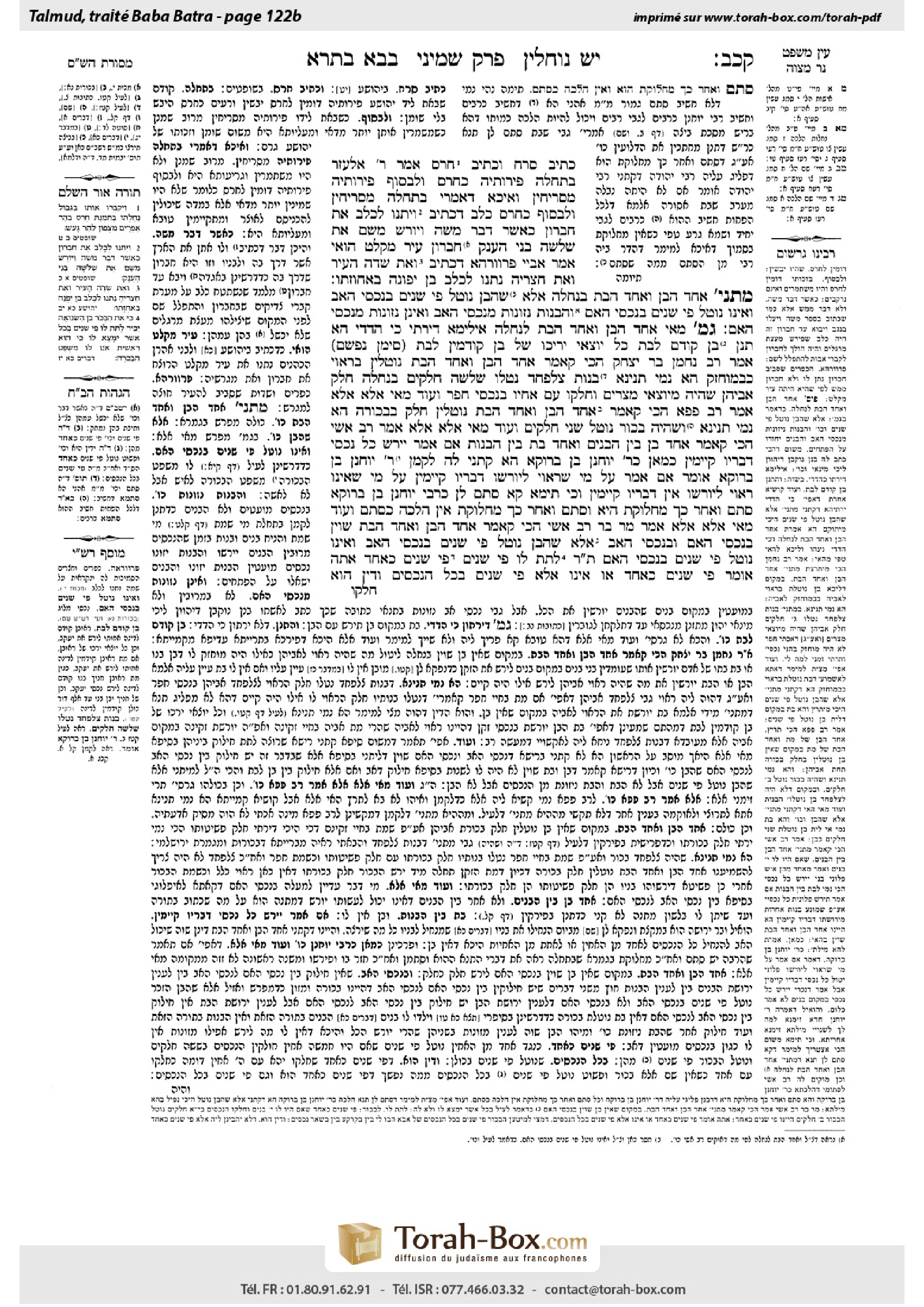
Bava Batra 122b: Talmud study for Daf Yomi
Study the Talmud for Daf Yomi with scanned pages, Hebrew text, English translations from Sefaria and AI-generated French translations.
Passage selection and English or AI-generated French translation are available where the scan has annotations. Daf Study is independent of Torah-Box and Sefaria.
Browse Bava Batra · בבא בתרא · All tractatesBava Batra 122b text and translations
This page of Bava Batra includes the Aramaic text, an English translation and an AI-generated French translation, alongside the scan above.
בבא בתרא קכ״ב ב · Aramaic and Hebrew text
כְּתִיב: ״סֶרַח״, וּכְתִיב: ״חֶרֶס״! אָמַר רַבִּי אֶלְעָזָר: בַּתְּחִלָּה פֵּירוֹתֶיהָ כְּחֶרֶס, וּלְבַסּוֹף פֵּירוֹתֶיהָ מַסְרִיחִין. וְאִיכָּא דְּאָמְרִי: בַּתְּחִלָּה מַסְרִיחִין, וּלְבַסּוֹף כְּחֶרֶס.
כָּלֵב – דִּכְתִיב: ״וַיִּתְּנוּ לְכָלֵב אֶת חֶבְרוֹן כַּאֲשֶׁר דִּבֶּר מֹשֶׁה, וַיּוֹרֶשׁ מִשָּׁם אֶת שְׁלֹשָׁה בְּנֵי הָעֲנָק״. חֶבְרוֹן עִיר מִקְלָט הֲוַאי! אָמַר אַבָּיֵי: פַּרְוורַהָא, דִּכְתִיב: ״וְאֶת שְׂדֵה הָעִיר וְאֶת חֲצֵרֶיהָ נָתְנוּ לְכָלֵב בֶּן יְפֻנֶּה בַּאֲחֻזָּתוֹ״.
מַתְנִי׳ אֶחָד הַבֵּן וְאֶחָד הַבַּת בַּנַּחֲלָה; אֶלָּא שֶׁהַבֵּן נוֹטֵל פִּי שְׁנַיִם בְּנִכְסֵי הָאָב, וְאֵינוֹ נוֹטֵל פִּי שְׁנַיִם בְּנִכְסֵי הָאֵם. וְהַבָּנוֹת – נִזּוֹנוֹת מִנִּכְסֵי הָאָב, וְאֵינָן נִזּוֹנוֹת מִנִּכְסֵי הָאֵם.
גְּמָ׳ מַאי ״אֶחָד הַבֵּן וְאֶחָד הַבַּת לְנַחֲלָה״? אִילֵּימָא דְּיָרְתִי כִּי הֲדָדֵי, הָא תְּנַן: בֵּן קוֹדֵם לַבַּת, כׇּל יוֹצְאֵי יְרֵיכוֹ שֶׁל בֵּן קוֹדְמִין לַבַּת!
(סִימָן: נַפְשָׁ״ם.) אָמַר רַב נַחְמָן בַּר יִצְחָק, הָכִי קָאָמַר: אֶחָד הַבֵּן וְאֶחָד הַבַּת נוֹטְלִין בָּרָאוּי כִּבְמוּחְזָק.
הָא נָמֵי תְּנֵינָא: בְּנוֹת צְלָפְחָד נָטְלוּ שְׁלֹשָׁה חֲלָקִים בַּנַּחֲלָה – חֵלֶק אֲבִיהֶן שֶׁהָיָה מִיּוֹצְאֵי מִצְרַיִם, וְחֶלְקוֹ עִם אֶחָיו בְּנִכְסֵי חֵפֶר!
וְעוֹד, מַאי ״אֶלָּא״?
אֶלָּא אָמַר רַב פָּפָּא, הָכִי קָאָמַר: אֶחָד הַבֵּן וְאֶחָד הַבַּת נוֹטְלִין חֵלֶק בִּבְכוֹרָה.
הָא נָמֵי תְּנֵינָא: וְשֶׁהָיָה בְּכוֹר נוֹטֵל שְׁנֵי חֲלָקִים! וְעוֹד, מַאי ״אֶלָּא״?
אֶלָּא אָמַר רַב אָשֵׁי, הָכִי קָאָמַר: אֶחָד בֵּן בֵּין הַבָּנִים וְאֶחָד בַּת בֵּין הַבָּנוֹת, אִם אָמַר: ״יִירַשׁ כׇּל נְכָסַי״ – דְּבָרָיו קַיָּימִין.
כְּמַאן, כְּרַבִּי יוֹחָנָן בֶּן בְּרוֹקָא?! הָא קָתָנֵי לַהּ לְקַמַּן – רַבִּי יוֹחָנָן בֶּן בְּרוֹקָא אוֹמֵר: אִם אָמַר עַל מִי שֶׁרָאוּי לְיוֹרְשׁוֹ – דְּבָרָיו קַיָּימִין, עַל מִי שֶׁאֵינוֹ רָאוּי לְיוֹרְשׁוֹ – אֵין דְּבָרָיו קַיָּימִין!
וְכִי תֵּימָא: קָא סָתַם לַן כְּרַבִּי יוֹחָנָן בֶּן בְּרוֹקָא; סְתָם וְאַחַר כָּךְ מַחֲלוֹקֶת הִיא, וּסְתָם וְאַחַר כָּךְ מַחֲלוֹקֶת – אֵין הֲלָכָה כַּסְּתָם!
וְעוֹד, מַאי ״אֶלָּא״?
אֶלָּא אָמַר מָר בַּר רַב אָשֵׁי, הָכִי קָאָמַר: אֶחָד הַבֵּן וְאֶחָד הַבַּת שָׁוִין בְּנִכְסֵי הָאֵם וּבְנִכְסֵי הָאָב, אֶלָּא שֶׁהַבֵּן נוֹטֵל פִּי שְׁנַיִם בְּנִכְסֵי הָאָב, וְאֵינוֹ נוֹטֵל פִּי שְׁנַיִם בְּנִכְסֵי הָאֵם.
תָּנוּ רַבָּנַן: ״לָתֶת לוֹ פִּי שְׁנַיִם״ – פִּי שְׁנַיִם כְּאֶחָד. אַתָּה אוֹמֵר פִּי שְׁנַיִם כְּאֶחָד, אוֹ אֵינוֹ אֶלָּא פִּי שְׁנַיִם בְּכׇל הַנְּכָסִים? וְדִין הוּא –
Bava Batra 122b · English translation
The Gemara interjects: It is written concerning Joshua’s burial: “And they buried him in the border of his inheritance in Timnath Serah” (Joshua 24:30), and it is written: “And they buried him in the border of his inheritance in Timnath Heres” (Judges 2:9). Why is the name changed? Rabbi Elazar says: Initially, its fruits were as dry as clay [keḥeres], and ultimately, its fruits were so plump that they were spoiling [masriḥin]. And there are those who say the opposite: Initially, the fruits were spoiling prematurely, and ultimately, they lasted as long as clay without spoiling.
Caleb also received his portion directly from God and not through the lottery, as it is written: “And they gave Hebron to Caleb, as Moses had spoken; and he drove out from there the three sons of the giant” (Judges 1:20). The Gemara asks about this verse: But Hebron was a city of refuge that belonged to the priests, as described in the book of Joshua (21:13); how could it have been given to Caleb? Abaye said: Its outskirts [parvaraha], i.e., only the fields and vineyards lying beyond the city limits, were given to Caleb. As it is written: “But the fields of the city, and the villages thereof, they gave to Caleb the son of Jephunneh for his possession” (Joshua 21:12).
MISHNA: Both the son and the daughter of the deceased are included in the halakhot of inheritance. But the difference is that the firstborn son takes a double portion of the property of the father, and he does not take a double portion of the property of the mother. And another difference is that the daughters are sustained from the property of the father after he dies, as it is a mandatory condition of their mother’s marriage contract that they are to be sustained even before the estate is disbursed to the children, but the daughters are not sustained from the property of the mother, which is all inherited by the sons.
GEMARA: The Gemara analyzes the mishna: What is meant by the first clause of the mishna: Both the son and the daughter of the deceased are included in the halakhot of inheritance? If we say that they inherit together, didn’t we learn in a mishna (115a): A son precedes a daughter? Additionally, all descendants of a son precede a daughter. It is clear that a daughter does not inherit together with a son.
Nafsham is a mnemonic for the names of the Sages cited in the following discussion: Naḥman; Pappa; Ashi; Mar. Rav Naḥman bar Yitzḥak says: This is what the mishna is saying: Both the son and the daughter take in inheritance the property due to their father as they would take in inheritance the property that he had in his possession.
The Gemara questions this explanation: We already learn this as well in a mishna (116b): Zelophehad’s daughters took three portions of land in the inheritance of Eretz Yisrael: Their father’s portion that he received because he was among those who left Egypt; and his portion that he received with his brothers in the property of Hepher, their father, although Zelophehad predeceased his father and never was in possession of the inheritance from Hepher; and an additional portion that he received from Hepher because he was a firstborn. It is already taught in that mishna that property due to the deceased is inherited in the same manner as property possessed by the deceased.
And furthermore, if the explanation of the mishna is as stated by Rav Naḥman, what is meant by the phrase: But the difference is that the firstborn son takes a double portion of the property of the father, and he does not take a double portion of the property of the mother? According to Rav Naḥman’s explanation, what is the contrast between the two clauses in the mishna?
Rather, Rav Pappa said: This is what the mishna is saying: Both the son and the daughter of the deceased take a portion of the firstborn.
The Gemara questions this explanation: We already learn this in a mishna as well (116b), which explains the third portion taken by the daughters of Zelophehad: And they took an additional portion that he received from Hepher, as he was a firstborn, and a firstborn takes two portions of inheritance from his father. And furthermore, if the explanation of the mishna is as stated by Rav Pappa, what is meant by the phrase: But the difference is that the firstborn son takes a double portion of the property of the father, and he does not take a double portion of the property of the mother? According to this explanation as well, the first clause of the mishna has nothing to do with inheriting from the mother.
Rather, Rav Ashi said: This is what the mishna is saying: With regard to both a son among the sons, and a daughter among the daughters, if the father says: This particular child shall inherit all my property, his statement stands. A father can do so for any one son, or, when there are no sons, for any one daughter.
The Gemara asks: In accordance with whose opinion does Rav Ashi say this? Is it in accordance with the opinion of Rabbi Yoḥanan ben Beroka? The Gemara challenges: But the mishna teaches this later (130a), as Rabbi Yoḥanan ben Beroka says: If one said about another who is fit to inherit from him that the named individual should inherit all his property, his statement stands, but if one said it about another who is unfit to inherit from him, his statement does not stand. It is not reasonable to say that this mishna is stating the same halakha that is recorded in the later mishna in the name of Rabbi Yoḥanan ben Beroka.
And if you would say that the tanna here taught us an unattributed mishna in accordance with the opinion of Rabbi Yoḥanan ben Beroka, in order to demonstrate that his opinion is accepted as halakha, this would not establish the halakha in accordance with his opinion. The reason is that this would be an instance of an unattributed mishna and thereafter a mishnaic dispute concerning the same matter, as in the later mishna there is a tanna who disagrees with the ruling of Rabbi Yoḥanan ben Beroka; and in an instance of an unattributed mishna and thereafter a mishnaic dispute, the halakha is not in accordance with the unattributed mishna.
And furthermore, if the explanation of the mishna is as stated by Rav Ashi, what is meant by the clause: But the difference is that the firstborn son takes a double portion of the property of the father, and he does not take a double portion of the property of the mother? According to this explanation as well, the first clause of the mishna has nothing to do with inheriting from the mother.
Rather, Mar bar Rav Ashi said: This is what the mishna is saying: Both the son and the daughter are equal in their rights both with regard to the property of the mother and with regard to the property of the father. Sons and daughters can inherit from either fathers or mothers. But the differences are that the firstborn son takes a double portion of the property of the father, and he does not take a double portion of the property of the mother, and that the daughters are sustained from their father’s estate before it is disbursed to the children, but they are not sustained from the property of their mother.
§ The Sages taught in a baraita: When the verse states: “But he shall acknowledge the firstborn, the son of the hated, by giving him a double portion of all that he has” (Deuteronomy 21:17), this means the firstborn receives double the property received by any other one inheritor. The baraita analyzes this statement: Do you say the firstborn receives double the property received by any one inheritor, or rather, is it a double portion of all the property, such that the firstborn receives two-thirds of the entire estate, which is twice the portion left for the other inheritors to divide between themselves? The baraita suggests: And this question can be resolved through logical inference:
Bava Batra 122b · Traduction française (IA)
La Guemara interrompt : Il est écrit concernant la sépulture de Josué : « Et ils le mirent en sépulture à la limite de sa portion, à Timnath Serah » (Josué 24:30), et il est écrit : « Et ils le mirent en sépulture à la limite de sa portion, à Timnath Heres » (Juges 2:9). Pourquoi le nom change-t-il ? Rabbi Eléazar dit : D'abord, ses fruits étaient aussi secs que de la terre [keḥeres], et finalement, ses fruits étaient si pleins qu'ils pourrissaient [masriḥin]. Et il y a ceux qui disent l'inverse : D'abord, les fruits pourrissaient prématurément, et finalement, ils duraient aussi longtemps que de la terre sans pourrir.
Caleb a aussi reçu sa portion directement de Dieu et non par le sort, comme il est écrit : « Et ils donnèrent Hebron à Caleb, comme Moïse avait dit ; et il chassa de là les trois fils du géant » (Juges 1:20). La Guemara pose une question sur cette versette : Mais Hebron était une ville de refuge qui appartenait aux prêtres, comme décrit dans le livre de Josué (21:13) ; comment pouvait-il être donné à Caleb ? Abaye dit : Ses faubourgs [parvaraha], c'est-à-dire seulement les champs et les vignobles situés en dehors des limites de la ville, furent donnés à Caleb. Comme il est écrit : « Mais les champs de la ville, et les villages qui y sont, ils les donnèrent à Caleb, fils de Jephunneh, pour sa possession » (Josué 21:12).
MICHNA : Les fils et les filles du défunt sont inclus dans les halakhot de l'héritage. La différence est que le premier-né prend une double portion de la propriété du père, et il ne prend pas une double portion de la propriété de la mère. Une autre différence est que les filles sont sustentées à partir de la propriété du père après sa mort, car c'est une condition obligatoire du contrat de mariage de leur mère qu'elles doivent être sustentées même avant que l'actif ne soit distribué aux enfants, mais les filles ne sont pas sustentées à partir de la propriété de la mère, qui est entièrement héritée par les fils.
GUEMARA : La Guemara analyse la Michna : Qu'entend-on par la première clause de la Michna : Les fils et les filles du défunt sont inclus dans les halakhot de l'héritage ? Si nous disons qu'ils héritent ensemble, n'avons-nous pas appris dans une Michna (115a) : Le fils précède la fille ? Et tous les descendants d'un fils précèdent la fille. Il est clair que la fille ne hérite pas avec le fils.
Nafsham est un acronyme pour les noms des Sages cités dans la discussion suivante : Naḥman ; Pappa ; Ashi ; Mar. Rav Naḥman bar Yitzḥak dit : C'est ce que la Michna dit : Les fils et les filles du défunt prennent dans l'héritage la propriété due à leur père, comme s'ils prenaient dans l'héritage la propriété qu'il avait en possession.
La Guemara questionne cette explication : Nous avons déjà appris cela dans une Michna (116b) : Les filles de Zelophehad ont pris trois portions de terre dans l'héritage de la Terre d'Israël : La portion de leur père qu'il avait reçue parce qu'il était parmi ceux qui sont sortis d'Égypte ; et sa portion qu'il avait reçue avec ses frères dans la propriété de Hepher, leur père, bien que Zelophehad soit décédé avant son père et n'ait jamais été en possession de l'héritage de Hepher ; et une portion supplémentaire qu'il avait reçue de Hepher parce qu'il était un premier-né. Il est déjà enseigné dans cette Michna que la propriété due au défunt est héritée de la même manière que la propriété possédée par le défunt.
Et de plus, si l'explication de la Michna est comme l'a dit Rav Naḥman, à quoi fait référence la phrase : Mais la différence est que le premier-né prend une double portion de la propriété du père, et il ne prend pas une double portion de la propriété de la mère ? Selon l'explication de Rav Naḥman, à quoi correspond le contraste entre les deux clauses de la Michna ?
Plutôt, Rav Pappa dit : C'est ce que la Michna dit : Les fils et les filles du défunt prennent une portion de premier-né.
La Guemara questionne cette explication : Nous avons déjà appris cela dans une Michna également (116b), qui explique la troisième portion prise par les filles de Zelophehad : Et elles prirent une portion supplémentaire qu'il avait reçue de Hepher, car il était un premier-né, et un premier-né prend deux portions d'héritage de son père. Et de plus, si l'explication de la Michna est comme l'a dit Rav Pappa, à quoi fait référence la phrase : Mais la différence est que le premier-né prend une double portion de la propriété du père, et il ne prend pas une double portion de la propriété de la mère ? Selon cette explication également, la première clause de la Michna n'a rien à voir avec l'héritage de la mère.
Plutôt, Rav Ashi dit : C'est ce que la Michna dit : Concernant à la fois un fils parmi les fils et une fille parmi les filles, si le père dit : Cet enfant particulier héritera de toute ma propriété, sa déclaration tient. Un père peut le faire pour n'importe quel fils, ou, lorsqu'il n'y a pas de fils, pour n'importe quelle fille.
La Guemara pose une question : Selon l'opinion de qui dit Rav Ashi cela ? Est-ce selon l'opinion de Rabbi Yoḥanan ben Beroka ? La Guemara conteste : Mais la Michna enseigne cela plus tard (130a), comme Rabbi Yoḥanan ben Beroka dit : Si l'on dit à propos d'un autre qui est digne d'hériter de lui que l'individu nommé devrait hériter de toute sa propriété, sa déclaration tient, mais si l'on dit cela à propos d'un autre qui n'est pas digne d'hériter de lui, sa déclaration ne tient pas. Il n'est pas raisonnable de dire que cette Michna énonce la même halakha que celle enregistrée dans la Michna ultérieure en nom de Rabbi Yoḥanan ben Beroka.
Et si l'on disait que le tanna ici nous a appris une mitsva non attribuée conformément à l'opinion de Rabbi Yoḥanan ben Beroka, afin de montrer que son opinion est acceptée comme halakha, cela ne suffirait pas à établir la halakha conformément à son opinion. La raison est que cela constituerait un cas d'une mitsva non attribuée suivie d'un débat mitsvique sur la même question, comme dans la mitsva ultérieure il y a un tanna qui s'oppose à la décision de Rabbi Yoḥanan ben Beroka ; et dans le cas d'une mitsva non attribuée suivie d'un débat mitsvique, la halakha ne suit pas la mitsva non attribuée.
Et de plus, si l'explication de la mitsva est celle donnée par Rav Ashi, que signifie la clause : Mais la différence est que le premier fils reçoit une double portion de la propriété du père, et il ne reçoit pas une double portion de la propriété de la mère ? Selon cette explication également, la première clause de la mitsva n'a rien à voir avec l'héritage de la mère.
Au contraire, Mar bar Rav Ashi a dit : C'est ce que la mitsva dit : Les fils et les filles sont égaux en droits tant par rapport à la propriété de la mère que par rapport à la propriété du père. Les fils et les filles peuvent hériter tant du père que de la mère. Mais les différences sont que le premier fils reçoit une double portion de la propriété du père, et il ne reçoit pas une double portion de la propriété de la mère, et que les filles sont sustentées à partir de l'État du père avant qu'il ne soit distribué aux enfants, mais elles ne sont pas sustentées à partir de la propriété de leur mère.
§ Les Sages ont enseigné dans une baraïta : Lorsque la Bible dit : « Mais il reconnaîtra le premier-né, le fils de l'haïssé, en lui donnant une double portion de tout ce qu'il a » (Deutéronome 21:17), cela signifie que le premier-né reçoit double la part reçue par tout autre héritier. La baraïta analyse cette affirmation : Dis-tu que le premier-né reçoit double la part reçue par un seul héritier, ou plutôt que c'est une double portion de toute la propriété, de sorte que le premier-né reçoit deux tiers de l'ensemble de l'héritage, ce qui est double la part laissée aux autres héritiers pour qu'ils la partagent entre eux ? La baraïta suggère : Et cette question peut être résolue par l'inférence logique :
Traduction française générée par IA à partir de l’édition anglaise de Sefaria. Vérifie toujours un passage avec le texte source.
Text from Sefaria: William Davidson Edition - Vocalized Aramaic (CC BY NC); William Davidson Edition - English (CC BY NC).