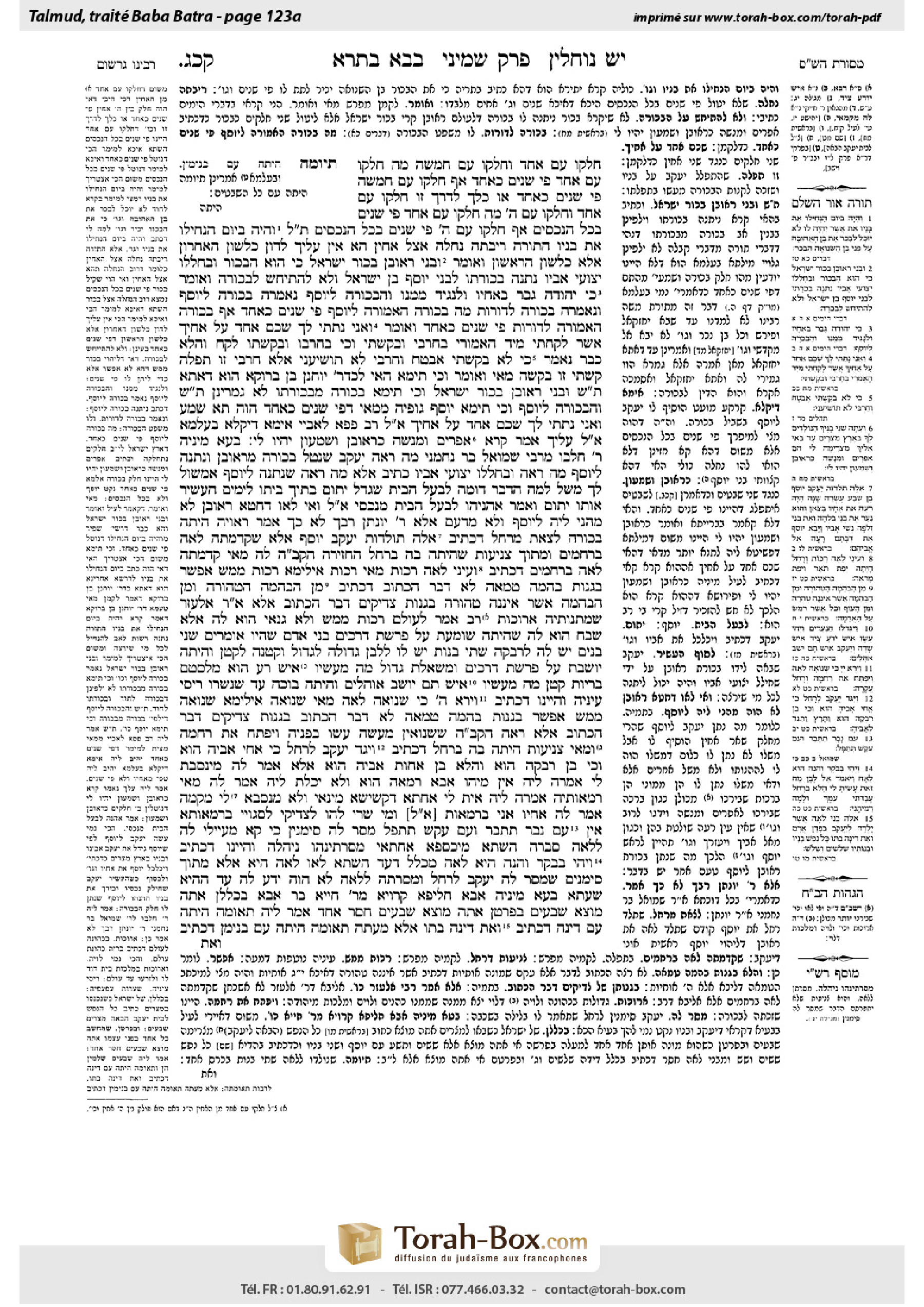
Bava Batra 123a: Talmud study for Daf Yomi
Study the Talmud for Daf Yomi with scanned pages, Hebrew text, English translations from Sefaria and AI-generated French translations.
Passage selection and English or AI-generated French translation are available where the scan has annotations. Daf Study is independent of Torah-Box and Sefaria.
Browse Bava Batra · בבא בתרא · All tractatesBava Batra 123a text and translations
This page of Bava Batra includes the Aramaic text, an English translation and an AI-generated French translation, alongside the scan above.
בבא בתרא קכ״ג א · Aramaic and Hebrew text
חֶלְקוֹ עִם אֶחָד, וְחֶלְקוֹ עִם חֲמִשָּׁה; מָה חֶלְקוֹ עִם אֶחָד – פִּי שְׁנַיִם כְּאֶחָד, אַף חֶלְקוֹ עִם חֲמִשָּׁה – פִּי שְׁנַיִם כְּאֶחָד!
אוֹ כְּלָךְ לְדֶרֶךְ זוֹ – חֶלְקוֹ עִם אֶחָד, וְחֶלְקוֹ עִם חֲמִשָּׁה; מָה חֶלְקוֹ עִם אֶחָד – פִּי שְׁנַיִם בְּכׇל הַנְּכָסִים, אַף חֶלְקוֹ עִם חֲמִשָּׁה – פִּי שְׁנַיִם בְּכׇל הַנְּכָסִים!
תַּלְמוּד לוֹמַר: ״וְהָיָה בְּיוֹם הַנְחִילוֹ אֶת בָּנָיו״ – הַתּוֹרָה רִיבְּתָה נַחֲלָה אֵצֶל אַחִין; הָא אֵין עָלֶיךָ לָדוּן כַּלָּשׁוֹן הָאַחֲרוֹן, אֶלָּא כַּלָּשׁוֹן הָרִאשׁוֹן.
וְאוֹמֵר: ״וּבְנֵי רְאוּבֵן בְּכוֹר יִשְׂרָאֵל, כִּי הוּא הַבְּכוֹר, וּבְחַלְּלוֹ יְצוּעֵי אָבִיו נִתְּנָה בְּכֹרָתוֹ לִבְנֵי יוֹסֵף בֶּן יִשְׂרָאֵל, וְלֹא לְהִתְיַחֵשׂ לַבְּכֹרָה״, וְאוֹמֵר: ״כִּי יְהוּדָה גָּבַר בְּאֶחָיו וּלְנָגִיד מִמֶּנּוּ, וְהַבְּכֹרָה לְיוֹסֵף״ –
נֶאֶמְרָה ״בְּכוֹרָה״ לְיוֹסֵף, וְנֶאֶמְרָה ״בְּכוֹרָה״ לְדוֹרוֹת; מָה בְּכוֹרָה הָאֲמוּרָה לְיוֹסֵף – פִּי שְׁנַיִם כְּאֶחָד, אַף בְּכוֹרָה הָאֲמוּרָה לְדוֹרוֹת – פִּי שְׁנַיִם כְּאֶחָד.
וְאוֹמֵר: ״וַאֲנִי נָתַתִּי לְךָ שְׁכֶם אַחַד עַל אַחֶיךָ, אֲשֶׁר לָקַחְתִּי מִיַּד הָאֱמוֹרִי בְּחַרְבִּי וּבְקַשְׁתִּי״ – וְכִי בְּחַרְבּוֹ וּבְקַשְׁתּוֹ לָקַח?! וַהֲלֹא כְּבָר נֶאֱמַר: ״כִּי לֹא בְקַשְׁתִּי אֶבְטָח, וְחַרְבִּי לֹא תוֹשִׁיעֵנִי״! אֶלָּא ״חַרְבִּי״ – זוֹ תְּפִלָּה, ״קַשְׁתִּי״ – זוֹ בַּקָּשָׁה.
מַאי ״וְאוֹמֵר״? וְכִי תֵּימָא הַאי לְכִדְרַבִּי יוֹחָנָן בֶּן בְּרוֹקָא הוּא דַּאֲתָא – תָּא שְׁמַע: ״וּבְנֵי רְאוּבֵן בְּכוֹר יִשְׂרָאֵל״.
וְכִי תֵּימָא ״בְּכוֹרָה״ מִ״בְּכוֹרָתוֹ״ לָא גָּמְרִינַן – תָּא שְׁמַע: ״וְהַבְּכֹרָה לְיוֹסֵף״.
וְכִי תֵּימָא: יוֹסֵף גּוּפֵיהּ – מִמַּאי דְּפִי שְׁנַיִם כְּאֶחָד הֲוָה? תָּא שְׁמַע: ״וַאֲנִי נָתַתִּי לְךָ שְׁכֶם אַחַד עַל אַחֶיךָ״.
אֲמַר לֵיהּ רַב פָּפָּא לְאַבָּיֵי: אֵימָא דִּיקְלָא בְּעָלְמָא! אֲמַר לֵיהּ, עָלֶיךָ אָמַר קְרָא: ״אֶפְרַיִם וּמְנַשֶּׁה – כִּרְאוּבֵן וְשִׁמְעוֹן יִהְיוּ לִי״.
בְּעָא מִינֵּיהּ רַבִּי חֶלְבּוֹ מֵרַבִּי שְׁמוּאֵל בַּר נַחְמָנִי: מָה רָאָה יַעֲקֹב שֶׁנָּטַל בְּכוֹרָה מֵרְאוּבֵן, וּנְתָנָהּ לְיוֹסֵף? מָה רָאָה?! ״וּבְחַלְּלוֹ יְצוּעֵי אָבִיו״ כְּתִיב! אֶלָּא מָה רָאָה שֶׁנְּתָנָהּ לְיוֹסֵף?
אֶמְשׁוֹל לְךָ מָשָׁל, לְמָה הַדָּבָר דּוֹמֶה? לְבַעַל הַבַּיִת שֶׁגִּדֵּל יָתוֹם בְּתוֹךְ בֵּיתוֹ; לְיָמִים הֶעֱשִׁיר אוֹתוֹ יָתוֹם, וְאָמַר: אֲהַנֵּיהוּ לְבַעַל הַבַּיִת מִנְּכָסַי. אֲמַר לֵיהּ: וְאִי לָאו דַּחֲטָא רְאוּבֵן, לָא מְהַנֵּי לֵיהּ לְיוֹסֵף וְלָא מִדָּעַם?!
אֶלָּא רַבִּי יוֹנָתָן רַבָּךְ לֹא כָּךְ אָמַר – רְאוּיָה הָיְתָה בְּכוֹרָה לָצֵאת מֵרָחֵל, דִּכְתִיב: ״אֵלֶּה תֹּלְדוֹת יַעֲקֹב, יוֹסֵף״, אֶלָּא שֶׁקְּדָמַתָּהּ לֵאָה בְּרַחֲמִים; וּמִתּוֹךְ צְנִיעוּת שֶׁהָיְתָה בָּהּ בְּרָחֵל, הֶחְזִירָהּ הַקָּדוֹשׁ בָּרוּךְ הוּא לָהּ.
מַאי ״קְדָמַתָּהּ לֵאָה בְּרַחֲמִים״? דִּכְתִיב: ״וְעֵינֵי לֵאָה רַכּוֹת״ – מַאי ״רַכּוֹת״? אִילֵּימָא רַכּוֹת מַמָּשׁ, אֶפְשָׁר בִּגְנוּת בְּהֵמָה טְמֵאָה לֹא דִּבֵּר הַכָּתוּב, דִּכְתִיב: ״מִן הַבְּהֵמָה הַטְּהוֹרָה וּמִן הַבְּהֵמָה אֲשֶׁר אֵינֶנָּה טְהֹרָה״; בִּגְנוּת צַדִּיקִים דִּבֵּר הַכָּתוּב?! אֶלָּא אָמַר רַבִּי אֶלְעָזָר: שֶׁמַּתְּנוֹתֶיהָ אֲרוּכּוֹת.
רַב אָמַר: לְעוֹלָם רַכּוֹת מַמָּשׁ, וְלֹא גְּנַאי הוּא לָהּ, אֶלָּא שֶׁבַח הוּא לָהּ. שֶׁהָיְתָה שׁוֹמַעַת עַל פָּרָשַׁת דְּרָכִים בְּנֵי אָדָם שֶׁהָיוּ אוֹמְרִים: שְׁנֵי בָנִים יֵשׁ לָהּ לְרִבְקָה, שְׁתֵּי בָנוֹת יֵשׁ לוֹ לְלָבָן, גְּדוֹלָה לַגָּדוֹל וּקְטַנָּה לַקָּטָן.
וְהָיְתָה יוֹשֶׁבֶת עַל פָּרָשַׁת דְּרָכִים וּמְשָׁאֶלֶת: גָּדוֹל מָה מַעֲשָׂיו? אִישׁ רַע הוּא מְלַסְטֵם בְּרִיּוֹת. קָטָן מָה מַעֲשָׂיו? ״אִישׁ תָּם יֹשֵׁב אֹהָלִים״. וְהָיְתָה בּוֹכָה, עַד שֶׁנָּשְׁרוּ רִיסֵי עֵינֶיהָ.
וְהַיְינוּ דִּכְתִיב: ״וַיַּרְא ה׳ כִּי שְׂנוּאָה לֵאָה״ – מַאי ״שְׂנוּאָה״? אִילֵּימָא שְׂנוּאָה מַמָּשׁ; אֶפְשָׁר בִּגְנוּת בְּהֵמָה טְמֵאָה לֹא דִּבֵּר הַכָּתוּב, בִּגְנוּת צַדִּיקִים דִּבֵּר הַכָּתוּב?! אֶלָּא רָאָה הַקָּדוֹשׁ בָּרוּךְ הוּא שֶׁשְּׂנוּאִין מַעֲשֵׂה עֵשָׂו בְּפָנֶיהָ, ״וַיִּפְתַּח אֶת רַחְמָהּ״.
וּמַאי צְנִיעוּת הָיְתָה בָּהּ בְּרָחֵל? דִּכְתִיב: ״וַיַּגֵּד יַעֲקֹב לְרָחֵל כִּי אֲחִי אָבִיהָ הוּא, וְכִי בֶן רִבְקָה הוּא״ וַהֲלֹא בֶּן אֲחוֹת אָבִיהָ הוּא! אֶלָּא אֲמַר לַהּ: מִינַּסְבַת לִי? אֲמַרָה לֵיהּ: אִין, מִיהוּ אַבָּא רַמָּאָה הוּא, וְלָא יָכְלַתְּ לֵיהּ.
אֲמַר לַהּ: מַאי רַמָּאוּתֵיהּ? אֲמַרָה לֵיהּ: אִית לִי אֲחָתָא דְּקַשִּׁישָׁא מִינַּאי, וְלָא מַנְסְבָא לִי מִקַּמַּהּ. אֲמַר לַהּ: אָחִיו אֲנִי בְּרַמָּאוּת. אֲמַרָה לֵיהּ: וּמִי שְׁרֵי לְהוּ לְצַדִּיקֵי לְסַגּוֹיֵי בְּרַמָּאוּתָא? אִין, ״עִם נָבָר תִּתָּבָר וְעִם עִקֵּשׁ תִּתַּפָּל״; מְסַר לַהּ סִימָנִין.
כִּי קָא מְעַיְּילִי לַהּ לְלֵאָה, סָבְרָה: הַשְׁתָּא מִיכַּסְפָא אֲחָתַאי. מְסַרְתִּינְהוּ נִיהֲלַהּ. וְהַיְינוּ דִּכְתִיב: ״וַיְהִי בַבֹּקֶר וְהִנֵּה הִיא לֵאָה״ – מִכְּלָל דְּעַד הַשְׁתָּא לָאו לֵאָה הִיא?! אֶלָּא מִתּוֹךְ סִימָנִים שֶׁמָּסַר לָהּ יַעֲקֹב לְרָחֵל, וּמְסָרָתַן לְלֵאָה – לָא הֲוָה יָדַע לַהּ עַד הַהִיא שַׁעְתָּא.
בְּעָא מִינֵּיהּ אַבָּא חֲלִיפָא קִרְוָיָא מֵרַבִּי חִיָּיא בַּר אַבָּא: בִּכְלָלָן – אַתָּה מוֹצֵא שִׁבְעִים; בִּפְרָטָן – אַתָּה מוֹצֵא שִׁבְעִים חָסֵר אֶחָד! אֲמַר לֵיהּ: תְּאוֹמָה הָיְתָה עִם דִּינָה, דִּכְתִיב: ״וְאֵת דִּינָה בִתּוֹ״. אֶלָּא מֵעַתָּה, תְּאוֹמָה הָיְתָה עִם בִּנְיָמִן – דִּכְתִיב:
Bava Batra 123a · English translation
There may be times when a firstborn takes his portion of the inheritance, dividing the estate with one other brother, and there may be times when a firstborn takes his portion of the inheritance, dividing the estate with five brothers, and there is no indication that the Torah differentiates between the manner in which the respective firstborns collect in each scenario. Therefore, just as when a firstborn takes his portion, dividing the estate with one other brother, he receives double the property received by one inheritor, so too, when a firstborn takes his portion of the inheritance, dividing the estate with five brothers, he receives double the property received by one inheritor.
The baraita suggests the opposite logical derivation: Or perhaps go this way: There may be times when a firstborn takes his portion of the inheritance, dividing the estate with one other brother, and there may be times when a firstborn takes his portion of the inheritance, dividing the estate with five brothers. Therefore, just as when a firstborn takes his portion, dividing the estate with one other brother, he receives a double portion of all the property, so too when a firstborn takes his portion of the inheritance, dividing the estate with five brothers, he receives a double portion of all the property.
As the logical inference can lead to either conclusion, the halakha is determined by a derivation from a verse. The verse states: “Then it shall be, in the day that he causes his sons to inherit” (Deuteronomy 21:16). As the next verse spells out: “But he shall acknowledge the firstborn, the son of the hated, by giving him a double portion of all that he has” (Deuteronomy 21:17), the former verse is ostensibly redundant. The additional verse is therefore understood as an inclusion: The Torah increased inheritance with regard to the brothers, indicating that the more brothers there are, the greater the portion they collect from the entire estate. Therefore, you should not reason in accordance with the final formulation, in which the baraita suggests that the firstborn inherits twice as much as all the other brothers combined, but in accordance with the first formulation, according to which the firstborn inherits twice as much as each other brother.
The baraita reinforces this statement by citing additional verses: And the verse states: “And the sons of Reuben the firstborn of Israel, for he was the firstborn; but, inasmuch as he defiled his father’s couch, his birthright [bekhorato] was given to the sons of Joseph the son of Israel, yet not so that he was to be reckoned in the genealogy as firstborn” (I Chronicles 5:1). And the following verse states: “For Judah prevailed above his brothers, and the prince came of him; but the birthright [vehabekhora] was Joseph’s” (I Chronicles 5:2).
The baraita derives: Birthright, i.e., firstborn status, is stated here with regard to Joseph, and birthright is stated in another verse concerning the double portion with regard to the later generations: “By giving him a double portion of all that he has, for he is the first-fruits of his strength, the birthright [habekhora] is his” (Deuteronomy 21:17). Just as the birthright stated with regard to Joseph is double the property received by one inheritor, as the Gemara will explain, so too the birthright stated with regard to the later generations is double the property received by one inheritor.
The baraita cites additional related verses: And with regard to Jacob’s bequest to Joseph, the verse states: “Moreover I have given to you one portion above your brothers, which I took out of the hand of the Amorite with my sword and with my bow” (Genesis 48:22). The baraita explains the verse: But is it so that Jacob took the portion with his sword and with his bow? But isn’t it already stated: “Through You do we push down our adversaries; through Your name do we trample those that rise against us. For I trust not in my bow, neither can my sword save me” (Psalms 44:6–7)? Rather, what is the meaning of “with my sword”? This is referring to prayer. What is the meaning of “with my bow”? This is referring to petition. This concludes the baraita.
The Gemara analyzes the baraita: What is the reason the baraita cites additional proofs, introducing them with the term: And the verse states? The Gemara explains: And if you would say that the proof from the verse: “Then it shall be, in the day that he causes his sons to inherit” is not valid, as perhaps this verse comes to teach the halakha of Rabbi Yoḥanan ben Beroka that a father may designate property for whichever child he desires, then come and hear a separate proof: “And the sons of Reuben the firstborn of Israel…his birthright was given to the sons of Joseph the son of Israel.” As Joseph’s birthright was that his sons received two portions, evidently the birthright of the firstborn is that he receives double the amount received by one inheritor.
And if you would say that this is not a proof either, as we do not derive the meaning of the term: “Birthright [bekhora]” (see Deuteronomy 21:17) from the similar but not identical term of: “His birthright [bekhorato],” come and hear a proof from the term employed in the following phrase from the verse: “But the birthright [vehabekhora] was Joseph’s.”
The Gemara continues to explicate the biblical citations in the baraita: And if you would say that this is not a proof either, as concerning Joseph himself, from where may it be learned that his birthright was double the property received by one inheritor? Come and hear a proof: “Moreover I have given to you one portion above your brothers,” indicating that Joseph received one more portion than each of the other sons of Jacob.
Rav Pappa said to Abaye: Why not say that the term “one portion” is referring to a mere palm tree or some other relatively small extra gift, instead of a full, equal share? Abaye said to him: For you, i.e., to answer your question, the verse states: “Ephraim and Manasseh, even as Reuben and Simeon, shall be mine” (Genesis 48:5). Evidently, Joseph’s children together received portions equal to that of Reuben and Simeon together, i.e., two full portions.
§ Rabbi Ḥelbo asked Rabbi Shmuel bar Naḥmani: What did Jacob see that he took the status as firstborn from Reuben and gave it to Joseph? The Gemara wonders: What does he mean, what did he see? The matter is written explicitly: “But, inasmuch as he defiled his father’s couch, his birthright was given to the sons of Joseph” (I Chronicles 5:1). Rather, Rabbi Ḥelbo’s question was: What did he see that he gave it specifically to Joseph?
Rabbi Shmuel bar Naḥmani answered Rabbi Ḥelbo: I will tell you a parable. To what is this matter comparable? To a homeowner who raised an orphan in his home. Eventually, that orphan became wealthy and said: I will provide benefit to the homeowner from my property. Similarly, since Joseph sustained Jacob in Egypt for a number of years, Jacob saw fit to repay the kindness. Rabbi Ḥelbo said to him: And if Reuben did not sin, would Jacob not have provided any benefit to Joseph? It cannot be that Jacob repaid Joseph only as a result of Reuben’ sin.
Rather, doesn’t your teacher Rabbi Yonatan say like this: It was appropriate for the child receiving the status of firstborn to emerge from Rachel, as it is written: “These are the generations of Jacob, Joseph” (Genesis 37:2), indicating that Joseph was Jacob’s primary progeny. But Leah advanced ahead of Rachel with appeals for mercy, i.e., with prayer, and thereby earned the status as firstborn for her firstborn. But because of the modesty that Rachel possessed, the Holy One, Blessed be He, returned the status as firstborn to her. This is why Jacob gave the status as firstborn to Joseph.
The Gemara explains this answer: What does it mean that Leah advanced ahead of Rachel with mercy? As it is written: “And Leah’s eyes were weak [rakkot]” (Genesis 29:17). What is the meaning of “rakkot”? If we say that her eyes were literally weak, is it possible that the verse would say that? The verse there did not speak to the disparagement of even a non-kosher animal, as it is written: “From the pure animals and from the animals that are lacking purity” (Genesis 7:8). The verse states: “That are lacking purity” rather than stating explicitly and disparagingly: That are impure. If that is so with regard to animals, did the verse speak here to the disparagement of the righteous? Rather, Rabbi Elazar says: The term alludes to the fact that her gifts, i.e., the gifts given to her descendants, e.g., the priesthood and the monarchy, were long-lasting [arukkot], as they were passed down from generation to generation.
Rav says that there is a different explanation of the verse: Actually, the verse means that her eyes were literally weak, and this is not a denigration of her but a praise of her. As she would hear people at the crossroads, coming from the land of Canaan, who would say: Rebecca has two sons, and her brother Laban has two daughters; the older daughter will be married to the older son, and the younger daughter will be married to the younger son.
Rav continues: And she would sit at the crossroads and ask: What are the deeds of the older son? The passersby would answer: He is an evil man, and he robs people. She would ask: What are the deeds of the younger son? They would answer: He is “a quiet man, dwelling in tents” (Genesis 25:27). And because she was so distraught at the prospect of marrying the evil brother, she would cry and pray for mercy until her eyelashes fell out. Since the weakness of her eyes was due to this cause, characterizing her eyes as weak constitutes praise. This is Leah’s prayer for mercy to which Rabbi Yonatan referred.
The Gemara comments: And her desire not to marry Esau is the basis of that which is written: “And the Lord saw that Leah was hated, and He opened her womb” (Genesis 29:31). What is the meaning of “hated”? If we say that she was literally hated, is it possible? The verse there did not speak to the disparagement of even a non-kosher animal, so did the verse here speak to the disparagement of the righteous? Rather, the Holy One, Blessed be He, saw that the behavior of Esau was hated by her, and therefore: “And He opened her womb.”
The Gemara now explains the second part of Rabbi Yonatan’s explanation: And what was a demonstration of the modesty that Rachel possessed? As it is written: “And Jacob told Rachel that he was her father’s brother, and that he was Rebecca’s son” (Genesis 29:12). The Gemara asks: But isn’t he the son of her father’s sister? Why did he say that he was her father’s brother? Rather, Jacob and Rachel had the following exchange: Jacob said to Rachel: Will you marry me? Rachel said to him: Yes, but my father is a deceitful person, and you cannot defeat him.
Jacob said to her: What is his method of deceit of which I need be aware? Rachel said to him: I have a sister who is older than me, and he will not marry me off before he marries her off, even if he promises that he will do so. Jacob said to her: I am his brother, i.e., equal, in deceit, and he will not be able to deceive me. That is why Jacob said that he was “her father’s brother.” Rachel said to him: But is it permitted for the righteous to act deceitfully? Jacob answered her: Yes, in certain circumstances. As the verse states concerning God: “With the pure You show Yourself pure; and with the crooked You show Yourself subtle” (II Samuel 22:27). Therefore, to counter Laban’s deceit, Jacob gave Rachel secret signs to prove to him that she was the one marrying him.
Laban did in fact attempt to have Jacob marry Leah instead of marrying Rachel. When Laban’s associates were bringing Leah up to the wedding canopy to marry Jacob, Rachel thought: Now my sister will be humiliated when Jacob discovers that she is the one marrying him. Therefore, Rachel gave the signs to Leah. And this is as it is written: “And it came to pass in the morning that, behold, it was Leah” (Genesis 29:25). This verse is difficult, as by inference, should one derive that until now she was not Leah? Rather, through the signs that Jacob gave to Rachel and that she gave to Leah, he did not know it was she until that moment. This is the modesty of Rachel to which Rabbi Yonatan was referring.
§ The Gemara continues its discussion of Jacob’s family. Abba Ḥalifa Karoya asked Rabbi Ḥiyya bar Abba: In the total tally of Jacob’s family members who descended to Egypt, you find seventy, as stated in the verse: “All the souls of the house of Jacob, that came into Egypt, were seventy” (Genesis 46:27). By contrast, in their individual listing, when the family members of each of his sons are listed by name, you find seventy-less-one. How can this be resolved? Rabbi Ḥiyya bar Abba said to him: A twin sister was born with Dinah, as it is written: “And [ve’et] his daughter Dinah” (Genesis 46:15). The term et implies an unspecified additional person. Abba Ḥalifa Karoya replied: If that is so, one would have to say that a twin sister was born with Benjamin, as it is written:
Bava Batra 123a · Traduction française (IA)
Il peut y avoir des moments où un premier-né prend sa part de l'héritage, divisant l'actif avec un seul frère, et il peut y avoir des moments où un premier-né prend sa part de l'héritage, divisant l'actif avec cinq frères, et il n'y a pas d'indication que la Torah distingue selon la manière dont les premiers-nés respectifs récoltent dans chaque cas. Par conséquent, tout comme lorsque le premier-né prend sa part, divisant l'actif avec un seul frère, il reçoit double la propriété reçue par un héritier, de même lorsque le premier-né prend sa part de l'héritage, divisant l'actif avec cinq frères, il reçoit double la propriété reçue par un héritier.
La baraïta suggère une déduction logique opposée : ou peut-être devons-nous envisager cela : il peut y avoir des moments où un premier-né prend sa part de l'héritage, divisant l'actif avec un seul frère, et il peut y avoir des moments où un premier-né prend sa part de l'héritage, divisant l'actif avec cinq frères. Par conséquent, tout comme lorsque le premier-né prend sa part, divisant l'actif avec un seul frère, il reçoit une part double de toute la propriété, de même lorsque le premier-né prend sa part de l'héritage, divisant l'actif avec cinq frères, il reçoit une part double de toute la propriété.
Comme l'inférence logique peut mener à l'une ou l'autre conclusion, la halakha est déterminée par une dérivation d'un verset. Le verset dit : « Et il arrivera, le jour où il fera hériter ses fils » (Deutéronome 21:16). Comme le verset suivant précise : « Mais il reconnaîtra le premier-né, le fils du détesté, en lui donnant une part double de tout ce qu'il a » (Deutéronome 21:17), le premier verset semble être redondant. Le verset supplémentaire est donc compris comme une inclusion : la Torah a augmenté l'héritage par rapport aux frères, indiquant que plus il y a de frères, plus grande est la part qu'ils récoltent de l'ensemble de l'actif. Par conséquent, vous ne devriez pas raisonner selon la formulation finale, dans laquelle la baraïta suggère que le premier-né hérite double de ce que tous les autres frères réunis récoltent, mais selon la première formulation, celle qui stipule que le premier-né hérite double de ce que chaque autre frère récolte.
La baraïta renforce cette déclaration en citant d'autres versets : le verset dit : « Et les fils de Rouben, le premier-né d'Israël, car il était le premier-né ; mais, en raison qu'il avait souillé le lit de son père, sa part de premier-né [bekhorato] fut donnée aux fils de Joseph, le fils d'Israël, mais pas de manière à ce qu'il soit compté dans la généalogie comme premier-né » (Chroniques I 5:1). Et le verset suivant dit : « Car Juda a triomphé sur ses frères, et le prince est sorti de lui ; mais la part de premier-né [vehabekhora] fut celle de Joseph » (Chroniques I 5:2).
La baraïta dérive : La part de premier-né, c'est-à-dire le statut de premier-né, est mentionnée ici concernant Joseph, et la part de premier-né est mentionnée dans un autre verset concernant la double portion par rapport aux générations futures : « En lui donnant une part double de tout ce qu'il a, car il est le premier-fruits de sa force, la part de premier-né [habekhora] est la sienne » (Deutéronome 21:17). Tout comme la part de premier-né mentionnée concernant Joseph est double de la propriété reçue par un héritier, comme l'expliquera la Guemara, de même la part de premier-né mentionnée concernant les générations futures est double de la propriété reçue par un héritier.
La baraïta cite d'autres versets liés : et concernant la donation de Jacob à Joseph, le verset dit : « Et j'ai donné à toi une portion au-dessus de tes frères, que j'ai tirée de la main des Amoréens avec mon épée et avec mon arc » (Genèse 48:22). La baraïta explique ce verset : Mais est-ce que Jacob a pris cette portion avec son épée et son arc ? Mais n'est-ce pas déjà dit : « Par toi nous poussons nos adversaires en bas ; par ton nom nous marchons sur ceux qui se lèvent contre nous. Car je ne fais pas confiance à mon épée, ni mon arc ne peut m'arracher » (Psaumes 44:6-7) ? Plutôt, quelle est la signification de « avec mon épée » ? Cela fait référence à la prière. Quelle est la signification de « avec mon arc » ? Cela fait référence à la supplication. Cela conclut la baraïta.
La Guemara analyse la baraïta : Quelle est la raison pour laquelle la baraïta cite des preuves supplémentaires, les introduisant avec le terme : « Et le verset dit » ? La Guemara explique : Et si vous dites que la preuve tirée du verset : « Et il arrivera, le jour où il fera hériter ses fils » n'est pas valable, car peut-être ce verset vient enseigner la halakha du maître Rabbi Yoḥanan ben Beroka selon laquelle un père peut désigner une propriété à n'importe quel enfant qu'il désire, alors venez écouter une preuve séparée : « Et les fils de Rouben, le premier-né d'Israël… sa part de premier-né [bekhorato] fut donnée aux fils de Joseph, le fils d'Israël. » Comme la part de premier-né de Joseph est celle que ses fils recevaient deux portions, évidemment la part de premier-né est celle qui permet au premier-né de recevoir double la quantité reçue par un héritier.
Et si vous dites que cela n'est pas une preuve non plus, car nous ne dérivons pas la signification du terme : « Part de premier-né [bekhora] » (Deutéronome 21:17) du terme similaire mais pas identique : « Sa part de premier-né [bekhorato] », venez écouter une preuve tirée du terme employé dans la phrase suivante du verset : « Mais la part de premier-né [vehabekhora] fut celle de Joseph. »
La Guemara continue d'expliquer les citations bibliques dans la baraïta : Et si vous dites que cela n'est pas une preuve non plus, concernant Joseph lui-même, d'où peut-on apprendre que sa part de premier-né était double la propriété reçue par un héritier ? Venez écouter une preuve : « Et j'ai donné à toi une portion au-dessus de tes frères », indiquant que Joseph a reçu une portion supplémentaire par rapport à chaque autre fils de Jacob.
Rav Pappa dit à Abaye : Pourquoi ne pas dire que le terme « une portion » fait référence à une simple palme ou à un petit cadeau supplémentaire, plutôt qu'à une part égale ? Abaye répond à lui : Pour répondre à votre question, le verset dit : « Ephraim et Manasseh, même comme Rouben et Siméon, seront à moi » (Genèse 48:5). Évidemment, les enfants de Joseph ont ensemble reçu des portions égales à celles de Rouben et Siméon ensemble, c'est-à-dire deux portions entières.
§ Rabbi Hélobo a demandé à Rabbi Shmuel bar Naḥmani : Qu'est-ce que Jacob a vu qui lui a permis de prendre le statut de premier-né de Réuben et de le donner à Joseph ? La Guemara se demande : De quoi parle-t-il, qu'a-t-il vu ? La question est clairement énoncée : « Mais, en raison de la souillure de son lit, le droit de naissance lui fut donné aux fils de Joseph » (I Chroniques 5:1). En réalité, la question de Hélobo était : Qu'est-ce que Jacob a vu qui lui a permis de donner le statut spécifiquement à Joseph ?
Rabbi Shmuel bar Naḥmani a répondu à Hélobo : Je te dirai une comparaison. À quoi est-ce comparable ? À un propriétaire qui a élevé un orphelin chez lui. Finalement, cet orphelin est devenu riche et a dit : Je veux offrir un bénéfice au propriétaire à partir de mes biens. De même, puisque Joseph a nourri Jacob en Égypte pendant plusieurs années, Jacob a jugé approprié de lui rendre la pareille. Hélobo a dit à lui : Et si Réuben n'avait pas péché, Jacob n'aurait-il pas offert un bénéfice à Joseph ? Il ne peut pas être dit que Jacob ait récompensé Joseph uniquement en raison du péché de Réuben.
En réalité, n'est-ce pas que ton maître, le rabbi Yonatan, a dit ainsi : Il était approprié que le fils recevant le statut de premier-né vienne de Rachel, comme il est écrit : « Ces sont les généalogies de Jacob, Joseph » (Genèse 37:2), indiquant que Joseph était le fils principal de Jacob. Mais Leah a pris l'avantage de Rachel par des prières, c'est-à-dire par des supplications, et a ainsi mérité le statut de premier-né pour son premier-né. Mais en raison de la modestie que Rachel possédait, l'Éternel, béni soit-Il, a rétabli le statut de premier-né à sa part. C'est pourquoi Jacob a donné le statut de premier-né à Joseph.
La Guemara explique cette réponse : De quoi signifie-t-il que Léa a pris l'avantage de Rachel par la miséricorde ? Comme il est écrit : « Et les yeux de Léa étaient faibles [rakkot] » (Genèse 29:17). Qu'entend-on par « faibles » ? Si l'on dit qu'ils étaient littéralement faibles, est-ce possible que la parole soit ainsi formulée ? La parole là ne faisait pas référence à la dénigration même d'un animal non-kosher, comme il est écrit : « Des animaux purs et des animaux manquant de pureté » (Genèse 7:8). La parole dit : « Manquant de pureté » plutôt que de manière explicite et dénigrante : « Impurs ». Si c'est ainsi concernant les animaux, la parole a-t-elle ici fait référence à la dénigration des justes ? En réalité, le rabbi Elazar dit : Ce terme désigne le fait que ses dons, c'est-à-dire les dons donnés à ses descendants, par exemple la royauté et la sagesse, étaient durables [arukkot], car ils étaient transmis de génération en génération.
Rav dit qu'il y a une autre explication de la parole : En réalité, la parole signifie que ses yeux étaient littéralement faibles, et cela n'est pas une dénigration, mais une louange. Car elle écoutait les passants aux carrefours, venant de la terre de Canaan, qui disaient : Récébél a deux fils, et son frère Léban a deux filles ; la fille aînée sera mariée au fils aîné, et la fille jeune sera mariée au fils jeune.
Rav continue : Et elle s'asseyait aux carrefours et demandait : Quels sont les actes du fils aîné ? Les passants répondraient : Il est un homme mauvais, et il vole les gens. Elle demandait : Quels sont les actes du fils jeune ? Ils répondraient : Il est « un homme calme, demeurant dans les tentes » (Genèse 25:27). Et parce qu'elle était si triste à l'idée de se marier avec le frère mauvais, elle pleurait et priait jusqu'à ce que ses cils tombent. Puisque la faiblesse de ses yeux était due à cette cause, qualifier ses yeux de faibles est une louange. C'est cette prière de miséricorde de Leah à laquelle le rabbi Yonatan faisait référence.
La Guemara commente : Et son désir de ne pas se marier avec Esau est la base de ce qui est écrit : « Et l'Éternel vit que Leah était haïe, et Il ouvrit son ventre » (Genèse 29:31). Qu'entend-on par « haïe » ? Si l'on dit qu'elle était littéralement haïe, est-ce possible ? La parole là ne faisait pas référence à la dénigration même d'un animal non-kosher, donc la parole ici faisait-elle référence à la dénigration des justes ? En réalité, l'Éternel a vu que le comportement d'Esau était haï par elle, et donc : « Et Il ouvrit son ventre. »
La Guemara explique maintenant la deuxième partie de l'explication du rabbi Yonatan : Et qu'était-ce qui démontrait la modestie que Rachel possédait ? Comme il est écrit : « Et Jacob dit à Rachel qu'il était le frère de son père, et qu'il était le fils de Rebecca » (Genèse 29:12). La Guemara demande : Mais n'est-ce pas le fils de sa tante ? Pourquoi a-t-il dit qu'il était le frère de sa mère ? En réalité, Jacob et Rachel avaient l'échange suivant : Jacob dit à Rachel : Veux-tu me marier ? Rachel dit à lui : Oui, mais mon père est un homme menteur, et tu ne peux pas le tromper.
Jacob dit à elle : Quel est le moyen de tromperie de laquelle j'ai besoin de m'occuper ? Rachel dit à lui : J'ai une sœur plus âgée que moi, et il ne me mariera pas avant d'avoir marié sa sœur, même s'il promet de le faire. Jacob dit à elle : Je suis son frère, c'est-à-dire égal, en tromperie, et il ne pourra pas me tromper. C'est pourquoi Jacob a dit qu'il était « le frère de sa mère ». Rachel dit à lui : Mais est-ce permis aux justes d'agir de manière trompeuse ? Jacob répondit à elle : Oui, dans certains cas. Comme la parole dit concernant Dieu : « Avec les purs, tu te montres pur ; et avec les déviantes, tu te montres subtil » (II Samuel 22:27). Ainsi, pour contrecarrer la tromperie de Laban, Jacob a donné à Rachel des signes secrets pour prouver à Laban qu'elle était celle qui le mariait.
Laban a effectivement tenté de faire marier Jacob avec Leah plutôt que Rachel. Lorsque les associés de Laban portaient Leah jusqu'au dais de mariage pour épouser Jacob, Rachel pensait : Maintenant ma sœur sera humiliée lorsque Jacob découvrira qu'elle est celle qui le marie. Ainsi, Rachel a donné les signes à Leah. Et c'est ce qui est écrit : « Et il arriva en matin, et voici, c'était Leah » (Genèse 29:25). Cette parole est difficile, car on pourrait en déduire que jusqu'à présent elle n'était pas Leah ? En réalité, grâce aux signes que Jacob avait donnés à Rachel et que Rachel avait donnés à Leah, il ne savait pas qu'il était elle jusqu'à ce moment-là. C'est cette modestie de Rachel à laquelle le rabbi Yonatan faisait référence.
§ La Guemara poursuit sa discussion sur la famille de Jacob. Abba Ḥalifa Karoya demande à Rabbi Ḥiyya bar Abba : Dans le recensement total des membres de la famille de Jacob qui sont descendus en Égypte, on trouve soixante-dix, comme indiqué dans la parole : « Toutes les âmes de la maison de Jacob, qui sont entrées en Égypte, étaient soixante-dix » (Genèse 46 : 27). En revanche, lors de la liste individuelle, lorsque les membres de la famille de chaque fils de Jacob sont énumérés par leur nom, on trouve soixante-dix moins un. Comment peut-on résoudre cela ? Rabbi Ḥiyya bar Abba répond à lui : Une sœur jumelle est née avec Dinah, comme il est écrit : « Et [ve’et] sa fille Dinah » (Genèse 46 : 15). Le terme « et » implique une personne supplémentaire non spécifiée. Abba Ḥalifa Karoya répond : Si c’est ainsi, on devrait dire qu’une sœur jumelle est née avec Benjamin, comme il est écrit :
Traduction française générée par IA à partir de l’édition anglaise de Sefaria. Vérifie toujours un passage avec le texte source.
Text from Sefaria: William Davidson Edition - Vocalized Aramaic (CC BY NC); William Davidson Edition - English (CC BY NC).