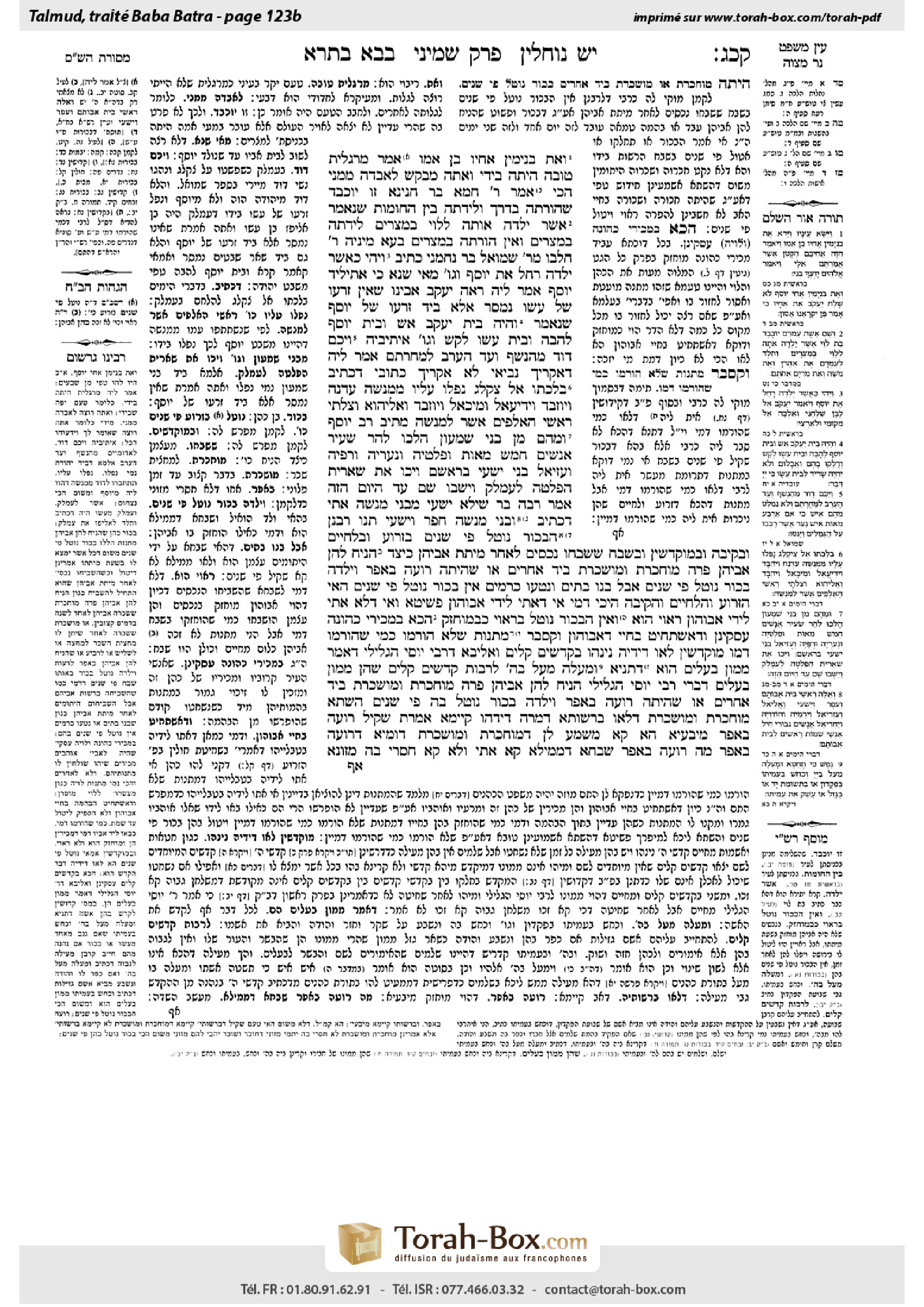
Bava Batra 123b: Talmud study for Daf Yomi
Study the Talmud for Daf Yomi with scanned pages, Hebrew text, English translations from Sefaria and AI-generated French translations.
Passage selection and English or AI-generated French translation are available where the scan has annotations. Daf Study is independent of Torah-Box and Sefaria.
Browse Bava Batra · בבא בתרא · All tractatesBava Batra 123b text and translations
This page of Bava Batra includes the Aramaic text, an English translation and an AI-generated French translation, alongside the scan above.
בבא בתרא קכ״ג ב · Aramaic and Hebrew text
״וְאֶת בִּנְיָמִין אָחִיו בֶּן אִמּוֹ״?! אֲמַר: מַרְגָּלִית טוֹבָה הָיְתָה בְּיָדִי, וְאַתָּה מְבַקֵּשׁ לְאַבְּדָהּ מִמֶּנִּי; הָכִי אָמַר רַבִּי חָמָא בַּר חֲנִינָא: זוֹ יוֹכֶבֶד – שֶׁהוֹרָתָהּ בַּדֶּרֶךְ, וְלֵידָתָהּ בֵּין הַחוֹמוֹת; שֶׁנֶּאֱמַר: ״אֲשֶׁר יָלְדָה אוֹתָהּ לְלֵוִי בְּמִצְרָיִם״ – לֵידָתָהּ בְּמִצְרַיִם, וְאֵין הוֹרָתָהּ בְּמִצְרַיִם.
בְּעָא מִינֵּיהּ רַבִּי חֶלְבּוֹ מֵרַבִּי שְׁמוּאֵל בַּר נַחְמָנִי, כְּתִיב: ״וַיְהִי כַּאֲשֶׁר יָלְדָה רָחֵל אֶת יוֹסֵף וְגוֹ׳״ – מַאי שְׁנָא כִּי אִתְיְלִיד יוֹסֵף? אֲמַר לֵיהּ: רָאָה יַעֲקֹב אָבִינוּ שֶׁאֵין זַרְעוֹ שֶׁל עֵשָׂו נִמְסָר אֶלָּא בְּיַד זַרְעוֹ שֶׁל יוֹסֵף, שֶׁנֶּאֱמַר: ״וְהָיָה בֵית יַעֲקֹב אֵשׁ, וּבֵית יוֹסֵף לֶהָבָה, וּבֵית עֵשָׂו לְקַשׁ וְגוֹ׳״.
אֵיתִיבֵיהּ: ״וַיַּכֵּם דָּוִד מֵהַנֶּשֶׁף וְעַד הָעֶרֶב לְמׇחֳרָתָם״! אֲמַר לֵיהּ: דְּאַקְרְיָךְ נְבִיאֵי לָא אַקְרְיָךְ כְּתוּבֵי; דִּכְתִיב: ״בְּלֶכְתּוֹ אֶל צִקְלַג, נָפְלוּ עָלָיו מִמְּנַשֶּׁה עַדְנָה וְיוֹזָבָד וִידִיעֲאֵל וּמִיכָאֵל וְיוֹזָבָד וֶאֱלִיהוּא וְצִלְּתָי – רָאשֵׁי הָאֲלָפִים אֲשֶׁר לִמְנַשֶּׁה״.
מֵתִיב רַב יוֹסֵף: ״וּמֵהֶם מִן בְּנֵי שִׁמְעוֹן הָלְכוּ לְהַר שֵׂעִיר אֲנָשִׁים חֲמֵשׁ מֵאוֹת, וּפְלַטְיָה וּנְעַרְיָה וּרְפָיָה וְעֻזִּיאֵל בְּנֵי יִשְׁעִי בְּרֹאשָׁם, וַיַּכּוּ אֶת שְׁאֵרִית הַפְּלֵטָה לַעֲמָלֵק, וַיֵּשְׁבוּ שָׁם עַד הַיּוֹם הַזֶּה״! אָמַר רַבָּה בַּר שֵׁילָא: יִשְׁעִי מִבְּנֵי מְנַשֶּׁה אָתֵי, דִּכְתִיב: ״וּבְנֵי מְנַשֶּׁה חֵפֶר וְיִשְׁעִי״.
תָּנוּ רַבָּנַן: הַבְּכוֹר נוֹטֵל פִּי שְׁנַיִם בַּזְּרוֹעַ וּבַלְּחָיַיִם וּבַקֵּיבָה, וּבְמוּקְדָּשִׁין, וּבְשֶׁבַח שֶׁשָּׁבְחוּ נְכָסִים לְאַחַר מִיתַת אֲבִיהֶן.
כֵּיצַד? הִנִּיחַ לָהֶן אֲבִיהֶן פָּרָה מוּחְכֶּרֶת וּמוּשְׂכֶּרֶת בְּיַד אֲחֵרִים, אוֹ שֶׁהָיְתָה רוֹעָה בָּאֲפָר; וְיָלְדָה – בְּכוֹר נוֹטֵל פִּי שְׁנַיִם. אֲבָל בָּנוּ בָּתִּים וְנָטְעוּ כְּרָמִים – אֵין בְּכוֹר נוֹטֵל פִּי שְׁנַיִם.
הַאי הַזְּרוֹעַ וְהַלְּחָיַיִם וְהַקֵּיבָה – הֵיכִי דָמֵי? אִי דְּאָתֵי לִידֵי אֲבוּהוֹן, פְּשִׁיטָא! וְאִי דְּלָא אָתֵי לִידֵי אֲבוּהוֹן, רָאוּי הוּא – וְאֵין הַבְּכוֹר נוֹטֵל בָּרָאוּי כִּבְמוּחְזָק!
הָכָא בְּמַכִּירֵי כְהוּנָּה עָסְקִינַן, וּדְאִשְׁתְּחִיט בְּחַיֵּי דַּאֲבוּהוֹן; וְקָסָבַר: מַתָּנוֹת שֶׁלֹּא הוּרְמוּ, כְּמִי שֶׁהוּרְמוּ דָּמוּ.
מוּקְדָּשִׁין – לָאו דִּידֵיהּ נִינְהוּ!
בְּקָדָשִׁים קַלִּים, וְאַלִּיבָּא דְּרַבִּי יוֹסֵי הַגְּלִילִי – דְּאָמַר: מָמוֹן בְּעָלִים הוּא. דְּתַנְיָא: ״וּמָעֲלָה מַעַל בַּה׳״ – לְרַבּוֹת קֳדָשִׁים קַלִּים, שֶׁהֵן מָמוֹן בְּעָלִים; דִּבְרֵי רַבִּי יוֹסֵי הַגְּלִילִי.
הִנִּיחַ לָהֶן אֲבִיהֶן פָּרָה מוּחְכֶּרֶת וּמוּשְׂכֶּרֶת בְּיַד אֲחֵרִים, אוֹ שֶׁהָיְתָה רוֹעָה בָּאֲפָר; וְיָלְדָה – בְּכוֹר נוֹטֵל בָּהּ פִּי שְׁנַיִם. הַשְׁתָּא מוּחְכֶּרֶת וּמוּשְׂכֶּרֶת – דְּלָאו בִּרְשׁוּתָא דְּמָרַהּ דִּידְהוּ קָיְימָא, אָמְרַתְּ שָׁקֵיל; רוֹעָה בָּאֲפָר מִיבַּעְיָא?!
הָא קָא מַשְׁמַע לַן – דְּמוּחְכֶּרֶת וּמוּשְׂכֶּרֶת, דּוּמְיָא דְּרוֹעָה בָּאֲפָר; מָה רוֹעָה בָּאֲפָר – שְׁבָחָא דְּמִמֵּילָא קָא אָתֵי, וְלָא קָא חָסְרִי בַּהּ מְזוֹנָא;
Bava Batra 123b · English translation
“And he lifted up his eyes, and saw et Benjamin his brother, his mother’s son” (Genesis 43:29), which would render the count of seventy incorrect. Rabbi Ḥiyya bar Abba said: There was a goodly pearl [margalit] in my hand, and you are trying to have me lose it. He continued: So said Rabbi Ḥama bar Ḥanina: This missing seventieth person is Jochebed, whose conception was on the journey, as the family of Jacob descended to Egypt, and she was born within the walls, i.e., in Egypt, as it is stated: “And the name of Amram’s wife was Jochebed, the daughter of Levi, who was born to Levi in Egypt” (Numbers 26:59). Her birth was in Egypt, but her conception was not in Egypt. Accordingly, the family had seventy persons upon arrival, but she could not have been listed as descending to Egypt.
§ Rabbi Ḥelbo asked Rabbi Shmuel bar Naḥmani: It is written: “And it came to pass, when Rachel gave birth to Joseph, that Jacob said to Laban: Send me away, that I may go to my own place, and to my country” (Genesis 30:25). What was different when Joseph was born, that Jacob decided only then to return home? Rabbi Shmuel bar Naḥmani said to him: Jacob our patriarch saw prophetically that the descendants of Esau will be delivered only to the hand of the descendants of Joseph, as it is stated: “And the house of Jacob shall be a fire, and the house of Joseph a flame, and the house of Esau for straw, and they shall kindle in them, and devour them” (Obadiah 1:18). Jacob had left Eretz Yisrael to escape Esau, but he now felt confident that he could return without endangering his family.
Rabbi Ḥelbo raised an objection to Rabbi Shmuel bar Naḥmani: Concering a battle between the Jewish people and the nation of Amalek, who descend from Esau, the verse states: “And David smote them from the twilight even to the evening of the next day” (I Samuel 30:17). David was from the tribe of Judah, yet he was able to defeat the descendants of Esau. Rabbi Shmuel bar Naḥmani said to him: Whoever read and taught Prophets to you did not read and teach Writings to you, as it is written: “As he went to Ziklag, there fell to him of Manasseh, Adnah, and Jozabad, and Jediael, and Michael, and Jozabad, and Elihu, and Zillethai, captains of thousands that were of Manasseh, and they helped David against the troop” (I Chronicles 12:21–2). The verse in Writings teaches that David’s campaign against Esau was led by Joseph’s descendants, from the family of Manasseh.
Rav Yosef raises an objection: Another verse indicates that the descendants of Simeon also have the ability to defeat the descendants of Esau: “And some of them, even of the sons of Simeon, five hundred men, went to Mount Seir, having for their captains Pelatiah, and Ne’ariah, and Rephaiah, and Uzziel, the sons of Ishi. And they struck the remnant of the Amalekites that escaped, and dwelled there until this day” (I Chronicles 4:42–43). Rabba bar Sheila said in response: Ishi came from the children of Manasseh, as it is written: And the sons of Manasseh: Hepher and Ishi.
§ The Sages taught (Tosefta 7:4–5): The firstborn priest takes a double portion of the foreleg, and of the jaw, and of the maw, which are given to a priest from all slaughtered non-sacred cattle, sheep, and goats (see Deuteronomy 18:3). And a firstborn, whether he is a priest or non-priest, takes a double portion of his father’s sacrificial animals and of the enhancement of the property that occurred after the death of their father.
The baraita continues: How so? To what type of enhancement is this referring? If their father left them a cow that was leased or rented in the possession of others, or if it was grazing in the meadow, and it gave birth, then the firstborn takes a double portion of the rental income or of the calf. But if the inheritors built homes or planted vineyards after their father’s death, thereby enhancing the property, the firstborn does not take a double portion. This is not considered enhancement of the father’s property, but profit due to their actions.
The Gemara analyzes the baraita: Concerning this right to collect a double portion of the foreleg, and the jaw, and the maw, what are the circumstances? If they came into the possession of their father, then it is obvious that the firstborn collects a double portion. And if they did not come into the possession of their father, then these items are merely property due to their father, and the firstborn does not take a double portion of property due to the deceased as he does the property his father possessed.
The Gemara answers: Here, we are dealing with associates of the priesthood, i.e., people who have an arrangement with a specific priest to give him their priestly gifts. And it was a case where the animal was slaughtered while the father was alive, and the tanna of this baraita holds: Priestly gifts that were not yet separated are considered as though they have already been separated. Therefore, even though the gifts were not yet given, they were considered in the possession of the priest before his death.
The Gemara continues to analyze the baraita: Why does the firstborn take a double portion of the father’s sacrificial animals? Isn’t it so that once the father consecrates them, they belong to Heaven and are not his?
The Gemara answers: This is stated with regard to a case of offerings of lesser sanctity, such as peace offerings, and in accordance with the opinion of Rabbi Yosei HaGelili, who says: These sacrificial animals are considered the property of their owners, as opposed to property of Heaven. As it is taught in a baraita that concerning one who steals another’s property and takes a false oath denying he has done so, incurring the obligation to bring a guilt-offering, the verse states: “And commits a trespass against the Lord, and deals falsely with his neighbor” (Leviticus 5:21). The verse serves to include offerings of lesser sanctity, which are the property of their owners; this is the statement of Rabbi Yosei HaGelili. Consequently, the firstborn collects a double portion of these as well.
The baraita states: If their father left them a cow that was leased or rented in the possession of others, or if it was grazing in the meadow, and it gave birth, then the firstborn takes a double portion of the rental income or calf. The Gemara asks: Now that in a case where the cow was leased or rented to others, where the animals are not in their owner’s possession, you say that the firstborn takes a double portion, in a case where it was grazing in the meadow, is it necessary for the baraita to state that he receives a double portion?
The Gemara answers that this is what the baraita teaches us: It teaches that a case where the animal was leased or rented is similar to a case where it was grazing in the meadow, in that just as in a case where it was grazing in the meadow, the enhancement came by itself and the brothers did not lose money for its sustenance,
Bava Batra 123b · Traduction française (IA)
«Et il leva les yeux, et vit Benjamin son frère, le fils de sa mère» (Genèse 43:29), ce qui rendrait le compte de soixante-dix personnes incorrect. Rabbi Ḥiyya bar Abba dit : Il y avait une belle margalit dans ma main, et vous essayez de me la faire perdre. Il continua : Rabbi Ḥama bar Ḥanina a dit : Cette personne manquante, la soixante-dixième, est Jochebed, dont la conception eut lieu pendant le voyage, lorsque la famille de Jacob descendait en Égypte, et elle naquit à l'intérieur des murailles, c'est-à-dire en Égypte, comme il est dit : «Et le nom de la femme d'Amran était Jochebed, la fille de Lévi, qui fut née à Lévi en Égypte» (Nombres 26:59). Sa naissance eut lieu en Égypte, mais sa conception ne fut pas en Égypte. Ainsi, la famille avait soixante-dix personnes lors de leur arrivée, mais elle ne pouvait pas être comptée comme descendant en Égypte.
§ Rabbi Ḥelbo demanda à Rabbi Shmuel bar Naḥmani : Il est écrit : «Et il arriva, lorsqu'Rachel eut donné naissance à Joseph, que Jacob dit à Laban : Envoie-moi loin, afin que je puisse aller vers mon propre lieu et vers ma patrie» (Genèse 30:25). Qu'était-ce qui différait lors de la naissance de Joseph, qui fit que Jacob décida alors seulement de rentrer chez lui ? Rabbi Shmuel bar Naḥmani dit à lui : Notre patriarche Jacob vit prophétiquement que les descendants d'Ésaü seront sauvés seulement entre les mains des descendants de Joseph, comme il est dit : «Et la maison de Jacob sera un feu, et la maison de Joseph une flamme, et la maison d'Ésaü pour du foin, et ils allumeront en eux et dévoreront» (Obadie 1:18). Jacob avait quitté la Terre d'Israël pour s'éloigner d'Ésaü, mais il se sentait maintenant suffisamment en sécurité pour revenir sans mettre en danger sa famille.
Rabbi Ḥelbo souleva une objection contre Rabbi Shmuel bar Naḥmani : Concernant un combat entre le peuple juif et la nation d'Amalek, descendants d'Ésaü, la versette dit : « Et David les tua du crépuscule jusqu'au crépuscule du jour suivant » (I Samuel 30:17). David était du tribu de Juda, pourtant il fut capable de vaincre les descendants d'Ésaü. Rabbi Shmuel bar Naḥmani dit à lui : Celui qui vous a appris et enseigné les Prophètes n'a pas appris et enseigné les Ecritures à vous, comme il est écrit : « Et il alla à Ziklag, et tombèrent à lui de Manasses, Adnah et Jozabad, et Jediael, et Michel, et Jozabad, et Elihu, et Ziltéthai, chefs de milliers qui étaient de Manasses, et ils aidèrent David contre la troupe » (I Chroniques 12:21–2). Le verset des Ecritures enseigne que la campagne de David contre Ésaü fut menée par les descendants de Joseph, de la famille de Manasses.
Rav Yosef souleva une objection : Un autre verset indique que les descendants de Siméon ont aussi la capacité de vaincre les descendants d'Ésaü : « Et quelques-uns d'entre eux, même des fils de Siméon, cinq cents hommes, allèrent à la montagne de Séir, ayant pour leurs chefs Pelatiah et Ne'ariah et Rephaïah et Uziel, fils d'Ishi. Et ils firent tomber le reste des Amalakites qui s'étaient enfuis, et ils y demeurèrent jusqu'à ce jour » (I Chroniques 4:42–43). Rabba bar Sheila répondit en disant : Ishi vint des enfants de Manasses, comme il est écrit : « Et les fils de Manasses : Hépher et Ishi ».
§ Les Sages enseignèrent (Tosefta 7:4–5) : Le prêtre aîné prend une double portion de la cuisse, de la mâchoire et de la gueule, qui sont données à un prêtre de tous les bœufs, brebis et chèvres non sacrés (voir Deutéronome 18:3). Et un aîné, qu'il soit prêtre ou non, prend une double portion de ses bêtes sacrées de son père et de l'amélioration de la propriété qui s'est produite après la mort de leur père.
La baraïta continue : Comment cela ? À quel type d'amélioration cela fait-il référence ? Si leur père leur avait laissé une vache louée ou louée chez d'autres, ou si elle paissait dans la prairie et a donné naissance à un veau, alors l'aîné prend une double portion des revenus de location ou du veau. Mais si les héritiers ont construit des maisons ou planté des vignobles après la mort de leur père, améliorant ainsi la propriété, l'aîné ne prend pas une double portion. Cela n'est pas considéré comme une amélioration de la propriété de leur père, mais un profit dû à leurs actions.
L'analyse de la Guemara sur la baraïta : Concernant ce droit de collecter une double portion de la cuisse, de la mâchoire et de la gueule, quels sont les circonstances ? Si ils sont entrés en possession de leur père, alors il est évident que l'aîné collecte une double portion. Et si ils n'ont pas entré en possession de leur père, alors ces objets sont simplement des biens dus à leur père, et l'aîné ne prend pas une double portion des biens dus au défunt, car il ne possède pas la propriété de leur père.
La Guemara répond : Ici, nous parlons d'associés du sacerdoce, c'est-à-dire des personnes ayant un arrangement avec un prêtre spécifique pour lui donner leurs offrandes sacerdotales. Et c'était un cas où l'animal était sacrifié pendant que le père était vivant, et le tanna de cette baraïta affirme : Les offrandes sacerdotales qui n'ont pas encore été séparées sont considérées comme si elles avaient déjà été séparées. Ainsi, même si les offrandes n'étaient pas encore données, elles étaient considérées comme appartenant au prêtre avant sa mort.
La Guemara continue son analyse de la baraïta : Pourquoi l'aîné reçoit-il une double portion des bêtes sacrifiées de son père ? N'est-ce pas parce que, une fois que le père les consacre, elles appartiennent à Dieu et ne lui appartiennent plus ?
La Guemara répond : Cela est dit concernant un cas d'offrandes de moindre sanctité, comme les offrandes de paix, et selon l'opinion de Rabbi Yosei HaGelili, qui dit : Ces bêtes sacrifiées sont considérées comme la propriété de leurs propriétaires, contrairement à la propriété de Dieu. Comme il est enseigné dans une baraïta concernant celui qui vole la propriété d'un autre et prend un faux serment en démentant avoir fait cela, entraînant l'obligation de présenter un sacrifice de culpabilité, le verset dit : « Et commet un péché contre l'Éternel, et ment à son prochain » (Lévitique 5:21). Le verset sert à inclure les offrandes de moindre sanctité, qui sont la propriété de leurs propriétaires ; c'est l'affirmation de Rabbi Yosei HaGelili. Ainsi, l'aîné collecte une double portion de ces offrandes également.
La baraïta stipule : Si leur père leur a laissé une vache louée ou louée à d'autrui, ou si elle paissait dans le pré, et qu'elle a donné naissance à un veau, alors le premier-né reçoit une double part du revenu de la location ou du veau. La Guemara pose la question : Maintenant que dans le cas où la vache était louée ou louée à d'autres, où les bêtes ne sont pas en possession de leur propriétaire, vous dites que le premier-né reçoit une double part, dans le cas où elle paissait dans le pré, est-il nécessaire que la baraïta précise qu'il reçoit une double part ?
La Guemara répond que c'est ce que la baraïta nous enseigne : Elle nous apprend que le cas où l'animal était loué ou loué est semblable au cas où il paissait dans le pré, car tout comme dans le cas où il paissait dans le pré, l'amélioration s'est produite d'elle-même et les frères n'ont pas perdu d'argent pour son alimentation,
Traduction française générée par IA à partir de l’édition anglaise de Sefaria. Vérifie toujours un passage avec le texte source.
Text from Sefaria: William Davidson Edition - Vocalized Aramaic (CC BY NC); William Davidson Edition - English (CC BY NC).