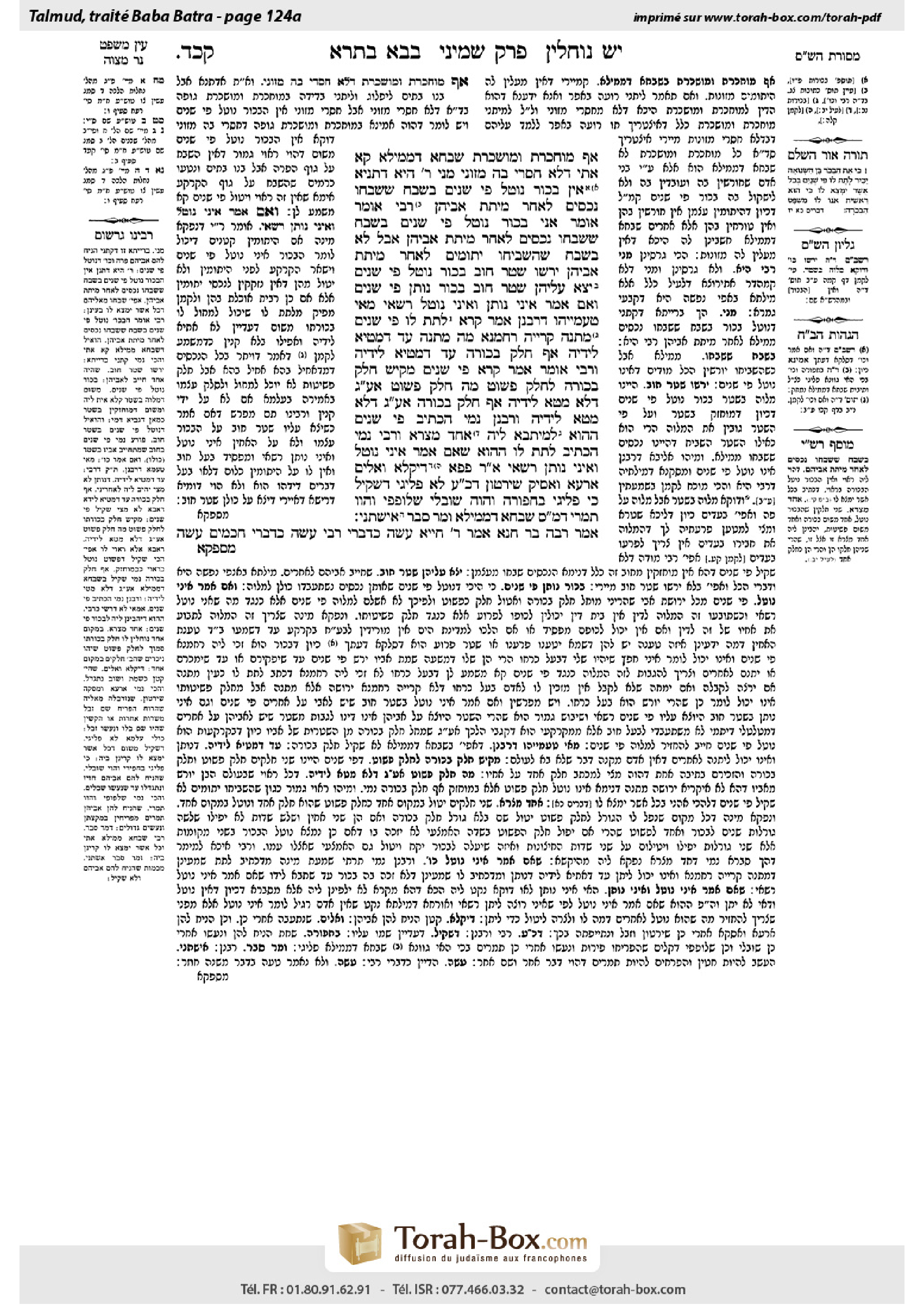
Bava Batra 124a: Talmud study for Daf Yomi
Study the Talmud for Daf Yomi with scanned pages, Hebrew text, English translations from Sefaria and AI-generated French translations.
Passage selection and English or AI-generated French translation are available where the scan has annotations. Daf Study is independent of Torah-Box and Sefaria.
Browse Bava Batra · בבא בתרא · All tractatesBava Batra 124a text and translations
This page of Bava Batra includes the Aramaic text, an English translation and an AI-generated French translation, alongside the scan above.
בבא בתרא קכ״ד א · Aramaic and Hebrew text
אַף מוּחְכֶּרֶת וּמוּשְׂכֶּרֶת – שְׁבָחָא דְּמִמֵּילָא קָא אָתֵי, דְּלָא חָסְרִי בַּהּ מְזוֹנֵי.
מַנִּי – רַבִּי הִיא, דְּתַנְיָא: אֵין בְּכוֹר נוֹטֵל פִּי שְׁנַיִם בְּשֶׁבַח שֶׁשָּׁבְחוּ נְכָסִים לְאַחַר מִיתַת אֲבִיהֶן. רַבִּי אוֹמֵר, אוֹמֵר אֲנִי: בְּכוֹר נוֹטֵל פִּי שְׁנַיִם בְּשֶׁבַח שֶׁשָּׁבְחוּ נְכָסִים לְאַחַר מִיתַת אֲבִיהֶן, אֲבָל לֹא בְּשֶׁבַח שֶׁהִשְׁבִּיחוּ יְתוֹמִים לְאַחַר מִיתַת אֲבִיהֶן.
יָרְשׁוּ שְׁטַר חוֹב – בְּכוֹר נוֹטֵל פִּי שְׁנַיִם. יָצָא עֲלֵיהֶן שְׁטַר חוֹב – בְּכוֹר נוֹתֵן פִּי שְׁנַיִם. וְאִם אָמַר: ״אֵינִי נוֹתֵן, וְאֵינִי נוֹטֵל״ – רַשַּׁאי.
מַאי טַעְמַיְיהוּ דְּרַבָּנַן? אָמַר קְרָא: ״לָתֶת לוֹ פִּי שְׁנַיִם״ – ״מַתָּנָה״ קַרְיֵיהּ רַחֲמָנָא; מָה מַתָּנָה – עַד דְּמָטְיָא לִידֵיהּ, אַף חֵלֶק בְּכוֹרָה – עַד דְּמָטְיָא לִידֵיהּ.
וְרַבִּי אוֹמֵר, אָמַר קְרָא: ״פִּי שְׁנַיִם״ – מַקִּישׁ חֵלֶק בְּכוֹרָה לְחֵלֶק פָּשׁוּט; מָה חֵלֶק פָּשׁוּט – אַף עַל גַּב דְּלָא מְטָא לִידֵיהּ, אַף חֵלֶק בְּכוֹרָה – אַף עַל גַּב דְּלָא מְטָא לִידֵיהּ.
וְרַבָּנַן נָמֵי, הָכְתִיב: ״פִּי שְׁנַיִם״! הָהוּא לְמִיתְּבָא לֵיהּ אַחַד מִצְרָא.
וְרַבִּי נָמֵי הָכְתִיב: ״לָתֶת לוֹ״! הַהוּא שֶׁאִם אָמַר: ״אֵינִי נוֹטֵל וְאֵינִי נוֹתֵן״ – רַשַּׁאי.
אָמַר רַב פָּפָּא: דִּיקְלָא וַאֲלֵים, אַרְעָא וְאַסֵּיק שִׂירְטוֹן – דְּכוּלֵּי עָלְמָא לָא פְּלִיגִי דְּשָׁקֵיל. כִּי פְּלִיגִי – בַּחֲפוּרָה וַהֲוָה שׁוּבְלֵי, שְׁלוּפְפֵי וַהֲווֹ תַּמְרֵי; דְּמָר סָבַר: שְׁבָחָא דְּמִמֵּילָא, וּמָר סָבַר: אִישְׁתַּנִּי.
אָמַר רַבָּה בַּר חָנָא אָמַר רַבִּי חִיָּיא: עָשָׂה כְּדִבְרֵי רַבִּי – עָשָׂה. כְּדִבְרֵי חֲכָמִים – עָשָׂה.
Bava Batra 124a · English translation
so too in the case of a cow that was leased or rented, the baraita is referring only to a case where the enhancement came by itself, as the brothers did not lose money for its sustenance, since it was stipulated that the one who rented or leased it would provide its feed.
§ The Gemara continues its discussion of the baraita. In accordance with whose opinion is the baraita? It is in accordance with the opinion of Rabbi Yehuda HaNasi, as it is taught in a baraita (Tosefta 7:4): A firstborn does not take a double portion of the enhancement of the property that occurred after the death of the sons’ father. Rabbi Yehuda HaNasi says: I say that a firstborn does take a double portion of the enhancement of the property that occurred by itself after their father’s death, e.g., the birth of a calf, but not of the enhancement that the orphans caused after their father’s death.
Rabbi Yehuda HaNasi continues: Therefore, if they inherited a promissory note indicating a debt owed to their father, the firstborn takes a double portion of the money when it is collected, as this is an enhancement to the estate that came by itself. The Gemara adds: In a case where a promissory note emerged against them for their father’s debt, the firstborn gives, i.e., repays, a double portion of the debt. But if he says: I am not giving a double portion of the debt and I am not taking a double portion of the estate, he is permitted to do so, and he is exempt from paying a double portion.
The Gemara asks: What is the reason for the ruling of the Rabbis that the firstborn does not receive a double portion of any enhancements that occur after the death of the father? The verse states: “Giving him a double portion” (Deuteronomy 21:17); by employing the term “giving” the Merciful One calls the double portion a gift. Just as a recipient of a gift does not acquire a gift unless it first reaches the possession of the one giving the gift, so too the firstborn does not acquire the portion of the firstborn unless it has reached the possession of the father before he died.
And Rabbi Yehuda HaNasi says that the reason for his ruling that a firstborn receives a double portion of the enhancement is that the verse states: “A double portion” (Deuteronomy 21:17). It juxtaposes the portion of the firstborn to the portion of an ordinary son, in that just as the portion of an ordinary son is inherited even from property that did not reach the father’s possession before he died, so too, the portion of the firstborn is inherited even from property that did not reach the father’s possession before he died.
The Gemara asks: And according to the Rabbis as well, isn’t the phrase “a double portion” written? The Gemara answers: That phrase can be said to teach a different halakha, requiring the brothers to give the firstborn both of his portions on one border, i.e., adjoining, and not in separate locations.
The Gemara asks: And according to Rabbi Yehuda HaNasi as well, isn’t the phrase “giving him” written? The Gemara answers: That phrase can be said to teach a different halakha, that if the firstborn says: I am not taking a double portion of the estate and I am not giving a double portion of the debt, he is permitted to do so. Since the inheritance is referred to as a gift, he has the right to refuse it.
The Gemara discusses several types of enhancement. Rav Pappa says: With regard to a palm tree that became enhanced by growing broader after the father’s death, or land that yielded silt and thereby became enhanced, everyone agrees that the firstborn takes a double portion of the enhancement. When they disagree is in a case when fodder [baḥafura], i.e., grain that has grown stalks but is not yet ripe, becomes full ears, of grain, and when date flowers [shelofafei] become fully developed dates. As one Sage, Rabbi Yehuda HaNasi, holds that since this enhancement develops by itself, the firstborn is entitled to a double portion of it, and one Sage, the Rabbis, holds that since the item transformed, it is not considered the same item that was in the father’s possession, and the firstborn is not entitled to a double portion of it.
§ Rabba bar Ḥana says that Rabbi Ḥiyya says: A judge who acted, i.e., ruled, in accordance with the statement of Rabbi Yehuda HaNasi has acted legally, and one who acted in accordance with the statement of the Rabbis has also acted legally. Either way, the decision stands.
Bava Batra 124a · Traduction française (IA)
De même, dans le cas d'une vache louée ou prêtée, la baraïta fait référence uniquement à un cas où l'amélioration s'est produite d'elle-même, car les frères n'ont pas perdu d'argent pour son entretien, puisque cela était stipulé que celui qui avait loué ou prêté la vache fournirait son alimentation.
§ La Guemara continue sa discussion sur la baraïta. Selon quel avis est-ce que la baraïta s'exprime ? C'est selon l'avis de Rabbi Yéhuda Hanassi, comme il est enseigné dans une baraïta (Tosefta 7:4) : Le premier-né ne prend pas une double part de l'amélioration du bien qui s'est produite après la mort du père des fils. Rabbi Yéhuda Hanassi dit : Je dis que le premier-né prend une double part de l'amélioration du bien qui s'est produite d'elle-même après la mort de leur père, par exemple la naissance d'une vache, mais pas de l'amélioration causée par les orphelins après la mort de leur père.
Rabbi Yéhuda Hanassi continue : Ainsi, si ils ont hérité d'une note de dette indiquant une dette envers leur père, le premier-né prend une double part de l'argent lorsqu'il est récupéré, car cela constitue une amélioration du patrimoine qui s'est produite d'elle-même. La Guemara ajoute : Dans le cas où une note de dette s'est élevée contre eux pour la dette de leur père, le premier-né remet, c'est-à-dire paie, une double part de la dette. Mais s'il dit : Je ne remets pas une double part de la dette et je ne prends pas une double part du patrimoine, il est autorisé à le faire et il est exempt de payer une double part.
La Guemara pose la question : Quel est le motif de la décision des Rabbins selon laquelle le premier-né ne reçoit pas une double part de toute amélioration qui s'est produite après la mort du père ? La Parashah dit : « Donnant-lui une double part » (Deutéronome 21:17) ; en utilisant le terme « donnant », le Misna appelle la double part un don. Aussi bien qu'un receveur d'un don ne possède ce don qu'une fois qu'il est en possession de celui qui le donne, de même le premier-né ne possède pas sa part de premier-né avant qu'elle n'ait atteint la possession du père avant sa mort.
Et Rabbi Yéhuda Hanassi dit que le motif de sa décision selon laquelle le premier-né reçoit une double part de l'amélioration est que la Parashah dit : « Une double part » (Deutéronome 21:17). Elle juxtapose la part du premier-né à la part d'un fils ordinaire, de sorte que, comme la part d'un fils ordinaire est héritée même de biens qui n'ont pas atteint la possession du père avant sa mort, de même la part du premier-né est héritée même de biens qui n'ont pas atteint la possession du père avant sa mort.
La Guemara pose la question : Et selon les Rabbins également, n'est-ce pas que la phrase « une double part » est écrite ? La Guemara répond : Cette phrase peut être dite pour enseigner une autre halakha, exigeant que les frères donnent au premier-né les deux parts sur une même frontière, c'est-à-dire adjacente, et non dans des lieux séparés.
La Guemara pose la question : Et selon Rabbi Yéhuda Hanassi également, n'est-ce pas que la phrase « donnant-lui » est écrite ? La Guemara répond : Cette phrase peut être dite pour enseigner une autre halakha, que si le premier-né dit : Je ne prends pas une double part du patrimoine et je ne donne pas une double part de la dette, il est autorisé à le faire. Puisque l'héritage est désigné comme un don, il a le droit de le refuser.
La Guemara discute plusieurs types d'amélioration. Rav Pappa dit : En ce qui concerne un palmier qui s'est amélioré en s'élargissant après la mort du père, ou un terrain qui a produit de la limaille et s'est ainsi amélioré, tout le monde convient que le premier-né prend une double part de l'amélioration. Ils divergent dans le cas où la nourriture [baḥafura], c'est-à-dire du grain qui a poussé des tiges mais n'est pas encore mûr, devient des épis de grain, et dans le cas où les fleurs de datte [shelofafei] deviennent des datte mûres. Comme un Sage, Rabbi Yéhuda Hanassi, considère que cette amélioration se produit d'elle-même, le premier-né est donc dû une double part, et un autre Sage, les Rabbins, considère que puisque l'objet s'est transformé, il n'est plus considéré comme le même objet que celui en possession du père, et le premier-né n'est donc pas dû une double part.
§ Rabba bar Ḥana dit que Rabbi Ḥiyya dit : Un juge qui a agi, c'est-à-dire a rendu un jugement, conformément à l'avis de Rabbi Yéhuda Hanassi a agi légalement, et celui qui a agi conformément à l'avis des Rabbins a également agi légalement. Quel que soit le cas, la décision est valable.
Traduction française générée par IA à partir de l’édition anglaise de Sefaria. Vérifie toujours un passage avec le texte source.
Text from Sefaria: William Davidson Edition - Vocalized Aramaic (CC BY NC); William Davidson Edition - English (CC BY NC).