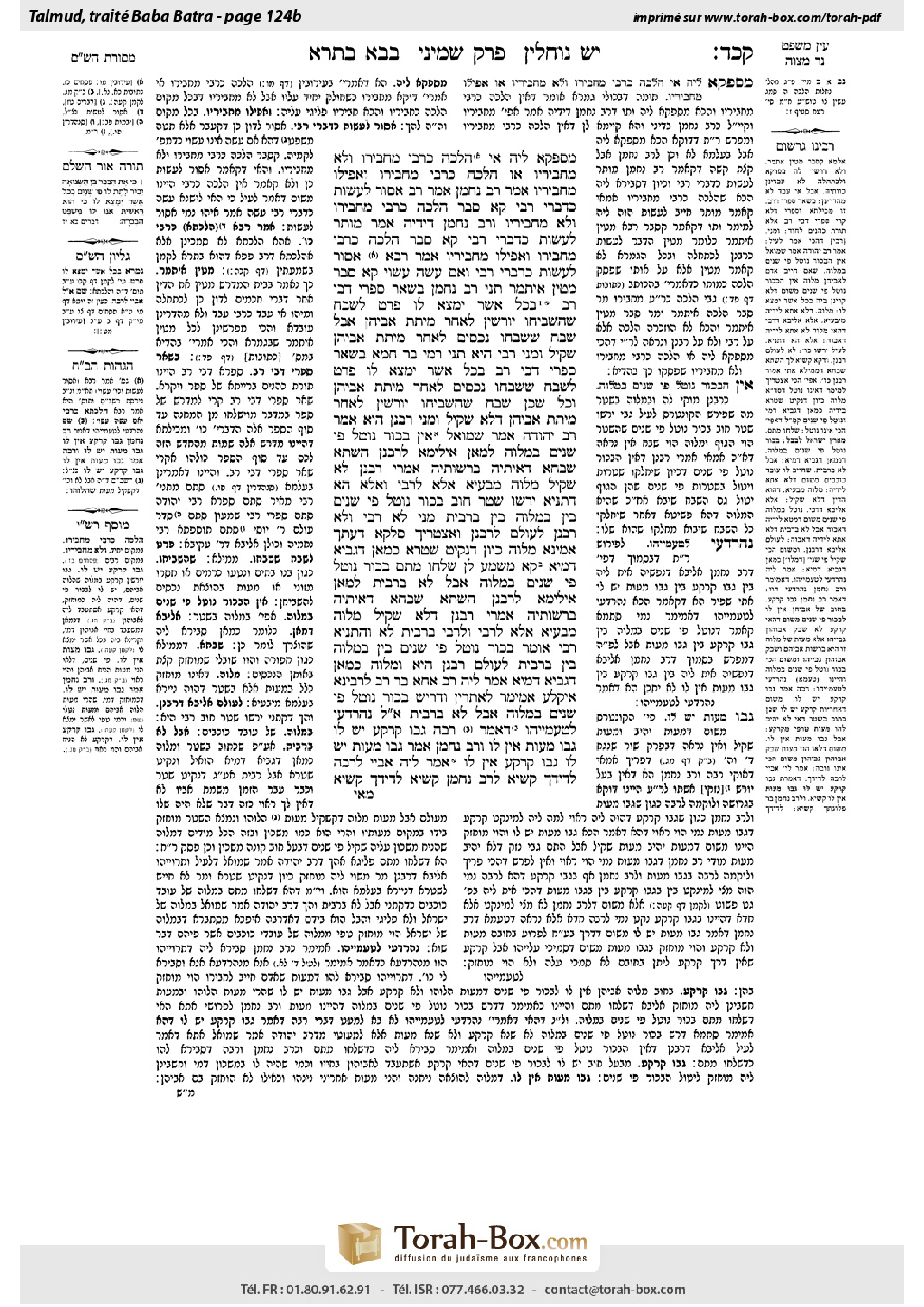
Bava Batra 124b: Talmud study for Daf Yomi
Study the Talmud for Daf Yomi with scanned pages, Hebrew text, English translations from Sefaria and AI-generated French translations.
Passage selection and English or AI-generated French translation are available where the scan has annotations. Daf Study is independent of Torah-Box and Sefaria.
Browse Bava Batra · בבא בתרא · All tractatesBava Batra 124b text and translations
This page of Bava Batra includes the Aramaic text, an English translation and an AI-generated French translation, alongside the scan above.
בבא בתרא קכ״ד ב · Aramaic and Hebrew text
מְסַפְּקָא לֵיהּ אִי הֲלָכָה כְּרַבִּי מֵחֲבֵירוֹ – וְלֹא מֵחֲבֵירָיו; אוֹ הֲלָכָה כְּרַבִּי מֵחֲבֵירוֹ – וַאֲפִילּוּ מֵחֲבֵירָיו.
אָמַר רַב נַחְמָן אָמַר רַב: אָסוּר לַעֲשׂוֹת כְּדִבְרֵי רַבִּי. קָא סָבַר: הֲלָכָה כְּרַבִּי מֵחֲבֵירוֹ – וְלֹא מֵחֲבֵירָיו.
וְרַב נַחְמָן דִּידֵיהּ אָמַר: מוּתָּר לַעֲשׂוֹת כְּדִבְרֵי רַבִּי. קָא סָבַר: הֲלָכָה כְּרַבִּי מֵחֲבֵירוֹ – וַאֲפִילּוּ מֵחֲבֵירָיו.
אָמַר רָבָא: אָסוּר לַעֲשׂוֹת כְּדִבְרֵי רַבִּי, וְאִם עָשָׂה – עָשׂוּי. קָא סָבַר: מַטִּין אִיתְּמַר.
תָּנֵי רַב נַחְמָן בִּשְׁאָר סִפְרֵי דְּבֵי רַב: ״בְּכׇל אֲשֶׁר יִמָּצֵא לוֹ״ – פְּרָט לְשֶׁבַח שֶׁהִשְׁבִּיחוּ יוֹרְשִׁין לְאַחַר מִיתַת אֲבִיהֶן. אֲבָל שֶׁבַח שֶׁשָּׁבְחוּ נְכָסִים לְאַחַר מִיתַת אֲבִיהֶן – שָׁקֵיל. וּמַנִּי – רַבִּי הִיא.
תָּנֵי רָמֵי בַּר חָמָא בִּשְׁאָר סִפְרֵי דְּבֵי רַב: ״בְּכׇל אֲשֶׁר יִמָּצֵא לוֹ״ – פְּרָט לְשֶׁבַח שֶׁשָּׁבְחוּ נְכָסִים לְאַחַר מִיתַת אֲבִיהֶן, וְכׇל שֶׁכֵּן שֶׁבַח שֶׁהִשְׁבִּיחוּ יוֹרְשִׁין לְאַחַר מִיתַת אֲבִיהֶן – דְּלָא שָׁקֵיל. וּמַנִּי – רַבָּנַן הִיא.
אָמַר רַב יְהוּדָה אָמַר שְׁמוּאֵל: אֵין בְּכוֹר נוֹטֵל פִּי שְׁנַיִם בַּמִּלְוָה. לְמַאן? אִילֵּימָא לְרַבָּנַן, הַשְׁתָּא שְׁבָחָא דְּאִיתֵיהּ בִּרְשׁוּתֵיהּ – אָמְרִי רַבָּנַן לָא שָׁקֵיל; מִלְוָה מִבַּעְיָא?!
אֶלָּא לְרַבִּי.
וְאֶלָּא הָא דְּתַנְיָא: יָרְשׁוּ שְׁטַר חוֹב – בְּכוֹר נוֹטֵל פִּי שְׁנַיִם, בֵּין בַּמִּלְוָה בֵּין בָּרִבִּית. מַנִּי? לָא רַבִּי וְלָא רַבָּנַן!
לְעוֹלָם לְרַבָּנַן, וְאִצְטְרִיךְ – סָלְקָא דַעְתָּךְ אָמֵינָא: מִלְוָה – כֵּיוָן דְּנָקֵיט שְׁטָרָא, כְּמַאן דְּגַבְיָא דָּמְיָא; קָא מַשְׁמַע לַן.
שְׁלַחוּ מִתָּם: בְּכוֹר נוֹטֵל פִּי שְׁנַיִם בַּמִּלְוָה, אֲבָל לֹא בָּרִבִּית.
לְמַאן? אִילֵּימָא לְרַבָּנַן, הַשְׁתָּא שְׁבָחָא דְּאִיתֵיהּ בִּרְשׁוּתֵיהּ – אָמְרִי רַבָּנַן דְּלָא שָׁקֵיל; מִלְוָה מִבַּעְיָא?!
אֶלָּא לְרַבִּי. וּלְרַבִּי, בָּרִבִּית לָא?! וְהָתַנְיָא, רַבִּי אוֹמֵר: בְּכוֹר נוֹטֵל פִּי שְׁנַיִם, בֵּין בַּמִּלְוָה בֵּין בָּרִבִּית!
לְעוֹלָם רַבָּנַן הִיא, וּמִלְוָה כְּמַאן דְּגַבְיָא דָּמְיָא.
אֲמַר לֵיהּ רַב אַחָא בַּר רַב לְרָבִינָא: אִיקְּלַע אַמֵּימָר לְאַתְרִין, וְדָרֵישׁ: בְּכוֹר נוֹטֵל פִּי שְׁנַיִם בַּמִּלְוָה, אֲבָל לֹא בָּרִבִּית. אֲמַר לֵיהּ: נְהַרְדָּעֵי לְטַעְמַיְיהוּ –
דְּאָמַר רַבָּה: גָּבוּ קַרְקַע – יֵשׁ לוֹ, גָּבוּ מָעוֹת – אֵין לוֹ. וְרַב נַחְמָן אָמַר: גָּבוּ מָעוֹת – יֵשׁ לוֹ, גָּבוּ קַרְקַע – אֵין לוֹ.
אֲמַר לֵיהּ אַבָּיֵי לְרַבָּה: לְדִידָךְ קַשְׁיָא, לְרַב נַחְמָן קַשְׁיָא. לְדִידָךְ קַשְׁיָא,
Bava Batra 124b · English translation
The Gemara explains: Rabbi Ḥiyya is uncertain as to whether the principle that the halakha is in accordance with the opinion of Rabbi Yehuda HaNasi in his disputes with his colleague applies specifically to a dispute with one other tanna but not to a dispute with several of his colleagues, or whether the principle that the halakha is in accordance with the opinion of Rabbi Yehuda HaNasi in his disputes with his colleague applies even to a dispute with several of his colleagues, as in this case, where the Rabbis disagree with Rabbi Yehuda HaNasi. Since he was uncertain, he left the decision to each individual judge.
Rav Naḥman says that Rav says: It is prohibited to act in accordance with the statement of Rabbi Yehuda HaNasi. The Gemara explains: Rav holds that the halakha is in accordance with the opinion of Rabbi Yehuda HaNasi in his disputes with his single colleague, but not in his disputes with several of his colleagues.
And Rav Naḥman says his own statement: It is permitted to act in accordance with the statement of Rabbi Yehuda HaNasi. The Gemara explains: He holds that the halakha is in accordance with the opinion of Rabbi Yehuda HaNasi not only in his disputes with his single colleague, but even in his disputes with several of his colleagues.
Rava says: It is prohibited to act in accordance with the statement of Rabbi Yehuda HaNasi, but if a judge acted in accordance with the statement of Rabbi Yehuda HaNasi, what is done is done and the decision stands. The Gemara explains: He holds that it was stated that one is inclined to follow the opinion of the Rabbis ab initio, but if a judge rules in accordance with the opinion of Rabbi Yehuda HaNasi, his decision stands.
The Gemara comments that there are conflicting opinions in halakhic midrash as to whether the halakha is in accordance with the opinion of Rabbi Yehuda HaNasi or in accordance with the opinion of the Rabbis, as each opinion is supported by a different version of the midrash. Rav Naḥman taught a baraita from the other books of the school of Rav [debei Rav], i.e., a volume of halakhic midrash other than Torat Kohanim, which is a halakhic midrash on the book of Leviticus. The phrase from the verse: “By giving him a double portion of all that he has” (Deuteronomy 21:17), excludes the enhancement that the heirs brought about after their father’s death, of which the firstborn is not entitled to a double portion. The Gemara infers: But of the enhancement of the property that occurred by itself after their father’s death, he does take a double portion. The Gemara comments: And whose opinion is this? It is the opinion of Rabbi Yehuda HaNasi.
Rami bar Ḥama taught a different version of the baraita from the other books of the school of Rav: “Of all that he has” excludes the enhancement of the property that occurred by itself after their father’s death, of which the firstborn is not entitled to a double portion. The Gemara infers: And all the more so, he does not take a double portion of the enhancement that the heirs brought about after their father’s death. The Gemara comments: And whose opinion is this? It is the opinion of the Rabbis. Accordingly, there is a discrepancy between the baraitot as to whether the halakha is in accordance with the opinion of the Rabbis or Rabbi Yehuda HaNasi.
§ Rav Yehuda says that Shmuel says: A firstborn does not take a double portion of a loan, i.e., of a debt that is owed to the father. The Gemara asks: According to whom is this halakha stated? If we say it is in accordance with the opinion of the Rabbis, now that the Rabbis say that a firstborn does not take a double portion even with regard to the enhancement of property that is in the possession of the father, is it necessary to state that he is not entitled to a double portion of a loan? The debt is not in the father’s possession at the time of his death; it is merely due to him.
Rather, it must be in accordance with the opinion of Rabbi Yehuda HaNasi. Although he holds that a firstborn is entitled to a double portion of the enhancement of the property itself, he concedes that he is not entitled to a double portion of the payment of a debt, as it was not in the possession of his father at the time of his death.
The Gemara asks: But if so, in accordance with whose opinion is that which is taught in a baraita: If the sons inherited a promissory note, the firstborn takes a double portion of the payment of both the value of the loan itself and the interest? It is neither in accordance with the opinion of Rabbi Yehuda HaNasi, nor the opinion of the Rabbis.
The Gemara answers: Actually, Shmuel’s statement that the firstborn is not entitled to a double portion of the payment of a debt is in accordance with the opinion of the Rabbis, and it was necessary to state it. It might enter your mind to say that with regard to a loan, since the creditor holds a promissory note, it is considered as though it has already been collected and is in the creditor’s possession, so too, the firstborn should be entitled to a double portion even according to the opinion of the Rabbis. Therefore, Shmuel teaches us that the loan is not considered to be in the creditor’s possession, and the firstborn is not entitled to a double portion.
The Gemara relates: They sent the following ruling from there, Eretz Yisrael: If the father lent money to a gentile, the firstborn takes a double portion of the value of the loan itself, but not of the interest, as the interest is considered property due to the father.
The Gemara asks: According to whom is this halakha stated? If we say it is in accordance with the opinion of the Rabbis, now that the Rabbis say that a firstborn does not take a double portion even with regard to the enhancement of property, which is in the possession of the father, is it necessary to state that they would hold that he is not entitled to a double portion of a loan? Since the debt is not in the father’s possession at the time of his death, as it is merely due to him, the rabbis would certainly not hold that the firstborn takes a double portion of it.
Rather, it must be in accordance with the opinion of Rabbi Yehuda HaNasi. The Gemara asks: And according to the opinion of Rabbi Yehuda HaNasi, is it so that the firstborn is not entitled to a double portion of the interest? But isn’t it taught in a baraita that Rabbi Yehuda HaNasi says: A firstborn takes a double portion of both the value of the loan itself and the interest?
The Gemara answers: Actually, the halakha sent from the Sages of Eretz Yisrael is in accordance with the opinion of the Rabbis. And the Sages of Eretz Yisrael hold that the Rabbis concede that the firstborn receives a double portion of the value of the loan itself, because a loan is considered as though it has already been collected and is in the creditor’s possession. By contrast, the interest on the loan is not considered as though it is already in the creditor’s possession, and therefore the firstborn does not receive a double portion of its payment.
Rav Aḥa bar Rav said to Ravina: Ameimar arrived at our locale and taught that a firstborn takes a double portion of the value of a loan itself, but not of the interest. Ravina said to him: The Sages of Neharde’a conform to their standard line of reasoning. Ameimar followed the opinion of Rav Naḥman, who was one of the Sages of Naharde’a, as was Ameimar.
The Gemara explains: As Rabba says: If the sons collected land as payment of a debt owed to their father, the firstborn has a double portion of it, but if they collected money, he does not have a double portion. And Rav Naḥman says that if they collected money, he has a double portion, but if they collected land, he does not have a double portion.
Abaye said to Rabba: According to your opinion it is difficult, and according to the opinion of Rav Naḥman it is also difficult. According to your opinion it is difficult
Bava Batra 124b · Traduction française (IA)
La Guemara explique : Rabbi Ḥiyya est incertain quant à la validité du principe selon lequel la halakha suit l'opinion de Rabbi Yehuda HaNasi lors de ses débats avec son collègue, s'appliquant spécifiquement à un débat avec un seul tanna, mais pas avec plusieurs de ses collègues, ou si ce principe s'applique même à un débat avec plusieurs de ses collègues, comme dans ce cas, où les Rabbins s'opposent à Rabbi Yehuda HaNasi. Puisqu'il était incertain, il a laissé la décision à chaque juge individuel.
Rav Naḥman dit que Rav dit : Il est interdit d'agir selon l'opinion de Rabbi Yehuda HaNasi. La Guemara explique : Rav considère que la halakha suit l'opinion de Rabbi Yehuda HaNasi lors de ses débats avec un seul collègue, mais pas lors de ses débats avec plusieurs de ses collègues.
Et Rav Naḥman dit sa propre opinion : Il est permis d'agir selon l'opinion de Rabbi Yehuda HaNasi. La Guemara explique : Il considère que la halakha suit l'opinion de Rabbi Yehuda HaNasi non seulement lors de ses débats avec un seul collègue, mais même lors de ses débats avec plusieurs de ses collègues.
Rava dit : Il est interdit d'agir selon l'opinion de Rabbi Yehuda HaNasi, mais si un juge a rendu un jugement selon l'opinion de Rabbi Yehuda HaNasi, ce qui a été fait est accompli et la décision est valable. La Guemara explique : Il considère que l'on est enclin à suivre l'opinion des Rabbins dès le début, mais si un juge rend un jugement selon l'opinion de Rabbi Yehuda HaNasi, sa décision est valable.
La Guemara commente que dans les midrash halakhiques, il y a des opinions divergentes quant à savoir si la halakha suit l'opinion de Rabbi Yehuda HaNasi ou celle des Rabbins, chaque opinion étant soutenue par une version différente du midrash. Rav Naḥman a enseigné un baraïta des autres livres de la maison de Rav, c'est-à-dire un volume de midrash halakhique autre que Torat Kohanim, qui est un midrash halakhique sur le livre de Lévitique. La phrase du verset : « En lui donnant une double portion de tout ce qu'il a » (Deutéronome 21:17), exclut l'amélioration que les héritiers ont apportée après la mort de leur père, dont le premier-né n'est pas dû une double portion. La Guemara déduit : Mais quant à l'amélioration du patrimoine qui s'est produite d'elle-même après la mort de leur père, il prend une double portion. La Guemara commente : Et selon quel avis est-ce ? C'est l'avis de Rabbi Yehuda HaNasi.
Rami bar Ḥama a enseigné une autre version du baraïta des autres livres de la maison de Rav : « De tout ce qu'il a » exclut l'amélioration du patrimoine qui s'est produite d'elle-même après la mort de leur père, dont le premier-né n'est pas dû une double portion. La Guemara déduit : Et encore plus, il ne prend pas une double portion de l'amélioration que les héritiers ont apportée après la mort de leur père. La Guemara commente : Et selon quel avis est-ce ? C'est l'avis des Rabbins. Ainsi, il y a un désaccord entre les baraitot quant à savoir si la halakha suit l'avis des Rabbins ou celui de Rabbi Yehuda HaNasi.
§ Rav Yehuda dit que Shmuel dit : Le premier-né ne prend pas une double portion d'un prêt, c'est-à-dire d'une dette due au père. La Guemara pose la question : Selon quel avis est-ce dit ? Si nous disons que c'est selon l'avis des Rabbins, maintenant que les Rabbins disent que le premier-né ne prend pas une double portion même concernant l'amélioration du patrimoine qui appartient au père, pourquoi faut-il dire qu'il n'est pas dû une double portion d'un prêt ? La dette n'est pas en possession du père au moment de sa mort ; elle est simplement due à lui.
Plutôt, il doit être selon l'avis de Rabbi Yehuda HaNasi. Bien qu'il considère que le premier-né est dû une double portion de l'amélioration du patrimoine lui-même, il reconnaît qu'il n'est pas dû une double portion du paiement d'une dette, car celle-ci n'était pas en possession de son père au moment de sa mort.
La Guemara pose la question : Mais si c'est ainsi, selon quel avis est-ce que ce qui est enseigné dans un baraïta : Si les fils héritent d'une note de promesse, le premier-né prend une double portion du paiement de la valeur du prêt lui-même et des intérêts ? Cela n'est ni selon l'avis de Rabbi Yehuda HaNasi, ni celui des Rabbins.
La Guemara répond : En réalité, l'affirmation de Shmuel selon laquelle le premier-né n'est pas dû une double portion du paiement d'une dette est selon l'avis des Rabbins, et il était nécessaire de le dire. Il pourrait entrer en vous l'idée que concernant un prêt, puisque le créancier détient une note de promesse, il est considéré comme s'il avait déjà été récupéré et est en possession du créancier, donc le premier-né devrait être dû une double portion même selon l'avis des Rabbins. Ainsi, Shmuel nous enseigne que le prêt n'est pas considéré comme étant en possession du créancier, et le premier-né n'est pas dû une double portion.
La Guemara rapporte : Ils ont envoyé le suivant jugement d'Eretz Yisrael : Si le père a prêté de l'argent à un non-Juif, le premier-né prend une double portion de la valeur du prêt lui-même, mais pas des intérêts, car les intérêts sont considérés comme une propriété due au père.
La Guemara pose la question : Selon quel opinion est énoncée cette halakha ? Si nous disons qu'elle est en conformité avec l'opinion des Sages, et que les Sages affirment que le premier-né ne prend pas une double part même en ce qui concerne la valeur du bien, qui est en possession du père, est-il nécessaire de préciser qu'ils penseraient qu'il n'a pas droit à une double part d'un prêt ? Puisque la dette n'est pas en possession du père au moment de sa mort, puisqu'elle est simplement due à lui, les Sages ne penseraient certainement pas que le premier-né prenne une double part de cela.
Au contraire, il doit être en conformité avec l'opinion de Rabbi Yehuda HaNasi. La Guemara pose la question : Et selon l'opinion de Rabbi Yehuda HaNasi, est-ce que le premier-né n'a pas droit à une double part des intérêts ? Mais n'est-il pas enseigné dans une baraïta que Rabbi Yehuda HaNasi dit : Le premier-né prend une double part de la valeur du prêt lui-même ainsi que des intérêts ?
La Guemara répond : En réalité, la halakha envoyée par les Sages d'Israël est en conformité avec l'opinion des Sages. Et les Sages d'Israël affirment que les Sages reconnaissent que le premier-né reçoit une double part de la valeur du prêt lui-même, car un prêt est considéré comme s'il avait déjà été récupéré et est en possession du créancier. En revanche, les intérêts du prêt ne sont pas considérés comme s'ils étaient déjà en possession du créancier, et par conséquent le premier-né ne reçoit pas une double part de leur paiement.
Rav Aḥa bar Rav dit à Ravina : Ameimar est arrivé dans notre région et a enseigné que le premier-né reçoit une double part de la valeur du prêt lui-même, mais pas des intérêts. Ravina dit à Ameimar : Les Sages de Neharde’a suivent leur ligne de raisonnement habituelle. Ameimar suivait l'opinion de Rav Naḥman, qui était l'un des Sages de Naharde’a, comme Ameimar lui-même.
La Guemara explique : Selon Rabba, si les fils ont récupéré une terre comme paiement d'une dette due à leur père, le premier-né reçoit une double part de celle-ci, mais si ils ont récupéré de l'argent, il n'a pas de double part. Et Rav Naḥman dit que si ils ont récupéré de l'argent, il reçoit une double part, mais si ils ont récupéré une terre, il n'a pas de double part.
Abaye dit à Rabba : Selon votre opinion, c'est difficile, et selon l'opinion de Rav Naḥman, c'est également difficile. Selon votre opinion, c'est difficile.
Traduction française générée par IA à partir de l’édition anglaise de Sefaria. Vérifie toujours un passage avec le texte source.
Text from Sefaria: William Davidson Edition - Vocalized Aramaic (CC BY NC); William Davidson Edition - English (CC BY NC).